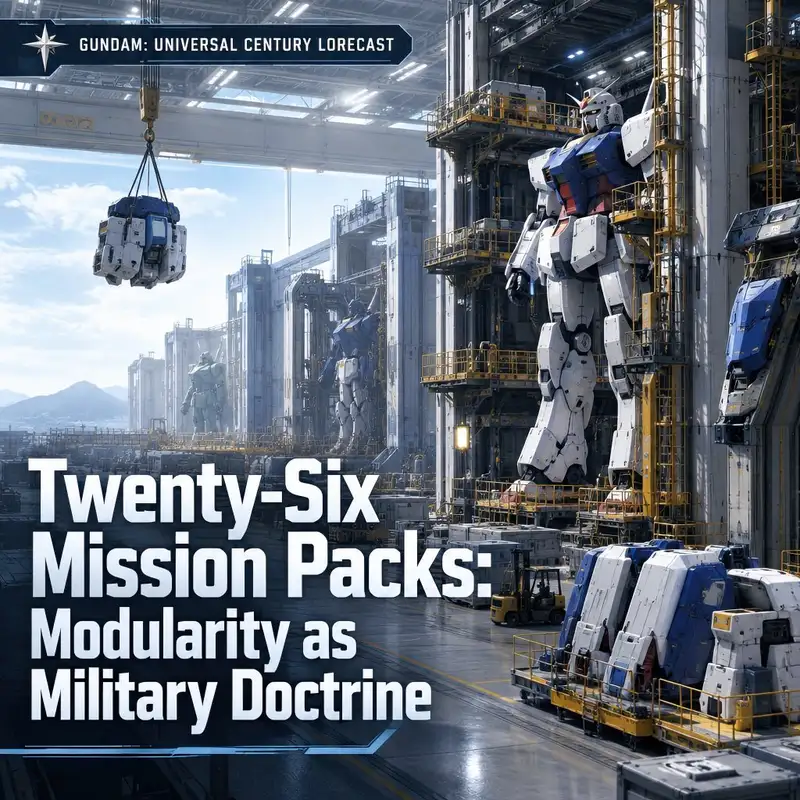
Twenty-Six Mission Packs: Modularity as Military Doctrine
Before an F90 sortie, the decisive work does not begin when the pilot closes the cockpit hatch. It begins in the hangar, where technicians decide what kind of machine the F90 will be for that mission. The same compact frame might receive equipment for a deep strike, electronic warfare, cold-weather operations, pursuit, close combat, or long-range support. On paper, that looks like a remarkable economy. One mobile suit becomes twenty-six. In practice, the question is less glamorous and much more important. Has the Earth Federation found a way to reduce military complexity, or has it simply moved that complexity out of the factory and into the hangar, depot, transport ship, maintenance schedule, and mission-planning room?
The Gundam F90 was built around that question. It was a Strategic Naval Research Institute prototype, created during the Formula Project’s search for smaller, high-performance mobile suits. Its basic configuration was deliberately adaptable rather than overloaded. Hardpoints on the frame allowed the attachment of mission packs, each intended to change the machine’s equipment and employment without requiring an entirely new mobile-suit design. The concept eventually became associated with twenty-six lettered packs, from A through Z. But that alphabet should not be mistaken for an order of battle. It does not prove that the Federation fielded twenty-six standardized F90 variants, or that every pack was available at the same time, in the same theater, or to ordinary line units.
The F90 was, first and foremost, a testbed. Its modularity represented a doctrine of configurable specialization. The machine could help researchers and military planners examine many tactical roles from one common baseline. That was a serious military idea. It was not a promise that one pilot, one hangar crew, and one transport could solve every problem from the ocean floor to deep space. The F90’s value lay partly in the capabilities of the packs themselves, but even more in the questions each pack forced the Strategic Naval Research Institute and the Federation Forces to answer. What could be standardized? What still had to remain specialized? And how much flexibility could a military sustain before flexibility became another word for logistical burden?
That made the F90 more than a prototype mobile suit. It was an argument about procurement. Instead of developing a wholly separate machine for every tactical role, the Federation might establish a common core design and adapt it with mission equipment. In theory, the common frame could simplify basic pilot familiarization, parts supply, engineering knowledge, and production methods. A pilot trained on the F90’s controls would not need to learn an entirely unfamiliar machine for every assignment. A maintenance crew would work from a known structure. A procurement office might buy one platform while tailoring it to several different requirements.
The heart of the F90 concept was straightforward. The base mobile suit provided the chassis, cockpit, primary mobility, core systems, and hardpoints. The mission pack supplied additional propulsion, sensors, armor, weapons, environmental equipment, or support systems appropriate to a particular assignment. The important word is appropriate. A mission pack was not meant to make the F90 universally superior. It was meant to make it more suitable for a defined problem. That distinction is the difference between doctrine and fantasy.
The F90’s hardpoints gave that principle a mobile-suit form. Before a mission, planners could select equipment based on terrain, expected opposition, range, endurance, support requirements, and political risk. A deep strike against a distant objective called for a different arrangement than escort work around a vulnerable installation. A cold-region deployment had different demands from an underwater operation. Electronic warfare required sensors and jamming equipment, not simply a larger beam weapon. The F90 was designed to make those choices visible and testable.
The Assault pack illustrates the logic clearly. It was intended for penetration and deep-attack operations, using additional mobility equipment, propellant tanks, and a beam bazooka. That configuration addressed a real operational problem. A mobile suit assigned to strike farther from its support ship or to break through a defended route needs more than courage and a powerful rifle. It needs the endurance to reach the objective, the mobility to survive the approach and withdrawal, and enough firepower to justify the risk of carrying extra equipment. The Assault pack attempted to supply those qualities.
Yet the very additions that made the Assault pack useful also created limitations. Extra propellant and large weapons increased the burden on handling, maintenance, storage, and transport. A deep-attack configuration might be valuable for a carefully planned operation, but it was not necessarily the ideal arrangement for a short-range patrol, a colony-security mission, or a close engagement in cluttered terrain. The F90 could be configured for assault. It did not become an assault machine in every circumstance.
The Long-Range and Support configurations addressed a different tactical demand. Long-range work depends on more than having a weapon that can reach farther. It requires target detection, identification, fire control, stable firing positions, communications, and an understanding of what lies beyond the target. In a Minovsky environment, where conventional long-range detection and communications are constrained, that challenge becomes more severe. A precision rifle and improved sensors can give a mobile suit useful stand-off capability, but they do not restore perfect battlefield awareness.
The Long-Range pack emphasized precision fire support through enhanced sensing and a long rifle. The Support pack brought heavier beam and missile armament for more substantial fire-support duties. These were not simply bigger-gun configurations. They represented an effort to ask whether a compact mobile suit could contribute to missions normally requiring a different balance of mobility, detection, ammunition capacity, and survivability. A long-range machine that cannot identify targets is merely firing into uncertainty. A support machine that exhausts its weapons or loses access to resupply becomes an expensive observer. The pack system made it possible to explore those relationships without first designing a separate platform from the ground up.
The Electronic pack made the information problem even more explicit. Its equipment included a radome, a jamming rifle, and electronic-support systems. In a setting shaped by Minovsky particle interference, electronic warfare could not simply consist of turning off an enemy’s sensors with a convenient button. Detection, jamming, communication, and identification remained contested activities. A machine equipped for electronic support might help its own force find, confuse, or approach an adversary. It might also become more dependent on careful coordination with ships, reconnaissance elements, and nearby units. Electronic warfare is rarely a solo performance, no matter how impressive the equipment looks attached to a mobile suit.
The Electronic pack also reveals a less obvious purpose of the F90 program. A mission pack could test the placement of sensors, antenna systems, cooling arrangements, power demands, pilot workload, and the effect of specialized equipment on maneuverability. The question was not only whether the F90 could carry electronic systems. It was whether a pilot could use them effectively while flying a combat machine, whether mechanics could keep them calibrated, and whether commanders could turn the information they produced into useful decisions before it became obsolete.
Other packs dealt with the physical environment. The Coldness configuration was intended for cold-region operations, incorporating heaters, ski equipment, and protective gear. That may sound specialized because it was specialized. Cold weather affects moving parts, power systems, visibility, maintenance, crew endurance, and ground mobility. A mobile suit designed around space operations cannot simply be dropped into an icy region and assumed to perform at its best. The Coldness pack recognized that terrain and climate still mattered in an age of fusion reactors and beam weapons.
The Marine pack addressed underwater operations. Water imposes different problems of movement, pressure, detection, weapons employment, corrosion, sealing, and recovery. A machine suited to vacuum does not automatically become efficient beneath the surface. The Hover pack, meanwhile, focused on high mobility over ground, where roads, terrain, surface conditions, and the need to move quickly between dispersed objectives could matter more than pure space maneuverability. These were not glamorous variants designed to fill out an alphabet. They were attempts to determine how much adaptation a common F90 frame could accept before it ceased to be genuinely common.
The Destroid and Fight configurations shifted toward close-range combat. The Destroid pack combined rockets, grenades, a gatling weapon, and high-mobility boosters for close-range suppression. The Fight pack emphasized close combat more directly. Their existence is a reminder that mobile-suit warfare did not become a clean contest of ever-longer beam-rifle ranges. In colonies, installations, urban areas, broken terrain, and crowded orbital environments, combat could close rapidly. Firepower had to be balanced against collateral risk, ammunition consumption, mobility, and the danger of fighting too near friendly forces or critical infrastructure.
The Tracer and Guard packs dealt with missions that are often less celebrated than an assault or a duel, but no less necessary. The Tracer configuration supported pursuit through long-range propulsion and large shields. Pursuit is difficult because the pursuing force must maintain contact, preserve enough fuel or propellant to continue the chase, and avoid being drawn into an ambush. A machine built for pursuit needs endurance, protection, and the ability to operate far enough from immediate support to prevent the target from simply escaping.
The Guard pack was intended for security and escort work. That role is not passive. Escort forces must remain alert, identify threats under uncertain conditions, protect slower or more vulnerable assets, and avoid being lured away by a decoy. A guard configuration may require very different priorities from an assault machine. It may favor endurance, defensive positioning, reliable communications, and the ability to respond quickly to short-range threats. The pack system’s strength was that it recognized these distinctions rather than assuming every combat machine should solve them in the same manner.
One of the more unusual concepts is the Warbird configuration, which developed a military-aircraft-like flight form and incorporated a prototype system associated with Minovsky-drive technology. This is also where source discipline matters. The Warbird belongs to later elaboration of the F90 mission-pack concept. It should not be treated as though it were a fully documented feature of the original nineteen-nineties F90 narrative. Its importance lies in showing how far the idea of modularity could be extended in later setting development. It explored the possibility that a common frame might accept equipment approaching the scale and complexity of a major transformation system.
That does not mean the Warbird demonstrates a routine Federation capability. A configuration involving experimental flight systems and advanced propulsion concepts is exactly the sort of design that requires caution. It may reveal an engineering ambition, a design study, or a limited experimental direction. It does not prove that regular Federation formations possessed practical, reliable, and widely supported flight-equipped F90s. The difference between a compelling test concept and an adopted force structure is where military history usually lives.
The F90’s alphabet therefore should be read as a map of problems. Deep strike. Long-range support. Electronic warfare. Security. Pursuit. Cold weather. Water. Ground mobility. Close combat. Each pack identified a mission that imposed a different demand on the mobile suit and its support network. The point was not to create twenty-six separate legends. It was to use one common platform to explore the range of requirements that the next generation of mobile suits might need to meet.
That approach offered real advantages. A shared base frame could reduce duplication in early development. Instead of designing a separate prototype for every role, S.N.R.I. could place different equipment on the F90 and compare the results. Engineers could identify where the frame accepted additional mass well, where cooling became inadequate, how different equipment affected balance, and which systems interfered with one another. Pilots could report on control response, visibility, workload, fatigue, and the practical usefulness of specialized equipment. Mechanics could identify which components failed most often, which hardpoints were difficult to access, and which systems imposed unreasonable maintenance demands.
The hardpoints themselves need compatible power and data connections. The controls must integrate with the new equipment. Sensors need calibration. Weapons require testing and ammunition support. Additional propulsion systems must be examined for leaks, damage, and alignment. Protective gear must not obstruct access to other components. The more ambitious the pack, the more the combined machine becomes a system whose limits are discovered through use. A standardized hardpoint is not the same thing as a standardized bureaucracy.
There is also the question of mission planning. A pack chosen for one assignment may create disadvantages in another. Additional propellant may increase endurance but complicate handling. Heavy support weapons may improve firepower but reduce agility or consume cargo space. Environmental equipment may make a machine safer in one theater while becoming dead weight in another. A force that changes configurations frequently must manage schedules, inspections, pilot conversion, and the risk that a machine will be unavailable when urgently needed. The F90 did not eliminate those tradeoffs. It made them easier to study.
The F90FF manga presents one expanded account of that study. Its principal flashback narrative is set in Universal Century one hundred twelve, during the accelerating transition toward smaller mobile suits. In that record, F90 Units One and Two are employed within an organized test effort involving the Thirteenth Experimental Combat Group and separate test teams. The story later introduces the Fastest Formula organization. These details belong to F90FF’s expanded history and should be understood on those terms. They should not be silently folded into the earlier F90 manga as though every event had always been part of one unbroken account.
What F90FF contributes is a clearer sense that the F90 program was not merely a machine in search of dramatic opponents. It was an institution. Pilots, mechanics, evaluators, commanders, and support personnel had to organize trials, assess results, respond to unexpected threats, and decide what counted as useful evidence. Patti Angelica, associated with Unit Two and the Thirteenth Experimental Combat Group, and Liv Angelica are part of that human structure. Their presence matters because test programs do not operate by machine design alone. They depend on people who can translate a sortie into a lesson.
A test pilot provides one kind of information. A pilot may tell engineers that a configuration responds poorly under high acceleration, that a sensor display creates confusion, or that a weapon cannot be used effectively while managing other systems. A mechanic may discover that a pack’s access panels make routine maintenance unnecessarily difficult. A commander may find that a configuration works in a controlled evaluation but complicates unit coordination during a fast-moving operation. None of these observations are glamorous. All of them can decide whether a system becomes a practical weapon or remains a clever prototype.
The F90FF record also includes simulations, mission-specific evaluations, ambiguous attacks, and the evolution of an organized testing culture. Those circumstances show why experimental programs need more than technical skill. A test organization must distinguish between performance under controlled conditions and performance under pressure. It must protect classified equipment while still exposing that equipment to realistic use. It must decide which failures belong to the machine, which belong to the pack, which belong to training, and which belong to poor planning. The answer is often inconvenient. A failed sortie may reveal less about a design flaw than about an unrealistic doctrine built around it.
Combat, however, exposes different truths. Under fire, pilots are tired, communications are uncertain, equipment suffers damage, and commanders make decisions with incomplete information. A pack that performs well during a planned trial may prove awkward when a unit must change course, protect a damaged ship, recover a disabled mobile suit, or operate farther from support than expected. The F90’s strategic value lay in bringing those two worlds together. It could generate data in controlled conditions and then test the relevance of that data when circumstances became less cooperative.
The original Mobile Suit Gundam F90 record shifts the emphasis in Universal Century one hundred twenty. Here, the F90 program becomes entangled with theft, security, and combat. An F90 is taken by Oldsmobile, a Mars-based Zeon remnant or independence movement. Def Stallion, the test pilot associated with F90 Unit One, is drawn from testing into Federation service as the effort to recover the stolen machine develops. The story turns the F90 from an experimental platform into an intelligence problem.
A stolen prototype is dangerous not simply because the enemy gains one machine. The adversary may gain technical knowledge, operational insight, propaganda value, or a basis for its own experiments. The Federation must determine what was taken, what records may have been compromised, what the thieves can actually operate, and whether the machine can be recovered before its systems are studied or copied. Even if the stolen F90 cannot be maintained indefinitely, its possession can force the Federation to divert resources, revise security procedures, and accelerate decisions that were previously being made at the pace of a test program.
For Def Stallion, the transition from test pilot to combat participant demonstrates the limit of treating experimentation as separate from war. A test pilot knows the machine deeply, but combat demands more than technical familiarity. It requires judgment under threat, cooperation with other units, awareness of political objectives, and the ability to preserve equipment that may be strategically valuable. The F90’s modular design could offer options, but the need to recover a stolen system did not necessarily allow the Federation to select the ideal pack, prepare a perfect sortie, or wait for every specialist to become available.
The Oldsmobile conflict also requires precision in language. Oldsmobile carried a Zeon inheritance and operated from Mars, but it was not the Principality of Zeon returned unchanged. It was not Char’s Neo Zeon, and it was not every other anti-Federation movement that had invoked Zeon’s name. The Universal Century repeatedly produced organizations that inherited symbols, grievances, uniforms, ambitions, and military traditions from earlier conflicts. That inheritance could be politically powerful. It did not make their institutions, objectives, or capabilities identical.
For Oldsmobile, possession of an F90 could serve military and political purposes at once. Militarily, the machine offered a valuable technological prize. Politically, it could demonstrate that the Federation’s research establishment was vulnerable and that a remnant movement could seize advanced equipment from the state it opposed. But captured technology creates burdens as well as opportunities. A stolen prototype needs parts, technicians, documentation, secure facilities, and pilots capable of understanding it. The ability to take a weapon is not the same as the ability to sustain it.
That is where the modular concept becomes especially revealing. A captured common frame might be useful, but the full value of its mission-pack system depends on access to the packs, their support equipment, their maintenance knowledge, and the planning structure that knows how to employ them. The F90 was not a self-contained answer stored inside its armor. Its flexibility existed within a network of institutional knowledge. Remove the machine from that network, and much of its potential becomes more difficult to realize.
This is the central caution surrounding the twenty-six-pack concept. The alphabet can tempt the observer to imagine a complete menu of finished combat systems, ready for a commander to select at will. The record supports a more restrained interpretation. The packs mark an experimental design space. They show the range of missions that S.N.R.I. believed a compact Formula-era platform might need to address. Some configurations were developed more fully than others. Some belong to later elaboration. Some appear in particular stories, games, reference materials, or design projects. Their presence in the record does not establish equal maturity, equal availability, or equal military significance.
F91 Formula Wars 0122 extends the Oldsmobile conflict toward the era of Mobile Suit Gundam F91. It can illuminate the machines and circumstances established in its own material. But games require particular caution. A player’s loadout, route choice, score, captured unit, or battlefield performance is not automatically fixed history. Strategy and action games need to give players choices, and those choices are often broader than what a single historical record can support. The appearance of a mission pack in a game-related setting does not prove that it became standard issue throughout the Earth Federation Forces.
The same caution applies to associated mechanical material. It can be valuable evidence of design intent, terminology, and configuration. It can clarify how a pack was imagined to function. Yet a mechanical profile is not always proof of large-scale production, sustained deployment, or universal availability. A design can exist on paper, in a test program, or in a limited setting without changing the structure of an entire military. The F90’s history is most useful when it is treated as a record of experimentation, not as a catalog of guaranteed operational capability.
The later F90 A to Z Project makes that distinction especially important. Beginning in real-world production history in two thousand nineteen, Bandai Spirits developed an official project that completed and elaborated the F90’s mission-pack concept. It presented a full A-through-Z lineup, including packs that had previously been unseen, lightly defined, or newly designed. Kunio Okawara’s involvement gave the project visual and conceptual authority, while model releases made the modular idea tangible in a way earlier material had only suggested.
That project should not be dismissed as irrelevant. Official later setting development can deepen the interpretation of an earlier concept. The A to Z Project demonstrates the remarkable breadth of the F90’s underlying doctrine. It shows how one compact frame could be imagined as a platform for radically different operational requirements. It also provides detailed visual language for systems that had not been equally developed in the original narrative material.
Its limitation is equally important. Product-release chronology is not in-universe deployment chronology. A pack designed, described, or released decades after the original F90 manga does not automatically become an original Universal Century one hundred twenty fact. Some configurations were newly drawn or substantially expanded by the later project. Their official status gives them a place in the evolving F90 setting, but it does not erase the difference between a nineteen-nineties narrative record, a later manga expansion, a game-related scenario, and a twenty-first-century design initiative.
That distinction is not a technicality. It protects the real historical meaning of the F90. If every lettered pack is treated as a fully operational Federation asset from the beginning, then the F90 becomes an implausible universal machine that somehow solved every tactical requirement at once. If the packs are treated only as merchandise, then the Formula Project loses one of its most interesting ideas. The stronger interpretation lies between those extremes. The F90 was a serious attempt to investigate managed specialization through a common mobile-suit platform.
The project’s success was intellectual and institutional before it was operational. It allowed S.N.R.I. and the Federation’s associated test structures to examine how a smaller frame could carry different combinations of weapons, sensors, propulsion, environmental protection, and support equipment. It could reveal which features were worth carrying forward, which imposed too much cost, and which required a more specialized machine after all. That kind of knowledge can influence later development without requiring every F90 configuration to become a direct ancestor of a specific later Formula machine.
The F90 also reveals a broader truth about late Universal Century military development. The Earth Federation had not escaped the old problems of procurement, institutional rivalry, political hesitation, and uneven readiness. It was trying to find more efficient ways to manage them. A modular platform promised savings through commonality, flexibility through specialized packs, and technical progress through shared testing. But each promise depended on organizations capable of making it real. A machine could be designed around interchangeable equipment. A military still had to decide what to buy, where to store it, who could install it, which crews would train on it, and what risks it was prepared to accept when the wrong configuration was the only one available.
For that reason, the twenty-six mission packs should not be read as twenty-six superweapons. They are a study in the limits of standardization. The common F90 frame could reduce the need to build an entirely new prototype for every tactical question. It could concentrate experiments, simplify some aspects of technical learning, and provide a consistent platform for comparing different solutions. But it could not abolish specialization. It redistributed specialization into the support system around the mobile suit.
The technicians still had to understand each configuration. The hangars still had to hold the equipment. Transport ships still had to carry it. Supply depots still had to inspect and replace it. Pilots still had to adapt their tactics. Commanders still had to choose the right package before the mission began, often with imperfect intelligence. The F90’s modularity was not magic. It was doctrine, and doctrine only becomes military capability when an institution can sustain it.