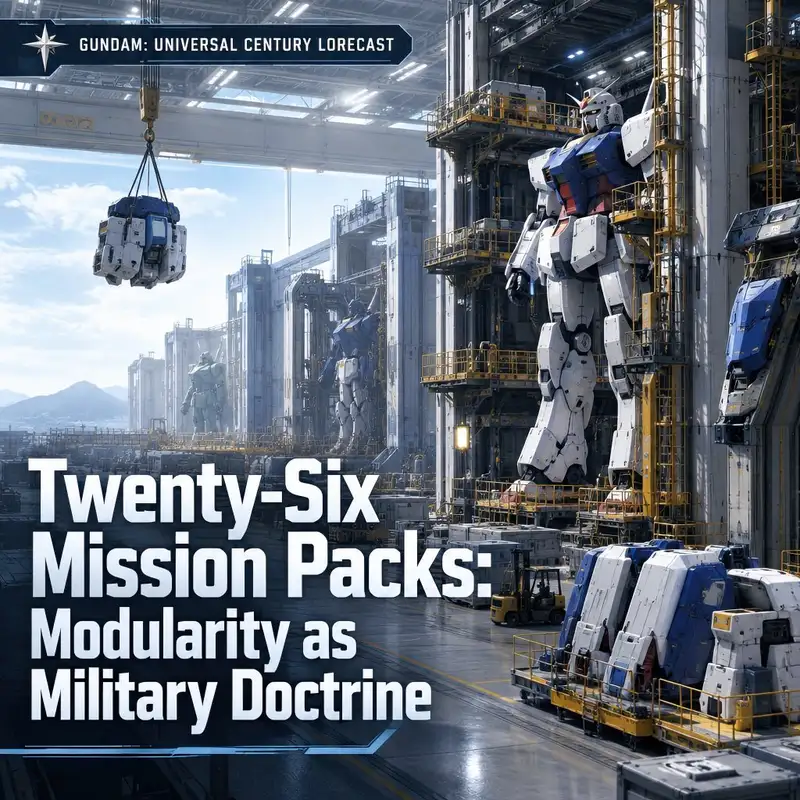
Twenty-Six Mission Packs: Modularity as Military Doctrine
The military significance of Twenty-Six Mission Packs is clearest when placed inside the Formula era, Cosmo Babylonia, Crossbone conflicts, and the growing strategic importance of the outer solar system. The analysis concentrates on miniaturized mobile suits, modular design, tes…
The military significance of Twenty-Six Mission Packs is clearest when placed inside the Formula era, Cosmo Babylonia, Crossbone conflicts, and the growing strategic importance of the outer solar system. The analysis concentrates on miniaturized mobile suits, modular design, test programs, industrial espionage, and the changing economics of force modernization, with attention to what leaders can know, mobilize, sustain, and risk. The Formula era shows how procurement competition and smaller machines can reshape doctrine even while older Zeon identities continue generating new armed movements. The episode stays within the supplied chronology and avoids unsupported continuity claims. Its position matters because the wider campaign shows how smaller mobile suits, industrial rivalry, weakened Federation reach, private military power, and frontier states shift warfare away from the patterns of the earlier Universal Century. The result is a study of what a decision solves immediately, what it costs later, and how it changes the next strategic problem. Visit ImaginedBattlefield.com for more military and science fiction.