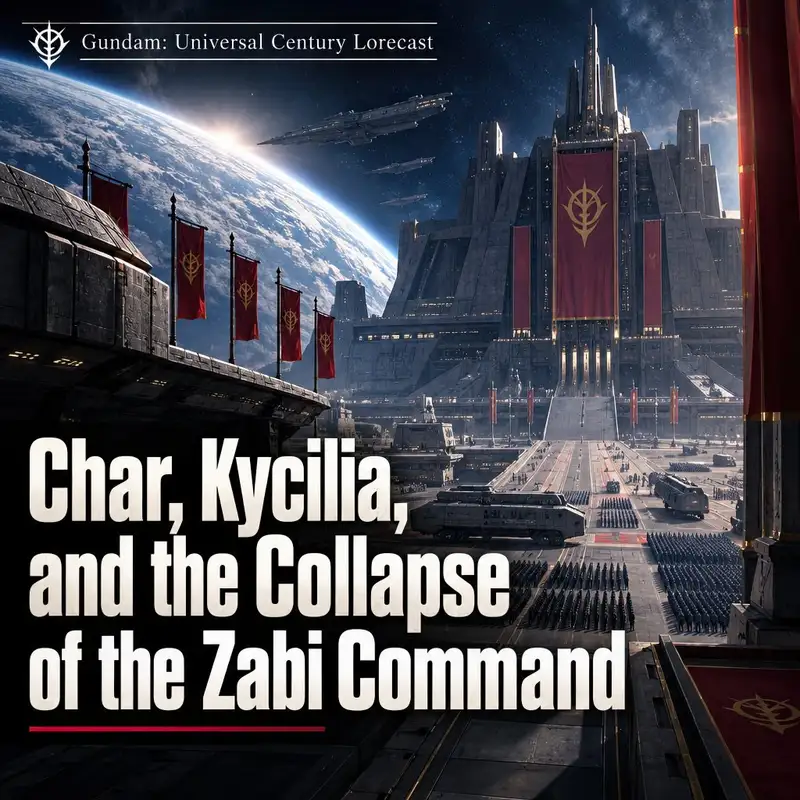
Char, Kycilia, and the Collapse of the Zabi Command
The Great Degwin leaves on a mission that has the shape of diplomacy and the timing of desperation. Degwin Zabi, nominal sovereign of the Principality of Zeon, is attempting to make contact with the Earth Federation fleet commanded by General Revil. The war has reached its last violent days. Zeon has lost ground, lost bases, and lost much of the strategic freedom it once possessed. Ahead lies A Baoa Qu, the fortress guarding the approaches to Side Three. Behind it lies the political center of the state Degwin helped build. His journey suggests that, at least in one corner of the ruling family, the question is no longer how to win the war, but how to stop the destruction before Zeon itself is destroyed.
Gihren Zabi sees the same moment differently. To him, negotiations are not an opening. They are an obstruction. He orders the Solar Ray to fire on the Federation fleet, and his father’s ship is deliberately placed within the weapon’s line of destruction. The attack kills Degwin and Revil together. Before the final battle at A Baoa Qu has properly begun, Zeon has sacrificed its own head of state in order to kill the Federation commander most capable of directing the offensive. It is a devastating military stroke. It is also political murder on a scale that no later speech can conceal.
That decision explains more about Zeon’s final collapse than any single breach in the defenses of A Baoa Qu. The Federation still had to fight through a fortress, warships, mobile suits, internal defenses, and the confusion of a final campaign. Zeon’s soldiers still fought hard, and many of its commanders remained capable professionals. But the state they served had reached the decisive battle with no trustworthy relationship between its formal government and its effective military ruler. Its command system had become a contest among members of one family. By the time Federation forces reached A Baoa Qu, the Zabis were no longer merely leading a war. They were fighting one another for the right to survive its end.
A Baoa Qu mattered because it was more than a dramatic stronghold at the edge of the war. It was Zeon’s last major defensive position before Side Three. A fortress in this role was not simply a giant gun platform. It was a base for ships, mobile-suit formations, repair work, ammunition storage, communications, medical care, command staffs, and the movement of reserves. Its defensive value came from its ability to organize combat across a wide area of space and then absorb damage long enough for its defenders to impose costs on the attacker.
That made coherent command especially important. A fortress can provide shelter, firing positions, docking facilities, and a prepared defensive geometry. It cannot decide where to send a reserve if the commander has been murdered. It cannot reconcile rival chains of authority. It cannot tell an exhausted pilot, a damaged warship, or an isolated mobile-suit unit whether the mission remains to hold, counterattack, withdraw, or preserve forces for another line of defense. A Baoa Qu gave Zeon a place to make its last stand. It did not give Zeon a political system capable of managing that stand.
By the end of the One Year War, Zeon’s military problem was inseparable from its political problem. The Principality had achieved remarkable early victories through surprise, mobile-suit doctrine, aggressive operational planning, and a willingness to escalate violence on a catastrophic scale. Those successes did not remove the basic imbalance between Zeon and the Earth Federation. The Federation possessed greater population, larger industrial resources, and the capacity to recover if it could survive the opening shock. As the war turned, Zeon found itself defending a shrinking strategic position with forces that could still be dangerous but could no longer dictate the war’s direction.
The final defense therefore demanded discipline. Zeon needed a political authority that could decide whether continued resistance served the state or merely the survival of particular leaders. It needed military command that could coordinate fleets, fortress defenses, mobile suits, and retreat routes under pressure. It needed a succession system that could function if senior figures were killed or cut off. Instead, it had an aging head of state seeking a way out, a son who had concentrated political and military authority around himself, a daughter with her own armed network and intelligence interests, and an officer serving inside the system while carrying a private grievance against the entire ruling family.
Degwin’s attempt to reach Revil’s fleet reveals how far the formal institutions of Zeon had already been hollowed out. Degwin remains the nominal head of state, and his name still carries political weight. Yet by this stage of the war, Gihren has become the effective ruler. Gihren directs strategy, speaks for the regime’s ideological purpose, and exercises enormous influence over the armed forces. Degwin’s position is not meaningless, but it is no longer sufficient to control the course of the war.
His peace initiative should not be treated as proof that Degwin had suddenly become a humane statesman. He had helped preside over a dictatorship and a war whose victims numbered beyond any ordinary military reckoning. Nor does the television record provide a detailed treaty proposal that can be reconstructed clause by clause. What it does establish is more immediate. Degwin recognizes that Zeon is approaching a point from which military defeat may become national ruin. He attempts to create contact with the Federation before the final battle turns into an annihilating confrontation.
That attempt places him in direct conflict with Gihren’s view of the war. Gihren does not appear to regard negotiation as a difficult but legitimate policy choice. In his political world, compromise threatens the entire meaning of his rule. Zeon’s survival, the prestige of the state, the military campaign, and Gihren’s own authority have been fused together. To admit that the war may need to end through negotiation would be to admit that his vision had limits. He is prepared to destroy the institutional source of that challenge rather than tolerate it.
The Solar Ray attack therefore has several consequences at once. Tactically, it inflicts catastrophic damage on the Federation force and kills General Revil. That is a serious blow. Revil is not just another senior officer. He is one of the Federation commanders whose experience and authority matter at the highest level of the campaign. Removing him disrupts Federation command at a crucial moment and demonstrates that Zeon retains an extraordinary capacity for concentrated destruction.
Strategically, the strike buys Zeon time and raises the cost of the Federation advance. It does not, however, erase the Federation’s ability to continue the offensive. The Federation assault on A Baoa Qu still goes forward. Its surviving commanders, ships, and mobile-suit units still have an objective. Zeon’s final position remains under attack. Solar Ray does not reverse the broader direction of the war. It is a powerful weapon used to create an opportunity, not a substitute for the forces needed to exploit that opportunity.
Politically, the strike is more damaging to Zeon than Gihren appears willing to understand. Degwin’s death removes the last figure within the ruling family who might have provided an alternative source of legitimacy or restraint. The nominal sovereign has not died in battle against the Federation. He has been killed by his own son’s decision. The state’s formal authority has been consumed by its military dictatorship. Zeon is now more centralized than before, but it is also less stable, because every remaining center of power has received the same warning. Under Gihren’s rule, no relationship and no title provides protection.
The moral meaning of the attack is equally important. Solar Ray is often remembered as a terrifying strategic weapon, and it is that. But its most revealing target is not only the Federation fleet. It is the Great Degwin. Gihren uses a weapon of mass destruction in a way that treats his father, his father’s escort, and the political possibility of ending the war as expendable material. The decision is not merely ruthless in a conventional military sense. It shows that the regime’s highest authority has reached the point where its own state institutions exist only as instruments of Gihren’s will.
This does not make Gihren a fool. He is too dangerous, too disciplined, and too capable for that simple description. He understands strategy. He understands the value of initiative, the effect of terror, the importance of technical advantage, and the need to impose political meaning on military action. Earlier in the war, those qualities helped Zeon overcome its weaker long-term position. A smaller power facing a larger enemy often depends on concentration, surprise, and speed. Gihren’s command style is well suited to that kind of war.
But a system built around one person’s will has a predictable weakness. It can move quickly while that person is alive, informed, and obeyed. It has difficulty absorbing dissent, failure, succession, or competing interests. In a more durable state, an argument between political leaders might be settled through a defined constitutional process, a cabinet decision, a military chain of command, or a negotiated transfer of authority. In Gihren’s Zeon, disagreement becomes a question of who can command armed men, control information, and remove rivals before they act first.
Kycilia Zabi represents that unresolved rival power. She is not simply Gihren’s sister standing at the edge of his political drama. She commands the Assault Mobile Fleet and possesses her own military and intelligence connections. Her authority is not independent in the sense of a separate state, but neither is it a mere extension of Gihren’s command. Zeon’s final defense is therefore not led by one integrated hierarchy. It contains overlapping centers of influence, each with its own personnel, loyalties, and calculations.
This arrangement may have appeared manageable while the war was moving in Zeon’s favor. Rival power centers can coexist when victories distribute prestige, when resources remain available, and when leaders believe they will benefit from the system’s survival. Defeat changes the incentives. Loss narrows the field. Every evacuation route, every remaining fleet, every intelligence channel, and every political symbol becomes more valuable. Under those conditions, a family government does not become more united simply because it faces danger. It may become more suspicious, because each member understands that another’s survival could mean his or her own elimination.
Kycilia’s reaction to Degwin’s death must be understood in that context. Gihren has not merely committed a private crime against their father. He has demonstrated that he will kill the nominal head of state in the middle of an attempted peace effort if that figure threatens his control. For Kycilia, this means that Gihren is no longer only a political rival. He is the sole authority in a system where no subordinate can rely on law, family, or office for safety. If he can destroy Degwin, he can destroy anyone.
Her decision to confront Gihren is therefore part revenge, part coup, and part attempt to seize control before Gihren’s war carries Zeon into complete disaster. It would be misleading to turn her into a democratic reformer. Kycilia is a product of the same regime. She has her own ambitions, her own military network, and her own record of operating through secrecy and coercion. Nor is she merely overcome by personal grief. Her act is political. She recognizes that Gihren’s dominance has become intolerable not only to her family but to the possibility of any Zeon leadership surviving him.
The difficulty is that even a necessary coup can be disastrous when it occurs during an active battle. Removing a commander in peacetime is complicated. Removing the officer directing the defense of the state’s final fortress is something else entirely. Orders are already in motion. Ships are engaged. Mobile suits are launching, returning damaged, or failing to return at all. Staff officers are processing incomplete reports through Minovsky interference and battle damage. Units may be scattered across open space, clustered around carriers, or fighting inside the fortress itself. No command system welcomes sudden ambiguity. A fortress under assault can least afford it.
Was the goal to fight until the Federation offensive broke? Was it to preserve a core force for negotiations? Was it to defend Side Three at all costs? Was it to save the ruling family and continue resistance elsewhere? Different leaders inside Zeon would have answered those questions differently. Degwin’s attempted contact with Revil suggests one answer. Gihren’s Solar Ray attack suggests another. Kycilia’s later actions suggest yet another. The problem is not merely that these leaders disagreed. It is that their disagreement had never been resolved by any institution stronger than the family itself.
When Kycilia confronts Gihren in the command center and shoots him, the event is often remembered as a moment of personal revenge. It is that, but it is also an operational crisis. Gihren is not killed at a distant palace or after the battle has ended. He is killed while the battle for A Baoa Qu is underway. The commander directing Zeon’s final defense has been removed by a rival who must now claim authority over the same forces he had been commanding moments earlier.
Kycilia does assume overall command. That is important. Zeon does not immediately become a collection of isolated individuals with no one issuing orders. But succession after an armed assassination is not the same as continuity. She inherits the fortress, the battle, the losses, and the assumptions of a plan designed under Gihren’s authority. She also inherits personnel who may have owed their position to Gihren, who may not know whether Kycilia intends to continue his strategy, and who may have their own views about the war’s now uncertain political end state.
The disruption should not be exaggerated into the sole explanation for Zeon’s defeat. The Federation had already reached A Baoa Qu. Zeon had already suffered strategic reverses. Solar Ray had not stopped the assault. The fortress was already under massive pressure, and local fighting still determined the fate of individual sectors. But command disruption matters most when a force has no margin for error. Zeon’s internal coup does not create every weakness in the defense. It makes those weaknesses harder to manage and impossible to repair in time.
Tactically, many units continue fighting. A pilot in a damaged mobile suit does not stop because the political situation has changed. A gun crew under fire still has a target. A ship captain threatened by an enemy formation still has to maneuver, defend the vessel, and protect the crew. The immediate battle continues through habit, discipline, fear, loyalty, and the simple fact that the enemy remains present. Large military organizations often retain local fighting power even after the political structure above them begins to fail.
Operationally, however, the loss of a stable command center becomes more serious. Defensive battles depend on the movement of reserves, the allocation of scarce assets, the assessment of threatened sectors, and the decision to abandon positions before they become traps. A commander cannot be everywhere. The purpose of a headquarters is to create a shared understanding of priorities and then move resources accordingly. When authority changes through murder, every prior priority becomes questionable. A reserve held for Gihren’s counterattack may no longer fit Kycilia’s plan. A withdrawal that once looked like defeat may become necessary for survival. But changing direction in battle takes time, and time is the one resource a collapsing defense does not possess.
Strategically, the problem is deeper still. Zeon can no longer connect military resistance to a credible political outcome. A battle must serve a purpose beyond the next exchange of fire. Even a doomed defense can buy time for evacuation, negotiation, reorganization, or the preservation of a government. But which government is Zeon preserving? Degwin is dead. Gihren is dead. Kycilia has seized command but cannot rely on a settled succession structure. The state is fighting, but the authority that gives the fighting political meaning is disintegrating at its center.
This is the point at which Char Aznable becomes more than a skilled Zeon officer with a personal grudge. In the television series, Char’s connection to the Zabi family is rooted in his concealed identity as Casval Rem Deikun. He has spent years inside the system built by the family that displaced his father’s political legacy. His career has given him rank, combat experience, access to senior figures, and a place within Zeon’s military hierarchy. He is not approaching A Baoa Qu as an outside insurgent. He is inside the command structure that is now coming apart.
That position gives his private motives public consequences. A personal feud is not always strategically significant. In most military systems, an officer with a grievance against the ruling family would be kept far from decisive information, sensitive movements, and senior leaders. Zeon’s political culture has not produced that kind of separation. Personal loyalty, military usefulness, intelligence access, family patronage, and political ambition overlap. Char has been valuable enough to remain close to power. That makes him dangerous when the people in power are most vulnerable.
His clash with Amuro Ray during the battle matters here only because it delays and redirects him at a crucial moment. Char pilots the incomplete Zeong against Amuro’s Gundam in one of the battle’s most intense individual engagements. But the duel is not the whole history of A Baoa Qu. Neither pilot controls the fate of every ship, fortress sector, or command decision around them. The larger battle continues while they fight, and the Zabi command crisis continues without regard for either man’s tactical skill.
The encounter does, however, bring Char into contact with Sayla, his sister. That moment confronts him with the personal cost of the path he has chosen. He is no longer simply pursuing revenge in the abstract. He is moving through a collapsing fortress where family identities, old loyalties, and immediate survival have collided. The television series does not reduce his decision-making to one clear political doctrine. His actions contain anger, inheritance, calculation, and a refusal to let the Zabi system escape the consequences of what it has done.
By this stage, Kycilia is the remaining Zabi leader in the theater who might still create an alternative center of authority. Her attempt to leave A Baoa Qu aboard a Zanzibar-class vessel should be read carefully. It is not evidence that she has abandoned every idea of resistance. The fortress is failing, and survival outside its immediate destruction could allow her to gather remaining forces or continue the struggle from another location. Commanders sometimes leave a doomed position because preserving a leader, staff, or mobile force can be militarily rational.
But Kycilia’s departure also carries a political cost. The woman who has just taken control after killing Gihren is preparing to leave the center of the final defense. Whatever her intention, the image is damaging. A Baoa Qu’s defenders are still fighting. The fortress staff is still attempting to manage a crisis. Yet the surviving claimant to Zabi authority is moving toward escape rather than remaining at the command center to impose a durable new order. Her authority is improvised, her plan is unclear, and the state’s command structure has become inseparable from the question of whether she can physically get away.
Char recognizes the opportunity. He identifies Kycilia’s escape route and attacks at close range with a bazooka. The strike kills her before she can establish herself beyond A Baoa Qu. The final Zabi leader in the theater is not eliminated by a Federation fleet bombardment or a formal political overthrow. She is killed by an insider whose access, military experience, and private history have allowed him to reach her at the exact moment Zeon’s system is least able to protect its leaders.
It would be too simple to describe this only as revenge. Char’s long hostility toward the Zabis is real, and Kycilia is one of the people he holds responsible for the destruction of his family’s political world. But his act also has immediate political consequences. By killing Kycilia, he prevents her from becoming the surviving point around which a remnant command structure might gather. Whether he intends every consequence is less important than the fact that Zeon’s system has made such a consequence possible. A state that depends on a ruling family makes the survival of individual family members a matter of strategic importance.
Nor should Char be credited with ending Zeon by himself. The Federation assault, the war’s accumulated losses, the destruction caused by Solar Ray, the breach of A Baoa Qu’s defenses, and the failure of Zeon’s larger strategy all matter. The Principality does not vanish because one officer fires one weapon. But Char’s attack is the final act in a sequence that turns political crisis into terminal command collapse. Degwin is killed by Gihren. Gihren is killed by Kycilia. Kycilia is killed by Char. Each death removes not merely a person, but a possible source of authority.
The pattern matters because it reveals the structure beneath the personalities. Zeon’s ruling order had fused state legitimacy, military command, family status, and ideological leadership into a narrow circle. That structure gave the regime speed and unity when the family appeared united. It gave the state no reliable way to survive when they were not. There was no widely accepted civilian institution capable of settling the dispute. No independent military chain could stand apart from the dynasty. No succession process could command universal obedience once the principal figures began removing one another.
The end of the Zabi command is not the same thing as immediate peace. Zeon soldiers, ships, and formations do not disappear the instant Kycilia dies. Men and women remain in combat, separated from higher command by distance, battle damage, and the uncertainty of the fortress’s collapse. Some may continue to defend their positions. Others may attempt to escape. Others may learn only gradually that the political leadership they served no longer exists in any meaningful form. A state can survive the death of rulers if institutions outlive them. Zeon’s problem is that its institutions have been made subordinate to the rulers’ personal struggle.
Still, the collapse of the Zabi command changes the immediate balance decisively. There is no uncontested ruler left to negotiate from strength, order a coordinated withdrawal, or direct a unified continuation of the war. There are remaining personnel and remaining weapons, but no stable center capable of converting them into coherent state power. The distinction is crucial. Armed resistance can continue without a government. A government cannot continue simply because armed people remain in the field.
A Baoa Qu therefore demonstrates the limit of military centralization. Gihren had built a system that could concentrate violence with extraordinary efficiency. Solar Ray is proof of that capacity. The fortress itself is proof of it. Zeon’s mobile-suit forces, fleet elements, and defensive installations are proof of it. Yet the same system could not create political resilience. It could organize destruction. It could not tolerate negotiation, succession, or shared authority. When the war demanded institutional endurance, Zeon had only the Zabi family’s ability to remain united.
They did not remain united. Degwin’s attempt to pursue a negotiated end exposed the divide between formal sovereignty and Gihren’s effective dictatorship. Gihren’s murder of Degwin destroyed the last internal restraint on his rule. Kycilia’s murder of Gihren removed the active wartime commander in the middle of the decisive battle. Char’s murder of Kycilia eliminated the last surviving Zabi leader in the theater before she could create an alternative command structure. None of these acts alone explains every tactical failure at A Baoa Qu. Together, they make recovery impossible.
The Federation defeated A Baoa Qu through military pressure, persistence, and the accumulated advantage of a war Zeon could no longer control. But the Zabis made defeat irreversible by turning their own command center into the last battlefield of their civil war. A fortress can protect a regime from an enemy fleet. It cannot defend that regime from the rulers who have made power, loyalty, and survival into reasons to kill one another.