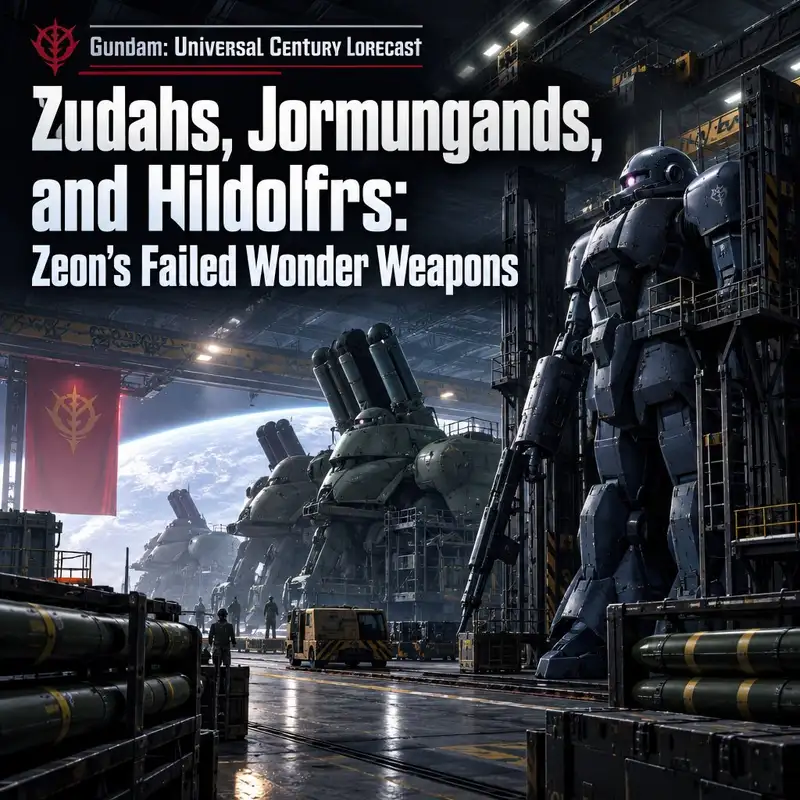
Zudahs, Jormungands, and Hildolfrs: Zeon’s Failed Wonder Weapons
At Loum, Zeon brought forward a weapon built for the old dream of decisive fleet battle. The Jormungand was immense, specialized, and intended to strike with the sort of concentrated firepower that could settle an engagement before an enemy commander understood what had happened. Its operator, Aleksandro Hemme, was a professional gunner from a military culture that still believed a well-placed shot from a powerful weapon could shape a campaign. In another kind of war, he might have been right. But around Side Five, while the Jormungand waited for its moment, Zeon’s mobile suits were already changing the terms of battle. The question was not whether the cannon could destroy a target. It could. The question was whether one extraordinary weapon could decide a battle after the system of warfare around it had begun to change.
The record comes through the 603rd Technical Evaluation Unit, a Zeon formation based aboard the Jotunheim. The unit was not an ordinary frontline command, but neither was it a protected laboratory. Its personnel lived in the uncomfortable space between designers, military headquarters, and combat formations. Engineers, pilots, technical officers, gunnery specialists, mechanics, and transport crews were expected to evaluate dangerous new weapons under the worst possible conditions: during an active war, against an enemy that was learning quickly, and under political pressure to produce results. Oliver May, an engineering lieutenant, provides much of the unit’s perspective. He is useful not because he knows everything, but because he sees how often technical evidence is filtered through fear, ambition, and institutional convenience.
The Jotunheim itself explains part of the problem. It began as a civilian cargo vessel and was adapted for military test support. That is not a glamorous assignment, but it is an important one. Prototypes do not move themselves from factory to battlefield. They need storage, transport, specialist maintenance, spare components, fuel or propellant, test instruments, communications, recovery plans, and people capable of understanding what has gone wrong after a trial fails. In peacetime, those functions might be divided among test ranges, depots, shipyards, and research facilities. Zeon was trying to compress them into a ship moving through a widening war. The 603rd was created to test the future, but it often found itself carrying technologies whose assumptions belonged to a past that was disappearing.
The Battle of Loum was an appropriate place to test a weapon like the Jormungand. It was one of the opening war’s great fleet actions, a battle in which Zeon sought not merely local destruction but an operational and political shock. Fleet engagements had traditionally rewarded range, concentration of fire, command coordination, and the ability to identify vulnerable enemy formations before they could respond. The Jormungand promised to magnify those principles. It was described as a weapon intended to help determine the outcome of the battle, and its presence reflected a familiar military instinct. When facing a stronger opponent, build something that can hit harder, farther, or more decisively than anything the enemy expects.
That instinct was not irrational. The Earth Federation possessed greater long-term resources, and Zeon’s leaders had every reason to seek temporary advantages before that larger industrial base could be organized for war. A powerful fleet weapon could create a window of opportunity. It could punish a formation, threaten a capital ship, disrupt a command arrangement, or force an enemy fleet to maneuver defensively. Hemme’s role mattered because a weapon of that kind depended on professional judgment. A cannon is not a strategy by itself. It needs target information, a firing solution, a clear line of fire, protection from attack, support from the surrounding fleet, and commanders who understand when to reveal it.
The Jormungand demonstrated that concentrated destructive power still had military value. The lesson from Loum is not that large guns became useless the moment mobile suits appeared. War rarely changes so cleanly. A fleet still needs heavy weapons. It still needs escorts, command ships, transports, defenses, and the ability to damage an enemy at range. The limitation was different. The Jormungand was a highly specialized answer to a narrow problem. It depended on finding the right target at the right time, then surviving long enough to exploit that opportunity. It could deliver a blow. It could not by itself create the reconnaissance, screening, maneuver, or sustained pressure needed to control a modern fleet battle.
At Loum, the more consequential transformation came from Zeon’s mobile suits. In Minovsky conditions, fleets could not rely on the same long-range sensing and communications practices that had shaped earlier doctrine. Commanders still had information, but it was incomplete, delayed, and often local. Ships faced threats from multiple directions. Identification became harder. A formation that depended on centralized fire control could be disrupted by smaller forces moving independently, closing distance, and striking at vulnerable points. Mobile suits gave Zeon a way to distribute combat power across the battlespace. They could scout, attack, confuse, screen, pursue, and exploit local openings in ways a single large weapon could not.
That did not make mobile suits magical. They still depended on carriers, tenders, pilots, technicians, fuel, weapons, and command decisions. But they fit the emerging environment more effectively than the Jormungand did. A mobile suit could be sent toward a threat. A cannon had to wait for one. A mobile-suit team could force a fleet to react across several axes. A specialized fleet weapon could dominate only the portion of the battle that entered its engagement opportunity. The distinction was not between advanced and obsolete technology. It was between a weapon that performed impressively and a system that changed the enemy’s behavior.
The Jormungand therefore stands as a warning against confusing tactical lethality with operational relevance. Zeon had built a weapon capable of destruction, but the Battle of Loum was increasingly decided by forces that could create disorder throughout a fleet. The cannon belonged to a battleship-centered logic in which the decisive act was concentrated fire from a decisive platform. The mobile suit represented a more distributed form of violence, one that placed greater responsibility on individual pilots and local commanders. The irony is that Zeon possessed both concepts at once. It was capable of innovation, but not always capable of deciding which innovations could be turned into durable doctrine.
The next major test undertaken by the 603rd moved from orbital fleet warfare to Earth. There, the question was not how to strike a formation in space, but how to combine mobility, protection, and heavy firepower under gravity. Earth warfare placed different demands on every machine. Roads, rock formations, buildings, dust, concealment, ammunition supply, mechanical wear, and the simple difficulty of recovering damaged equipment all mattered. A mobile suit that moved brilliantly in space might become cumbersome on uneven ground. A tank that could dominate open terrain might struggle in close country or against enemies able to attack from above. The Hildolfr emerged from this problem, and from a part of Zeon’s military culture that had been pushed aside by the rise of the mobile suit.
The YMT-05 Hildolfr was a prototype mobile tank, a design rejected two years earlier and later brought back for field testing during Zeon’s Earth invasion. It was associated with Demeziere Sonnen, an armored-warfare officer whose career had not followed the direction Zeon’s military institutions now preferred. The mobile suit had become the symbol of the future. It was versatile, dramatic, and politically valuable. A tank officer, by contrast, could look like a representative of an older doctrine, even when the older doctrine still answered real battlefield needs. Sonnen’s resentment was not merely personal bitterness. It reflected the fate of soldiers whose professional knowledge had been devalued almost overnight by a revolution in military technology.
His perspective was worth taking seriously. Mobile suits did not make terrain irrelevant. They did not make direct fire irrelevant. They did not eliminate the value of concealment, gunnery, armor, or the disciplined use of a vehicle designed around a specific battlefield role. The Hildolfr was not simply a conventional tank with an exotic silhouette. It attempted to combine heavy direct fire and ground mobility with a degree of flexibility that could let it operate in a mobile-suit battlefield. Its design recognized that armored warfare had not disappeared. It had become more dangerous because armored vehicles now faced opponents with unusual mobility, vertical attack options, and powerful weapons.
The test took place in Arizona, where the Hildolfr encountered Federation forces operating captured Zaku mobile suits. That detail matters. A machine’s silhouette does not guarantee its allegiance. Captured equipment can create confusion in identification, communications, and rules of engagement. It can also reveal a deeper problem for the original owner. Once the enemy has captured a weapon, it may gain more than a vehicle. It may gain access to its strengths, weaknesses, maintenance demands, and tactical habits. The Federation’s use of captured Zakus did not mean it had absorbed Zeon doctrine whole. Operating a machine is not the same as sustaining a force structure. But it complicated the battlefield enough to make a technically focused test mission into a real intelligence problem.
The Hildolfr performed well in the setting for which it had been built. Its heavy firepower could threaten mobile suits. Its mobility allowed it to reposition and use the ground rather than simply present itself as a static target. Terrain and concealment became part of its weapon system. A competent armored officer could use folds in the landscape, sight lines, and timing to create a firing opportunity against an opponent that expected to dominate through mobility alone. Sonnen’s local success demonstrated something important: mobile suits were not the only answer to ground combat. A specialized armored vehicle, properly employed, could still be formidable.
But battlefield success is the easiest standard for a prototype to meet. A prototype can appear at one place, under the control of an unusually capable operator, in terrain favorable to its design, and produce an impressive result. Procurement success asks harder questions. Can the machine be built in enough numbers to matter? Can it be moved where it is needed? Can mechanics maintain it away from a specialized support ship? Can units carry its ammunition, recover it after damage, train enough crews, and coordinate it with infantry, artillery, aircraft, mobile suits, and supply columns? Can commanders understand where it belongs in the order of battle? A machine that is dangerous in a single engagement may still be unsuitable for a war spread across an entire planet.
The Hildolfr’s limitations were not proof that tanks were inferior to mobile suits in every circumstance. That would simply repeat the kind of technological dogma that had marginalized Sonnen in the first place. Its limitation was that it was highly specialized and scarce. It could not easily become a universal replacement for the mobile suit, because the mobile suit’s appeal lay in its adaptability across different theaters and mission types. A mobile suit could be used badly, and often was. But it offered commanders a flexible platform for the strange mixture of urban fighting, desert movement, river crossings, fortification attacks, and rapid redeployment that the Earth campaign demanded.
The Hildolfr also needed a support system of its own. Heavy weapons consume ammunition. Ground vehicles require repair, recovery, and access to routes that can bear their weight. Crews need training in their vehicle’s particular controls and tactical methods. A machine designed to exploit concealment still has to be supplied, protected, and coordinated with other units. In a stable army, those problems can be addressed through doctrine, depots, schools, and standardized organization. Zeon’s Earth forces were expanding rapidly, fighting across vast distances, and trying to sustain an invasion with limited strategic depth. The state had little time to build an entire operational ecosystem around one unusual armored prototype.
Sonnen’s fate gives the episode its human edge. He was not simply a test pilot who accepted a risk sheet and lost a machine. He was a specialist whose experience had been pushed to the margin, then recalled when the institution wanted proof that an abandoned concept might still be useful. His competence produced a local victory. It did not produce a procurement program, an armored revival, or a new place for him within Zeon doctrine. The machine and the man were spent in combat before their lessons could be converted into sustained capability. That is one of the cruelties of wartime development. A prototype is sent into danger because there is no time for a safer test. Then its destruction is treated as evidence that the idea itself has no future.
By late October, the 603rd was confronting a different form of failure. The issue was no longer whether a neglected weapon might have a useful tactical role. It was whether Zeon could turn an embarrassing development history into a public story of technological superiority. On October twenty-fourth, Universal Century seventy-nine, Zeon announced the Zudah as a new mobile suit, presented as superior to the Zaku. The claim carried obvious political weight. The Zaku had become the face of Zeon’s early military success. To announce a successor that was faster and more capable was to imply that Zeon retained the initiative, that its engineers were still ahead, and that the Federation’s growing industrial mobilization could be answered by another leap forward.
The Zudah, however, was tied to the earlier EMS-04 design. That machine had lost the competition to become Zeon’s first major combat mobile suit, a contest won by the Zaku. The earlier design had not simply been overlooked by an unimaginative bureaucracy. It had a serious problem. When pushed toward excessive performance, it became unstable and could suffer catastrophic failure. The later Zudah presentation, under the EMS-10 designation, attempted to place a new name over an old institutional wound. That did not necessarily mean everyone involved was dishonest. Engineers can believe that a design deserves a second chance. Test pilots can see genuine potential in a machine that failed under earlier conditions. But renaming a problem does not solve it.
Jean-Luc Duvall became the Zudah’s pilot and public advocate. His attachment to the machine was personal, professional, and political all at once. He represented a development culture that wanted recognition for an idea defeated by the Zaku program. In that sense, the Zudah was carrying more than weapons and propulsion equipment. It carried pride, corporate and military rivalry, and the need to prove that a past judgment had been wrong. Duvall’s confidence was not foolish. The Zudah’s speed and maneuverability were real enough to make it impressive. The tragedy was that the institution around him asked the machine to validate a public claim before its central safety problem had been honestly resolved.
Monique Cadillac’s presence around the 603rd shows how closely technical evaluation had become tied to higher command and political oversight. She is not evidence that one official secretly controlled every weapons program. Zeon’s military and political institutions were too large and too fractured for that kind of simple conspiracy. But her role does reveal that the Zudah was no longer just an engineering question. The state needed an answer to the Federation’s Gundam, or at least a symbol that could be presented as an answer. In a deteriorating war, technological prestige becomes a form of political currency. It reassures supporters, pressures subordinates, and offers a narrative of recovery when the strategic situation is becoming harder to conceal.
That is where the Zudah’s defect becomes decisive. High speed is not the same as military capability. A combat machine must perform repeatedly, within a safe operating envelope, in the hands of ordinary trained pilots under battlefield stress. It must tolerate imperfect maintenance, damaged components, rushed launches, uncertain information, and commanders who may demand more than prudent conditions allow. A machine that can briefly exceed another in speed but becomes structurally unsafe when pushed toward that performance is not a dependable frontline weapon. It is a test article carrying a warning label.
The exact technical mechanism of the Zudah’s failure matters less than its operational meaning. The screen record establishes instability and catastrophic breakup at excessive performance. That is enough to understand why the design could not be treated as a clean replacement for the Zaku. A military does not equip a force merely because an expert pilot can demonstrate a machine’s best qualities. It equips a force when those qualities can be reproduced safely, maintained in the field, and translated into units that survive long enough to matter. The Zudah’s speed was real. So was its danger. The mistake was to treat those facts as if they could be separated.
Technical evaluation exists to identify limits. A good test program does not regard bad results as betrayal. It treats them as information. A dangerous speed threshold should lead to redesign, restriction, or cancellation. It may be painful. It may embarrass a sponsor. It may end a career. But it is still preferable to discovering the problem after the machine has been handed to a combat unit. Political pressure reverses that logic. Once a weapon has been announced as superior, its limitations become inconvenient. Engineers are tempted to minimize them. Commanders are tempted to demand demonstrations that prove the public message. Test pilots become responsible for making the machine look better than the evidence allows.
The Zudah’s high-speed demonstration ended in catastrophic breakup. It was not merely an accident in the narrow sense. Mechanical failure occurred, certainly, but the larger failure was institutional. Zeon had attempted to convert an unresolved design flaw into a public contest of prestige. The demonstration exposed the gap between advertised performance and usable performance. It also revealed how much burden had been placed on Duvall. He was expected to demonstrate not just a machine, but a revision of history. If the Zudah succeeded, it would vindicate the people who believed the original EMS-04 had been wronged. If it failed, the pilot could be blamed for pushing too far, while the institution that created the pressure remained intact.
By the time of Apocalypse 0079, the setting had changed again. Zeon was no longer an expanding power exploiting surprise. It was a state under growing pressure, conducting evacuations, fighting delaying actions, and watching its strategic freedom contract. The 603rd continued to test and deploy unusual systems, but the purpose had shifted. Early in the war, experimental weapons could be imagined as tools for gaining an advantage. Late in the war, they increasingly became instruments of desperation. Zeon could still produce skilled soldiers, inventive engineers, and remarkable machines. What it could no longer reliably produce was the time, industrial security, and operational stability required to transform experiments into a war-winning force.
Zeon’s defeat was not caused by a lack of talent. Its technical culture was capable of adaptation and bold design. Its officers could still make difficult local decisions. Its soldiers could still fight effectively. But military power is more than ingenuity. It is the ability to replace losses, train crews, sustain fleets, move equipment, protect factories, maintain communications, and turn a successful idea into something more durable than a single sortie. As Zeon lost territory and initiative, each new prototype had to carry an impossible burden. A machine was expected to compensate for strategic decline, political misjudgment, and industrial weakness. No machine could do that.
Duvall’s final use of the Zudah came amid this late-war atmosphere. His sortie around Earth orbit was not an ordinary acceptance test. It was an attempt to restore the reputation of the machine and, with it, his own professional identity. The Zudah’s speed and maneuverability still offered tactical possibilities. In the right moment, a fast machine can intercept, evade, strike, or create a brief opening for other forces. That is the genuine military promise that made Duvall’s faith understandable. But an individual sortie, however skillful, cannot establish a production base. It cannot train squadrons. It cannot create spare-parts pipelines, repair facilities, or an operational doctrine accepted across the force.
The human cost is what makes these failures more than a procurement story. Hemme, Sonnen, and Duvall were not abstractions in a development chart. Each brought experience, pride, and professional judgment to a weapon that promised to justify his role in a changing war. Hemme represented the gunnery culture of fleet combat. Sonnen represented armored warfare’s claim to continued relevance on Earth. Duvall represented a mobile-suit concept that had been rejected, revived, and burdened with public meaning. Their competence mattered. Their deaths and losses mattered. But none of them could solve the institutional failures that placed them in situations where dangerous prototypes became substitutes for coherent strategy.
The crews around them mattered as well. Mechanics had to keep unfamiliar systems functioning. Engineers had to interpret incomplete results. Transport personnel had to move weapons through hostile territory and contested space. Commanders had to decide when a test could become a combat mission, and when combat pressure made a test meaningless. Those people are often invisible when history remembers only the pilot and the machine. Yet they are the difference between a demonstration and a capability. A weapon becomes militarily significant only when a large system of ordinary labor can make its performance repeatable.
The Jormungand, Hildolfr, and Zudah therefore failed in different ways. The Jormungand was tactically destructive, but it did not fit the emerging operational reality as well as mobile suits did. It was a powerful fleet weapon in a war increasingly shaped by distributed maneuver, local initiative, and the disruption of fleets from multiple directions. Its failure was not that it could not kill. Its failure was that it could not become the organizing principle of a new kind of fleet warfare.
The Hildolfr failed differently. It demonstrated that armored doctrine retained value on Earth. Heavy direct fire, terrain use, mobility, and disciplined gunnery could still threaten mobile suits. Sonnen’s performance established that much. But the Hildolfr was too specialized and too limited in availability to become a broad answer to Zeon’s ground-war requirements. It required suitable terrain, skilled employment, maintenance, ammunition, recovery, and an organization prepared to use it properly. It was a dangerous local solution, not the foundation of an army.
The Zudah’s failure was the most direct and the most politically revealing. It had impressive performance, but it lacked the safe, repeatable reliability required of a frontline mobile suit. Its defect was not a minor inconvenience that could be ignored because the machine was fast. It was a boundary beyond which performance became self-destruction. Reviving the design under a new designation did not transform that boundary into an advantage. The attempt to use public confidence and pilot commitment to overcome technical evidence only made the failure more costly.
All three systems answered real military questions. How can a smaller power strike a stronger fleet? How can heavy ground firepower survive in a mobile-suit war? How can a state regain a technological edge over an enemy’s new prototype? These were not foolish questions. The failure came in the answers Zeon tried to impose. Each weapon was asked to solve a problem larger than its design could bear. The Jormungand was asked to decide a battlespace that had become too dispersed. The Hildolfr was asked to restore an entire doctrinal tradition through one prototype. The Zudah was asked to repair an old institutional humiliation while serving as a symbol of recovery.
This is why wonder weapons are so attractive to states in trouble. They promise a shortcut around hard realities. A spectacular cannon seems to overcome fleet weakness. A remarkable armored vehicle seems to overcome doctrinal uncertainty. A faster mobile suit seems to overcome industrial decline. The attraction is especially strong when leaders cannot easily admit that the real problems are political and organizational. A state can announce a new weapon more easily than it can reform its command culture. It can celebrate a prototype more easily than it can build a durable maintenance system. It can ask a test pilot for one more demonstration more easily than it can acknowledge that the war is slipping beyond recovery.
Zeon’s early success had rested on genuine operational innovation. It exploited surprise, mobile suits, Minovsky conditions, aggressive planning, and the Federation’s lack of readiness. But early innovation did not remove the need for strategic endurance. As the war continued, Zeon faced the harder tasks of sustaining an invasion, defending distant positions, replacing losses, and competing with a larger opponent that was learning how to fight back. The more its position deteriorated, the more tempting it became to search for isolated technical miracles. That search produced real machines and real accomplishments. It did not produce a substitute for industrial depth, coherent strategy, or political legitimacy.
The 603rd Technical Evaluation Unit becomes valuable historical evidence precisely because it stands near that point of failure. The unit sees weapons before they become myths. It sees the maintenance work, the arguments, the uncertain reports, the pressure from headquarters, and the human beings asked to prove that an idea can survive contact with reality. It also sees the difference between a machine that is impressive and a machine that is usable. In wartime, that difference can be measured in the lives of pilots and crews who are told that a prototype must work because there is no time left for it not to.
Zeon’s failed wonder weapons were not failures of imagination. They were failures of scale, timing, and institutional honesty. The Jormungand lacked a future-proof role in the mobile-suit battlespace. The Hildolfr lacked the numbers and broad applicability to reshape the Earth campaign. The Zudah lacked the safe, repeatable performance required of a frontline weapon. Their histories show a regime rich in engineering skill and individual courage, but increasingly unable to turn invention into durable military power, or to admit when a symbol of superiority had become a liability.