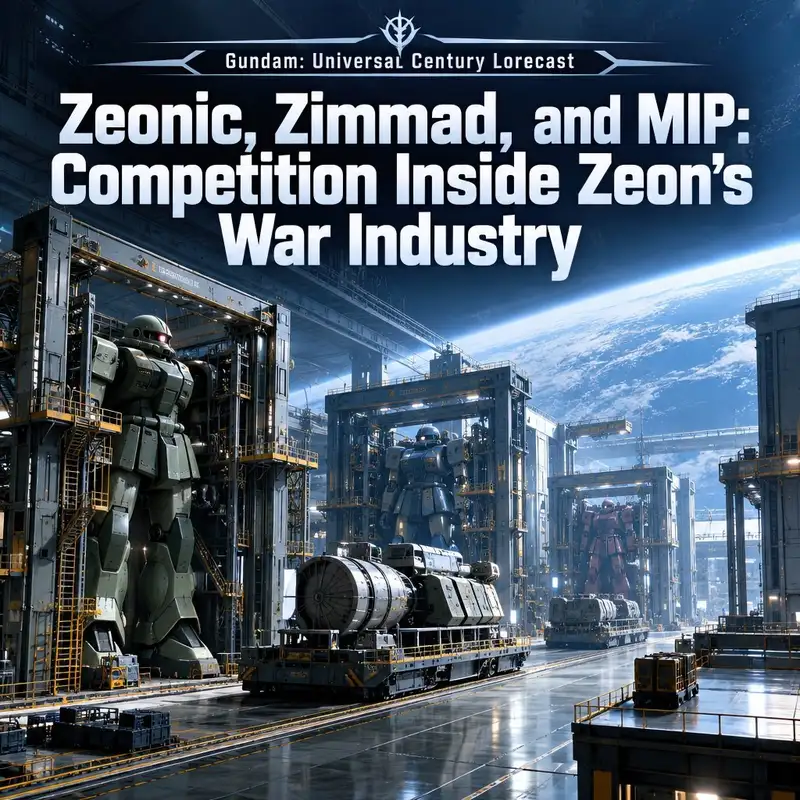
Zeonic, Zimmad, and MIP: Competition Inside Zeon’s War Industry
By the final months of the One Year War, the Principality of Zeon had reached an awkward milestone. It had machines that pointed beyond the Zaku. The Gelgoog offered a new standard for a front line mobile suit, while the Gyan represented a different and more specialized answer to the same succession problem. Yet this was not a comfortable sign of technological abundance. It was evidence of a procurement system running out of time. Zeon was still deciding how to replace its principal workhorse while the Earth Federation was turning its greater industrial depth into growing numbers of standardized mobile suits, warships, crews, and replacement formations. The question was never whether Zeon had talented designers. It plainly did. The harder question was whether a smaller state at war could afford so many competing answers to urgent military problems.
That question leads directly to three names that recur throughout the technical history of Zeon’s armed forces: Zeonic, Zimmad, and MIP. They were not independent kingdoms with armies of their own, and they did not dictate strategy to the Principality’s military leadership. They were contractors inside a wartime political system. Zeon’s military authorities set requirements, selected projects, issued contracts, evaluated results, and decided, sometimes imperfectly, which systems would enter service. But those decisions were shaped by rivalry between firms, by specialized engineering cultures, by the political pressure of war, and by a military need that kept changing faster than any single production plan could comfortably follow.
The result was a genuine industrial strength. Zeon developed versatile mobile suits, high-mobility heavy assault machines, amphibious weapons, and mobile armours built for particular forms of space combat. It also created a more fragmented force than its strategic position could easily sustain. The same competition that produced inventive systems could divide resources, multiply maintenance burdens, delay standardization, and reward a promising prototype long after the larger war had begun to move beyond the point where a prototype could matter. Zeon’s industrial competition was not foolish. In many respects, it was a rational response to a difficult war. But rational choices made under pressure can still accumulate into a strategic problem.
The pressure began with the military consequences of Minovsky warfare. The widespread use of Minovsky particles made long-range detection, communications, and guided missile employment less reliable than planners had expected in earlier forms of space combat. This did not make electronics useless, and it did not reduce warfare to individual duels. Ships still needed sensors, signals, reconnaissance, and command structures. But it did make local judgment more important. Forces often had to identify threats at shorter ranges, maneuver with incomplete information, and fight in conditions where an individual pilot or small unit could have an unusually large effect on the immediate engagement.
For Zeon, that created an opportunity. The Earth Federation possessed a larger population, broader territory, and a deeper industrial base. Zeon could not expect to defeat such an opponent simply by matching every battleship, transport, factory, and trained crew with an equivalent of its own. It needed an asymmetric advantage. Mobile suits, operating in the disrupted information environment created by Minovsky particles, offered one. They could maneuver in space, use cover around ships and installations, approach targets at close range, and employ weapons with a degree of flexibility that conventional spacecraft had not been designed to match.
But the military requirement was never as simple as “build a humanoid machine.” Zeon needed systems that could operate around colonies, where a battle might threaten pressure hulls and civilian infrastructure. It needed machines for open space, lunar facilities, asteroid bases, and, once the war expanded, Earth itself. Earth brought deserts, forests, cities, mountains, coastlines, rivers, and oceans into the problem. A weapon optimized for high-speed space interception might be unsuitable for urban fighting. A machine built for an amphibious approach might be expensive dead weight in a desert. The war did not present one battlefield. It presented a series of environments that punished any military organization that mistook a successful design for a universal solution.
The early competition between Zeonic and MIP is preserved most clearly in supplementary technical history rather than in the original animated war record. That material should be treated carefully. It provides a useful account of competing concepts, but not a perfectly documented procurement archive with unquestioned dates, specifications, and test results. The broad idea is more important than any disputed technical figure. Zeon’s industrial base did not begin with a unanimous answer to the question of what a mobile weapon should be. It considered different ways to create mobility, firepower, and survivability in the new Minovsky environment.
Zeonic’s associated answer became the general-purpose mobile suit. The humanoid form was not valuable because it resembled a person. It was valuable because manipulators, legs, and a flexible body plan could perform several military tasks with the same basic architecture. A mobile suit could carry different weapons, use hand-held equipment, operate around structures, move through varied terrain, and adapt to missions that might otherwise require several specialized vehicles. In space, its articulated frame supported maneuver and orientation. On the ground, its limbs allowed it to negotiate obstacles that would inconvenience a more rigid combat machine. None of this made the design free of compromise. It made the design adaptable.
That adaptability became institutional as well as mechanical in the Zaku lineage. A successful military system is not merely a machine that performs well in a demonstration. It is a machine that can be manufactured repeatedly, issued to ordinary units, repaired under field conditions, supplied with weapons and parts, and understood by pilots and mechanics who did not help design it. The Zaku became central to Zeon because it offered a common architecture around which training, maintenance, doctrine, and production could develop. Different units could modify equipment for local needs, but they began from a familiar framework. That familiarity matters in war. It shortens training. It simplifies repair. It lets a supply officer stock fewer categories of parts. It gives a commander some confidence that a replacement unit can operate alongside an existing one.
Zeonic’s strength, then, was not simply that it made an iconic mobile suit. Its strength was that it represented standardization at a moment when Zeon needed a weapon system that could become an army rather than remain an experiment. The Zaku could not excel in every environment. It was not the fastest machine, the heaviest assault platform, the strongest amphibious system, or the most powerful interceptor. But it could be built into a broad force structure. It could appear in space, on Earth, around bases, and in occupied territory. It could support Zeon’s early offensive operations because it was flexible enough to travel with the war.
That does not mean Zeonic won the industrial argument once and for all. Its success established a baseline, and rival firms had every reason to challenge it. If the Zaku was the generalist’s answer, then Zimmad’s work represented a different proposition. Some missions did not require a machine that could do almost anything. They required a machine that could do one difficult thing much better than a general-purpose design. Zimmad’s reputation rests heavily on propulsion expertise and on the effort to turn mobility itself into a tactical advantage.
Official material associated with the Mobile Suit Discovery project describes Zimmad as possessing strong propulsion capabilities. It also depicts an industrial relationship more complicated than simple corporate rivalry. Zimmad accepted commissioned production connected to Zeonic systems, including Zaku and Gouf production, while pursuing its own designs. That is a familiar wartime arrangement. Contractors can compete for future programs while cooperating on current output. A military may need every available factory and every experienced engineering team, even when those teams are rivals for the next contract. Shared production does not erase competition. It can make the competition sharper, because each firm learns what the other has done well and where it sees an opening.
The Dom is the clearest expression of Zimmad’s design logic. Its hover system addressed a practical limitation of conventional legged mobility on suitable terrain. A walking mobile suit could cross broken ground, obstacles, and urban clutter with considerable flexibility. But open terrain created another problem. On broad plains or hard surfaces, speed and momentum could become as important as obstacle crossing. Hover-based movement offered a way to move a heavy assault machine rapidly across the ground without depending entirely on a walking gait. In military terms, that could improve an advance, support a breakthrough, or allow a unit to reposition before an enemy could exploit its slower movement.
The value of the Dom was not a simple matter of a speed statistic. Hover movement changes how a pilot judges distance, how a unit approaches cover, how it brakes, and how it commits to an attack. It also changes the maintenance burden. Propulsion systems require specialists, spare components, testing, and careful recovery when damaged. A machine built for high-speed movement across open ground may be less comfortable in dense ruins, forests, steep mountains, or crowded settlements. A weapon system can be impressive precisely because it solves a specific problem. That does not make it a universal replacement for everything that came before.
The Rick Dom extended this propulsion-centered approach into space operations. It was not simply a ground Dom painted for a different theater. The important point is that Zimmad’s engineers were pursuing a family of ideas about mobility, weight, and offensive employment in more than one environment. In space, acceleration, approach geometry, propellant use, and the ability to attack from an unexpected direction all mattered. A heavy mobile suit with strong mobility could be formidable, especially in an assault role. Yet it also had to be transported, maintained, armed, and recovered. Space did not remove those requirements. It made some of them more severe.
Zimmad’s contribution shows why Zeon’s competition had real military value. A single dominant contractor might have produced a more uniform force, but it might also have missed opportunities created by particular environments and missions. The Dom family gave Zeon an option for heavy, high-mobility assault. It asked a different question from the Zaku. Instead of asking how one machine could serve across many roles, it asked what could happen if a machine were designed around a demanding movement requirement. That is not waste by definition. It is specialization. The difficulty came later, when a military already under industrial strain had to decide how much specialization it could afford.
MIP represented an even more fundamental challenge to the assumption that the mobile suit was always the preferred answer. MIP is often remembered through a few famous designs, especially the Z’Gok and the mobile armour lineage associated with the Bigro. That memory can be too narrow. Its importance lies in a design culture that emphasized concentrated weapons, speed, specialized attack profiles, and systems that did not necessarily need the all-purpose manipulators and locomotion of a conventional mobile suit.
Supplementary sources describe an early MIP concept, the MIP-X1, as part of the conceptual background for the MA-05 Bigro. The exact development sequence is not secure enough to treat as a universal and perfectly harmonized record. But the larger distinction is clear. A mobile armour could sacrifice flexibility in order to emphasize acceleration, weapons concentration, and a particular engagement geometry. Where a mobile suit could hold equipment, operate around structures, and shift among roles, a mobile armour could be designed to hit hard and fast within a more defined mission.
That made mobile armours especially relevant to fleet operations. In a Minovsky environment, a force might need a weapon capable of rapidly closing distance, attacking a vulnerable formation, or exploiting a temporary gap in defenses. A mobile armour could provide formidable firepower in such a role. But a mobile armour was not independent of the military system around it. It needed pilots with the training to manage its workload. It needed a carrier, tender, or base capable of supporting it. It required maintenance personnel familiar with its specialized systems. It needed propellant, weapons support, recovery procedures, and a doctrine that explained when commanders should risk such a valuable machine.
The same qualities that made a mobile armour dangerous could limit its broader usefulness. A machine designed around a powerful frontal attack might be less adaptable when the battle changed unexpectedly. A specialized system may require an operational plan that creates the right conditions for it to succeed. If intelligence is poor, if escorts fail, if a carrier cannot recover it, or if the enemy forces combat into an unsuitable environment, the specialized machine can become an expensive burden. MIP’s designs expanded Zeon’s tactical vocabulary. They also widened the range of technical knowledge and logistical support the military needed to sustain.
The amphibious mobile-suit competition made this problem especially visible. Once Zeon carried the war to Earth, oceans and coastlines became military routes rather than empty spaces between land campaigns. Amphibious forces could approach from directions that land defenses neglected. They could threaten ports, coastal installations, river crossings, naval facilities, and supply routes. They could support landing operations or infiltration missions. For a force trying to operate across a planet it did not fully control, the ability to move through water had obvious appeal.
The traditional supplementary account associates Zimmad with the MSM-03 Gogg and MIP with the MSM-07 Z’Gok, developed in parallel for this amphibious requirement. The exact corporate chronology should not be treated as fully established by the original animated record. Still, the contrast between the machines illustrates two different approaches to the same operational problem. The Gogg emphasized robustness and heavy assault capability. The Z’Gok emphasized a more agile profile, flexible limbs, and integrated weapon systems. Both represented attempts to make a combat machine function under conditions that would defeat an ordinary land-oriented mobile suit.
Amphibious warfare demanded more than a sealed hull. A machine operating underwater had to deal with pressure, cooling, water resistance, movement through a dense medium, and the challenge of transitioning between water and land. Its weapons needed to function in the intended environment. Its base needed facilities capable of maintaining specialized seals, propulsion equipment, and internal systems. Its crews needed to understand coastal conditions, tides, routes, and the vulnerability of ports and transport infrastructure. An amphibious mobile suit was not an underwater Zaku with a different paint scheme. It was a response to a distinct military environment.
That response had geographic limits. Amphibious machines could be extremely useful near coastlines, waterways, and naval targets. They did not replace general-purpose mobile suits across the entire Earth front. A force operating in mountains, dense cities, dry interior regions, or areas far from navigable water needed different tools. This is the recurring logic of Zeon’s industry. Specialization could produce a real local advantage. But each specialized solution added another class of parts, another maintenance routine, another training demand, and another planning problem for commanders who already had to move forces across a vast and contested planet.
There was also a civilian dimension to these operations. Ports, waterways, colony access points, and coastal cities are not abstract terrain features. They are infrastructure used by workers, shipping crews, families, and local economies. Military planners may see a harbor as an objective or a logistics node. The people living nearby see it as the place where food, medicine, employment, and transport arrive. Amphibious operations could threaten these systems even when their immediate target was military. The militarization of coastlines turned inhabited spaces into approach routes and potential battlefields.
The hidden cost of variety was not that every specialized Zeon machine was incompatible with every other one. That would overstate the case. Zeon had common technologies, shared military institutions, and overlapping production systems. Its contractors did not create weapons in complete isolation. But different design philosophies imposed different demands. A Zaku unit, a Dom unit, an amphibious unit, and a mobile armour detachment did not require identical spare parts, tools, technicians, transport arrangements, or pilot preparation. The more unusual the machine, the more likely it was to depend on skilled personnel and a narrower supply chain.
Compact fusion reactors gave mobile suits extraordinary power compared with earlier vehicles, but they did not grant unlimited endurance. A machine still needed propellant for maneuver. It needed ammunition, replacement weapons, seals, armor repairs, cooling support, and regular inspection. A damaged suit had to be recovered, not merely admired for surviving its last battle. A carrier needed hangar space, launch equipment, mechanics, stores, medical facilities, and protection from enemy attack. An advanced unit that could not be moved to the right theater, kept operational, or crewed by trained personnel had limited strategic value no matter how impressive it appeared during a test or a single engagement.
Standardization is often misunderstood as the enemy of innovation. In war, it is usually the mechanism that turns innovation into sustained military power. A standardized system allows a military to train replacements quickly, move parts across multiple fronts, and organize units around known capabilities. It also makes production more efficient because factories and suppliers can repeat established processes. The danger is that standardization can freeze a force into an outdated design. The opposite danger is that constant experimentation prevents a force from building the institutional depth needed to use any design well. Zeon had to manage both risks at once.
Its strategic position made that balance especially difficult. A larger industrial adversary could absorb some duplication, failed experiments, and production changes more easily. The Federation had its own bureaucratic delays, uneven readiness, and flawed programs. It was not a frictionless machine of mass production. But as the war continued, the Federation could increasingly combine new mobile-suit designs with a broader base of factories, personnel, transport, and territorial resources. Zeon had less room for error. Every project had an opportunity cost. Material devoted to one specialized program was material not available for a standard replacement machine, a transport, a repair facility, or the training system required to keep pilots alive long enough to become experienced.
Competition also created institutional incentives that could distort technical judgment. The most revealing example comes from Mobile Suit Gundam MS IGLOO and its account of the Zudah. That story belongs to its own animated side record and should not be treated as a complete answer to every question about Zeon’s early industrial history. Its value lies elsewhere. It presents corporate rivalry, test-pilot culture, and the political importance of preserving a company’s claim to significance. The Zudah is not simply a machine in a comparison chart. It is a case study in what happens when technical evidence becomes entangled with prestige.
Tests are supposed to reduce uncertainty. They reveal weaknesses in design, expose maintenance problems, and show whether a machine can survive outside controlled conditions. Yet an institution does not always accept the meaning of a test result. A company may see a failure as an unfair evaluation. Military officials may be reluctant to admit that an earlier procurement decision was mistaken. A pilot may interpret risk differently from an engineer. Political leaders may want a symbol of technological progress, even if the machine’s actual operational usefulness remains doubtful. None of this requires a grand conspiracy. It is ordinary institutional self-protection, made more dangerous by wartime urgency.
The Zudah story also reminds us that a failed or dangerous system can remain politically useful. It can justify further funding. It can preserve a company’s reputation. It can become evidence in a dispute over who was treated fairly in an earlier competition. It can inspire later engineers to recover parts of a discarded concept. But political usefulness is not the same as combat reliability. A procurement system needs the ability to say that a promising idea has reached its limit, and to do so before pride, sunk cost, or propaganda turns a warning sign into another burden for front-line personnel.
That ability was tested again by the Gelgoog and the Gyan. Both emerged as advanced successor concepts during the late war, when Zeon needed a mobile suit that could meet the Federation’s growing capabilities. The reliable historical point is straightforward. The Gelgoog was selected for production, while the Gyan was not mass-produced. The surviving material does not support a simple account in which one precisely recorded test proved the Gelgoog superior in every respect. Military selection is rarely that clean. A standard machine must be judged not only by its performance in the hands of an exceptional pilot, but by weapons fit, production prospects, maintenance demands, training requirements, and usefulness across the missions a force expects to fight.
The Gyan’s failure to enter mass production does not mean it lacked value as a design. Its specialized character may have been attractive for particular combat roles. But a state fighting a long industrial war needed a successor that could become a common system. It needed a machine that could be issued across formations, supported by depots, supplied with weapons, and incorporated into a replacement pipeline. A force cannot build its entire future around the assumption that every pilot will be an ace or that every engagement will suit a highly specialized weapon.
The Gelgoog represented progress, but it also exposed Zeon’s timing problem. By the time it entered the war, Zeon could not fully complete the work required to make a new standard machine strategically decisive. Production had to ramp up. Units had to receive the machines. Pilots had to train on them. Mechanics had to learn their systems. Spare parts and weapons had to reach operational bases. Commanders had to understand how to employ them alongside older machines, ships, and existing formations. These are not glamorous steps, but they are the steps that determine whether a design becomes a weapon system or remains a late demonstration of what might have been.
This was not simply a matter of Zeon choosing the wrong machine. The war had already imposed losses in pilots, experienced technicians, transport capacity, industrial facilities, and strategic freedom of action. The Federation’s expanding mobile-suit forces were not perfect, but they were entering the field within a broader mobilization effort. The Federation could learn from its early systems, build new variants, and distribute equipment through a larger war economy. Zeon’s new designs had to succeed while its overall position was deteriorating. Even an excellent machine cannot reverse a strategic trend if it arrives after the enemy has achieved the ability to replace losses faster than it can be imposed.
That is the central limit of Zeon’s industrial innovation. Tactical quality can create local superiority. A specialized amphibious machine can surprise a coastal defense. A high-mobility assault suit can exploit open terrain. A mobile armour can threaten a fleet formation. A new standard machine can outperform an older one in the right hands. These achievements matter. They can save ships, seize a position, delay an offensive, or change the outcome of an engagement. But tactical success is not the same as operational success, and operational success is not the same as strategic victory.
Operationally, specialization created difficult choices about deployment and support. A commander had to decide where a rare machine would actually change the campaign. A specialized unit might be held in reserve for the ideal mission, only to arrive too late. Or it might be committed in an unsuitable environment because it was the only available reinforcement. At the strategic level, Zeon still had to sustain forces on Earth, defend space routes, protect industrial facilities, replace trained personnel, and manage the consequences of a war it had expanded far beyond a short campaign. No contractor could solve those problems alone.
The political context mattered as well. Zeon’s war economy existed inside an authoritarian state committed to aggressive war and governed by leaders whose military objectives, internal rivalries, and ideological claims did not always align with the practical requirements of long-term national survival. Industrial competition took place within that system. Contracts, prestige, secrecy, and military priorities were shaped by a state that could mobilize society rapidly, but could also conceal errors, punish dissent, and treat populations as resources to be consumed. A procurement system can produce remarkable weapons while still serving a strategy that is politically and morally catastrophic.
The burden of that system did not fall only on designers, officers, and corporate managers. Zeonic, Zimmad, and MIP were institutions embedded in Zeon’s colonial and lunar industrial society. Their work required factories, machine tools, test facilities, transport networks, component suppliers, technical schools, laboratories, and large numbers of skilled workers. Firms such as ZAS and other suppliers formed part of the wider industrial web, even when the precise relationships among individual components and factories are not fully documented. A mobile suit was not the work of one famous company logo. It was the product of a system of labor, material, energy, and political direction.
That system redirected civilian capacity toward war. Industrial sites became military targets. Technical personnel became essential to the survival of front-line units. Resources devoted to weapons could not also support ordinary civilian needs without strain. Colonies and lunar cities were not merely places where military hardware appeared. They were communities whose infrastructure, workers, and families were drawn into a conflict that put their own habitats at risk. In a society built around vulnerable artificial environments, the distance between factory, home, port, and battlefield could become dangerously short.
Zeon’s defeat did not erase the knowledge accumulated in those institutions. Technical records, manufacturing experience, design concepts, and trained personnel outlived the wartime state that had directed them. Official Mobile Suit Discovery material establishes that Anaheim Electronics had absorbed Zeonic by Universal Century eighty-two and was examining records associated with Zeonic, Zimmad, MIP, and other former Zeon industrial concerns. The exact legal fate of every company is less clear, and it should not be assumed that all three passed into Anaheim through the same documented transaction. But the broader pattern is unmistakable. Defeat redistributed industrial knowledge. It did not make that knowledge disappear.
Zeonic, Zimmad, and MIP therefore deserve to be understood as more than manufacturers of famous machines. Zeonic demonstrated the military power of a flexible, standardized mobile-suit architecture. Zimmad showed what could be achieved by treating propulsion, weight, and specialized mobility as central operational problems. MIP expanded the field further through mobile-armour concepts, integrated weapons, and amphibious development. Their competition gave Zeon real advantages because different firms were able, and often required, to pursue different answers.
Zeonic, Zimmad, and MIP mattered because their competition gave Zeon several real answers to different battlefield problems. The same diversity also imposed a burden on a smaller wartime economy that had to train crews, maintain specialized machines, move parts, and decide which designs deserved scarce production capacity. Innovation was valuable only when it arrived in time and could be supported at scale. Zeon’s industry produced remarkable machines, but no contractor could solve the strategic problem created by a long war against a larger opponent. The decisive question was never whether Zeon could design something better. It was whether the state could turn invention into a coherent, replaceable, sustainable force before its margin for experimentation disappeared.