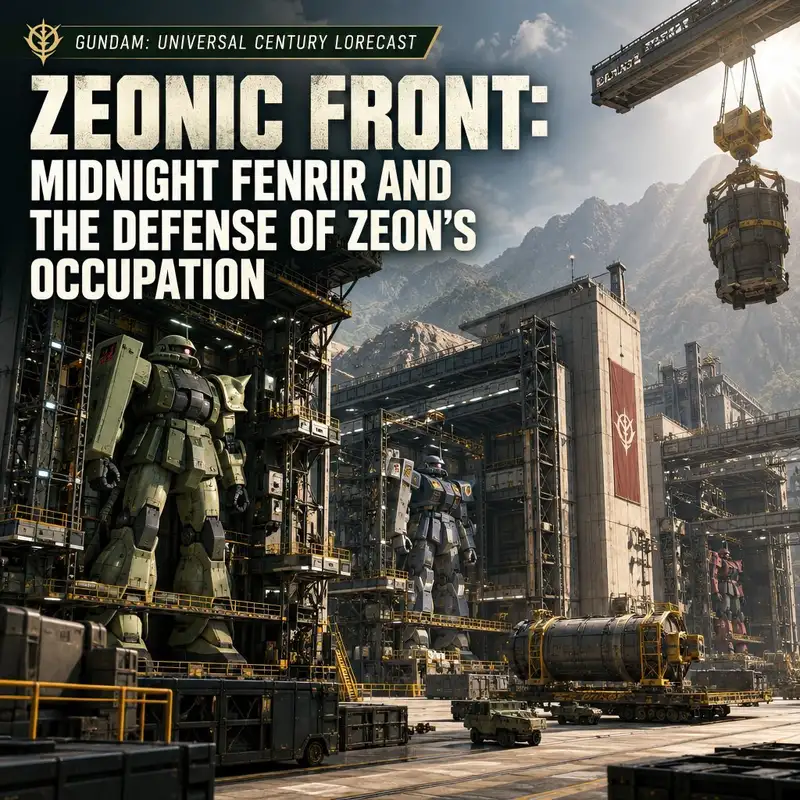
Zeonic Front: Midnight Fenrir and the Defense of Zeon’s Occupation [Game]
The high-altitude launch vehicle was not a weapon, and that was precisely why it mattered. By the time Midnight Fenrir stood guard over it, Zeon’s Earth campaign had reached its most revealing phase. The force that had descended from space to seize airfields, ports, bases, and transport routes was now defending the machinery required to leave. Every launch carried more than personnel. It carried trained mechanics, pilots, technical records, communications specialists, equipment that could not be replaced on a collapsing front, and the possibility that some part of the Earth occupation force might continue the war elsewhere.
The immediate threat was Federation pressure, including Lieutenant Agar and the completed Gundam Mudrock. But the larger meaning of the battle lay in the launch vehicle itself. Midnight Fenrir was no longer scouting ahead of an advance or breaking a local defensive line. It was covering an evacuation route. That is one of the clearest signs of strategic reversal in any campaign. A rear guard may fight with exceptional skill. It may delay the enemy, preserve a formation, and save lives. But it is fighting to manage a defeat already decided at a larger scale.
That final duty gives Midnight Fenrir’s campaign its proper shape. The corps began as a specialized Zeon mobile-suit formation during the expansion of the invasion of Earth. It conducted attacks, reconnaissance, night operations, base defense, and local counterattacks. Across the campaign, its role changed with Zeon’s fortunes. First, it helped create the military conditions for occupation. Then it helped protect the infrastructure that occupation required. Finally, it defended the routes, supply troops, and launch assets needed to withdraw from a planet Zeon could no longer hold.
Rapid conquest creates a hungry map. The more territory an army captures, the more fuel, ammunition, spare parts, food, medical support, transport, repair capacity, and communications it must protect. It also creates more routes along which an enemy can regroup, infiltrate, or simply wait for the occupier’s thinly spread forces to move elsewhere. Zeon’s mobile suits gave it a powerful instrument for the initial seizure of territory. They did not eliminate the requirement for conventional ground forces, transport networks, engineers, naval support, and a political structure capable of controlling what had been taken.
Midnight Fenrir was created for the narrow but important space between a conventional line unit and an independent strategic command. Garret Schmitzer, a veteran mobile-suit pilot whose combat injuries had pushed him into a command role, organized the corps as a specialized formation. Kycilia Zabi’s authorization mattered. It gave the unit access, status, and a place inside Zeon’s military system. But sponsorship from a powerful figure was not the same as strategic independence. Midnight Fenrir still served Zeon’s larger campaign, with all the opportunities and limitations that campaign imposed.
Schmitzer’s importance was not simply that he had fought before. Many soldiers had combat experience by this point in the war. His significance lay in the way the game presents him converting experience into an operational method. He understood that a small mobile-suit formation could not afford to fight every enemy it encountered. It had to choose engagements, gather information, exploit terrain, identify weak points, and preserve itself for missions that justified the risk. This was not romantic restraint. It was the discipline of a force too valuable, and too limited in number, to waste on spectacle.
The corps itself was more than a collection of named pilots. Lou Roher, the deputy commander and principal field leader, represented the need for reliable tactical control when the commander could not personally direct every contact. Matt Austin, associated with an older Zaku I, brought the value of experience into a force operating alongside newer and more specialized machines. Nikki Roberto and Charlotte Hepner represented younger personnel learning under the pressure of an elite unit’s expectations. Other pilots, operators, technical staff, and maintenance personnel made the formation viable in the first place.
That mixture created strength, but it also created strain. Elite formations often depend on veterans who can make quick decisions under uncertain conditions. They also depend on junior personnel who must learn rapidly without being treated as expendable. A special unit may have better equipment or more freedom of action than a line formation, but neither advantage repairs a damaged machine, replaces an exhausted pilot, or resolves internal friction by itself. Professional competence is an institutional achievement. It is built from command discipline, technical supervision, communications, maintenance, training, and the ability to make disagreements subordinate to the mission.
The game gives these relationships dramatic form, including tensions among members of the corps. The larger military point is more useful than any individual quarrel. A mobile-suit team operating under Minovsky interference could not depend on a distant headquarters to solve every problem. It required subordinates who understood intent, trusted one another enough to coordinate under pressure, and knew when to disengage. That was especially important for a force expected to perform reconnaissance and local defense as well as offensive strikes.
The original game’s multi-squad structure expresses this doctrine clearly. The player could control one group while issuing instructions to others, setting up overlapping tasks rather than directing one machine through a series of isolated duels. That should not be mistaken for a literal transcript of every historical maneuver. It is a gameplay abstraction. But it is an abstraction built around a serious operational idea. Midnight Fenrir’s effectiveness came from the ability to use several small mobile-suit groups for reconnaissance, overwatch, flanking attacks, deception, diversion, and simultaneous assaults on separate objectives.
For a small Zeon unit, this uncertainty could be an advantage. A formation that knew the ground, moved carefully, and avoided obvious approaches could locate defenses before those defenses fully understood the threat. It could use one group to observe, another to threaten a flank, and a third to strike a weak point or protect the withdrawal route. Against fixed positions, that was often more useful than charging directly into the strongest guns. Against mobile defenders, it created opportunities to isolate elements before the full defensive system could respond.
This was mobile-suit warfare as team combat rather than knightly combat. The machine mattered, but the machine was only one part of the system. A mobile suit needed reconnaissance to find the enemy, terrain to conceal its approach, ammunition and propellant to sustain a mission, mechanics to restore it afterward, and a command structure capable of turning local reports into coherent action. Midnight Fenrir’s campaign repeatedly demonstrates that the most dangerous mobile suit is not necessarily the one with the most impressive weapon. It may be the one that arrives first at the right place, with support nearby and a clear idea of what must be accomplished.
Midnight Fenrir’s early operations show Zeon attempting to seize the skeleton of military control. Federation air bases, fixed defenses, underground facilities, and defensive lines mattered because they supported the Federation’s ability to observe, move, and strike. An airfield was not merely a collection of targets. It was a place from which aircraft could reconnoiter, attack ground columns, move personnel, and connect a local defense to a larger operational network. A fixed gun position was not important because it was stationary. It was important because it could deny a route, protect a base, or force an attacker into a more predictable approach.
The corps’ missions against such objectives illustrate the value of selective violence. A force does not always need to destroy every enemy position. It may need only to suppress a gun long enough to open a route, bypass a strongpoint that cannot influence the main task, or identify a subterranean approach before committing its machines. In a campaign of rapid expansion, time is often the decisive resource. A delay at one airfield or one defensive belt can allow a threatened command to call in aircraft, armor, reinforcements, or evacuation assets.
Night operations reinforced this logic. Darkness was not a magical cloak, and mobile suits did not become invisible simply because the sun went down. But darkness complicated observation, identification, and command. It rewarded forces that could coordinate locally, make better use of sensors, and avoid broadcasting their intentions through careless movement. It also increased the danger of confusion. A unit that lost track of its own position, its supporting elements, or the civilian and military infrastructure around it could turn a carefully planned raid into a self-inflicted disaster.
The campaign’s underground submarine-facility operations broaden the picture further. Zeon’s war on Earth was never fought by mobile suits alone. Naval infrastructure, submarines, aircraft, tanks, supply vehicles, fixed defenses, and ground troops all remained relevant. A mobile suit’s ability to breach, maneuver, and deliver concentrated fire could make it useful against hardened or unusual objectives. But it still needed intelligence about the facility, routes into it, and the defenses that protected it. It also needed other arms of service to exploit any success. Seizing an installation is not the same as operating it.
Early victories of this kind helped Zeon disrupt Federation local resistance and create room for occupation forces to move. They did not produce durable control by themselves. Every captured facility had to be staffed, supplied, repaired, connected to a larger command network, and defended against counterattack. The more successful Zeon became in taking ground, the more of these obligations it accumulated. This was the occupation’s central contradiction. Zeon’s mobility gave it a way to seize valuable infrastructure quickly. It also made that infrastructure a series of fixed liabilities once the Federation began recovering its balance.
The Gobi Desert supply-base defense brings that contradiction into focus. A supply base is rarely glamorous, but armies do not operate on glamour. It is where ammunition, parts, food, medical supplies, communications equipment, and maintenance capacity are gathered and distributed. It is where damaged machines can be assessed, where vehicles can be refueled or replenished, and where commanders can convert transport into sustained combat power. If a base is lost, the effect extends beyond the perimeter. Units in the field begin to lose mobility, endurance, and confidence.
Midnight Fenrir’s role in defending Zeon logistics was therefore not a secondary duty. It was central to whether the occupation could function at all. The corps also supported vulnerable ground formations, including Magella Attack units. Those forces could provide armor, firepower, and local presence, but they were exposed to the same problems that affected all ground forces. They needed fuel, ammunition, maintenance, and protection from enemy aircraft, artillery, armor, and mobile suits. A mobile-suit team could react quickly to a breakthrough or an attack on a convoy. It could not substitute for the entire logistical network behind the convoy.
The reconnaissance mission involving the White Base, described as the Trojan Horse, reveals another side of Midnight Fenrir’s role. The assignment was not to destroy the ship at any cost. It was to gather information about a dangerous and unusual Federation threat while avoiding a direct engagement the unit could not afford. This is the kind of mission that distinguishes a special reconnaissance formation from a force sent merely to seek battle. Information was the objective. Survival was part of the objective, because intelligence carried home is more useful than intelligence acquired seconds before a unit is destroyed.
The White Base and its mobile suits represented a changing problem for Zeon. The Federation was not simply defending old positions with old methods. It was fielding new capabilities, experimenting with mobile-suit operations, and developing forces that could challenge Zeon’s initial advantage. Midnight Fenrir’s task was to identify the threat, assess its movement, and report what it could. A small unit could observe a growing danger. It could not, through courage alone, erase the industrial and organizational system producing that danger.
The discipline required for reconnaissance is easy to underestimate. A pilot sees a high-value target and naturally wants to act. An aggressive commander may believe that a sudden attack can turn observation into a decisive victory. But a reconnaissance force that attacks without understanding the enemy’s strength risks losing both its intelligence and its future usefulness. The White Base mission therefore expresses a mature military principle. Not every contact should become a battle. Sometimes the most valuable result is to confirm what the enemy has, where it is going, and what it may mean for the next phase of the campaign.
Reconnaissance, however, does not solve the problem it identifies. Midnight Fenrir could report a threat. Zeon still needed the industrial resources, command coherence, logistics, and operational freedom to counter it. As the war progressed, that became increasingly difficult. The Federation’s recovering strength was not experienced everywhere at once or in identical form. The game does not support a claim that every Federation formation had suddenly achieved equal capability. What it does show is a growing ability to bring mobile suits, armor, aircraft, bases, and large ground formations into a more coherent defense and counteroffensive.
Odessa marked the point at which this larger shift became impossible to ignore. The region mattered because it was not merely a battlefield. It was part of the wider contest over Zeon’s position on Earth, its supply, and its ability to maintain major forces outside its original areas of strength. By the time Midnight Fenrir operated in the Odessa campaign, the unit’s tasks increasingly involved counterattacks, local defense, and protection of forces under pressure. The initiative that had characterized the early invasion was becoming harder to retain.
A special unit could still matter enormously in such a campaign. It could probe a flank, delay an advance, protect a command post, guide a local counterattack, escort a vulnerable formation, or cover a withdrawal. These are not minor contributions. A few hours gained at a critical point can save a battalion, preserve equipment, or prevent a retreat from becoming a rout. But the same facts define the unit’s limits. It could not replace the formations already lost. It could not generate fuel and ammunition from nothing. It could not rebuild a broken command system through tactical skill.
The original game shows Midnight Fenrir operating within this worsening situation. It does not require the more elaborate account found in the separate novelization, which expands the Odessa collapse in different ways. The game’s own record is enough. Local missions become increasingly defensive because the wider position is increasingly unstable. This is the moment when tactical excellence begins serving a different purpose. At the beginning of a campaign, it opens opportunities. During a retreat, it reduces damage and preserves what remains.
The Federation’s advantage in this phase was not simply numerical. Numbers matter, but they matter through institutions. The Federation had been surprised by Zeon’s initial mobile-suit operations and suffered terrible losses early in the war. Yet it retained a vast base of population, territory, industry, and infrastructure. Once it adapted, developed mobile suits of its own, organized larger combined-arms responses, and began reclaiming operational initiative, Zeon faced a problem that elite formations could delay but not solve. Zeon’s early edge had been sharp. The Federation’s recovery was broad.
Jaburo made that contrast unavoidable. The Federation’s South American headquarters was not merely a difficult fortress or an impressive map of tunnels and defenses. It was an institutional center of gravity. It represented command authority, military planning, industrial coordination, personnel systems, communications, and the ability to direct a war across multiple theaters. An assault against Jaburo therefore had significance far beyond the destruction of individual defenses. If Zeon could seize or neutralize it, the Federation’s ability to organize resistance might be deeply damaged. If it could not, the Federation would retain the core structures needed to continue fighting.
Midnight Fenrir joined the Zeon assault into that defended environment. The operation required penetration through prepared defenses and combat against Federation forces that included Pegasus-class opposition and a Gundam-type machine. The unit’s participation demonstrated the same qualities visible throughout its campaign: movement under pressure, adaptation to complex terrain, and the ability to contribute to an assault where conventional lines of sight and communications were constrained. On the battlefield, these were demanding missions, and Midnight Fenrir’s presence was not meaningless.
But Jaburo was a strategic failure for Zeon because tactical penetration did not become institutional destruction. A force can enter a headquarters complex without capturing the command system it represents. It can damage installations without ending production. It can fight a powerful ship or mobile suit without permanently removing the enemy’s ability to build and deploy more. The Federation’s war-making capacity survived. That survival mattered more than the outcome of any one corridor, hangar, or mobile-suit engagement.
For Midnight Fenrir, the consequences were immediate. The corps could continue fighting effectively, but its missions were increasingly shaped by the need to protect Zeon’s shrinking network of terrestrial bases. It had become harder to speak of expanding occupation. The issue was now how long particular nodes could be held, what equipment and personnel could be evacuated, and which forces would be left exposed when a base became untenable. The war on Earth was becoming a contest over withdrawal routes as much as over advances.
California Base was one of the most important of those nodes in the game’s campaign. Zeon had captured it and used it as a major terrestrial military and logistical position. Its value came not from a precise count of facilities or a speculative map of every dock and runway. The game establishes enough. A former Federation naval and aerospace base offered repair capacity, stockpiles, staging areas, transport access, and a connection to the routes by which troops and equipment might be moved within Earth’s atmosphere or sent back toward space.
That value also made the base difficult to keep. Captured infrastructure is an asset, but it is also a fixed target. It requires a garrison. It requires maintenance. It draws supplies toward itself. It becomes a place the enemy can identify, isolate, and attack. A mobile force may choose when to move. A base cannot. Once Zeon relied on California Base as a logistical hub, it had to commit forces to its defense even as the wider situation made those forces increasingly scarce.
Midnight Fenrir’s changing mission profile at California Base captures the shrinking geography of Zeon power. Earlier in the campaign, the corps had been used to take ground, scout threats, and disrupt Federation defenses. Now it was helping defend a point on a map that had become essential because Zeon’s remaining options were narrowing. This was not a failure of the corps. It was a consequence of the strategic situation. As an army loses freedom of action, its best units are often drawn into guarding the routes and installations needed to preserve the rest of the force.
The final high-altitude launch vehicle defense takes that process to its logical end. The launch vehicle was a bottleneck. It represented limited lift capacity, limited time, and limited opportunity. The Federation did not need to destroy every Zeon unit on Earth to make the withdrawal disastrous. It could threaten the means by which Zeon’s trained personnel and valuable equipment escaped the gravity well. For Zeon, protecting the HLV meant preserving a fragment of military capability that might still matter in the space war.
Agar’s appearance in the Gundam Mudrock gave the immediate tactical problem a human face. Throughout the game, Agar functions as a recurring Federation counterpart to Schmitzer and Midnight Fenrir. His machines and persistence demonstrate that the Federation was no longer merely reacting to Zeon’s mobile-suit advantage. But it would be a mistake to turn him into the single explanation for the Federation recovery. He was one officer inside a much larger war effort. The true threat came from the system behind him: a Federation increasingly able to field capable personnel, mobile suits, defenses, and sustained operations.
The Mudrock was dangerous because of what it represented in that moment, not because the campaign needs to become a contest of specifications. A completed Gundam-type machine, in the hands of a determined Federation officer, placed heavy pressure on a rear guard already operating under the burden of evacuation. Midnight Fenrir had to think beyond destruction of the enemy. It had to buy time. It had to preserve the launch asset. It had to prevent the enemy from turning tactical pressure into the loss of a vital escape route.
That is the logic of rear-guard war. The rear guard is not judged only by territory held or enemies destroyed. Its value lies in delay, cohesion, and preservation. It may have to accept risks that would be foolish in an offensive operation because the larger force depends on time. It may fight while knowing that its own withdrawal is uncertain. Its task is not glorious, despite the way military memory often treats last stands. Its task is brutally practical. Keep the route open. Move the wounded. Launch the personnel. Save the equipment that can still be saved. Prevent panic from turning defeat into annihilation.
The final response to the distress call from the Number Eleven Supply Corps brings the campaign’s argument into its sharpest form. Supply troops are not usually the figures preserved in heroic war narratives. They carry equipment, maintain routes, manage stores, move damaged materiel, and keep units alive long after the initial assault has passed. When such a formation is threatened during a collapse, its loss can be more serious than the destruction of another isolated combat vehicle. The disappearance of supply personnel and resources can leave surviving combat units unable to move, repair, communicate, or evacuate.
Midnight Fenrir’s final defense was therefore not simply another battle. It was the culmination of the unit’s changing role. The corps had begun by helping Zeon disrupt the Federation’s defensive system. It had then protected Zeon’s own logistical skeleton. At the end, it was defending stranded or retreating personnel and the fragile cohesion of forces that no longer possessed a secure territorial position. The object was not to restore the occupation. That possibility had passed. The object was to save what could still be saved from its collapse.
There is an important moral distinction here. Tactical skill does not legitimize the invasion Zeon had undertaken. A formation can be disciplined, brave, and professionally capable while serving an aggressive war and an occupation it did not create. At the same time, acknowledging the nature of Zeon’s war does not require pretending that every Zeon soldier was incompetent, disposable, or indifferent to the people beside them. Midnight Fenrir’s record is compelling precisely because it shows soldiers trying to preserve their unit and their comrades inside a campaign whose larger objectives had become unattainable.
It also reveals the practical limits of elite military solutions. Zeon could create a highly capable special mobile-suit corps. It could give that corps experienced leadership, talented pilots, specialized missions, and the freedom to use concealment and local initiative. It could use the corps to seize facilities, scout enemy movements, defend supply points, and delay stronger forces. What it could not do was create a sustainable occupation through special operations alone.
No elite unit can guard every route across a continent. No mobile-suit team can replace an industrial base. No successful reconnaissance mission can reverse an enemy’s growing ability to train personnel, manufacture weapons, organize combined arms, and coordinate counteroffensives. No defense of a base can guarantee that the wider network supporting the base will survive. And no rear guard, however effective, can transform a strategic withdrawal into a territorial victory.
Midnight Fenrir’s campaign shows that Zeon understood something important about the tactical use of mobile suits. Small, coordinated teams could exploit uncertainty, terrain, surprise, and weak intelligence. They could operate as scouts, raiders, defenders, and local counterattack forces. They could make a limited number of machines carry an influence greater than their size might suggest. In the early stages of the Earth campaign, that capability helped Zeon seize opportunities the Federation was not yet prepared to deny.
But the same campaign records the boundary of that capability. Zeon could build elite formations faster than it could secure every supply route, replace every loss, hold every captured facility, defeat the Federation’s institutional core, or convert military occupation into durable political control. By the time Midnight Fenrir defended launch vehicles and supply troops, its skill had not disappeared. It still saved time, equipment, and people. It simply could not make a collapsing occupation into a victory.