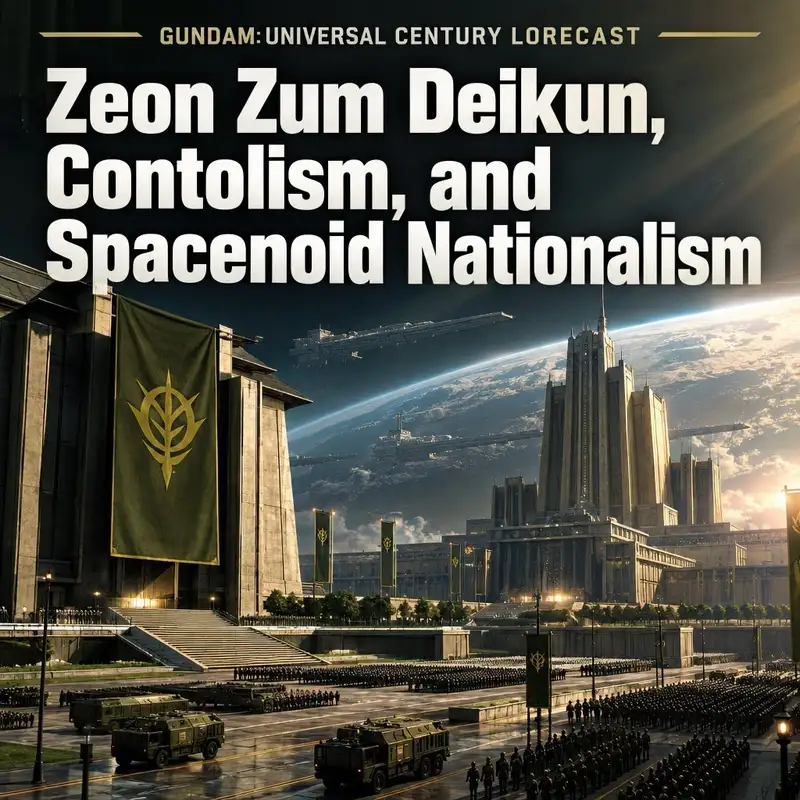
Zeon Zum Deikun, Contolism, and Spacenoid Nationalism
In Universal Century fifty-eight, Side Three declared that it would no longer accept its future being decided from Earth. The new Republic of Zeon was not simply a change of flag or a local administrative dispute. It was a claim that people living in space had become a political community in their own right, with interests, responsibilities, and a future that could not be treated as an extension of Earth. At the center of that claim stood Zeon Zum Deikun, the philosopher and political leader whose name would outlive him.
That name would later be carried by a principality, a war machine, and movements that spoke in the language of liberation while preparing for domination. By Universal Century seventy-nine, the state calling itself Zeon would begin a war marked by mass killing, occupation, and the destruction of colonies that it claimed to defend. The contradiction is difficult to miss. How did a demand for colonial self-government become part of the ideological foundation for authoritarian state power?
The answer is not that Deikun was secretly responsible for every crime committed in his name. Nor is it that his thought was politically harmless until later villains corrupted it. Deikun gave real colonial grievances a language of autonomy, ecological responsibility, and human transformation. But that language also contained an unstable question. If humanity in space was becoming something new, what place remained for the people and institutions of Earth? The answer to that question could support equality. It could also support hierarchy.
The decision in Universal Century fifty-one to freeze new colony construction sharpened colonial suspicion of Earth-centered authority. Whatever administrative, economic, or environmental reasons lay behind the policy, the practical lesson for many people in space was clear. Their future remained subject to Earth’s permission. The Federation could regulate expansion, constrain settlement, and define the limits of colonial development. A population that had built communities in space could be told that the political and physical growth of those communities had reached a limit.
This did not mean every colonist wanted independence. Spacenoids were not a single people with one ideology, one class interest, or one political program. Some benefited from the Federation system. Some feared separation. Some wanted reform inside the existing order. Others had little interest in high politics and were concerned with employment, housing, education, food, and the maintenance schedules that kept their homes habitable. But the gap between demographic reality and political representation created an opening for a new kind of movement.
Zeon Zum Deikun’s importance lay in his ability to interpret that gap. He did not merely say that the Federation was inefficient or unfair. He argued that Earth-centered rule had become historically obsolete. The colonies, in his view, were not dependent extensions of humanity’s old home. They were the setting in which humanity could become something different, and perhaps something better. That argument gave political meaning to the ordinary frustrations of colonial life.
Official Universal Century background material dates Deikun’s proposal of Contolism to Universal Century forty-six. The term is firmly associated with him, but the surviving record does not give us one complete and uncontested Contolist manifesto. It would be a mistake to treat the doctrine as a tidy list of articles, fully defined in a single speech and preserved without disagreement. What survives is better understood as a political framework. It linked the autonomy of space settlements, the preservation of Earth, and the possibility that life in space would change human consciousness.
At one level, Contolism was a critique of Earth-centered civilization. Earth had become the privileged center of authority, wealth, memory, and residence. At the same time, it was environmentally strained and politically burdened by the weight of an enormous civilization. Deikun’s thought proposed that humanity should stop treating Earth as an object to be endlessly consumed, settled, exploited, and fought over. Earth should be preserved. Space, rather than Earth, should become the main arena of human expansion.
This was not simply an environmental argument in the modern technical sense. It was also moral and spiritual. Earth was humanity’s place of origin, but that did not mean humanity had the right to dominate it forever. In the broad reconstruction of Deikun’s thought, removing population and political pressure from Earth was a way of preserving it. The colonies would not be temporary overflow districts. They would become the primary sites of human development.
A related idea emphasized the political role of the Sides. If people in space were expected to build, maintain, defend, and inhabit these immense artificial worlds, then they required meaningful control over their own affairs. This was the autonomy side of Deikun’s program. The language of colonial self-government had obvious appeal. It spoke to people who believed that the Federation collected authority from the colonies while denying them an equal voice in the system they helped sustain.
Taken together, these ideas created a powerful vision. Earth would be protected rather than endlessly burdened. Space settlements would govern themselves. Humanity would mature by leaving behind the political habits of an Earth-bound past. It is not difficult to see why this appealed to colonists who felt that they were asked to carry the burdens of a larger civilization while being denied the authority of full political membership.
But Contolism also carried a tension that could not be ignored. To say that Earth should be preserved is not the same as saying that Earth’s inhabitants should lose political rights. To say that colonies deserve autonomy is not the same as saying that one colony or one movement should rule all others. And to say that life in space might transform humanity is not the same as saying that people born in space were entitled to govern those who remained on Earth.
Those distinctions would become central to the history of Zeon. Deikun’s political language could be read as a demand for decentralization, autonomy, and a less destructive relationship with Earth. It could also be read as a declaration that Earthnoids belonged to an exhausted past while Spacenoids represented the future. The first reading challenged colonial subordination. The second created the intellectual possibility of a new hierarchy, one that could justify domination in the name of progress.
The most distinctive element of Deikun’s philosophy was his early concept of the Newtype. Later generations would associate Newtypes with military laboratories, psycommu systems, remote weapons, experimental machines, and young pilots forced to carry burdens that institutions could not solve. That is not where the idea began. In Deikun’s thought, the Newtype was not first a military asset. It was a political and human possibility.
He proposed that people living in space might develop expanded perception and a greater capacity for mutual understanding. The colonies, with their distance from Earth and their shared dependence on complex environments, could encourage a new form of consciousness. This was not presented as a simple increase in reflexes or an inventory of supernatural powers. The essential idea was that humanity might become more capable of understanding one another across the divisions that had produced violence on Earth.
The political implication was profound. If space was producing a new human consciousness, then institutions built around Earth’s old assumptions might no longer be adequate. An Earth-centered state could be not merely unjust but historically behind the people it governed. Deikun’s Newtype concept therefore reinforced his argument for Spacenoid autonomy. The future, in this view, was already being born in the colonies.
There was hope in that idea. It suggested that human beings were not permanently trapped by the political failures of their past. It offered a language of development rather than decline. But there was danger as well. Any claim that one population is more evolved, more perceptive, or more historically advanced than another can become an argument for unequal rights. The path from “space may change humanity” to “Spacenoids should rule Earthnoids” is not inevitable, but it is short enough that political leaders can cross it quickly.
Newtype potential, even in later eras where unusual abilities are visibly observed, never proves moral superiority. Greater sensitivity does not guarantee wisdom. The ability to perceive another person does not guarantee agreement with them. Nor does it make the institutions around that person less violent. The Universal Century would repeatedly demonstrate that people capable of extraordinary perception could still be divided by fear, ideology, trauma, ambition, and command structures designed to turn human potential into a weapon.
Deikun’s Newtype theory must therefore be separated from the institutions that later claimed to inherit it. The Flanagan Institute, Cyber Newtype programs, psycommu research, and psycho-frame projects belonged to later military and political efforts to measure, reproduce, control, or exploit exceptional human capacity. Those programs were not the same thing as Deikun’s original philosophical claim. A political theory about mutual understanding became, in other hands, a rationale for laboratories, classification systems, and human experimentation.
Still, philosophy matters when it enters politics. Deikun did not remain an isolated thinker. He became the leader of a movement in Side Three, then the founder of a republic. His immediate political objective was concrete. Side Three needed autonomy and, ultimately, independence from the Earth Federation. The future of the colonies could not depend on a central government that treated their people as subordinate residents of an Earth-led order.
That goal gathered support from people with different motives. Some were attracted by the principle of self-government. Some resented economic dependency. Some feared that the Federation would tighten control over the colonies. Some saw in Deikun’s thought a chance to protect Earth from continued exploitation. Some were drawn by local pride. Some believed that the future truly belonged to humanity in space. A nationalist movement is rarely built from one belief alone. It survives by giving different groups a common political language.
That common language also concealed disagreements. A dockworker worried about employment, a local official seeking greater power, an engineer concerned about colonial expansion, and an ideologue convinced of Spacenoid destiny could all support a movement for autonomy without meaning the same thing by it. This is one reason that broad liberation movements can become unstable once they approach power. The slogans that unite a population against an outside authority do not automatically answer the question of how that population will govern itself.
Not every Spacenoid was a supporter of Side Three. Not every person who favored colonial reform accepted Deikun’s larger philosophy. And not every resident of Side Three shared the same understanding of independence. The later tendency to treat “Spacenoid” and “Zeon supporter” as interchangeable is a distortion created by war and propaganda. The Earth Sphere contained many colonies, many local interests, and many political cultures. Side Three spoke loudly, but it did not speak for everyone in space.
A later retelling, Mobile Suit Gundam: The Origin, makes the internal politics of Deikun’s movement far more explicit. In that branch, the Zeon Party contains rival factions, and Deikun is portrayed as a more forceful, more compromised political actor than the distant martyr of the principal animated background. The Zabis build their own position within the movement, while Jimba Ral and others resist their growing influence. That is valuable as a comparison, but it should not be silently treated as a complete record of the principal animated history.
Side Three declared independence in Universal Century fifty-eight. In the principal reference tradition, this created the Republic of Zeon. The declaration was a direct challenge to Federation authority. It asserted that a colony Side could become a sovereign political community rather than an administered territory. For people who believed that the Federation had failed to recognize the political maturity of humanity in space, it was an act of self-determination.
The Federation’s response came quickly. In Universal Century fifty-nine, it imposed economic sanctions on the new republic. Sanctions are often described in diplomatic history as if they were a technical measure somewhere between a speech and a blockade. In practice, they are coercive statecraft. They affect trade, planning, confidence, access to resources, and the belief that political disputes can be resolved through ordinary constitutional means. For a colony society dependent on wider networks, economic pressure was not a minor inconvenience.
Federation leaders may have believed that sanctions could compel compliance without open conflict. They may have seen them as a way to preserve the integrity of the Earth Sphere, deter further secession, or avoid setting a precedent that could fragment interplanetary government. But political actions are judged not only by what leaders intend. They are judged by how people under pressure experience them. In Side Three, sanctions could appear to confirm the nationalist claim that Earth would accept colonial participation only so long as Earth retained final control.
That perception strengthened harder political arguments. If the Federation responded to independence with economic coercion, then reform could seem futile. If a colony’s economy could be constrained from Earth, then autonomy without sovereignty might look like a polite fiction. The danger in such moments is that a government attempting to preserve order can make the language of separation more persuasive. Coercion may weaken a movement. It may also give that movement the evidence it needs to recruit.
The rejection of a colony-autonomy bill in Universal Century sixty-seven reinforced the same lesson. The failure of reform did not prove that all compromise was impossible. Historical actors rarely possess that kind of certainty. But it damaged confidence in the possibility of compromise. When constitutional avenues repeatedly fail, leaders who promise a sharper break gain credibility. A movement that once contained reformers, moderates, nationalists, environmentalists, and opportunists can begin to favor those who insist that only decisive confrontation will work.
Here, the distinction between grievance and political program becomes essential. The Federation’s failures were real. Colonial inequality, central control, economic dependency, military oversight, and the refusal to expand autonomy gave Deikun’s message its power. But a government’s failure does not guarantee that its opponents will build a better order. Nationalist movements can diagnose injustice accurately and still create new forms of domination once they acquire state power.
Spacenoid nationalism is useful as an analytical description, but it should not be treated as a complete synonym for Deikun’s thought. It describes the effort to define people living in space as a distinct political community with collective interests and a right to self-government. In that sense, it was a response to colonial subordination. It insisted that residents of the Sides were not merely displaced Earth citizens waiting for instructions from the planet below.
That first proposition, that colonists deserve self-government, is neither inherently extreme nor inherently violent. It is a serious political claim, especially in a civilization where most of the population has moved into space while authority remains concentrated on Earth. The fact that later regimes abused this claim does not make the underlying problem disappear. A political order that cannot explain why millions of people should accept permanent rule from afar is already in difficulty.
The second proposition was that humanity might change through life in space. This was Deikun’s Newtype vision. It was philosophical, speculative, and hopeful. It suggested that distance from Earth, exposure to a new environment, and the experience of building societies beyond the planet could alter human consciousness. It did not need to be scientifically proven in every detail to function politically. It offered colonists a way to understand their lives as part of a larger historical transformation.
The third proposition was the dangerous one. If Spacenoids were becoming a new humanity, perhaps they deserved authority over those who remained on Earth. At that point, the argument ceased to be only about autonomy. It became a claim of superiority. The demand was no longer that Earth recognize the political equality of space. It was that Earth accept political subordination to those deemed more advanced. That is the point where anti-colonial language can become supremacist nationalism.
The Origin makes this problem more explicit than the principal animated background. Its account places stronger emphasis on the idea of Spacenoid superiority and on the political manipulation surrounding it. That emphasis belongs to that retelling. The principal record preserves a less detailed image of Deikun, focused more heavily on independence, Newtype development, and the preservation of Earth. But even in the broader reference tradition, the tension remains. A philosophy that divides humanity into the advanced and the stagnant can be transformed into a theory of rightful domination.
This does not mean that every use of Spacenoid identity was supremacist. Political identities are contested. They are shaped by workers, students, officials, veterans, refugees, intellectuals, business interests, and families trying to survive in difficult conditions. The question is always who gets to define the nation, who is included in it, and what is demanded in its name. Deikun’s legacy became dangerous precisely because it could serve both the demand for equal political standing and the claim that equality was no longer enough.
The movement entered a decisive crisis in Universal Century sixty-eight, when Zeon Zum Deikun died suddenly during the continuing struggle over Side Three’s future. His death removed the person most closely associated with the republic’s founding vision. It also created an immediate problem of succession. In politics, a leader’s death is never just personal. It changes access to institutions, party machinery, public symbols, and the story a movement tells about itself.
The principal animated historical tradition does not securely settle every question surrounding Deikun’s death. The accusation that the Zabi family murdered him became politically central, but it should not be presented as established fact simply because later figures believed it. Jimba Ral, Deikun’s associate and supporter, preserved and promoted that accusation. For him, Deikun’s death was not merely a tragedy. It was evidence that the movement had been betrayed from within.
That belief had consequences regardless of whether every detail could be proven. It transformed Deikun from a political leader into a martyr. A martyr does not need to leave behind a complete program. In some ways, ambiguity makes martyrdom more useful. Different factions can claim to be the true heirs. They can turn uncertainty into accusation, accusation into legitimacy, and legitimacy into a weapon against rivals. The dead founder cannot correct anyone who invokes his name.
Deikun’s children, Casval and Artesia, became important in this political struggle because they represented continuity with the founder. Their identities connected them to a claim that could not easily be erased. The question was not simply whether they held office or possessed military power. Their existence reminded supporters and opponents alike that the Zabi-controlled state did not own the meaning of Zeon without challenge. Later lives, later aliases, and later conflicts would deepen that symbolism, but they should not be mistaken for a simple continuation of Deikun’s own intentions.
The Origin gives Deikun’s death and the surrounding factional maneuvering a more concrete dramatic form. It depicts political rivalry, suspicion, and the use of crisis by competing actors in much greater detail. That is one of the strengths of the retelling, but it is still a particular branch. In the principal animated background, the important point is not a solved murder mystery. It is that Deikun’s death opened the way for the Zabis to consolidate control while leaving behind a grievance that could never be fully resolved.
Degwin Sodo Zabi emerged as the central political figure in Side Three after Deikun’s death. By Universal Century sixty-nine, the republic had become the Principality of Zeon. The change in name signaled more than constitutional decoration. A republic, whatever its shortcomings, suggests a political community organized around public institutions and citizenship. A principality centers authority in a ruling house. The shift marked the conversion of a movement associated with self-government into a state increasingly organized around dynasty, command, and obedience.
The Zabis did not build their power from nothing. They inherited a population with legitimate grievances, a powerful symbolic vocabulary, and a political identity already shaped by conflict with the Federation. Their achievement, if that is the word for it, was institutional. They turned a contested movement into a state apparatus. They made “Zeon” less a question about colonial autonomy and more an official identity administered from above.
Gihren Zabi was particularly important in this transformation, not because one man alone created a militarized society, but because political organization and propaganda mattered. Nationalism becomes militarily useful when it gives a population a common identity, identifies an external enemy, presents sacrifice as civic duty, and describes dissent as betrayal. It can turn strategic preparation into national renewal and treat obedience as proof of loyalty. That process requires more than speeches. It requires institutions that can repeat, enforce, and normalize the message.
The Origin portrays this process with particular clarity. Its Zabi faction builds party machinery, uses media, expands security institutions, promotes military education, and prepares for war while speaking the language of independence. These details belong most fully to the Origin branch, but they illuminate a broader historical truth. Militarism is not created by ideology alone. It needs schools, factories, recruitment systems, intelligence organizations, officers, technicians, transport networks, weapons programs, and a political class willing to make the state’s needs more important than the freedom it claims to defend.
The Principality’s leaders turned insecurity into a resource. Federation sanctions and political resistance could be presented as proof that compromise was impossible. The memory of colonial subordination could be transformed into a permanent warning against internal dissent. Deikun’s ideas about human transformation could be simplified into claims about Spacenoid superiority. The preservation of Earth could become entangled with the ambition to control Earth. A movement that began by questioning centralized power could now build a more concentrated state of its own.
This was the decisive betrayal contained in the Zabi capture of the Zeon name. The word “Zeon” retained its associations with autonomy, space, and human possibility. But it became attached to a state that demanded loyalty through hierarchy. The ruling family could claim to carry forward Deikun’s legacy while removing the political openness that had made that legacy meaningful. In this sense, the Principality did not merely inherit his ideas. It selected the parts that served state power and discarded the parts that might limit it.
Militarization also changed the role of civilian society. Colonies were no longer only political communities seeking recognition. They became recruitment pools, industrial centers, strategic assets, propaganda symbols, and potential targets. Their population could be mobilized for labor, military service, technical education, and ideological discipline. The people whose right to self-government had justified the movement could find themselves governed in the name of that same right, with fewer opportunities to challenge the state claiming to represent them.
This transformation should not be reduced to a morality tale in which philosophy inevitably becomes tyranny. Ideas require institutions to become dangerous at scale. The Zabi state needed industrial capacity, disciplined armed forces, security control, and a political culture prepared to accept extraordinary sacrifice. It needed to convert a regional political grievance into a strategic program for the entire Earth Sphere. That was not the automatic consequence of Contolism. It was a series of choices made by rulers, officials, officers, propagandists, and supporters.
By Universal Century seventy-nine, those choices had produced a state capable of launching war against the Earth Federation. The One Year War would display Zeon’s military innovation, operational boldness, and early ability to exploit Federation unpreparedness. Mobile suits, Minovsky conditions, and aggressive campaigns changed the military balance in ways that no political philosopher could have fully predicted decades earlier. But technological surprise and tactical success did not answer the political question that had created the conflict.
The Principality’s war did not establish that Zeon had the right to rule the Earth Sphere. It did not prove that Spacenoids were inherently superior. It did not transform colonial grievance into moral legitimacy. Instead, the conduct of the war exposed the contradiction between liberation language and authoritarian practice. Colony gassing, mass killing, aggressive war, occupation, and the conversion of inhabited space into a battlefield belonged to later state actors and institutions. They should not be assigned casually to Deikun’s original program.
At the same time, Deikun remained relevant because the Principality fought under a name derived from him and used concepts associated with his legacy. The state could invoke the oppression of Spacenoids, the failures of the Federation, the destiny of humanity in space, and the need to break Earth’s dominance. Those themes gave its war a vocabulary that resonated with real experience. Propaganda is most powerful when it borrows from truths that people already know.
For that reason, it is inadequate to say that the Zabis simply distorted an otherwise innocent doctrine. They distorted it, certainly. But they also found within it language that could be made useful to a hierarchical state. The idea that humanity was dividing into advanced and stagnant populations could be sharpened into supremacy. The belief that Earth should be preserved could be converted into a claim that Earth must be ruled by someone else. The demand for colonial autonomy could become an excuse to deny autonomy to other colonies, Earth residents, and political opponents.
In later eras, different movements would invoke different parts of Deikun’s inheritance. Some emphasized independence from Earth. Some appealed to anger at Federation corruption and colonial exclusion. Some used Newtype destiny as political symbolism. Some invoked environmental responsibility. Some claimed legitimacy through family memory or the idea of restoring a lost national purpose. These later movements were not one continuous organization, and they should not all be treated as the same kind of force. What they shared was access to a powerful political resource.
“Zeon” became a language through which people could express genuine frustration with the Earth Sphere’s unequal order. It also became a language through which ambitious leaders could claim authority, demand sacrifice, and turn historical grievance into a justification for violence. That dual character is Deikun’s real legacy. His ideas could not be separated from the conditions that made them persuasive, but neither could they be separated from the hierarchy that later rulers found so useful.
Zeon Zum Deikun made a necessary political problem impossible to ignore. A civilization in which most people lived in space could not indefinitely be governed as an extension of Earth. Colonial autonomy was not an illegitimate demand. The Federation’s failure to address it gave Deikun’s movement strength, and its coercive response made harder forms of nationalism more credible.
But Deikun’s answer combined self-government with an unstable vision of human hierarchy. Federation pressure made that answer more persuasive. The Zabis then converted its symbols into the machinery of a dynastic war state. The tragedy was not that Spacenoids asked to govern themselves. It was that a movement capable of expressing that demand was captured by leaders who transformed liberation into command, and political aspiration into a claim to rule through force.