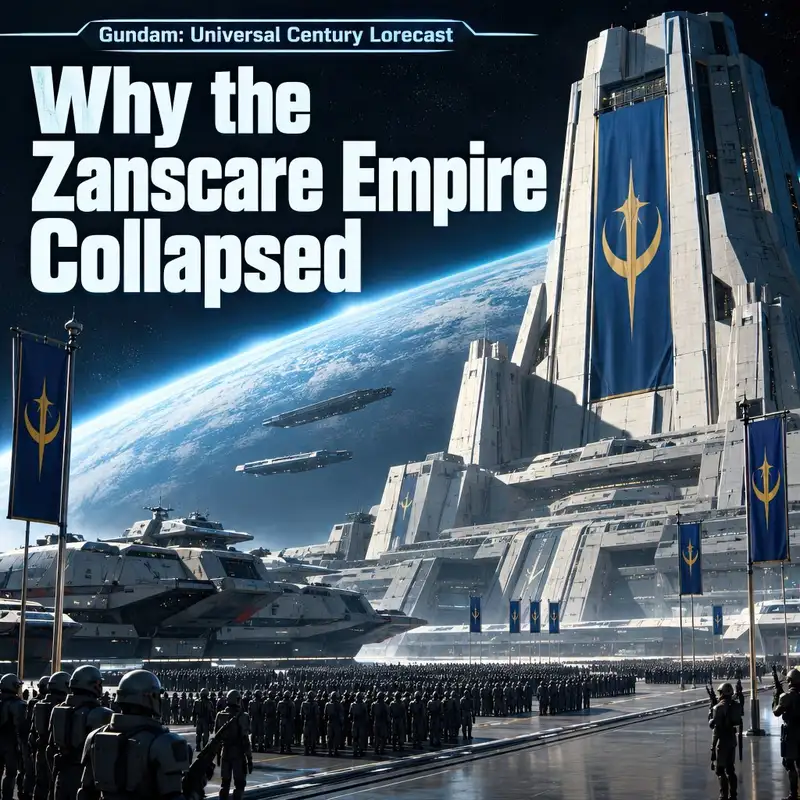
Why the Zanscare Empire Collapsed
Angel Halo was meant to end the war by reaching past armies and governments into the human mind. At the height of Zanscare’s final campaign, the empire possessed advanced mobile suits, a major fleet, occupied territory on Earth, and an immense Newtype-related installation whose effects could overwhelm ordinary military calculation. Yet the state attempting to use that instrument was already coming apart. Its chancellor could not trust his senior commanders. Its queen was no longer free to speak for the ideology built around her. Its fleet could not hold a secure perimeter. Its military was fighting a coalition that had grown larger and more capable than Zanscare had allowed itself to believe. Angel Halo’s eventual disintegration was therefore more than the destruction of a superweapon. It was the visible collapse of a political system that had mistaken fear for loyalty, technological reach for control, and obedience under pressure for a durable basis of rule. The question is not why Zanscare lost a final battle. Battles can be lost and forces rebuilt. The question is why an empire capable of invading Earth and building Angel Halo collapsed so quickly once that battle went against it. The answer lies in the way Zanscare had organized power from the beginning. It had built a state around a symbolic queen, a coercive ruling apparatus, a centralized military, and a promise that violence could produce peace. When all four failed at once, there was very little underneath them.
The public language of that state was Mariaism. Queen Maria Pure Armonia stood at its center as healer, monarch, and moral symbol. Her image gave Zanscare something that tanks, mobile suits, and execution platforms could not provide on their own. It gave the empire a claim to benevolence. Mariaism could promise compassion, social harmony, and an escape from the failures of the old Federation order. For citizens tired of distant bureaucracy and political decay, that promise had obvious appeal. A regime does not need to be wholly honest to attract support. It only needs to speak to conditions people recognize. But the Zanscare Empire that fought the war was not governed by Maria’s moral authority. Practical power rested with Fonse Kagatie, the Gachi Party, BESPA, and the institutions of intimidation that enforced imperial control. Maria was queen, but Kagatie exercised the authority of a ruler. The distinction was not ceremonial. It was the central weakness of the regime. Maria’s name and image were necessary because they made Zanscare’s power appear humane. Yet Maria herself was kept politically isolated and did not possess full knowledge of the war being conducted in her name. The empire required her innocence, because it could not survive the public recognition that its actual methods contradicted its declared ideals.
That contradiction mattered far beyond the palace. Zanscare used terror as an instrument of government. The guillotine was not merely a punishment device. It was political theater, intended to make imperial authority visible and unavoidable. Occupation forces could compel a population to submit in the immediate sense. They could seize food, control roads, arrest opponents, and make an example of those who resisted. But coercion does not automatically produce cooperation, useful intelligence, or confidence in the future. It often produces silence, concealment, and a careful public performance of loyalty. Civilians learn not to say what they think. Junior officials learn to report what superiors want to hear. Military officers learn that failure may be punished more severely than dishonesty. Under those conditions, a state can look strong right up to the moment it loses the ability to frighten people. Mariaism was supposed to provide a gentler foundation beneath the coercion. Instead, Maria’s political confinement revealed that the moral language of the empire had become an accessory to rule rather than a guide to it. Once Maria came to understand more of what Zanscare was doing, the regime faced an impossible problem. It could allow its own queen to speak honestly and undermine its war, or it could restrain her and demonstrate that Mariaism existed only so long as Maria remained useful to men who did not believe in it.
But advanced equipment does not eliminate the systems needed to sustain it. A specialized mobile suit requires trained pilots, technicians, spare parts, ammunition or energy support, secure staging areas, recovery capability, and command arrangements that can use it effectively. A large fleet requires escorts, maintenance, navigation, communications, intelligence, medical support, fuel or propellant, and replacement crews. The more sophisticated the system, the more vulnerable it may become to organizational disruption. Zanscare’s weapons were impressive because they represented a real concentration of industrial and military resources. Yet that concentration also meant that the loss of experienced crews, command ships, and protected supply routes could have effects well beyond a single engagement. The series does not provide a stable accounting of every factory, shipyard, or production line available to Zanscare, and it would be unwise to invent one. What the military record does show is enough. Zanscare could build and field formidable systems. It could not assume that every loss was easy to replace, especially while sustaining an invasion, defending its space approaches, and preparing Angel Halo for use. Its military power was substantial, but it was not limitless. And it was being asked to serve a political strategy far larger than its institutional foundation.
The gap between invasion and governance became decisive. Landing forces on Earth was difficult, but it was a bounded military task. A force needed transports, orbital access, landing operations, secured supply points, and enough combat power to defeat or bypass local defenders. Governing occupied territory was a different undertaking. It required administrators, interpreters, police, transport schedules, food distribution, repair crews, intelligence networks, political intermediaries, and some explanation for why ordinary people should accept the new order. It required enough troops to hold roads, depots, towns, and communications nodes without leaving every mobile suit tied down as a garrison asset. It required a way to distinguish resistance from civilian survival. Most of all, it required legitimacy strong enough that people would cooperate when no armed patrol was present. Zanscare possessed the means to occupy portions of Europe. It did not demonstrate that it had created a stable political settlement there.
This was strategic overreach in its most practical form. The empire expanded its military reach faster than it expanded the institutions needed to support that reach. Every additional area of occupation created a demand for transport, security, maintenance, intelligence, and political management. Every act of terror might suppress resistance in one place while making recruitment easier somewhere else. Every threat against civilians could secure short-term compliance while eroding the prospect of long-term acceptance. A state that governs through fear also creates a dangerous information environment. Reports tend to travel upward in distorted form. Officers may understate losses. Civil administrators may conceal unrest. Local collaborators may tell occupiers what they need to hear in order to survive. Senior leaders become isolated from the conditions their own policies create. Kagatie’s confidence in decisive coercion was therefore not simply a moral failure. It was an intelligence failure. He treated resistance as a problem to be crushed and political alienation as a weakness to be exploited. He did not adequately account for the way repression could preserve an enemy’s will to fight while hollowing out his own state’s capacity to understand the war.
The League Militaire survived because it represented a different kind of organization. It was not stronger than Zanscare in every direct comparison. It lacked the imperial state’s centralized command, its formal territory, and much of its heavy equipment. It relied on improvised networks, technical specialists, former Federation personnel, civilian support, scattered bases, and people willing to fight because they had few reasons to trust Zanscare’s promises. Its equipment, including the Victory Gundam family and later the Victory Two, gave the League important tactical capabilities. The modular design of its mobile suits mattered because it allowed flexibility in an organization that could not afford to treat every machine as disposable. But the League’s durability did not rest on one machine or one extraordinary pilot. Uso Ewin’s ability was important. So were the crews who maintained the ships, the adults who organized resistance, the civilians who carried information and supplies, and the personnel who kept a small force functioning under repeated pressure. Resistance organizations often survive not because they can defeat an occupier in open battle, but because they can absorb losses, relocate, share local knowledge, and make the occupier spend more resources than it expected.
Zanscare never fully eliminated that network. Instead, the war widened. The Earth Federation’s eventual participation transformed the strategic situation. This was not a simple story of a restored Federation arriving to solve everything. The Federation had contributed to the conditions that made Zanscare’s rise possible, and its earlier weakness was real. But states that appear politically stagnant can still mobilize when a threat becomes sufficiently clear. Once Federation forces joined the fight more directly, the League Militaire’s experience and initiative could combine with larger conventional resources. The League understood Zanscare’s methods, local conditions, and the operational value of its own specialized equipment. Federation forces brought scale, additional fleets, and the ability to turn scattered resistance into a broader anti-Zanscare campaign. This coalition was not automatically harmonious. Organizations with different histories, chains of command, and political purposes rarely become seamless partners. But they did not need perfect unity. They needed enough coordination to deny Zanscare the quick, decisive victory it required. The empire now faced a problem it was poorly suited to solve. It was no longer confronting a small resistance movement that could be isolated and terrorized. It was confronting a widening coalition that could impose conventional losses while the occupied population remained politically unreliable.
The late campaign exposed the difference between a force built for concentration and one capable of recovering from disruption. BESPA’s defensive line came under increasing pressure from Federation and League Militaire operations. Important commanders and combat units were lost. The series makes clear that the empire’s ability to shield its key assets was degrading, even if it does not provide a complete and trustworthy order of battle. That is the level at which the campaign should be understood. The critical issue was not a tally of destroyed machines. A mobile suit lost in isolation might be a tactical event. A loss that opened a route, weakened a screen, removed a commander, or forced a ship to withdraw could become an operational problem. Zanscare was trying to defend its final strategic project while under pressure from opponents who could attack at more than one scale. The Federation could bring mass. The League could bring specialized units, local knowledge, and a willingness to operate in spaces where a regular force might hesitate.
The Motorad fleet suffered particularly serious losses. Its destruction was not just the defeat of an unusual naval formation. The fleet represented Zanscare’s ability to concentrate force, move mobile suits and personnel, sustain offensive operations, and intimidate opponents through the apparent inevitability of imperial advance. Once that force was badly damaged, Zanscare lost much of its ability to maneuver and reinforce in the final phase of the war. A fleet is not merely a collection of guns and hulls. It is a mobile support system. It carries command staffs, communications equipment, maintenance spaces, recovery capacity, stores, medical facilities, and the means to launch and recover combat machines. When such a force is destroyed, the surviving mobile suits do not become independent strategic assets. They become harder to coordinate, harder to repair, and harder to employ beyond the immediate fight. Zanscare’s late-war concentration made those losses especially dangerous. A more redundant force might have shifted headquarters, drawn on regional reserves, or replaced one damaged formation with another. Zanscare’s political and military structure gave it fewer comfortable options.
The empire’s commanders also paid a price for the political culture in which they served. In a system where power flowed through Kagatie and where blame could be assigned downward, senior officers had reason to worry about their own position even before enemy action reached them. The loss of figures such as Lupe Cineau and Arbeo Pippiniden mattered not because any individual commander was irreplaceable in some mystical sense, but because experienced leaders carry operational knowledge, personal networks, and the confidence of subordinates. Their removal intensified the strain on a command structure already facing a coalition offensive. Zanscare had built an impressive military machine, but it had not built a culture in which leaders could easily report bad news, challenge reckless assumptions, or manage defeat without becoming targets themselves. The result was a force that could hit hard, but which became progressively more brittle as its margin for error disappeared.
That brittleness became unmistakable in Tassilo Vago’s rebellion. Tassilo was not an outsider, a democratic reformer, or the representative of a popular uprising against imperial repression. He was a senior figure within the Zanscare system, a man shaped by its hierarchy and ambitions. His break with Kagatie was a struggle over power inside the regime. It grew from distrust, from his treatment as a scapegoat, and from the recognition that a state organized around personal authority becomes dangerous for everyone beneath the ruler. Tassilo did not seek to dismantle the machinery of coercion. He sought to seize control of it. That distinction is important. A palace revolt can weaken a dictatorship without making the resulting alternative more humane. In Zanscare’s case, Tassilo’s move revealed that even its most senior leaders no longer trusted the system to protect them.
The timing could hardly have been worse for the empire. A final strategic operation requires unity of command. Forces need to know who sets priorities, who controls reserves, who receives intelligence, and who can issue orders that will still be obeyed when communications become difficult. Angel Halo demanded even more coordination than an ordinary fleet operation. It involved a complex installation, extraordinary human participants, a political purpose of immense scale, and a defensive posture that could not afford internal confusion. Yet at precisely that moment, Tassilo turned inward. He captured Queen Maria and used her as both political leverage and a physical shield. The act stripped away any remaining pretense that Maria was a sovereign directing the empire. She had become a hostage in the contest between men who claimed to defend her order.
This was an institutional failure before it was a personal betrayal. Zanscare lacked a trusted mechanism for succession, dispute resolution, or crisis management. Kagatie’s authority depended on being feared and obeyed. Maria’s legitimacy depended on being revered. Tassilo’s rebellion showed that neither source of authority could settle a confrontation among armed elites. There was no constitutional process that could decide who had the right to command. There was no professional military norm strong enough to keep BESPA outside a political struggle. There was no credible neutral institution that could restrain the contestants. Once the ruling circle fractured, force became the only language left. In a state built on coercion, that language comes easily. It is also ruinous. Every unit redirected toward internal conflict is a unit unavailable for defense. Every officer forced to choose sides becomes less focused on the enemy. Every contradictory order degrades the ability of a fleet to operate under pressure. Tassilo’s revolt did not create all of Zanscare’s weaknesses. It exposed them at the moment when they could no longer be hidden.
Angel Halo was the regime’s attempt to solve those weaknesses by bypassing politics altogether. The installation’s effects in the series reach into thought, consciousness, and bodily or mental functioning. It produces confusion, visions, disorientation, and an assault on the human capacity to act freely. But its exact mechanism is not presented as settled science, and it should not be reduced to the convenient phrase brainwashing. Angel Halo was a Newtype-related system, dependent on conditions and people that even its operators did not fully master. Its power was extraordinary, but extraordinary is not the same as controllable. Kagatie believed that the device could impose an answer upon a fractured Earth Sphere. In this sense, Angel Halo was a strategic weapon and a political confession. It confessed that Zanscare could no longer persuade. It confessed that occupation, Mariaism, and military victory had not created a stable order. If the empire needed to alter human thought in order to secure peace, then it had already admitted that it could not rule through consent.
That is the recurring temptation of authoritarian technological projects. A government confronted by resistance begins to imagine that a new weapon, a new surveillance system, a new scientific breakthrough, or a new punishment mechanism can compensate for every failure of legitimacy. Technology can change the battlefield. It can extend a state’s reach. It can frighten an enemy, disrupt command, or create a temporary advantage. But it cannot make leaders trust one another. It cannot make a population believe in a government whose actions they experience as predatory. It cannot erase the logistical requirements of defense. And it cannot guarantee that a system built around rare human capabilities will behave like an ordinary machine.
Shakti Kareen’s role makes that limitation especially clear. She was not simply a key inserted into a device, nor a mystical solution delivered from outside history. She was a young person drawn into a system much larger than herself, a system created by adults who wanted to weaponize human sensitivity and Newtype potential for political ends. Angel Halo’s dependence on particular individuals was a weakness as much as a source of power. The more the device depended on human consciousness, emotion, and connection, the less it could be treated as a stable instrument of command. Kagatie could issue orders. He could seize facilities. He could deploy fleets. But he could not reduce every human participant to a component. In the end, Angel Halo did not become the foundation of an empire. It became proof that an empire built on coercion had entrusted its survival to forces it neither understood nor deserved to control.
Queen Maria’s death destroyed the remaining political fiction on which Zanscare rested. In the final crisis, Maria reaches toward Uso through the phenomenon the series depicts. Whether understood as Newtype communication, extraordinary empathy, or something that cannot be fully classified, the moment matters because it reveals her separation from the men claiming to act in her name. Maria is not speaking as a ruler ordering violence. She is reaching across the battlefield as a human being caught inside a system that has taken her image and turned it into an instrument of war. Tassilo kills her when she no longer serves his purpose. It is a personal atrocity, but its political consequences are larger than the immediate crime.
Mariaism required Maria. It required her as a living moral presence, as a symbol of healing, and as the figure through whom Zanscare could claim that its authority was compassionate. After her death, Kagatie could not plausibly present himself as the guardian of Maria’s order. The regime had isolated her, exploited her name, and failed to protect her from its own internal power struggle. Tassilo’s act did not merely remove a hostage. It destroyed the symbol that made the empire’s ideology intelligible to many of its followers. The loss of a monarch does not always destroy a monarchy. States can survive the death of rulers if their institutions, succession systems, and political identity are strong enough. Zanscare had none of those protections in sufficient depth. Maria was not only queen. She was the bridge between the empire’s public ideals and its brutal reality. Once that bridge collapsed, the regime was left with Kagatie, BESPA, and force. By then, force was failing too.
The final destruction of the Motorad fleet completed the conventional military collapse of Zanscare’s offensive. The Reinforce Junior’s attack was a desperate act carried out at terrible cost, but its importance was not confined to the heroism of a single crew or ship. It removed a central component of Zanscare’s ability to fight as an organized strategic force. The loss of the fleet meant the loss of maneuvering platforms, mobile-suit support, command facilities, recovery capacity, and the ability to move or protect the personnel needed around Angel Halo. It also narrowed the options for evacuation and extraction. Political leaders cannot direct a collapsing war from a command platform that no longer exists. Mobile suits cannot maintain a defensive screen indefinitely without ships, supply, and coordination. The destruction of the Motorad force therefore transformed the battlefield around Angel Halo. Zanscare was no longer defending a controlled strategic asset. It was attempting to survive around an increasingly uncontrollable liability.
Kagatie’s death amid Angel Halo’s disintegration removed the practical center of the imperial system. That death was not the cause of every failure, but it ensured that no coherent authority remained to manage the failures already underway. The chancellor had made himself indispensable. He had concentrated practical power around his own direction while using Maria as ideological cover. Such arrangements can appear efficient during expansion, because decisions are made quickly and dissent is suppressed. They are catastrophic during collapse. When the central figure disappears, subordinates do not necessarily inherit a functioning chain of command. They inherit uncertainty, fear, competing loyalties, and incomplete information. Zanscare had no visible reserve of institutional legitimacy capable of taking Kagatie’s place.
Chronicle Asher’s final combat belongs within this broader collapse. He was a serious military figure, not merely a rival pilot in a personal feud. His death removed another senior commander from the empire’s dwindling leadership. But Zanscare was not defeated because Uso won a duel. By the time Chronicle’s final struggle reached its end, the imperial political center had already fractured, the queen was dead, the Motorad fleet was destroyed, and Angel Halo was breaking apart. Personal combat could still matter. It could remove a commander, open a route, or decide whether a critical mission succeeded. It could not restore a state whose institutions had ceased to function. Katejina Loos survived the immediate fighting, but her survival offers no counterexample. She emerged physically and psychologically shattered. An individual can live through the destruction of an army or a government. That does not preserve the army or government as a meaningful political force.
What collapsed, then, was more than a battlefield formation. Tactically, BESPA’s final forces were defeated and its crucial fleet was destroyed. Operationally, Zanscare lost the capacity to protect Angel Halo, coordinate a final offensive, and sustain its remaining combat units as an integrated force. Strategically, its attempt to dominate Earth and impose a new order on the Earth Sphere failed. Politically, Mariaism lost the living figure who made its claims of compassion believable, while Kagatie’s dictatorship lost the man who had exercised practical control. Institutionally, Zanscare had no resilient succession system and no trusted structure capable of recovering from leadership decapitation and factional fracture. Its military, party apparatus, and ideological order had been too closely tied to a handful of people and too dependent on coercion to survive their simultaneous failure.
The civilian consequences remained real even after the empire fell. Zanscare’s occupation, terror politics, and attempt to use Angel Halo had inflicted harm that could not be undone by a final victory in space. Nor did the defeat of Zanscare prove that the Earth Federation’s earlier decline, colonial alienation, or political inequalities had been resolved. The Federation had been weak enough to invite challenge. Many communities had reasons to distrust its distant authority. Zanscare exploited those conditions, but it did not solve them. It offered a new hierarchy, a new coercive apparatus, and a new promise that peace could be manufactured through obedience. Its defeat removed an empire. It did not remove the historical failures that had allowed such an empire to rise.
Zanscare did not collapse because it lacked courage, weapons, or battlefield skill. It collapsed because it made coercion its method of government, Maria’s image its source of legitimacy, and Angel Halo its substitute for political consent. When the fleet was destroyed, the leadership turned on itself, Maria was killed, and Angel Halo ceased to be controllable, the empire discovered that terror can seize territory and technology can terrify populations, but neither can hold together a state whose rulers no longer believe in one another.