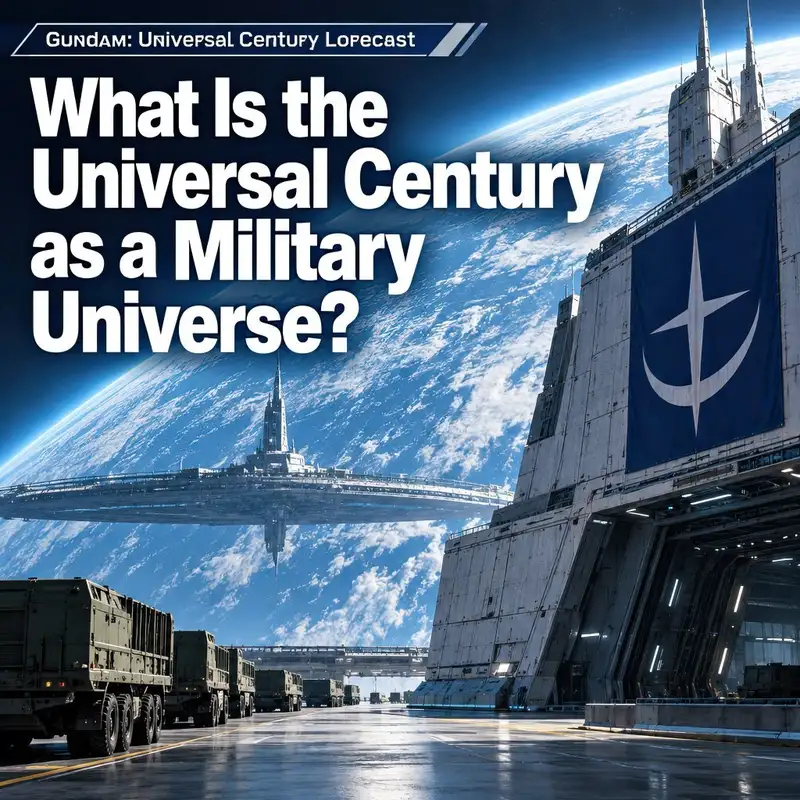
What Is the Universal Century as a Military Universe?
A space colony under military threat is not merely an object moving through orbit. It is a pressurized home. It contains families, schools, farms, docks, workshops, hospitals, power systems, and the accumulated routines of people who must trust machinery every day simply to breathe. It is also a political community, with grievances, loyalties, divisions, and memories of who makes decisions far away. Military planners may see a transport hub, a factory complex, a staging point, or a target whose destruction will alter an enemy’s logistics. The people inside see the place where they live. That difference is at the heart of the Universal Century. Its wars are not simply contests between spectacular weapons. They are struggles over who has the authority to govern human beings spread across Earth, the Moon, and the colonies, and what happens when force is used to answer a political question.
That is what makes the Universal Century a military universe. Its conflicts are built from strategic geography, colonial administration, industrial competition, ideological movements, and institutions that repeatedly mistake battlefield success for political settlement. Mobile suits matter enormously within that history, but they do not explain it by themselves. A mobile suit needs a pilot, a crew chief, replacement parts, propellant, ammunition, a carrier or base, intelligence, communications, and a government capable of paying for all of it. A colony needs food, water, power, transport, law, and public trust. A state that can destroy an enemy fleet may still fail to govern a population. A rebellion may expose real injustice and still become a dictatorship. The Universal Century returns to these problems again and again because humanity has expanded into space without building a durable political order equal to that expansion.
The Earth Sphere is not a single battlefield. Earth sits at the center of a gravity well, and that matters. Moving people, machines, and supplies from the surface into orbit requires infrastructure, energy, planning, and secure launch routes. Coming back down requires reentry corridors, landing zones, and control of the ground below. The Moon is not just a distant backdrop. It is an industrial and political center. Asteroids can become resource sites, dockyards, fortresses, or mobile bases. Lagrange points and colony clusters become crossroads where trade, migration, and military movement meet. In this setting, the map is made of orbital paths, docks, launch facilities, inhabited cylinders, and routes between them. Control of one location can open a supply line or threaten a population, but it does not automatically create political control over everyone who lives nearby.
The colonies themselves sharpen that problem. They are vulnerable in ways that cities on Earth are not. A colony’s atmosphere, structure, mirrors, agricultural areas, transport systems, and life-support machinery are all part of civilian life and military infrastructure at once. Damage can be both tactical and humanitarian. A commander may wish to disable a port, deny an enemy a manufacturing base, or force an evacuation. Yet the consequences reach people who may have no influence over the government or military using that colony’s facilities. The Universal Century understands this, even when its commanders do not. It treats civilian infrastructure as something wars consume. Habitats become hostages to strategy. The destruction of a colony is not just a large explosion. It is the collapse of a society built inside an engineered world.
The calendar called the Universal Century begins with that larger project of migration and governance. In Universal Century one, humanity formally enters an era defined by large-scale movement into space. The Earth Federation already exists as the central political authority, while colony construction and lunar settlement expand the physical reach of human society beyond the planet. In theory, this should create a common civilization. In practice, it creates a hierarchy. The institutions that govern the Earth Sphere remain heavily centered on Earth, while more people live, work, and raise families far from the center of political power. The question is not whether a common government is necessary. An interplanetary society needs coordination. The question is whose interests that government serves, how representation works, and whether people in space have meaningful control over the systems that shape their lives.
As the colony population grows, so does a distinct political consciousness among people living in space. The term Spacenoid is often used broadly, but it should not be treated as a party membership card or an ethnic label. Spacenoids include people with different classes, local identities, professions, political beliefs, and relationships to Earth. Some support reform. Some seek local autonomy. Some support the Federation. Some become nationalists, revolutionaries, collaborators, or simply civilians trying to avoid the next crisis. Earth residents are no more politically uniform. The Universal Century is not a clean division between one planet and everyone who lives above it. It is a struggle within an interdependent civilization, where wealth, authority, environmental pressure, and access to opportunity are distributed unevenly.
The grievances behind Spacenoid politics are not difficult to understand. Decisions affecting colonies may be made by officials far away. Colonial economies can depend on trade, Earth-based markets, extraction, and transport systems controlled by institutions that do not share local conditions. Migration changes class structures. The environmental burden of sustaining life on Earth remains a political issue, while the colonies are expected to function as both population outlets and productive industrial centers. Distance makes representation feel abstract. A citizen can be formally included in a political order and still experience that order as remote, dismissive, and unaccountable. Those conditions create room for movements that promise dignity, independence, and a different future.
Zeon Zum Deikun gives one of the era’s most influential political expressions to that dissatisfaction. His ideas about the people of space, human development, and political self-determination become central to later Universal Century arguments. But his thought must be separated from what follows. Deikun’s political philosophy is not the same thing as the Principality of Zeon. His use of the name Zeon does not make every later Zeon government the fulfillment of his ideas. Political movements often inherit symbols more easily than principles. A demand for representation can become a claim that one population is inherently superior. A movement against central authority can create an even more centralized state of its own. The Universal Century is full of leaders who speak the language of liberation while building institutions of surveillance, coercion, and war.
That danger becomes unmistakable under the Zabi family’s Principality of Zeon. Zeon’s leaders draw on real colonial resentment, but they turn that resentment toward dictatorship, militarism, conquest, and mass violence. This is one of the setting’s essential moral distinctions. Federation corruption, colonial inequality, and political indifference are real problems. They do not excuse aggressive war. They do not excuse the gassing of colonies, the killing of civilians, or the treatment of inhabited worlds as expendable instruments of state policy. Understanding why people support or tolerate a regime is not the same as absolving the regime. The Universal Century asks listeners to hold both truths at once. Political exclusion creates danger. Authoritarian nationalism does not solve it.
The political crisis becomes more dangerous because the military environment changes. The most important technological condition of the Universal Century is the widespread military effect of Minovsky particles. These particles interfere with radar, long-range electromagnetic detection, and some forms of communications. They complicate missile guidance, reduce the clarity of the battlefield picture, and make centralized command more difficult. Forces cannot always rely on distant sensors or headquarters to see and direct everything. They need visual identification, local initiative, scouts, prearranged plans, and commanders who can act under uncertainty. The result is not total blindness. Sensors still exist, communications still exist, and military forces still attempt to gather information. But the old confidence that a fleet can detect, track, and destroy an enemy at long range is badly weakened.
That environment gives mobile suits a practical military role. A mobile suit can maneuver, carry weapons, use its limbs to manipulate equipment, operate near ships or structures, and fight in complex spaces where a conventional warship is too large or too vulnerable. In space, it can move among debris, installations, and formations. On Earth, it can cross difficult ground, use terrain, and combine firepower with mobility. In the Minovsky environment, it becomes a flexible platform for close-range combat, reconnaissance, assault, and defense. It is not useful because humanoid machinery is inherently ideal in every conceivable war. It is useful because the Universal Century’s particular technological and operational conditions reward adaptable machines operated by human pilots close to the point of decision.
Still, mobile suits do not replace every other part of war. A mobile suit cannot build its own spare parts in the field, recover itself after every serious failure, or sustain a campaign without transport and support. It depends on ships for strategic movement, launch and recovery, resupply, medical care, command facilities, and maintenance. It depends on technicians who understand its reactor, joints, weapons, sensors, and life-support systems. It may fight alongside tanks, infantry, artillery, aircraft, engineers, and fixed defenses. It may be able to dominate a local engagement, yet still lose its operational value if its carrier is destroyed or its supply chain collapses. The Universal Century remains a world of fleets, factories, depots, shipyards, and human labor. The mobile suit changes the fight. It does not abolish the system behind the fight.
The rise of Zeon’s mobile suit force illustrates this better than any specification table could. Before the One Year War, Zeon invests in mobile-suit development, doctrine, production, and pilot training. The Zaku I becomes an early mass-produced mobile suit, and the Zaku II becomes the main symbol of Zeon’s military advantage. Its significance is not simply that it is a capable machine. It represents an institution that has identified a new way of fighting and prepared to use it before its opponent has done the same. Zeon has factories, test programs, trained personnel, transport arrangements, and commanders willing to organize operations around the mobile suit. A weapon system becomes decisive when doctrine, industry, training, and command all meet at the same time.
When Zeon begins the One Year War in Universal Century seventy-nine, the Federation is caught by that combination of political and military surprise. The Federation possesses greater population, territory, and industrial depth, but those strengths are not immediately available as combat power. Large states can be slow to recognize threats, slow to change procurement priorities, and slow to move authority through their own bureaucracies. Zeon’s early offensive exploits this weakness. Mobile suits gain an advantage over forces not prepared to counter them effectively, while the opening campaign brings warfare to a civilian scale so vast that it changes the character of the conflict. The first month alone kills more than half the population of both sides. This is not a conventional border war. It is a disaster created by governments willing to use entire populations as instruments of military and political coercion.
The One Year War therefore establishes a pattern that will endure long after the fighting stops. Zeon achieves spectacular tactical and operational results early in the war. It seizes initiative, shocks the Federation, and demonstrates the military value of the mobile suit. But early success is not the same as sustainable strategic success. Zeon is fighting an opponent with a larger resource base and greater capacity to mobilize once it survives the initial shock. Its own political system also creates limits. Dictatorships can concentrate authority quickly, but they distort information, encourage rivalry, and make honest assessment dangerous. Their commanders may receive grand objectives without the resources to hold what they seize. Their soldiers may fight with courage while serving a strategy that cannot deliver a durable political outcome.
The Federation’s response is often simplified into the story of one machine and one exceptional pilot. That story has some truth. The RX seventy-eight two Gundam is a remarkable prototype. It combines advanced armor, mobility, beam weaponry, and systems intended to gather useful combat data. It proves that the Federation can field a machine capable of meeting Zeon’s mobile suits on more equal terms. Its deployment with White Base also matters because White Base is not simply a backdrop for the Gundam. It is a warship, carrier, transport, command center, repair facility, and refuge for a crew operating under extraordinary pressure. The Gundam’s battlefield record has real operational and symbolic value. It demonstrates possibilities that Federation planners and engineers can learn from.
But the Gundam is not an explanation for victory by itself. A prototype can reveal a design path. It can test weapons and armor in real combat. It can generate data, confidence, propaganda, and urgency. It can also consume rare parts, demand skilled maintenance, and depend on unusual personnel. Its broader significance comes from what the Federation can do with the knowledge it gains. The Federation’s recovery requires production systems capable of building more practical machines, including the GM, and of supplying those machines with pilots, technicians, weapons, transports, and ships. It requires factories that can keep working under wartime pressure. It requires officers who can develop mobile-suit units, crews who can launch and recover them, and a military organization able to replace losses.
This is the difference between a tactical marvel and an industrial war effort. Amuro Ray’s abilities matter. So do the actions of individual crews, commanders, and engineers. But no individual can substitute for the Federation’s wider mobilization. The war turns because Zeon’s initial advantage cannot remain exclusive, while the Federation can translate adaptation into scale. That process is not elegant. It is marked by delay, loss, bureaucratic friction, and uneven competence. Yet a state with deeper industrial reserves can recover if it learns fast enough. The Universal Century is skeptical of simple hero stories because it understands that victory often belongs to the side that can repair, train, ship, feed, and replace.
The end of the One Year War does not solve the political crisis that caused it. It removes the Principality of Zeon as the dominant wartime enemy, but it leaves behind devastated colonies, displaced civilians, veterans, military secrets, resentments, and armed survivors. The Federation wins the war, but victory also gives it the temptation to treat every remaining security problem as a military problem. That temptation is understandable. Remnant forces exist. Weapons remain hidden. Sabotage and insurgency are real risks. Yet a government that responds to every political danger with exceptional powers can produce the very conditions that make future rebellion more likely.
The Delaz Conflict in Universal Century eighty-three shows this clearly. Zeon remnant forces under the Delaz Fleet launch an operation centered on the theft of a nuclear-capable Gundam prototype and the wider plan known as Operation Stardust. The Earth Federation responds through conventional military pursuit, intelligence work, and political crisis management. The conflict reveals serious weaknesses in postwar security. A dangerous weapon can be stolen. Remnant organizations can retain access to personnel, equipment, and planning. Command relationships can be confused by secrecy and institutional rivalry. None of this requires a single hidden conspiracy to explain. Governments are often capable of creating their own blind spots through compartmentalization, complacency, and competition among offices that should be sharing information.
The consequences of the Delaz Conflict reach beyond the immediate operation. Fear of renewed Zeon violence creates political space for stronger internal security measures. The Titans emerge from that postwar environment as a Federation military organization initially justified by anti-Zeon and anti-insurgency missions. The threat they respond to is not imaginary. But authority granted in a crisis has a habit of seeking new reasons to expand. The Titans become more than a security force. They become an instrument of colonial repression, intimidation, and political control. This is a recurring Universal Century failure. A government confronted with insecurity creates an organization that is meant to preserve order, then fails to constrain it once that organization begins treating whole populations as suspect.
By Universal Century eighty-seven, the Gryps Conflict is not simply Federation versus Zeon. The political map has become more complicated. The Titans operate within the Federation’s military structure, but they are not identical to the Federation government, the whole Earth Federation Forces, or every soldier serving under the Federation flag. Opposing them are the Anti-Earth Union Group, often called the A E U G, as well as Karaba and other networks of military defectors, Spacenoid activists, civilian supporters, and industrial backers. Their coalition exists because regular institutions have failed to restrain the Titans. This is how civil-military legitimacy breaks down. When legal authority is used to protect abuse rather than limit it, opposition moves outside normal channels.
The Gryps Conflict also demonstrates that resistance is never just a matter of courage in a cockpit. The A E U G and its allies need ships, mechanics, intelligence, safe ports, funding, political contacts, and people willing to risk their careers or lives by providing support. The Titans, for their part, possess access to state resources, formal authority, and military infrastructure. But those strengths are weakened when commanders misuse them. A force can have advanced mobile suits and powerful warships yet still lose legitimacy through coercion and brutality. Colonies become sites of surveillance, punishment, bargaining, and propaganda. Their residents are once again treated as populations to manage rather than citizens whose consent matters.
The defeat of the Titans does not produce a stable settlement either. The Federation has removed one repressive instrument, but the underlying weaknesses remain. War has damaged institutions, exhausted personnel, and created new openings for ambitious factions. The First Neo Zeon War follows in Universal Century eighty-eight and eighty-nine, led by a political movement distinct from the old Principality and distinct from later Neo Zeon forces. Haman Karn’s Neo Zeon combines claims of Zeon heritage with its own internal hierarchy, military structure, and ambitions. It exploits Federation exhaustion and political fragmentation. It also suffers from internal conflict of its own. The lesson is not that every anti-Federation movement inevitably fails for the same reason. It is that a movement can identify real weakness in its enemy while remaining incapable of building a just and stable order itself.
The Dublin colony drop during that war makes the civilian stakes impossible to ignore. A colony used as a weapon is not an abstract strategic asset. It is a habitat transformed into an instrument of mass killing. The operation seeks military and political effect through terror, destruction, and shock. It demonstrates the terrible logic of strategic coercion in the Universal Century. If a government or movement cannot compel consent through legitimacy, it may try to compel obedience through catastrophe. Yet catastrophe does not create a durable political community. It may silence opponents temporarily. It may force governments into crisis. It may produce military opportunities. It also deepens trauma, hatred, and the expectation that the next conflict will be even less restrained.
Char’s Rebellion in Universal Century ninety-three carries that pattern into asteroid warfare and planetary-scale coercion. Char’s Neo Zeon is not Haman’s Neo Zeon, even though both use the name and draw upon overlapping historical symbols. The political context has changed, the leadership has changed, and the strategy has changed. Char seeks to force a transformation of humanity’s relationship with Earth by making the planet itself vulnerable. Fifth Luna and Axis become instruments of strategic pressure. Londo Bell, a Federation task force operating with limited resources and imperfect political backing, attempts to stop a threat whose consequences reach far beyond one fleet engagement. The conflict shows that the Federation still has military capacity, but not necessarily the political clarity or institutional confidence required to prevent every crisis before it becomes catastrophic.
Asteroid operations in the Universal Century are often remembered for their scale and spectacle. Their historical meaning is more severe. They show what happens when strategic geography is turned directly against civilian life. An asteroid is a resource, a base, a fortress, and sometimes a weapon. Moving one toward Earth requires planning, propulsion, control, labor, and a willingness to make planetary populations pay for political objectives set elsewhere. No amount of tactical brilliance can make that morally clean. Nor can a mass-casualty plan create legitimate consent. A movement may claim that it is acting for environmental survival, colonial emancipation, or the future of humanity. If its method is to threaten millions of people with devastation, it has revealed the limits of its political imagination.
The Universal Century also repeatedly militarizes the idea of the Newtype. Zeon Zum Deikun’s thought connects the experience of space with the possibility of human development, but later institutions turn that possibility into a military question. Newtypes are not best understood as a standardized class of people with one fixed set of powers. Different individuals show different forms of heightened awareness, empathy, communication, anticipation, or pilot-machine compatibility. Some can operate advanced systems more effectively. Some appear able to perceive other people in extraordinary ways. Some are simply placed under unbearable expectations because others believe they possess special potential. The setting does not support the easy conclusion that Newtype ability produces wisdom, peace, or political agreement.
Cyber Newtype programs make the ethical failure explicit. These programs do not simply create stronger pilots. They involve attempts to manufacture, condition, control, or exploit human potential through institutions willing to use vulnerable people as military assets. Trauma, medication, isolation, coercion, and manipulation become part of the weapons program. The harm is not an unfortunate side effect separate from the military project. It is built into the effort to turn a person into a reproducible capability. The Universal Century is clear on this point even when its governments are not. A state that cannot understand human difference without trying to weaponize it has learned very little from the wars it claims to have survived.
By Universal Century ninety-six and ninety-seven, the events of Gundam Unicorn and Gundam Narrative show that the past has not been buried so much as stored under pressure. Questions surrounding Laplace’s Box, the history of the Federation, Zeon identity, and the meaning of Newtype possibility remain politically explosive. The Federation’s interest in secrecy persists because old compromises still shape present authority. Zeon symbols retain power because the grievances that made them meaningful were never fully resolved. Psycho-frame technology becomes a further source of anxiety because it is associated with events that institutions can observe but cannot reliably explain, reproduce, or control. The sensible military response to an unpredictable technology would be caution. The more common response is containment, competition, and the hope that someone else will bear the risk.
By the time of Gundam F91 in Universal Century one hundred twenty-three, the Federation faces a different version of the same crisis. It is no longer simply a powerful Earth-centered government imposing its will on a restless periphery. Its authority has weakened, its institutions are compromised, and new political movements believe they can replace it. Cosmo Babylonia and the Crossbone Vanguard represent a challenge shaped by aristocratic ideology, private military power, and the ambition to create a new social order. The majority of humanity now lives in space, yet the political system has still not found a convincing way to command broad loyalty. This is the long-term consequence of governing through inertia. A state may survive for decades after it loses public confidence, but survival is not the same thing as legitimacy.
The late Universal Century does not become less military because the Federation weakens. It becomes more fragmented. In Victory Gundam, set in Universal Century one hundred fifty-three, the Federation’s authority has become largely nominal in many places. Zanscare and its military arm, BESPA, can mount a renewed campaign of conquest and invasion. Opposing them is the League Militaire, a resistance movement whose existence reflects both local determination and the inadequacy of established institutions. The conflict involves mobile suits and warships, but it also involves communities forced to organize their own defense because the larger political order cannot protect them. When central authority fails, people do not automatically become free. They become vulnerable to whoever can organize force first.
This late fragmentation is important because it prevents an overly simple reading of the Universal Century. The problem is not merely that the Federation is too strong. A weak Federation can be just as dangerous when it leaves populations exposed to private armies, authoritarian movements, and local wars. Nor is the answer simply more military power. The Titans demonstrate what happens when emergency authority becomes repression. Neo Zeon demonstrates what happens when resentment becomes militarized coercion. Zanscare demonstrates that a new ideology can use old failures as an opening for new forms of domination. The recurring issue is accountability. Who governs, for whom, under what limits, and with what ability to answer for the violence carried out in the name of security or liberation?
Across all these eras, the military pattern remains consistent. At the tactical level, mobile suits are decisive tools. A skilled pilot in a capable machine can protect a ship, break an ambush, defend a colony approach, or alter the outcome of a local engagement. At the operational level, however, fleets, bases, routes, hangars, repair facilities, intelligence networks, and logistics remain indispensable. A mobile suit force that cannot refuel, rearm, recover damaged machines, or communicate under pressure will not remain effective for long. At the strategic level, military force can seize territory, deny access, destroy infrastructure, or threaten populations. It cannot reliably create legitimacy. It can compel obedience for a time. It cannot make people believe that they are represented.
The civilian pattern is even more consistent. Homes become military targets. Workers become defense labor. Children become refugees, symbols, recruits, or research subjects. Families are divided by evacuation, occupation, conscription, and political suspicion. Medical personnel, mechanics, transport crews, and local organizers sustain societies while commanders argue over objectives on maps. The Universal Century’s famous pilots matter because their actions occur at points of great pressure. But the wider history belongs equally to the people who keep ships running, repair damaged habitats, move food and water, hide from bombardment, and try to preserve ordinary life inside a civilization that repeatedly chooses war over reform.
The Universal Century is therefore not defined by the existence of mobile suits. It is defined by the failure of political institutions to match humanity’s expansion into space. Mobile suits, fleets, Newtype systems, and superweapons repeatedly change how wars are fought, but none can settle the underlying contest over representation, resources, citizenship, and authority. Its military history is a history of extraordinary weapons used by governments and movements that remain unable, or unwilling, to build a durable peace for the people living inside the worlds those weapons endanger.