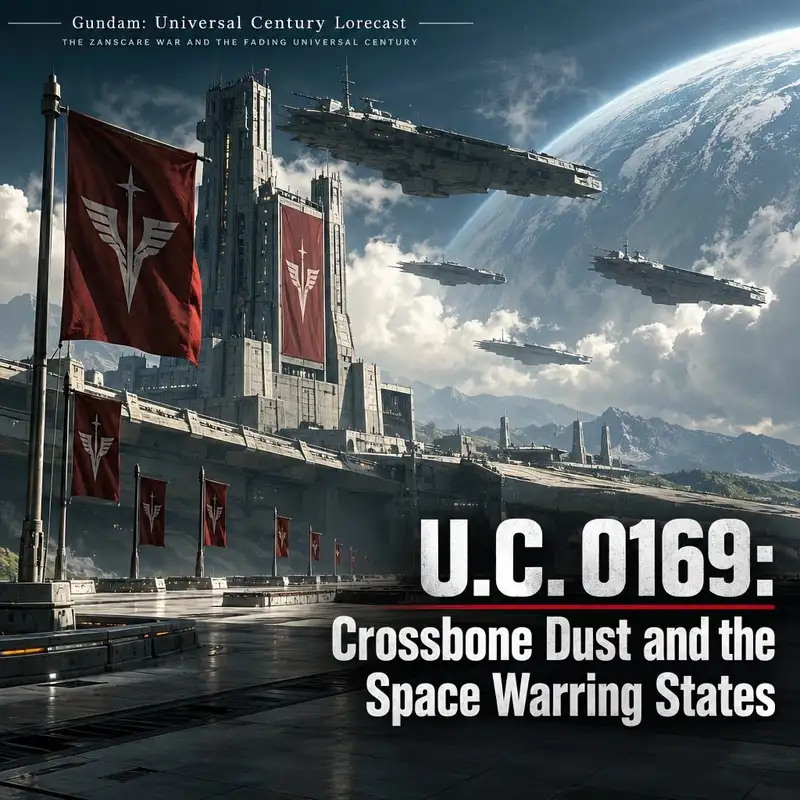
U.C. 0169: Crossbone Dust and the Space Warring States [Manga]
Ninety million people cannot be evacuated in the ordinary sense. They cannot be loaded onto transports, moved through a guarded corridor, and resettled while some distant government manages the paperwork. Ninety million people carry hospitals, water systems, food stores, schools, workshops, power grids, families, debts, political loyalties, and the accumulated habits of an entire society. In Universal Century one hundred sixty-nine, the colony Neo-One faces a proposition on that scale. Rather than merely defend the habitat or remove a small number of refugees, its people are to be carried toward Earth inside the colony itself, converted into an ark-like vessel called Hakobune.
That proposal is the DUST Plan, and it immediately raises an uncomfortable question. Is this a rescue, a military maneuver, an act of desperation, or a weapon waiting to be misused? An inhabited colony descending toward Earth evokes the most terrible precedents in Universal Century history. But Neo-One is not being sent down as a conventional impact weapon. The plan is an attempt to preserve a civilian population that no longer has confidence in remaining where it is. That distinction matters. It does not make the operation safe. It makes the danger more human.
Crossbone Gundam: Dust places this crisis in a late Universal Century where the Earth Federation still exists, but no longer governs the Earth Sphere with reliable authority. Its flags, personnel, facilities, and legal claims remain. What has weakened is the ability to turn those claims into consistent protection, administration, and military control. A colony may have a local government. A fortress may have a commander. A transport company may have armed escorts. A surviving Federation formation may insist that it represents lawful order. None of those facts guarantees that food will arrive, that a route will remain open, or that civilians will be protected when rival forces decide they are useful.
This is the condition the manga describes as a Space Warring States era. The phrase does not mean that all order has disappeared. It means that authority has become local, conditional, and contested. The Earth Sphere is no longer organized around one central state capable of enforcing common rules across its colonies, lunar settlements, routes, and military installations. Instead, power is distributed among colony governments, fortress commands, commercial organizations, mercenary forces, religious-political movements, private operators, and remnants of older institutions. Some possess legal claims. Others possess guns, fuel, engineers, or control of a dockyard. In practice, those resources can matter more than formal legitimacy.
The period comes after the Zanscare War, but Dust is not simply a sequel to that conflict’s battlefield record. Its real subject is what happens after repeated wars have exhausted institutions faster than they exhaust machines. Humanity has not forgotten fusion reactors, mobile suits, or advanced engineering. The Earth Sphere still contains the hardware of earlier eras. It contains old weapons, old industrial facilities, abandoned designs, military archives, skilled technicians, and veterans who remember systems that once worked. What has deteriorated is the network that connected those things. A machine may survive without the factory that built it. A factory may survive without access to parts. A technician may survive without an employer capable of paying for standardized production.
That difference is central to the military history of Dust. Technological decline is often imagined as a straight line downward, with advanced machines replaced by crude substitutes. The manga offers something more complicated. It shows advanced technology surviving unevenly, in fragments, in workshops, in private hands, and in local arsenals. Old systems are repaired, combined, modified, and repurposed. They remain dangerous. They may even be ingenious. But the ability to keep one machine functioning is not the same as the ability to equip an army, train replacement crews, maintain common standards, or sustain a campaign across the Earth Sphere.
Ash King operates within this environment through Invincible Transport, the armed transport organization based aboard the Escal. Invincible Transport is not a conventional military unit, even though it can fight. It combines the functions of merchant shipping, cargo movement, salvage, repairs, armed escort, and local defense. That combination gives it influence far beyond the size of any one mobile suit. In a fragmented Earth Sphere, whoever moves people, food, spare parts, and technical knowledge is exercising political power. The organization that keeps a route open may become more important to a colony than a distant government that claims jurisdiction but cannot deliver supplies.
The Escal is therefore more than a ship carrying Ash and his crew from one crisis to another. It is a mobile node in a damaged logistical network. It carries the capacity to connect places that might otherwise become isolated. It can transport goods, rescue people, recover equipment, and offer armed protection where no public force is dependable. That makes it necessary. It also makes it difficult to classify. A transport company that can defend its cargo and negotiate with local powers may function as a lifeline. It may also acquire leverage that governments normally reserve for themselves. The line between commerce, humanitarian movement, and private military activity becomes very thin.
Ash’s authority reflects that ambiguity. He leads because people trust him, need him, work for him, or enter into agreements with him. His authority is personal and contractual rather than constitutional. He cannot issue orders because a recognized government has invested him with universal legal power. He can act because he has a ship, a crew, a mobile suit, and a reputation for getting people through dangerous situations. In a crisis, that may be more useful than a formal office. But it also means that security depends on relationships that can break, resources that can run out, and armed individuals who may not answer to a public institution.
Leo Tail gives that situation a civilian face. As a survivor displaced from Side Five, she is not merely a passenger observing military activity from a safe distance. Her presence reminds the story that transport is never only about cargo. People who lose homes, routes, and political protection become dependent on whoever can move them. They must trust crews they did not elect, accept protection they may not fully understand, and make decisions under conditions where remaining in place may be as dangerous as leaving. In the Space Warring States, displacement is not a background detail. It is one of the ways power is redistributed.
Private armed transport can keep people alive, but it cannot entirely replace public authority. A transport organization can escort a convoy. It cannot easily provide universal law, stable taxation, long-term infrastructure investment, broad medical systems, or a credible guarantee that every community will receive equal protection. The problem is not that private actors are automatically corrupt or cruel. The problem is that their authority is necessarily limited. Their mission depends on contracts, fuel, crews, maintenance, and local agreements. They can fill gaps in a collapsing order. They cannot, by themselves, rebuild the political structure that created the gaps.
The Cyclops faction represents a different response. Operating from the fortress Titano Machia, Cyclops is associated with the Earth Federation Forces and claims a role in restoring order. It is not simply the Titans returned under a new name, and it should not be treated as though it were identical to that earlier security organization. But it carries an institutional inheritance from the Federation’s long history of responding to crisis through militarized control. Cyclops sees fragmentation as a problem that must be managed. In some respects, it is right. A divided Earth Sphere cannot coordinate defense, protect routes, or conduct a project on the scale of Neo-One’s movement without some degree of common command.
Its difficulty is that the need for coordination can become an excuse for coercion. Cyclops contains internal rivalries, corruption, secret enhancement programs, and competing ideas about what restored order should mean. A weakened central state is especially vulnerable to this pattern. Officials who inherit fragments of legal authority may believe that their personal control is the only alternative to chaos. They may not be entirely wrong about the danger of chaos. But the methods used to defeat disorder can create a new form of domination, especially when civilian consent, oversight, and accountability are treated as luxuries the emergency cannot afford.
Arnold Silvester rises within this environment as a senior Cyclops figure concerned with preserving or consolidating control over the Earth Sphere’s future. His position matters because he represents bureaucratic authority in an era when bureaucracy has lost much of its practical foundation. He can think in terms of population, resources, routes, and large-scale survival. Those are necessary concerns. No one can move millions of people without planning at that scale. Yet administrative reasoning becomes dangerous when human beings are reduced to quantities to be shifted, contained, or sacrificed for an abstract calculation of order.
Cyclops’s effort to standardize sensors and communications across machines of different generations is one of its most revealing policies. It may seem like a minor technical matter beside the spectacle of mobile-suit combat. In fact, it addresses one of the central problems of a fragmented military environment. Mixed inventories do not merely create maintenance problems. They create command problems. If units cannot communicate, identify each other, share targeting information, or follow common procedures, their combat power remains local and fragile. A force with modest machines but reliable communication may be more useful than one possessing a few extraordinary weapons that cannot work together.
Interoperability is the unglamorous architecture of command. In the Minovsky-era Earth Sphere, no military can depend entirely on distant sensors or uninterrupted communications. But a force still needs a way to coordinate scouts, escorts, mobile suits, ships, depots, and local allies. Standardizing common components across old and new machines is an attempt to recover that capability. It shows that some surviving Federation personnel understand the real problem. The issue is not simply obtaining a more powerful mobile suit. It is building a force that can see, speak, and act together despite years of institutional and industrial fragmentation.
Yet even a sound technical objective can serve a dangerous political purpose. A standardized network can coordinate relief and defense. It can also extend surveillance, enforce obedience, and centralize power in the hands of an organization that has not earned trust. This is the recurring contradiction of Dust. The Earth Sphere needs institutions capable of acting at scale. But its surviving institutions have often contributed to the very distrust that makes large-scale cooperation difficult. The demand for security is real. So is the fear that security will become another name for control by whichever armed faction gains access to the network.
The Hymn Nation offers a more destructive response to collapse. It is not Zeon, Neo Zeon, or a revival of the Zanscare Empire under another banner. Treating it as one of those older movements would miss what makes the late Universal Century of Dust distinctive. The Hymn Nation is a political and quasi-religious force shaped by the present crisis. It draws strength from the vacuum left by weak public authority, the fear created by instability, and the willingness of some people to accept catastrophic solutions when ordinary governance appears exhausted.
Its leader, Evans Silvester, known as the Beheading King, embodies the conversion of institutional failure into a politics of ruin. As a former Federation figure, he is not an outsider who simply attacks a stable system. He emerges from the damaged remains of that system. His authority rests not on a credible promise to rebuild accountable government, but on a destructive vision that treats collapse as an opportunity. That is a recurring danger in fractured societies. When people no longer believe institutions can protect them, the leader who promises decisive violence may appear more convincing than the administrator who offers slow repair.
Evans’s politics must be kept distinct from Arnold’s population-management logic, even when the two become entangled in the same crisis. Arnold represents the temptation to treat humanity as an administrative problem. Evans represents the temptation to treat humanity as material for an apocalyptic political project. Both approaches can lose sight of individual lives. But they are not morally or politically identical. Technocratic calculation can become cold and coercive without necessarily seeking destruction. Evans’s program turns destruction into a source of authority. The difference matters because not every failure of compassion takes the same form, and not every claimant to order is pursuing the same end.
Frank Oz and Jean Dovan reveal another dimension of this struggle. They are specialists whose knowledge has political weight because advanced technical expertise is scarce and unevenly distributed. In a healthier system, an engineer or military professional may work within institutions that set limits, establish procedures, and distribute responsibility. In the Space Warring States, specialists can become dependent on whichever faction protects their workshop, funds their project, or controls access to equipment. Their disillusionment with Evans demonstrates that technical service cannot remain morally neutral forever. Engineers and soldiers may not choose every political objective, but their work can still enable it.
The Anchor’s connection to Frank Oz makes this especially clear. Engineering knowledge is not inherently liberating or oppressive. It is a capability. It can keep a transport organization alive. It can help repair a colony. It can improve a weapon. It can also be captured by a destructive movement. Dust repeatedly asks who controls expertise, who pays for it, and who decides its purpose. The answer is rarely simple. In a fragmented Earth Sphere, a specialist may serve several masters over time, not because all masters are equal, but because survival, coercion, and access to tools are tangled together.
Moon Moon broadens the political map still further. Its role in the story, involving Kaguya Shiratori and the priest Elazo Kano, demonstrates that the late Universal Century cannot be reduced to a familiar binary of Federation forces against anti-Federation insurgents. Local communities possess their own political traditions, technological resources, religious structures, and strategic interests. They may cooperate with larger factions when it serves survival. They may resist them when outside authority threatens local autonomy. Their decisions cannot be understood simply by asking which flag they prefer.
This is what fragmentation means in operational terms. Alliances are negotiated rather than assumed. Intelligence is often local. A commander may know the capabilities of a nearby dock, the loyalties of a settlement, or the availability of a repair team, while knowing little about events only a few routes away. Supply access becomes political bargaining. A faction cannot assume that its rear area is secure merely because it controls a fortress or claims a region. Every route may depend on permission, payment, personal trust, or the willingness of local people to tolerate an armed presence.
The military consequences are profound. In a centralized war, a force can often rely on an established chain of command, standardized maintenance, and a strategic rear area that supplies replacements. In the Space Warring States, a mobile suit may be powerful but isolated. A ship may be armed but unable to refuel safely. A colony may be nominally allied but unwilling to admit troops. A local leader may possess valuable intelligence but refuse to share it without guarantees. Military power becomes less about the total number of machines available across the Earth Sphere and more about who can assemble a functioning network at the moment of crisis.
For that reason, colonies in Dust must never be treated as fortresses waiting to be seized. A colony is life support, industry, housing, transport, food distribution, memory, and political community. Its people are not merely the population listed in a strategic report. They are the workforce that maintains it, the families who depend on its systems, and the citizens whose cooperation determines whether it can be governed at all. Capturing a dock or intimidating a council may produce temporary access. It does not create legitimacy. It does not make technicians loyal. It does not guarantee that agricultural sections, power systems, or medical facilities will continue functioning under pressure.
Neo-One brings every one of these problems into focus. Its leaders, Tars Bance and Orie Bance, confront a situation in which the colony’s vulnerability becomes strategic leverage for others. A population that large cannot disappear quietly. Whoever influences its movement influences labor, resources, political legitimacy, and the future distribution of people between space and Earth. That makes Neo-One a humanitarian responsibility and a strategic prize at the same time. The people living there need security. Rival powers may see them as a demographic resource, a hostage population, a bargaining position, or a threat.
The DUST Plan responds to this pressure by transforming Neo-One into Hakobune, an ark capable of moving toward Earth with the support of connected resource satellites. This is a remarkable feat of improvisation, but it should not be mistaken for a simple act of launching a spacecraft. A colony is not designed to be casually repurposed as a transport vehicle. Any attempt to move it must address structure, propulsion, mass distribution, power, life support, food, water, internal transportation, communications, and the physical safety of an enormous civilian population. It must also account for the political danger created by the movement itself.
The plan depends on far more than mobile suits. Mobile suits can escort, defend, sabotage, repair, and gain access to critical facilities. They may matter in a confrontation around the colony. But they cannot feed ninety million people, regulate a habitat’s atmosphere, maintain its internal systems, or govern its residents during a crisis. Those tasks belong to engineers, medical workers, transport crews, administrators, technicians, and civilians whose labor determines whether the operation remains a rescue rather than becoming a catastrophe. In this sense, Hakobune is a civil-engineering operation conducted under military pressure.
Its connection to resource satellites underlines the scale of the logistical problem. A colony in motion needs more than a dramatic push in the right direction. It needs material support. It needs systems that can keep functioning during a dangerous transition. It needs a route protected from hostile intervention, but it also needs the internal capacity to prevent panic, manage shortages, and maintain trust among people who understand that their home has become part of a high-risk operation. The DUST Plan is therefore a test of whether fragmented institutions can cooperate long enough to preserve civilian life.
That cooperation is never politically neutral. Whoever organizes the movement may claim authority over the population. Whoever provides security may demand influence afterward. Whoever controls access to the colony’s systems may be able to dictate terms during the crisis. The same operation that promises survival can become a way of concentrating power. This is why the conflict around Neo-One cannot be reduced to a contest over whether the colony descends. The deeper issue is who gets to decide what survival means, who bears the risk, and who will govern the people once the immediate danger has passed.
Cyclops, the Hymn Nation, Invincible Transport, local powers, and surviving specialists enter this struggle with different interests and different forms of authority. Some seek order. Some seek control. Some seek to prevent destruction. Some see opportunity in the chaos. The political turning point comes when the prospect of simply stopping or destroying the descent becomes inadequate. Once Neo-One’s people are recognized as a population whose survival cannot be treated as collateral damage, the question changes. The issue is no longer only whether the colony can be moved. It becomes whether anyone can control the future created by that movement.
Armed action around an inhabited colony has limits that a conventional battlefield does not. A mobile suit may be capable of destroying a target, but the political and humanitarian consequences of doing so may be unacceptable. Sabotage can threaten not only enemy plans but life support and civilian security. An escort force can protect an operation while also intimidating the very people it claims to save. A fortress command can demand compliance in the name of public order while increasing fear among the population. Military power remains important, but it is constrained by the fact that the battlefield is also a home for millions of people.
This does not make violence disappear. The Space Warring States is not a peaceful era of decentralized communities. It is dangerous precisely because armed groups operate amid weak oversight and uncertain legitimacy. Yet Dust refuses the easy fantasy that force alone can solve a civil crisis. A faction may win an engagement, secure a route, or seize a facility. None of that automatically gives it the administrative capacity to care for Neo-One’s population, the moral authority to direct their future, or the resources to sustain them after arrival. Tactical success and political control are not the same thing.
The DUST Plan eventually achieves what could easily have become impossible: Neo-One reaches Earth rather than being used as a conventional impact weapon. That outcome matters enormously. It means that a vast civilian population survives an operation whose scale and danger recall some of the worst weapons of earlier Universal Century wars. But survival is not the same as resolution. Neo-One’s arrival does not restore a stable Federation order. It does not erase the forces that made the plan necessary. It does not prove that the Earth Sphere has found a durable answer to fragmentation.
What it proves is that fragmented societies can still accomplish extraordinary things. Engineers can adapt old systems. Transport crews can preserve routes. local leaders can negotiate cooperation. Armed groups can be forced, persuaded, or compelled by circumstances to protect rather than destroy. People who do not share one government can still recognize a common danger. That capacity for improvisation is one of Dust’s most hopeful ideas. Humanity has not lost its technical intelligence. It has not lost its ability to cooperate entirely. Even after institutional decline, people can still build something immense in order to save one another.
But that hope is inseparable from vulnerability. Neo-One’s people survive because an unstable collection of transporters, local authorities, remnant officials, engineers, fighters, and civilians manages to create a working bargain under extreme pressure. That is an achievement. It is also an indictment of the political order that left them with no safer alternative. Ninety million people should not have to trust their future to a conversion of their colony into an ark because no reliable authority can guarantee their security where they live.
Crossbone Gundam: Dust does not define its Space Warring States era by the disappearance of powerful machines. The machines remain. So do the engineers who understand them, the old military facilities that can still be used, and the ambitions of people who want to command them. What has failed is the system that once decided how those machines would be supplied, regulated, coordinated, and held accountable. Hardware survives. Institutions fail. The result is an Earth Sphere where ingenuity remains possible, but where survival depends on bargains too fragile to protect anyone from the next political experiment.
Neo-One’s journey is therefore not merely a late Universal Century spectacle. It is a warning about power without dependable public responsibility. A mobile suit can be rebuilt from scraps. A transport ship can become an armed lifeline. A fortress can standardize its communications. A colony can be turned into an ark. None of those achievements answers the harder question of who has the right to command, who is responsible for civilian lives, and what happens when no institution can be trusted to keep that responsibility.