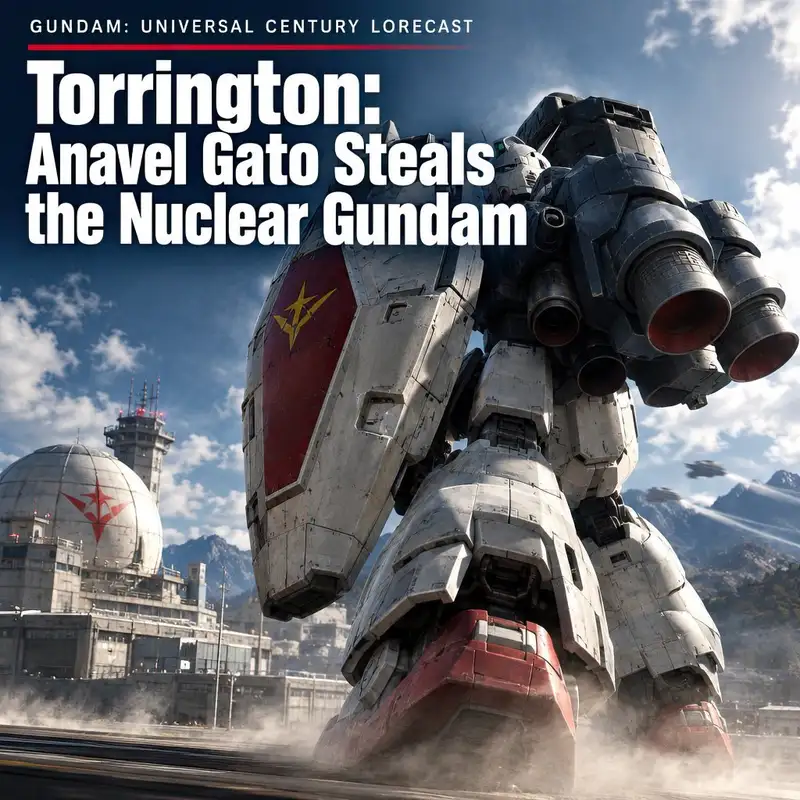
Torrington: Anavel Gato Steals the Nuclear Gundam
At Torrington Base in Australia, the Earth Federation was loading a nuclear warhead into a mobile suit. Not storing it in a distant arsenal. Not moving it under the protection of a fleet. Loading it directly into the RX-78GP02A Gundam Physalis, one of the most sensitive prototypes produced since the One Year War. Nearby stood its companion machine, the RX-78GP01 Gundam Zephyranthes. Both had arrived aboard the assault carrier Albion for ground testing. Engineers, test pilots, ship personnel, and base staff were all present. The site held advanced machines, classified data, and a weapon whose very existence contradicted the postwar restrictions the Federation publicly claimed to uphold. Before the night ended, Anavel Gato would leave Torrington in the GP02A. He would take the warhead with him. And a local failure of security would become the opening move in a much larger crisis.
The importance of the theft begins with the nature of the machine. The GP02A was not simply a high-performance Gundam, nor was it built as a general-purpose replacement for ordinary Federation mobile suits. It was a specialized nuclear delivery system. Its defining weapon was an atomic bazooka designed to fire a tactical nuclear warhead. Its heavy protective features, including its enormous shield and reinforced construction, existed because the pilot had to survive the heat, blast, and radiation effects associated with launching such a weapon at dangerous proximity. It was a machine designed around one terrible mission. Get close enough to deliver a nuclear strike. Fire. Escape the immediate consequences.
That made Torrington more than a test base. It was a point where the Federation’s technical ambition, political anxiety, military secrecy, and postwar complacency had been brought together in one vulnerable place. The Federation had won the One Year War. It had defeated the Principality of Zeon and recovered much of the strategic initiative that Zeon had held during the conflict’s opening months. But victory had not erased Zeon’s veterans, political networks, hidden stores of equipment, or the resentments that continued to sustain remnant movements. The war was over in a legal and formal sense. It was not over in the minds of everyone who had fought it.
The Delaz Fleet understood that it did not need to defeat the Earth Federation everywhere. That would have been beyond the capability of a Zeon remnant formation operating after the war. It did not need to seize Australia, destroy the Albion, or hold Torrington against counterattack. It needed a brief operational window. It needed to create confusion around the base, get one experienced pilot into one specialized mobile suit, and extract that machine before the Federation could restore control. A small force with a narrow objective can sometimes impose a strategic cost far larger than its numbers would suggest. Torrington was built around that logic.
The man selected to carry out the seizure was Anavel Gato. By Universal Century eighty-three, Gato was already known as a veteran of the One Year War and a prominent officer within the Delaz Fleet. His wartime reputation mattered, but not because it made him superhuman. Delaz trusted him because he had experience under combat conditions, a reputation for discipline, and the confidence required for a mission where delay could ruin everything. He was not being sent to win a duel for prestige. He was being sent to capture a weapon system intact, preserve its nuclear capability, and deliver it to a force that intended to use the theft for both military and political effect.
The Delaz Fleet was not the restored Principality of Zeon. It did not possess the territory, industrial scale, or formal state structure of the wartime regime. It was a remnant force, built around officers, crews, equipment, ideology, and a refusal to accept the political order that followed Zeon’s defeat. The distinction shapes what follows. A remnant force cannot generally sustain a conventional war against a larger state. It must rely on concentration, secrecy, mobility, and symbolic action. It must make the stronger side feel insecure in places where it assumed the war had ended.
The GP02A gave the Delaz Fleet the possibility of exactly that kind of action. Capturing it meant more than gaining an advanced mobile suit. The Fleet gained a nuclear-capable delivery platform and the warhead already assigned to it. It gained technical intelligence about Federation weapons development. It gained a propaganda victory, because the machine was visibly a Federation Gundam, one of the symbols of the victor’s technological recovery after the One Year War. And it gained proof that the Federation could be penetrated at a protected military site on Earth itself.
There were limits to what the theft could accomplish. Possession of one prototype did not give the Delaz Fleet a sustainable production line, a trained maintenance establishment, or the industrial capacity to build a nuclear mobile-suit force. The GP02A was valuable precisely because it was unusual. It represented a chance to conduct one devastating operation, not a shortcut to strategic parity. A specialized prototype can be more useful to a weaker force as a political and operational instrument than as the beginning of a new standard arsenal. The Delaz Fleet did not need a hundred GP02As. It needed one that worked, one warhead, one capable pilot, and enough time to carry the machine to its next objective.
That opportunity depended on information from inside the Gundam Development Project. The decisive breach at Torrington was not merely Gato’s infiltration. It was the assistance provided by Nick Orville, an Anaheim Electronics operative working for the Delaz Fleet. Orville’s role changes the meaning of the raid. Without insider assistance, Gato would still have been dangerous. With it, the raiders could exploit knowledge that an external attacker would struggle to obtain in time. They could identify the moment when the GP02A would be at its most valuable and most vulnerable. They could understand the relationship between the prototype, the warhead, the test personnel, and the base.
The Gundam Development Project had created an institutional problem before Gato arrived. The program involved Federation military authority, Anaheim’s engineering work, test pilots, technical crews, transport personnel from the Albion, and base security at Torrington. Each group had a legitimate role. The engineers understood the machines. The military held formal responsibility for security. The ship had transported the prototypes. The base provided facilities for testing. Yet a project can have many responsible parties and still lack one authority clearly accountable for the entire security problem.
Compartmentalization can protect a secret from outside observation. It can also prevent people inside an organization from seeing how the parts fit together. A base commander may know that a prototype is valuable without knowing every technical detail. An engineer may know the machine’s capabilities without controlling guard procedures. A transport crew may be responsible for delivery but not for long-term site security. Corporate personnel may require access to a machine while remaining outside a standard military chain of command. These arrangements are manageable when routine holds. They become dangerous when an attacker understands the system well enough to turn its divisions against it.
The OVA does not provide a complete security manual for Torrington, and there is no need to invent one. It does establish the essential fact. Orville enabled Gato’s infiltration and the successful seizure of the GP02A. That means the raid was prepared as an intelligence operation before it became a combat operation. The Delaz Fleet did not simply discover a nuclear Gundam and decide to steal it. It had access, timing, and local knowledge. Gato’s skill mattered. So did the person who made it possible for him to reach the critical asset at the critical moment.
Orville opened the path. The diversionary assault made sure that the defenders could not concentrate on it. While Gato moved toward the GP02A, Zeon-remnant forces attacked Torrington. The assault was not designed to occupy the base permanently. It was designed to create several simultaneous emergencies. Defenders had to identify the attackers, protect personnel, secure infrastructure, account for the prototypes, and respond to hostile mobile suits and vehicles outside the immediate hangar area. Under those conditions, every minute spent fighting the diversion was a minute not spent sealing the real breach.
This is the direct-action half of the raid. Covert access alone would not have guaranteed extraction. Once the theft began, the Federation would eventually understand what was happening. The attackers therefore needed to slow the response, fragment local command, and prevent the defenders from assembling a coherent force around the hangar and the escape route. The objective was not battlefield victory in the ordinary sense. It was time. Time for Gato to enter the GP02A. Time to launch. Time to place distance between the stolen machine and the base before the Federation could bring superior forces to bear.
Night operations magnified the problem. In a Minovsky environment, radar and long-range communications could be degraded, though the OVA does not establish a total communications blackout at Torrington. What matters is that surprise and interference both increased the importance of local judgment. Personnel could not wait for a perfectly clear picture from headquarters. They had to identify threats, distinguish friend from enemy, protect sensitive equipment, and decide which emergency mattered most. Those are difficult demands in any military organization. They become harder when the installation is built around peacetime testing routines rather than a prepared defense against an enemy raid.
Torrington’s defenders were also dealing with the peculiar vulnerability of prototype operations. A prototype is often surrounded by specialists, unique components, incomplete procedures, and personnel whose primary mission is not combat. The GP01 and GP02A were not line machines assigned to an experienced combat unit with established tactical doctrine, replacement crews, and a rehearsed alert posture. They were test assets. Their value lay partly in what they could reveal to the Federation’s future mobile-suit program. That made their theft or destruction serious. The presence of a nuclear weapon made it far worse.
Amid the fighting outside, the decisive action was taking place around the GP02A. Gato entered the machine, took possession of the nuclear-capable Gundam, and departed before the Federation could convert its nominal ownership into actual control. That difference changes the analysis. A government can own an asset on paper, guard it behind fences, and classify its capabilities. None of that guarantees security if access control, intelligence assessment, response readiness, and command authority all fail at the same time. Torrington had the machine. The Federation had built it. But in the moment that mattered, Gato had the initiative.
His success should not be explained as the achievement of one unstoppable ace. Gato benefited from disguise, surprise, insider assistance, and an assault carefully designed to overload the base’s response. He also understood his mission. He did not linger to prove that the GP02A could defeat every Federation machine. He did not need to destroy Torrington. He needed to leave with the weapon intact. That is the discipline of a successful special operation. The objective is not maximum destruction. The objective is the achievement of a particular political and military result.
The Federation still possessed an immediate answer of sorts. The GP01 Zephyranthes remained at Torrington. It was the other major prototype of the development project, and it was capable of taking the field. But a mobile suit in a hangar is not the same thing as a ready combat capability. It needs a pilot, launch preparation, technical support, an understanding of the threat, and some form of command direction. Under normal testing conditions, those requirements can be managed carefully. Under surprise attack, they must be improvised.
The pilot who entered the GP01 was Kou Uraki. Kou was nineteen years old, technically gifted, and attached to the test effort at Torrington. His aptitude was real. He had an eye for machinery and an enthusiasm that made him well suited to a development environment. But technical familiarity with a prototype is not the same as combat experience. The ability to recognize a system’s performance characteristics does not automatically provide the judgment required to pursue a veteran enemy through a confused battlefield at night.
Kou’s launch was urgent and improvised. The OVA presents the GP01 as the only immediate mobile-suit answer available to challenge Gato’s escape. Whether every part of the response was formally authorized matters less than the operational reality. The base had lost its intended security plan. Decisions now had to be made by the people still capable of acting. Kou launched because someone had to attempt an interception, and because the Federation could not allow a nuclear-capable prototype to disappear into the Australian night without pursuit.
That decision should not be treated as reckless heroism or as evidence that the Federation had no professionals at Torrington. The base had experienced personnel, including South Burning and other test pilots. But surprise creates uneven availability. A capable organization may have skilled people present and still fail to put the right person in the right machine at the right moment. Combat readiness is not merely a list of qualified names. It is the ability to turn people, equipment, information, and authority into action before the enemy reaches the next phase of the operation.
Kou’s first clash with Gato exposed the gap between test flying and combat experience. Gato had fought through the One Year War and had been chosen for a mission that demanded calm under pressure. Kou was confronting a real enemy in a live combat situation for the first time. He was also trying to stop a pilot whose purpose was escape, not a fair fight. Gato had the advantage of initiative, mission preparation, and a clear extraction plan. Kou had a newly launched prototype, limited information, and the burden of preventing a catastrophe that had already begun.
It would be wrong to turn that encounter into a simple comparison of machines. The GP02A was built around nuclear delivery and survivability. The GP01 had a different role within the Federation’s development program. Neither machine’s broader quality can be reduced to the result of this first encounter. The outcome was shaped by the pilots, the surprise of the raid, the confusion at the base, the fact that the machines were still in a testing environment, and the fundamentally different missions each pilot was trying to accomplish. A veteran escaping with a stolen nuclear weapon does not need to prove universal superiority. He only needs to avoid being stopped.
Kou failed to stop Gato at Torrington. That failure was painful, but it was not merely personal. It revealed a deeper institutional mistake. The Federation had treated possession of advanced technology as though it automatically created readiness. It had the GP01. It had skilled personnel. It had the Albion nearby. Yet none of those things had been organized into a reliable defense against the theft of the GP02A. The Federation possessed capability in pieces. Gato exploited the time required to assemble those pieces into a response.
Once the GP02A left the base, the operation entered its next and equally important phase. Theft was not enough. The Delaz Fleet had to extract a large, specialized mobile suit from a compromised location in Australia and move it toward a route where Federation pursuit could no longer easily contain it. A stolen prototype trapped on land would have been a temporary embarrassment. A stolen prototype delivered to the Fleet would become a strategic weapon. The difference between those outcomes was logistics.
The immediate pursuit across Australia demonstrates that the raiders had planned beyond the hangar. Gato’s withdrawal was supported by additional remnant assets and by deception. The OVA’s sequence includes a Komusai shuttle used as a diversion while a submarine provided the actual means of extraction. The point was not that every Zeon remnant operation followed the same pattern. This was a tailored plan for this mission and this terrain. The Federation had to chase visible possibilities while the real escape route moved through a different domain.
That use of deception was operationally sound. An aircraft or shuttle can draw attention because it offers an obvious route away from a ground battle. It can force pursuers to focus upward, outward, and toward the most visible escape corridor. A submarine, by contrast, can exploit a different set of assumptions. It can conceal movement, reduce exposure, and connect a coastal withdrawal to a wider maritime or orbital support network. The important fact is not the particular vehicle. It is that the Delaz Fleet had planned an extraction system rather than merely an escape scene.
A raid succeeds only when the force and the objective reach safety. This is an old military truth, but it is often forgotten when the dramatic moment is the seizure itself. Getting Gato into the GP02A was the tactical achievement. Moving him beyond immediate Federation control was the operational achievement. The Fleet needed coordination between infiltrators, assault elements, diversionary assets, transport arrangements, and the pilot carrying the stolen machine. None of that required a force equal to the Earth Federation. It required preparation, discipline, and a defender caught reacting to the first stage of a plan while the attackers were already executing the second.
The Federation’s difficulty was compounded by the need to protect as well as pursue. Torrington still contained personnel, technical data, the GP01, the Albion, and a base under attack. Commanders could not simply throw every available resource after Gato and ignore the possibility of further sabotage. They had to determine whether the assault was a raid, the opening of a larger offensive, or cover for additional infiltration. They had to secure the surviving prototype and account for the people who had been given access to the project. In a crisis, uncertainty creates its own burden. Every unverified possibility consumes attention.
The Albion’s role illustrates how responsibility can become blurred even when all parties are acting in good faith. Captain Eiphar Synapse commanded the ship that had transported the prototypes. The Albion was central to the project’s mobility and would soon become central to the effort to recover the stolen GP02A. But the Albion did not command Torrington Base. Transport security, base security, prototype test control, and corporate engineering responsibility were related, but they were not identical. The same machines lay at the center of all four systems, yet no single relationship automatically guaranteed a unified response.
Nina Purpleton’s position makes that distinction especially clear. As an Anaheim engineer attached to the Gundam Development Project, she possessed direct knowledge of the prototypes and their technical significance. Her responsibility was real, but it was not the same as military command. Her expertise could explain what the GP02A was designed to do. It could not by itself establish a defensive perimeter, issue operational orders, or direct pursuit forces. In a well-run program, technical specialists and commanders support each other. In a crisis, the difference between expertise and authority becomes impossible to ignore.
South Burning and the other test personnel likewise demonstrate that skilled individuals cannot substitute for an integrated security system. A capable pilot may be present. A competent captain may be available. Engineers may understand the machine better than anyone else. Yet if the warning comes too late, if the enemy has inside help, if the threat is misread, and if the defenders must improvise their response under attack, individual competence may only limit the damage rather than prevent it. Torrington was not the failure of one officer, one engineer, or one young pilot. It was the failure of a system built from overlapping responsibilities without enough preparation for the moment when those responsibilities collided.
The most troubling part of the Torrington raid is that the Federation had created the vulnerability itself by developing the GP02A. The Antarctic Treaty had prohibited the use of nuclear weapons after the One Year War. In that context, the creation of a mobile suit designed specifically to deliver a tactical nuclear strike was politically explosive. The OVA establishes the contradiction clearly. The Federation was participating in a postwar order that treated nuclear weapons as forbidden, while quietly developing a machine whose purpose depended on them.
The point is not that no government would ever retain dangerous weapons after a treaty. States often maintain programs because they fear that rivals possess similar capabilities, because bureaucracies resist surrendering options, because research creates its own momentum, or because leaders convince themselves that secrecy makes a weapon controllable. A state may call a program deterrence, contingency planning, research, or a safeguard against future threats. The label does not change the fact that the weapon exists, that people must guard it, and that its discovery or theft can transform the political landscape.
The Federation’s decision reflected a familiar postwar temptation. Having survived a catastrophic conflict, it sought to prevent another defeat without fully confronting the moral and political cost of preserving tools of total war. The GP02A was not an ordinary defensive system. Its usefulness depended on the possibility of nuclear employment. Its designers had solved the technical question of how a mobile suit might carry and survive the launch of such a weapon. They had not solved the political question of what it meant for the Federation to possess it, or the security question of whether it could remain under reliable control.
That contradiction did not excuse the Delaz Fleet. Gato did not seize the GP02A in order to expose hypocrisy through peaceful disclosure. He seized it because the Fleet intended to use it as a weapon. His understanding of the machine’s importance made the operation more dangerous, not more admirable. Professionalism in military operations is morally neutral until one asks what the operation is meant to achieve. Gato’s discipline and competence made a mass-casualty capability more usable. They did not make that capability legitimate.
The same distinction applies to Federation negligence. Torrington’s failures do not absolve the Delaz Fleet of responsibility for the consequences it intended to create. The Federation built and inadequately protected a nuclear delivery system. The Delaz Fleet exploited that failure in pursuit of renewed conflict. Both facts belong in the same history. The first explains why the theft became possible. The second explains why it became catastrophic. A security failure can create opportunity. It does not determine how an armed political movement chooses to use that opportunity.
The Torrington raid was the opening phase of Operation Stardust. Its immediate purpose was to obtain the GP02A and its nuclear warhead. Its larger purpose was to demonstrate that the Delaz Fleet could still strike the Federation at the level of strategic theater operations. The later nuclear attack on the Federation naval review would prove why the machine mattered. That later event should not overshadow Torrington, because the naval review strike was only possible after the earlier raid succeeded in every essential stage. The weapon had to be built. It had to be loaded. It had to be stolen. It had to escape Australia. Only then could it become the instrument of a larger operation.
Tactically, the result was straightforward. Gato took the GP02A. Operationally, the Delaz Fleet extracted him from the immediate pursuit and preserved the machine for later employment. Strategically, the Federation was forced to confront the fact that Zeon remnants could still coordinate intelligence, infiltration, direct assault, deception, and extraction. Politically, the theft exposed a nuclear program that was difficult to reconcile with the restrictions and assumptions of the postwar order. It also gave advocates of renewed militarization an example they could use to argue that the Federation faced an ongoing emergency.
The civilian stakes must not disappear beneath the image of two Gundams fighting across Australia. A nuclear warhead is not a trophy, and it is not simply a device for destroying enemy ships. Its intended use carries the possibility of mass death, radiological consequences, escalation, and political terror that extend far beyond an immediate military target. The Federation’s secret development program endangered civilians by preserving such a capability. The Delaz Fleet endangered civilians by turning that capability into an operational weapon. The fact that the raid began at a military base does not make its ultimate consequences merely military.
Torrington also demonstrates the danger of treating advanced weapons as solutions to political failure. The Federation had not resolved the conditions that allowed Zeon remnant movements to survive. It had not fully reconciled the Earth Sphere after the One Year War. It had not created a postwar security structure capable of balancing vigilance with accountability. Instead, it combined reconstruction with secrecy, technological ambition, and uneven institutional control. The GP02A embodied that mixture. It was an answer to a military problem that created a larger political one.
Anavel Gato stole the nuclear Gundam because the Federation treated postwar security as an administrative problem while quietly preserving a weapon of total war. His skill mattered, but it was not enough by itself. The raid required insider access, careful timing, a diversionary assault, an improvised and overloaded defense, and an extraction plan that extended beyond the base. Torrington proved that a remnant force did not need a fleet equal to the Federation’s to change history. It needed intelligence, a narrow operational window, a veteran commander, and an institution willing to hide dangerous capabilities until somebody else seized them.