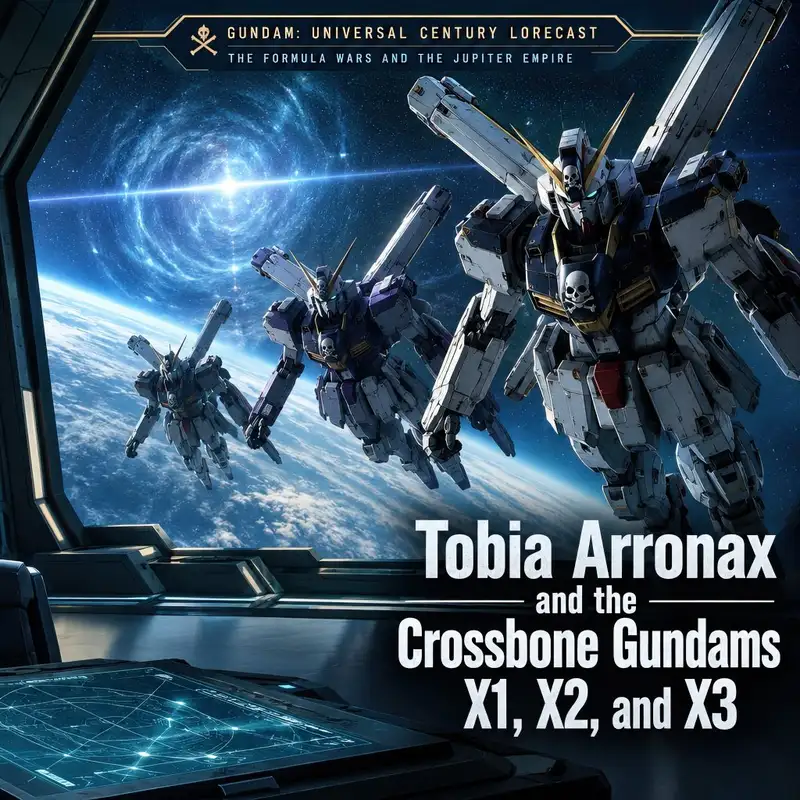
Tobia Arronax and the Crossbone Gundams X1, X2, and X3
Tobia Arronax did not set out for Jupiter looking for a war, a cause, or a Gundam. He was an exchange student traveling from Earth aboard the civilian transport Smashion, headed toward a distant society that most Earth Sphere residents knew less as a political community than as a source of fuel, industry, and hard-to-reach opportunity. That distance mattered. Jupiter was not merely far away on a map. It lay beyond the ordinary reach of quick Federation supervision, public scrutiny, and routine military response. A student voyage could become intelligence collection without anyone aboard consenting to that role. And when Tobia encountered evidence that the Jupiter Empire was preparing poison gas as part of a larger assault on the Earth Sphere, education gave way to a more immediate question. Who was prepared to act on the warning?
The answer was uncomfortable. The people with the clearest understanding of the danger were not a recognized Federation task force or a publicly accountable security agency. They were the new Crossbone Vanguard, a small force officially treated as space pirates. That label carried real consequences. It denied them legal standing, made resupply and access more difficult, and allowed authorities to dismiss them as criminals or adventurers. But it also concealed a practical reality. In Universal Century one hundred thirty-three, formal legitimacy and actual defensive capability did not reliably occupy the same place. The Crossbone Vanguard could see a threat developing at Jupiter because it operated where larger institutions were absent, distracted, or politically unwilling to look.
That contradiction is the foundation of Tobia’s story in the original Mobile Suit Crossbone Gundam manga. This is a print-continuity sequel-style branch set ten years after the Cosmo Babylonia conflict of Mobile Suit Gundam F91. It is not an animated record, and it should not be treated as though every later Crossbone story, game scenario, or model-kit variation belongs automatically to this campaign. Within this manga’s account, Tobia’s importance comes from the way he grows through contact with three related but very different mobile suits: the Crossbone Gundams X1, X2, and X3. The machines matter, but not because they form a simple ladder from weaker to stronger. Each one teaches him something different about war, trust, skill, and responsibility.
The evidence Tobia encountered ended the idea that politics could remain an abstraction studied from the safety of a classroom. He does not become involved because he has inherited a famous name or been selected by a state program. He becomes involved because he has seen enough to understand that inaction carries consequences. That moral instinct is important, but instinct alone does not make a pilot, much less a soldier. The manga does not present Tobia as a finished ace stepping into a cockpit already prepared for greatness. He enters a conflict with courage and unusual potential, but also with limited experience, incomplete information, and no mature understanding of how a military organization keeps people alive.
Tobia joins this world because the information he carries has become inseparable from the fight over what to do with it. That does not mean he joins a cleanly organized cause with simple moral boundaries. The Crossbone Vanguard is resisting a genuine danger, but it must operate through deception, illegal movement, and violence. The Federation possesses formal authority, but fails to respond adequately to a threat developing beyond its political comfort zone. The Jupiter Empire speaks in the language of resources, power, and a return to Earth, but its preparations show a willingness to make civilian populations pay for those ambitions. Tobia’s education in war begins with the recognition that legitimacy, law, necessity, and survival do not always align.
His first combat experience reinforces that lesson. Tobia does not begin as the permanent pilot of a Crossbone Gundam. He operates Jupiter Empire equipment, including Batalla-type mobile suits and later a Pez Batalla. This matters because it places his early development in the world of improvised warfare rather than inherited prestige. He has to learn how a machine handles, how limited equipment changes decisions, and how a pilot survives when the suit under him is not a symbol of national technological supremacy. Captured or repurposed equipment can be valuable, especially to an irregular force, but it comes with costs. Maintenance is uncertain. Spare parts may be scarce. Documentation may be incomplete. The crew may understand the machine’s design better than the person now trying to use it against them.
The Crossbone Gundam X1 embodies the organization’s best strengths and its vulnerability. Its primary pilot is Kincade Nau, a veteran whose identity connects this story to the prior generation. Kincade is Seabook Arno, the former pilot of the Gundam F91, though in the context of the Crossbone Vanguard he operates under the name Kincade. That history matters, but it should not overwhelm Tobia’s story. Kincade is not present merely to provide a familiar face from an earlier conflict. He represents a kind of military continuity: a survivor who has learned that talent must be paired with experience, restraint, and the ability to keep others alive.
The X1 itself is associated with the F97 concept developed through the Strategic Naval Research Institute. Its design reflects the demands of operations in the Jupiter sphere, where mobility, maneuver, and close combat have to be understood in the context of difficult approaches, limited support, and a harsh strategic environment far from Earth. Its large movable rear thrusters give it the ability to maneuver with unusual flexibility. Its equipment favors close-range fighting. But the important point is not a list of weapons or a contest of specifications. The X1’s design is meaningful because it supports a particular style of combat: aggressive maneuver, rapid changes in orientation, and decisive action at close range when long-distance certainty is limited.
Tobia briefly operates the X1 during the early campaign. The experience is significant, but it is not a ceremonial transfer of heroic status. The X1 remains Kincade’s machine, and it expresses Kincade’s accumulated competence more than Tobia’s potential. A young pilot can sit in the cockpit of a high-performance mobile suit. He cannot instantly inherit the reflexes shaped by earlier combat, the habits of caution built through loss, or the judgment required to distinguish a bold move from a reckless one. Access to a weapon is not the same as mastery of it.
This is one of the most useful ideas in Tobia’s development. Inherited technology can reveal what excellence looks like. It can show a new pilot the reach of an experienced combatant’s skill. It can give him confidence that a problem has a physical answer. But it can also mislead him. A famous machine makes it easy to believe that ability resides in hardware. Kincade’s relationship with the X1 demonstrates the opposite. The suit is formidable because it is paired with a pilot who understands its limits, a crew that sustains it, and an organization that uses it selectively.
Kincade’s mentorship is therefore more important than any one lesson in the cockpit. Tobia is exposed to a form of leadership that does not simply reward reckless initiative. The veteran pilot does not need to deny Tobia’s courage. He needs to give that courage shape. He needs to teach him that protecting others may mean withdrawing, preserving a machine for a later operation, accepting that an enemy cannot be defeated immediately, or relying on a teammate rather than demanding personal victory. Those are not glamorous lessons, but they are the difference between a gifted survivor and a reliable combatant.
The Crossbone Gundam X2 presents a harsher lesson. Where the X1 is associated with Kincade’s experience and the survival of institutional memory, the X2 becomes associated with Zabine Chareux and the collapse of trust within the Crossbone Vanguard. Zabine is not merely an enemy pilot who happens to possess a matching machine. He begins as a senior figure within the organization. That makes his break with it politically and operationally significant. In a large military, a defection can still be damaging, but there may be layers of staff, records, security procedures, reserve units, and redundant communications to absorb the shock. In a small clandestine force, personal loyalty carries far more weight.
Zabine’s defection to the Jupiter Empire demonstrates that shared equipment, shared uniforms, and even shared enemies do not guarantee shared purpose. The Crossbone Vanguard’s members are united against a growing threat, but they do not necessarily agree about power, legitimacy, authority, or what should replace the failing structures around them. Zabine’s motives are not reducible to a single simple explanation. Personal grievance, elite confidence, political ambiguity, and strategic calculation all matter. What matters most is that his choice exposes a weakness built into resistance warfare. A force that must trust exceptional individuals because it lacks normal institutional depth can be wounded deeply when one of those individuals decides that his own judgment outranks the organization.
The X2 becomes a visual and military expression of that betrayal. It is a Crossbone Gundam, a sister machine to the X1, designed from the same general family of ideas. Yet it is turned against the people who once treated it as part of their own strength. This is not simply a matter of one side capturing enemy hardware. The defection gives the Jupiter Empire access not just to a powerful mobile suit, but to a pilot familiar with the Crossbone Vanguard’s practices, habits, and vulnerabilities. In an environment where intelligence and surprise are central, that knowledge can be as dangerous as the machine itself.
For Tobia, the X2 is not a trophy and not proof that he has graduated beyond Kincade or Zabine. His encounter with it takes place under coercive circumstances. His escape through the machine’s Core Fighter is a moment of resourcefulness under severe pressure. It demonstrates that Tobia can recognize an opening, understand the practical value of a component system, and act decisively when survival depends on improvisation. But escaping in part of an enemy-held machine is not the same as mastering that machine in combat. It is an extraction, not an accession.
That is exactly the kind of thinking Tobia needs to develop. Early courage asks, “Can I win this fight?” Maturing judgment asks, “What must survive, what can be recovered, and what does this action allow us to do next?” The Crossbone Vanguard cannot afford to confuse a dramatic duel with a strategic result. It must preserve people, information, and scarce assets. It must know when an escape is an achievement. Tobia’s experience with the X2 begins to move him away from the idea that a mobile suit’s purpose is simply to defeat the mobile suit in front of it.
Behind these individual encounters lies the larger danger from Jupiter. The Jupiter Empire’s campaign depends on distance, concealment, long-range preparation, and the assumption that the Earth Sphere will fail to respond in time. Moving military power from Jupiter toward Earth is not a casual undertaking. It requires infrastructure, staging, supplies, trained personnel, and the ability to conceal intentions across an immense strategic space. A force preparing such an operation cannot rely on one dramatic weapon or one impulsive commander. It must create a system capable of sustaining movement and violence far from home.
For that reason, intelligence is so important in the story. Discovering a threat is only the first step. A warning must be believed, transmitted, evaluated, and acted upon by institutions capable of responding. The Crossbone Vanguard possesses information, but not formal authority. The Federation possesses formal authority, but its relationship with the Vanguard is compromised by suspicion and legality. A government can be strong enough to declare who is an outlaw and still be too slow, too complacent, or too politically divided to address the danger that outlaw has identified. That gap between legal status and practical security is one of the most persistent failures in the Universal Century.
The Crossbone Gundam X3 enters this environment as an experimental answer to a specific combat problem, not as a declaration that Tobia has acquired the best machine. Like the X1 and X2, it belongs to the same general family and is broadly comparable in basic performance. Its significance lies in specialized equipment and the tactical demands that equipment creates. The X3 is built for dangerous close combat and for surviving particular forms of beam threat. That makes it a powerful tool in the right circumstances. It also makes it a demanding machine, one that requires its pilot to understand what its systems can and cannot do.
Its most distinctive weapon is the Muramasa Blaster. Rather than treating it as a decorative superweapon, it is better understood as an attempt to give the X3 unusual close-range offensive options. Its blade incorporates numerous small beam sabers, allowing the weapon to create a dense and flexible cutting edge. In combat, that kind of system can make an opponent’s defensive assumptions unreliable. A conventional weapon may be blocked or parried in expected ways. A complex beam-blade system changes the geometry of the engagement. It gives the pilot options, but only if the pilot can bring the machine into the right position and maintain control under pressure.
The X3 also carries I-field generators in both arms. These are specialized defensive systems intended to counter beam attacks. They do not make the machine invulnerable. An I-field is not an invisible wall that protects every surface at every moment from every threat. Its effectiveness depends on the direction of attack, the system’s operation, the tactical situation, and the pilot’s ability to place the machine correctly. The arm-mounted arrangement gives the X3 a focused means of defense, particularly when it can bring those arms between itself and incoming beam fire. But focused protection is not the same thing as general protection.
That distinction becomes even more important because the X3 lacks the standard ABC mantle associated with the other Crossbone Gundams. The mantle is not merely a visual accessory. It contributes to survivability by offering protection in the beam-weapon environment. Without it, the X3’s defensive approach is more specialized and more dependent on active use of its I-fields. The machine can be exceptionally dangerous when it dictates the terms of close combat. It is less forgiving when it is forced into the wrong engagement geometry, caught from an unfavorable angle, or subjected to threats that its arm-mounted systems cannot neatly address.
In other words, the X3 gives Tobia capability, but it also gives him responsibility. A specialized machine can tempt a pilot toward overconfidence. It can encourage the belief that a new system has solved an old problem. But every technical advantage carries a tactical condition. The Muramasa Blaster is valuable if the pilot can close, maneuver, and exploit the moment. The I-fields are valuable if the pilot recognizes where the danger is coming from and how to orient the machine. Neither system replaces situational awareness. Neither replaces teamwork. Neither prevents the pilot from becoming isolated, exhausted, or overwhelmed.
The X3 also illustrates the industrial limits of the Crossbone Vanguard’s war. Experimental systems are not simple to maintain. They require specialized knowledge, careful repair, and a support organization capable of keeping a rare machine in service. The Vanguard cannot treat the X3 as a disposable asset. It is not a mass-production design with a broad pool of replacements. Its operational value must be balanced against the cost of losing it, the risk of deploying it before its pilot is ready, and the burden it places on the Mother Vanguard’s technical personnel. A prototype may be impressive in combat and still be a poor answer to a long war if the organization cannot sustain it.
For Tobia, however, the X3 is appropriate precisely because it forces this discipline. He is developing as a pilot, and the manga presents his Newtype potential as something observed gradually rather than as a completed and all-powerful ability. He becomes more perceptive. He can adapt under pressure. He displays the heightened awareness that makes him increasingly valuable in mobile-suit combat. But he is not transformed into an infallible figure who sees every danger in advance. Newtype sensitivity does not erase fear, fatigue, incomplete intelligence, or the consequences of a bad decision.
The X3’s limitations make that argument visible. A pilot who believes the machine is invincible will use it badly. A pilot who understands that its defenses are directional, its close-combat power situational, and its maintenance burden real can make better decisions. Tobia’s growth lies in becoming more capable of that second kind of thinking. Courage remains part of his character, but courage becomes useful only when it is connected to judgment. He has to learn not simply to rush toward danger, but to understand the danger’s structure.
That structure changes when the conflict reaches ground combat. The final stage of the Jupiter War includes fighting involving Tobia and the Death Gale squadron before the struggle returns to the decisive confrontation with the Jupiter Empire. Ground operations matter because they strip away the illusion that Gundam-class machines operate in a clean arena of individual duels. On the ground, terrain constrains movement. Infrastructure channels forces. Local defenders, infantry, vehicles, civilians, and damaged structures complicate every use of firepower. A mobile suit may have great mobility, but it still has to see through dust, move around obstacles, avoid harming the people it claims to protect, and remain supplied and repairable after combat.
The Crossbone Vanguard’s small-force method becomes especially demanding in such conditions. It relies on concentration. It brings scarce high-performance assets to places where they can disrupt an enemy plan. It uses intelligence and initiative to compensate for its lack of numbers. But concentration also means risk. If the enemy can fix those assets in place, isolate them from support, or force them into a battle of attrition, the Vanguard’s advantages shrink quickly. A resistance force cannot casually trade machines and pilots for ground. It must choose when to strike, where to disengage, and how to preserve its ability to fight after the immediate objective is complete.
This is where the relationship between X1 and X3 becomes more meaningful than any contest between them. When Tobia is in difficulty, the X1 returns to the fight. The moment is not a declaration that the older machine is superior, nor is it an insult to Tobia’s developing skill in the X3. It is an example of mutual support. Kincade’s experience remains relevant. Tobia’s growth does not require the older generation to disappear. The two machines represent different forms of capability, and the force survives because those capabilities can reinforce one another.
The Jupiter Empire conflict reaches its conclusion through this combination of scarce technology, veteran competence, youthful adaptation, intelligence, and collective risk. The immediate military result is clear enough. The invasion threat is defeated. The Empire’s plans to bring catastrophic violence to the Earth Sphere are stopped. That is not a small achievement. Preventing chemical attack and invasion means preserving lives that would otherwise have been treated as expendable. It means denying an imperial leadership the chance to translate distance, secrecy, and military preparation into mass coercion.
At the tactical level, the Crossbone Vanguard proves that a small force can defeat a larger danger when it has superior knowledge, mobility, trained personnel, and the willingness to concentrate risk. At the operational level, however, that success remains highly contingent. The Vanguard does not win because piracy is a superior permanent form of government. It wins because exceptional people, rare machines, and a capable support ship are able to act before the enemy’s preparations become irreversible. That is an important difference. A method that succeeds under emergency conditions may not be reproducible at strategic scale.
The political result is more troubling. The Federation’s failure to align formal authority with actual defense needs remains exposed. The Crossbone Vanguard has to operate outside normal legitimacy because the recognized institutions do not respond adequately to the threat. That does not make law meaningless. It shows that law without competent and trusted institutions can become an obstacle to security rather than a foundation for it. A government that dismisses every unofficial warning as piracy may preserve its procedures while losing the ability to protect the people those procedures are supposed to serve.
The civilian result is equally important. Tobia’s story begins with a student and a civilian transport, and it ends with the recognition that ordinary people were always the real target. Jupiter’s leadership treats Earth and its inhabitants as resources to be seized, punished, or destroyed. The Crossbone Vanguard’s struggle is not meaningful because its mobile suits look dramatic in battle. It is meaningful because it prevents a plan that would have turned civilians into the cost of imperial ambition. The same is true of the people aboard ships, in colonies, and in contested regions throughout the campaign. They are not background scenery for elite pilots. They are the reason military decisions carry moral weight.
After the war, Tobia’s eventual inheritance of the X1 following Kincade’s retirement has meaning precisely because it is not an automatic reward. He does not receive it because the X1, X2, and X3 were interchangeable stages in a collection. He receives it as part of a transition in responsibility. By then, he has learned what the X1 represents. It is not just the machine of a famous predecessor. It is an instrument sustained by crews, shaped by doctrine, and made effective by judgment earned through experience. To inherit it is to inherit obligations, not merely status.
The X2 leaves a different legacy. It demonstrates that technical excellence cannot compensate for the collapse of trust. A resistance organization can possess advanced mobile suits and still be endangered by internal fracture, political ambiguity, and the ambitions of its own elite members. The betrayal associated with Zabine is not an argument that every individual should be mistrusted. It is an argument that courage and skill require institutions worthy of loyalty. If a force depends entirely on exceptional personalities, it may be brilliant in action and brittle in crisis.
The X3 leaves the most personal lesson for Tobia. It gives him a machine suited to his developing abilities, but it refuses to make those abilities effortless. Its specialized weapons and arm-mounted I-fields reward tactical positioning. Its lack of the standard mantle preserves risk. Its experimental character reminds the pilot and crew that technological advantage is never free. Tobia becomes capable because he learns to work within those limits. He does not become significant by possessing the most powerful prototype. He becomes significant by understanding that power without judgment is merely another way to get people killed.
That is what the three Crossbone Gundams reveal about Tobia Arronax. X1 teaches him that excellence rests on experience, support, and institutional memory. X2 teaches him that even elite machines cannot survive political betrayal by themselves. X3 teaches him that specialized strength demands discipline, restraint, and the willingness to recognize danger before it becomes irreversible. Tobia grows not by climbing a hierarchy of better machines, but by learning what each machine cannot do for him.
The Crossbone Vanguard defeats a larger threat through skill, intelligence, courage, and the concentrated use of scarce resources. But its victory also exposes the weakness of a political order that leaves real defense to outlawed specialists while recognized authorities hesitate. Tobia’s maturity is therefore more than the story of a student becoming a pilot. It is the story of someone learning to use inherited technology without mistaking it for inherited wisdom, in a war where no prototype can replace legitimate institutions capable of protecting the people caught between empires.