The Zeroth Oldsmobile War [Manga]
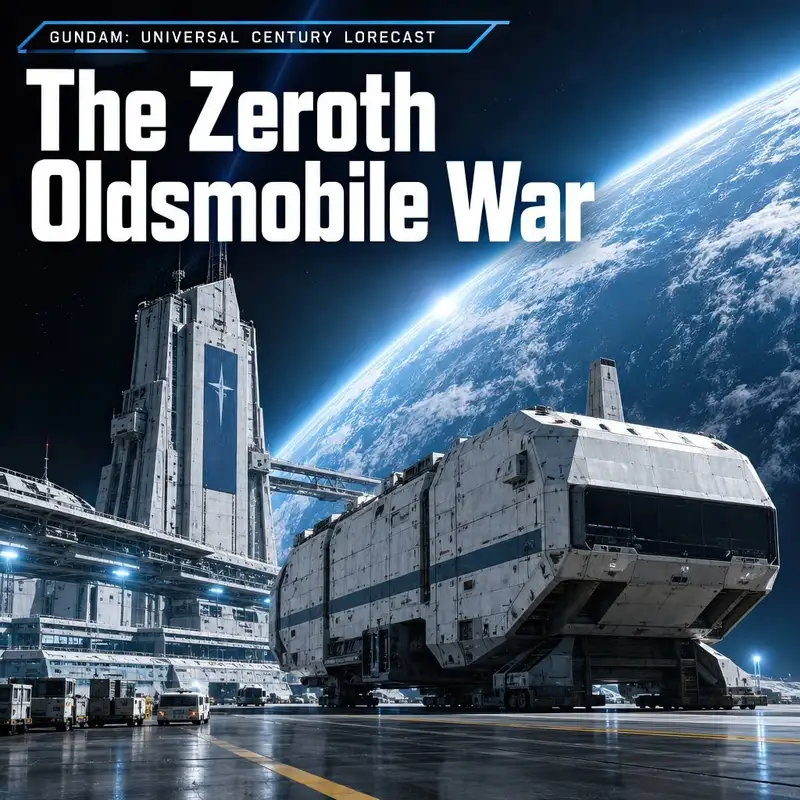
Trimurti was built to keep disaster away from Earth. It was an orbital charged-particle defense platform, part of a system meant to answer the old nightmare of an incoming asteroid or other large object on a collision course with the planet below. Its purpose was defensive in the broadest possible sense. It was infrastructure for planetary survival, and therefore infrastructure with immense political value. In Universal Century one hundred sixteen, the danger was no asteroid. It was seizure. Legacy, a coalition of Zeon-derived remnant and anti-Federation forces, moved against Trimurti with the intention of turning a defensive installation into a strategic hostage. The immediate issue was not whether Legacy could defeat the Earth Federation in an open campaign. It could not. The issue was whether a force too weak to conquer could still compel negotiations by making the Federation fear what might happen if it lost control of a weapon positioned above Earth.
The distinction matters. A remnant organization does not need the ships, factories, population, or administrative apparatus required to govern the Earth Sphere. It needs a target that converts limited military strength into political leverage. Trimurti offered exactly that possibility. Its capture could threaten Earth, disrupt traffic and communications around a major orbital installation, and demonstrate that the Federation could not protect the systems on which its own authority depended. The platform’s destructive potential was only part of the problem. Its capture would also have been a public humiliation. A government that cannot secure a planetary-defense weapon is not simply embarrassed. It invites every dissatisfied colony, corporation, officer corps, and political movement to ask whether its power is real.
The conflict later known in this manga record as the Zeroth Oldsmobile War began in that gap between military weakness and political leverage. Legacy had genuine roots in the unsettled aftermath of the Neo Zeon conflicts. Its leaders and fighters were not inventions of a Ronah family plot. They carried old loyalties, grievances, military experience, and a political language shaped by the long history of conflict between Earth-centered authority and the colonies. But the crisis they created also became useful to people with more access to parliamentary institutions, industrial programs, and long-term political strategy than any remnant commander could claim. That is the central problem of the Zeroth Oldsmobile War. It was a real uprising. It was also an opportunity for others to shape events from a safer distance.
Legacy was one such coalition. Under Rhein Dragun, it attempted to turn scattered resentment and inherited military networks into something more consequential than a series of raids. Its stated political purpose was the recognition of Side Three’s independence under terms associated with earlier Neo Zeon demands. That aim drew upon a real history of colonial grievance. Side Three had long been more than a battlefield name. It was a political community burdened by the memory of Zeon, by the legacy of dictatorship, and by the Federation’s failure to produce a settlement that could separate local self-government from recurring militarized nationalism.
But a claim to independence does not automatically create a workable political program, and it does not excuse the methods used to force recognition. Legacy’s practical problem was simple. It could not negotiate as an equal because it lacked the power of a state. It had no secure territory capable of sustaining a conventional military. It had no openly recognized government with the resources to administer a population, maintain industry, and survive a Federation blockade. If Rhein Dragun wanted the Federation to listen, he needed a crisis that made refusal dangerous. Trimurti was meant to be that crisis. The platform could provide a threat far beyond the reach of ordinary remnant raids, allowing Legacy to speak not merely with rifles and mobile suits, but with a weapon whose possible use could affect the entire Earth Sphere.
The Federation’s label for the forces involved was Oldsmobile. In the context of Mobile Suit Gundam F90FF, that name did not describe one perfectly unified army. It became a broad Federation term for Zeon-derived terrorist and remnant groups that used machines resembling mobile suits from the former Principality of Zeon. The label was politically convenient. It suggested a return of old enemies in old colors, a revival of a danger that the Federation had supposedly defeated generations earlier. It helped officials and military planners group together organizations that did not necessarily share a single chain of command, industrial sponsor, or political objective.
The RF Gromlin Two and the Draig illustrate the point without requiring a catalogue of every machine involved. Their value to Legacy was not simply that they could fight. They also made a political statement. They placed modern weapons inside the visual language of an older revolutionary war. For Legacy, that imagery could imply continuity. For the Federation, it could imply that every new attack was another return of the same defeated enemy. Neither interpretation was entirely accurate. The remnant networks of Universal Century one hundred sixteen were not the Principality of Zeon reborn, and they were not yet the later Mars-based forces associated with the First Oldsmobile War. They were a fractured political and military phenomenon operating under a name that concealed as much as it revealed.
Rhein Dragun stood at the center of Legacy’s attempt to turn that fragmented inheritance into political power. He carried the prestige of a former Neo Zeon commander, including service in the era of Haman Karn and the First Neo Zeon War. That past gave him credibility among people who valued military experience, remembered earlier campaigns, or believed that the Federation had survived only because its enemies had failed to unite. But past service was not the same as present capacity. Rhein was no longer commanding a state military with secure bases, formal logistics, and a recognized government behind it. He was leading a coalition. Coalition warfare is difficult even for governments. For remnant forces, it is a permanent condition.
Rhein’s plan for Trimurti was therefore a gamble on transformation. He needed to transform Legacy from a network of armed resistance into the temporary controller of a strategic system. If that succeeded, he could transform disruption into coercion, and coercion into negotiations. The intended political outcome was not merely destruction. In fact, indiscriminate destruction would have undermined the very leverage he sought. A hostage has value only while it remains vulnerable and valuable. Legacy needed Trimurti intact, functional, and visibly under its control. The threat had to be credible enough to frighten the Federation, but controlled enough to make bargaining possible.
That was the operational logic. It also contained the seed of Rhein’s fatal misunderstanding. He believed the crisis could be directed toward Legacy’s political goals. He understood that a remnant movement required a spectacular objective. He understood that Federation complacency could be exploited. What he did not fully understand was that a crisis can be useful to more than the people who begin it. The more public and consequential the emergency became, the more it attracted politicians, industrial interests, and dynastic projects that could use danger to force their own preferred changes. Rhein did not become a puppet without agency. Legacy chose violence, planned the seizure, and bore responsibility for threatening civilians and strategic infrastructure. But its leader entered a political contest in which other actors had deeper institutional reach.
The first major warning of Legacy’s reach came at Frontier I. Frontier I was not merely a convenient location for mobile-suit combat. It was inhabited space, a site of infrastructure, administration, and civilian life. An attack there meant more than damage to facilities or the movement of armed machines through colony space. It meant fear in a place where people lived, worked, traveled, and expected some measure of protection from the state that claimed authority over them. In a colony environment, security failures are never purely military. A battle can endanger transport systems, life-support networks, public confidence, and the fragile belief that political disputes will not be settled by turning inhabited infrastructure into a battlefield.
Legacy’s attack on Frontier I was connected to an attempt on Hauserie Ronah’s life. The combination was important. A public figure was threatened at the same time that the political order around him was shown to be penetrable. The attack demonstrated that Legacy could reach beyond remote bases or isolated military targets. It could enter a politically significant colony, threaten an influential politician, and create a spectacle that forced the Federation to respond. For an insurgent or remnant organization, visibility can be as important as firepower. The purpose is not always to destroy an enemy formation. Sometimes it is to demonstrate that security is conditional, that authority is vulnerable, and that ordinary life depends on decisions made far above the people most exposed to the danger.
The civilian effect of such an operation cannot be measured only in physical damage. A colony population does not need to see a weapon strike its home to understand what an attack means. The presence of armed forces can disrupt transport, commerce, communications, and public services. Rumors spread faster than official statements, especially when officials are still deciding what they can safely admit. Families make evacuation decisions with incomplete information. Workers wonder whether their facility is a target. Local authorities must decide whether to cooperate with security forces, resist them, or simply keep essential systems functioning. Every one of those decisions becomes part of the political battlefield.
Hauserie Ronah had already been attempting to change the Federation through politics. In Universal Century one hundred thirteen, he advanced the Earth Preservation Act and a measure concerning the abolition of excessive medical care. Both were vetoed. Their specific contents mattered, but their larger significance was political. Hauserie was not satisfied with a Federation that treated its existing institutions as adequate merely because they had survived successive wars. He pursued an interventionist reform agenda in a legislature resistant to change. He saw the Earth Sphere as a system in need of deliberate correction, not gradual drift.
When Hauserie reintroduced the Earth Preservation Act amid the Oldsmobile crisis, the timing was not incidental. The remnant threat made arguments for systemic action more urgent. It demonstrated, at least on the surface, that the Federation faced dangers it had not prepared for. The attack on Frontier I and the threat to Trimurti could be read as proof that the political order had become incapable of protecting Earth, the colonies, or the infrastructure connecting them. That interpretation was not wholly false. The danger was real. But the manga’s later revelations make clear that Hauserie’s relationship to the crisis was not that of a passive reformer swept along by events.
The exact boundary between Hauserie’s political strategy, Legacy’s independent actions, and the broader Ronah family agenda remains difficult to treat as a simple public record. The story presents a relationship of manipulation and calculated use. That does not mean Hauserie personally controlled every armed action, every remnant cell, or every decision made by Rhein Dragun. It means that he recognized the political usefulness of the emergency and was willing to operate within, around, and through a crisis that endangered real people. That distinction is essential. A manufactured crisis can contain genuine violence. An exploited insurgency can still possess its own ideology and agency. The existence of a hidden political beneficiary does not transform the people taking hostages into innocent tools.
What links them is the growing belief that the Federation’s existing order could not reform itself. That belief could produce genuine proposals for environmental or administrative change. It could also become a justification for bypassing consent, exploiting fear, and concentrating power in private hands. The Zeroth Oldsmobile War exposed that danger in miniature. A remnant uprising created the appearance of chaos. Political actors could then present themselves as the only people willing to restore order. Industrial programs could be accelerated in the name of security. New military systems could be tested under operational pressure. And the public, frightened by attacks on inhabited colonies and strategic installations, could be asked to accept changes it might otherwise question.
The military response to this crisis fell heavily upon Fastest Formula. The name suggests speed and technical ambition, which was appropriate. Fastest Formula was built around the testing ecosystem of the F90 program. It brought together test pilots, experimental mobile suits, support personnel, and attached specialists connected to the next generation of Federation mobile-suit development. Its people included Dir Rider, Gideon Blondin, Kanata Sawame, Buzz Galemson, Mizma Muerte, Faona Brigand, and others whose experiences shaped the unit’s character. But Fastest Formula should not be understood as a conventional fleet formation with the depth of an established service command. It was a special formation assembled around exceptional people and exceptional machines.
Fastest Formula operated during a transition in Federation military technology. Smaller and more advanced mobile suits were becoming increasingly important. The F90 program represented not just a single machine, but a search for flexible systems capable of meeting multiple missions through changing equipment and specialized configurations. That search involved institutional competition. Anaheim Electronics remained a major industrial actor, while the Strategic Naval Research Institute represented a different center of Federation military development. Such competition could produce innovation. It could also create overlapping priorities, secrecy, and pressure to demonstrate that one program or another had immediate operational value.
As Legacy moved against Trimurti, Fastest Formula’s task was clear enough in broad terms. It had to prevent a remnant coalition from turning the defense platform into an instrument of coercion. The mission was not to win a duel for prestige or to prove that the F90 could defeat a particular enemy design. It was to keep Legacy from obtaining control, firing authority, or the political credibility that would come from holding Trimurti. This made the battle an operation around infrastructure. The platform’s systems, personnel, approach routes, and command arrangements mattered as much as the mobile suits fighting in the surrounding space.
Space operations around a strategic installation are unforgiving even before combat begins. A force approaching Trimurti had to account for relative motion, docking access, traffic around the facility, and the possibility that debris from damaged mobile suits could become a hazard to the platform itself. Communications were subject to the familiar complications of Minovsky conditions, which did not make every system blind or silent but did make command more dependent on local judgment, prearranged plans, and incomplete information. The defenders needed to know who controlled which part of the installation. The attackers needed to seize key functions before the Federation could isolate or disable them. In such an environment, a delay of minutes could matter more than the nominal performance of any one machine.
Legacy’s objective was therefore both technical and theatrical. Technically, it needed access to Trimurti’s ability to threaten Earth. Politically, it needed the Federation and the public to believe that access had been achieved or was close enough to force concessions. Fastest Formula’s mission was the mirror image. It had to prevent actual seizure, but it also had to collapse the credibility of Legacy’s threat. A remnant organization cannot sustain strategic coercion if its prize is visibly beyond its control. The Federation did not need to annihilate every surviving enemy machine in order to win the mission. It needed to deny the hostage value of Trimurti.
The equipment committed to the battle reflected the improvised and experimental character of the conflict. The F90 FF type and the F90 PV Special represented different attempts to draw operational value from advanced Federation development. Legacy’s RF Gromlin Two and Draig combined modern capability with an older visual identity. Other systems joined the struggle as the crisis expanded. The variety of equipment could create tactical flexibility, but it also imposed a burden. Different machines require different support, different operating assumptions, and different levels of pilot familiarity. The more unusual the force, the harder it is to coordinate under pressure, particularly when the objective is not open-space destruction but the control of a complicated orbital platform.
This is where the romance of prototype warfare runs into its practical limits. Advanced machines can give a small force sharp local advantages. They can respond quickly, adapt to unexpected threats, and perform missions for which standard equipment is inadequate. But they also concentrate risk. A special configuration may depend on a specialized crew. An unusual control system may demand a pilot with rare experience. Damage that a mass-production unit could absorb through replacement or field repair may remove an experimental machine from the fight entirely. A force like Fastest Formula could be decisive in a narrow window. It could not be casually spent.
The battle for Trimurti ended with the collapse of Legacy’s operation, but not without severe losses to Fastest Formula. Much of the experimental force was destroyed in the process of stopping the seizure. That outcome should be measured at several levels. At the tactical level, Legacy failed to secure the platform. At the mission level, the Federation-linked defenders prevented Trimurti from becoming a functioning hostage. At the operational level, a potentially wider crisis was contained before it could compel a political settlement under armed threat. Those are substantial successes. Yet the cost reveals why victory in such a battle cannot be reduced to which mobile suit remained standing at the end.
Fastest Formula had succeeded precisely because it was unusual. It could bring highly capable machines and skilled personnel into a crisis where conventional structures had not provided a ready answer. But that unusual quality made its losses harder to replace. A standardized unit can be rebuilt through established production, training, and maintenance systems. It may take time, but the institution understands the process. An experimental organization often depends on people, components, and knowledge that do not exist in depth. When those are lost, the replacement problem is not merely industrial. It is intellectual and organizational. The design team may know how to build another machine eventually. That does not mean it can restore the same combat capability tomorrow.
The contrast with Legacy is revealing. Legacy depended on symbolic continuity, political networks, and the ability to gather dispersed forces around a dramatic objective. Its weakness was lack of stable institutional depth. Fastest Formula depended on technical expertise, prototypes, and the willingness of the Federation to employ a test organization in combat. Its weakness was also lack of stable institutional depth, though of a different kind. Neither side was structured for a prolonged conventional war. Legacy could not hold major infrastructure indefinitely. Fastest Formula could not absorb losses like a mature service formation. The battle became a collision between two fragile systems, each trying to achieve a decisive effect before its own limitations became fatal.
That does not make the sides morally equivalent. Legacy chose a strategy of coercion that put civilians and strategic infrastructure at risk. Its demand for political recognition did not justify threatening Earth through a planetary-defense weapon. The Federation-linked side acted to prevent that coercion. But historical analysis requires more than a moral scorecard. The Federation’s ability to stop the threat depended on a special force whose very existence exposed the gaps in ordinary readiness. The crisis showed a government still capable of defending itself, but not necessarily capable of doing so through institutions that were transparent, durable, or politically trusted.
Rhein Dragun died, and Legacy was effectively destroyed as a coherent operational force. In immediate terms, this was the end of the uprising’s central gamble. Without Trimurti, Legacy lost the leverage it needed to force negotiations. Without Rhein, it lost a commander who could connect disparate remnant elements through prestige and experience. Its network could leave behind survivors, memories, and local resentments, but the organization no longer had the ability to turn those fragments into a crisis of the same scale. The Federation had won the battle it needed to win.
It had not won a final political settlement. Side Three’s future remained unresolved by force. The Federation’s institutional stagnation remained unresolved by force. The conditions that allowed remnant networks to recruit, hide, and obtain modern equipment remained unresolved by force. And the political culture that allowed powerful figures to use emergency conditions for broader agendas remained unresolved by force. Rhein’s failure was not that he misunderstood the importance of political leverage. He understood it very well. His failure was believing that control of a weapon would give Legacy control over the political meaning of the crisis.
In that sense, Rhein was neither merely a doomed romantic nor merely an expendable pawn. He was a commander with agency, a genuine political agenda, and responsibility for the violence Legacy used. He attempted to force the Federation into recognizing a settlement it had resisted. But he was also operating in a landscape where people like Hauserie Ronah could treat instability as evidence for their own projects. The remnant commander wanted to make the Federation negotiate. The political dynasty could use his attack to demonstrate that the Federation needed transformation on terms far more favorable to elite reformers and industrial planners than to Legacy itself.
The aftermath was marked not by triumphal public memory, but by obscurity. Fastest Formula became a suppressed or poorly remembered episode within Federation institutional history. That pattern is understandable. Governments do not always hide events because every fact is false. They often conceal or minimize events because the truth is inconvenient. The Zeroth Oldsmobile War exposed the vulnerability of strategic infrastructure. It revealed the operational use of experimental systems. It raised questions about political manipulation, private influence, and the relationship between reform programs and security crises. It also demonstrated the cost of relying on specialized personnel who could not easily be replaced.
Hauserie Ronah’s assassination in Universal Century one hundred eighteen underlined the instability of the political world he had tried to influence. His death did not settle the arguments around his reform agenda. It did not prove that every one of his policies had been wrong, nor did it redeem the manipulative methods associated with the Oldsmobile crisis. It showed instead that political projects built around concentrated influence, emergency conditions, and elite maneuver could generate enemies as readily as solutions. The Federation remained a system in which reformers could be blocked, security threats could be exploited, and public institutions could be bypassed by people with enough wealth, access, or private power.
The Ronah family’s later importance lies in that convergence of political ambition, industrial capability, and dissatisfaction with the Federation’s inability to renew itself. The Zeroth Oldsmobile War did not make the later Cosmo Babylonia project inevitable. History is not that tidy. Later authoritarian movements required their own choices, institutions, collaborators, and victims. But the conflict did reveal a dangerous direction of travel. The old language of Zeon rebellion still had power to mobilize anger. At the same time, emerging elites were learning that they did not need to revive Zeon’s institutions in order to benefit from the instability Zeon’s memory could produce.
For that reason, Trimurti remains the right image for understanding the war. It was designed to protect Earth from an external catastrophe, yet it became vulnerable to capture by people who understood that infrastructure can be more valuable than territory. Legacy did not need to occupy the planet. It needed to threaten the systems that made the planet governable. Fastest Formula did not need to destroy every remnant force in the Earth Sphere. It needed to prevent the strategic weapon from becoming a bargaining chip. Hauserie Ronah did not need to command every attacker. He needed the crisis to demonstrate the inadequacy of the political order he sought to change.
The Zeroth Oldsmobile War therefore began as a genuine remnant uprising and became something larger and more troubling. Legacy brought real grievances, real personnel, and real violence to the field. Its attempt to seize Trimurti was not an illusion. Yet the war’s decisive historical meaning lay in the way that uprising could be directed, exploited, and partly concealed by actors with greater access to institutions, industry, and political strategy. The tactical result was Legacy’s defeat. The operational result was the preservation of Trimurti, at a heavy cost to Fastest Formula. Strategically, no durable settlement for Side Three emerged. Politically, the crisis strengthened arguments for systemic change while demonstrating how reform itself could be weaponized.
The Federation contained the emergency without curing the vulnerabilities that produced it. Inhabited colonies, orbital infrastructure, and Earth itself remained objects that powerful factions could use as leverage in their struggle for authority. The Zeroth Oldsmobile War was not a simple revival of the One Year War in updated machines. It marked a more dangerous phase of the Universal Century, one in which old symbols could still mobilize anger, while newer powers learned to turn that anger into instruments of controlled instability.