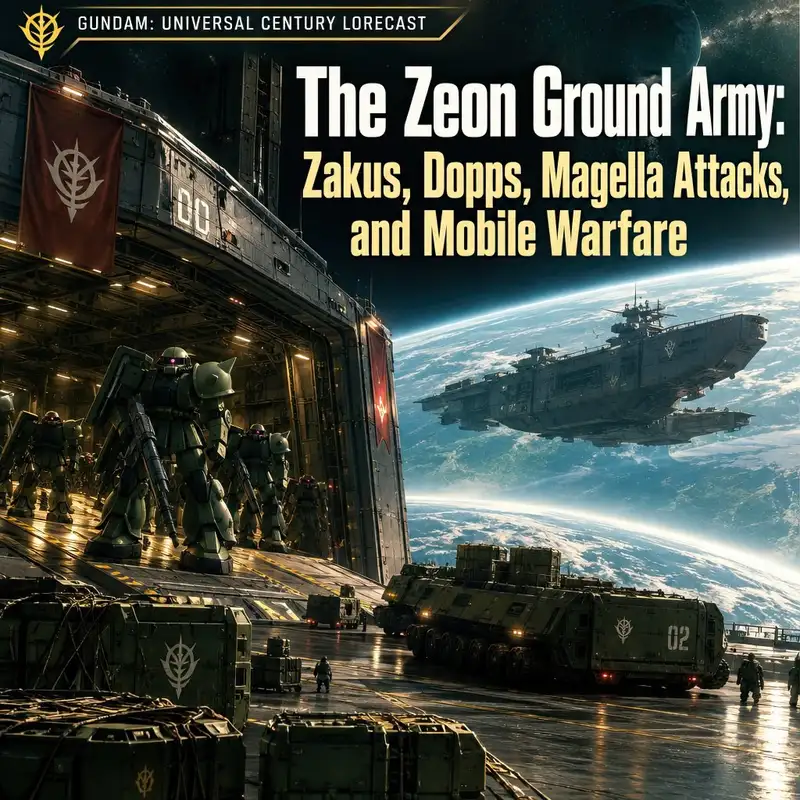
The Zeon Ground Army: Zakus, Dopps, Magella Attacks, and Mobile Warfare
A Zaku crossing open ground on Earth was more than an unfamiliar weapon appearing on an unfamiliar battlefield. It was a declaration that the old division between land, air, and armored warfare had been disrupted. The machine could stride over broken roads, use buildings and ridgelines for cover, carry weapons suited to several missions, and fight at the short ranges imposed by Minovsky interference. But a Zaku was never alone for long. It needed fuel or propellant, ammunition, mechanics, transport, communications, air cover, and somewhere to return when its seals, joints, armor, or pilot failed. Around it moved Magella Attacks, Dopp fighters, Gaw carriers, heavy transports, command vehicles, and the less glamorous machinery of occupation. Zeon’s early victories on Earth came from making this system work quickly. Its later failure came from discovering that seizing a planet and sustaining control of one were different military problems.
The contradiction was obvious from the beginning. The Principality of Zeon was a space-colony state. Its armed forces had developed around the strategic conditions of the Earth Sphere, especially the disruptive effects of Minovsky particles and the military promise of the mobile suit. It did not possess the long terrestrial military tradition, continental infrastructure, or established global presence of the Earth Federation. Yet in Universal Century seventy-nine, Zeon landed forces on Earth, seized major regions, and placed the Federation under pressure across a planet that had once been the center of its political and industrial power.
Zeon exploited that shock. It did not need to conquer every kilometer of Earth at once. It needed to seize key areas, disrupt Federation recovery, threaten launch and industrial infrastructure, establish bases, and force the Federation to respond under pressure. A force that could arrive quickly, move across difficult terrain, and strike before defenders could concentrate had a genuine operational advantage. The Zaku became the symbol of that advantage. But the mobile suit was only the visible part of a much larger terrestrial war system.
The Zaku Two was the mature expression of Zeon’s early mobile-suit program. It improved on the earlier Zaku model in endurance, power transmission, and flexibility, becoming the standard machine around which much of Zeon’s conventional military effort could be organized. Its historical importance was not that it possessed one miraculous weapon or that every pilot inside one was an ace. The important fact was that a single platform could carry useful firepower, move through terrain that constrained many conventional vehicles, manipulate equipment and obstacles with its hands, and operate in space, on land, and in other demanding environments with appropriate preparation.
That versatility mattered because Earth presented too many kinds of battlefield for a narrow weapon system. A desert approach, a ruined industrial district, a forest road, a mountain pass, and the outskirts of a city each imposed different demands. A tank could provide direct fire. Infantry could scout, hold ground, and enter spaces too dangerous or confined for larger machines. Aircraft could cover distance quickly. Artillery could strike beyond visual range. The Zaku did not replace all of them. It combined some of their useful qualities in one mobile combat machine, and that combination gave Zeon commanders options that the Federation was initially unprepared to counter.
Its standard weapons reflected that flexibility. The Zaku machine gun provided conventional automatic fire. The bazooka gave it a heavier anti-armor and anti-fortification option. The heat hawk gave the machine a close-combat weapon and a tool for destructive work. Other equipment could be fitted according to mission and availability. What mattered was less the inventory than the adaptability. A Zaku formation could move with infantry, cover an armored thrust, defend a base, raid a transport route, or exploit a local breakthrough without requiring a separate specialized vehicle for every task.
That capability was particularly valuable in a war where long-range electronic systems could not be assumed to work normally. In the Minovsky environment, combat often moved toward visual identification, short warning times, and local decision-making. A mobile suit could climb, crouch, cross obstacles, use concealment, and shift its weapon quickly toward a target. It could observe from a higher point than a tank, then descend into terrain where an aircraft could not remain. Zeon had built a weapon that gave small units considerable independence at the point of contact.
Independence at the point of contact, however, is not the same thing as independence from supply. A Zaku’s ability to walk did not mean it could march forever. Its weapons consumed ammunition. Its moving parts required inspection and repair. Its pilot required rest, briefing, medical care, and replacement if lost. Battle damage that a tank crew might address with field repairs could still immobilize a mobile suit if the necessary parts, lifting equipment, or skilled technicians were unavailable. The machine’s sophistication was an advantage in combat, but it also created a maintenance burden.
This was one of the central facts of Zeon’s ground war. The Zaku gave Zeon tactical flexibility, but it did not free Zeon from the practical demands of operating an expeditionary army. The more widely Zeon deployed its mobile suits, the more it needed workshops, recovery teams, transport, spare parts, secure depots, and technical labor across the territories it had seized. A mobile suit was not a knight wandering independently across a battlefield. It was the forward edge of an industrial and logistical system.
The Zaku therefore created demands for supporting arms rather than eliminating them. It needed armor to help cover broad fronts, aircraft to contest local airspace and scout approaches, transports to move heavy equipment, carriers to extend the reach of air power, and mobile headquarters to keep operations moving. Zeon’s terrestrial force was effective because it understood this at least well enough to build a combined-arms system around the mobile suit. The Magella Attack was one of the clearest signs that Zeon did not believe Zakus could be everywhere or do everything.
The Magella Attack was an armored fighting vehicle developed to supplement mobile suits. It gave Zeon a cheaper means of distributing direct firepower across a wide front. Where a Zaku was valuable, complex, and dependent on a trained mobile-suit pilot, an armored vehicle could support defensive positions, escort movement, engage conventional armor, and provide local fire support without consuming the same scarce resources. In a continental campaign, that distinction mattered. Even a force with excellent mobile suits had to decide where those machines were most needed and what could be done by other systems.
Its design was unusual. The tracked Magella Base carried the vehicle across the ground, while the Magella Top carried the principal cannon and could separate from the base. In theory, that gave the crew a measure of flexibility. If the base was damaged or terrain demanded it, the upper unit could retain some limited combat value. But the two components were designed to work together. Separation did not turn the Magella Top into a fully capable fighter aircraft. It meant accepting penalties in stability, endurance, protection, and overall combat effectiveness.
That compromise tells us something useful about Zeon’s ground doctrine. The Magella Attack was not a sign that conventional armor had become irrelevant in the age of mobile suits. It was evidence of the opposite. Zeon still needed tracked vehicles to hold ground, support infantry, defend installations, and add firepower where mobile suits were scarce. The vehicle’s peculiar split configuration may have offered tactical options, but it also reflected the broader improvisation of a military trying to expand rapidly into an environment for which it had not built a mature, settled force structure.
In practical terms, the Magella Attack could support Zaku formations by engaging targets that did not require a mobile suit’s full flexibility. It could contribute to anti-armor work, local defense, and direct-fire missions. It could also preserve mobile suits for the moments when their mobility, height, and adaptability mattered most. That was force economy. A Zaku used to guard every road junction was a Zaku unavailable for reconnaissance, counterattack, or exploitation. The Magella Attack helped spread Zeon’s combat power across more ground than its mobile-suit inventory alone could cover.
The limits remained clear. Armored vehicles were tied more closely to terrain and routes than mobile suits. They required fuel, ammunition, maintenance, recovery, and crews of their own. They could not solve the political problem of controlling occupied populations. They could not guarantee air cover. And they could not substitute for mobile suits in the close, confused engagements that Minovsky conditions increasingly favored. Zeon’s strength came from combining these systems, not from finding a single machine that made the others obsolete.
Armor could support the ground force, but Zeon also needed to control the air immediately above it. That requirement produced the Dopp. The Dopp was a short-range atmospheric fighter developed after Zeon committed itself to major Earth operations. It was not the product of a long-established terrestrial air service with generations of infrastructure, test ranges, doctrine, and maintenance culture behind it. It was an urgent answer to a military problem that Zeon could no longer avoid.
In a Minovsky environment, the Dopp’s mission made sense. Long-range detection and missile employment were less dependable than they had been in prewar assumptions. Visual contact became more important. A fast aircraft carrying machine guns and air-to-air missiles could intercept threats near a defended area, escort a local operation, and contest the airspace around a mobile formation or base. The Dopp could move faster than ground forces and react to incursions that a Zaku unit might not be able to reach in time.
Its limits also made sense. Official descriptions emphasize its short range and the importance of carrier support. The Dopp was not a machine built for leisurely endurance over a continent. It needed nearby bases, carriers, maintenance, fuel, ammunition, and pilots. Its operational usefulness was greatest when it worked as part of a system, close to the Gaws, airfields, and ground formations that could sustain it. Detached from that support, its performance mattered much less.
The Gaw attack carrier was part of that hidden architecture. It was an atmospheric assault and air-support platform capable of moving combat power into a region where fixed facilities might be limited or threatened. Official reference material identifies it as able to carry mobile suits and Dopp fighters, though no prudent historian should assume every vessel of the class always carried the same complement in every operation. What matters is the mission. A Gaw extended the reach of Zeon’s ground force by bringing aircraft, mobile suits, personnel, and supplies closer to the fight.
That made the Gaw more than a dramatic flying battleship. It was a mobile base. It could help generate sorties, shift forces between threatened sectors, and provide an immediate platform for air and assault operations. Its value depended on timing and protection. A carrier had to survive long enough to launch its machines, recover what it could, and move onward. It needed fuel, maintenance crews, ammunition, navigational support, and information about the airspace and ground situation ahead. Its cargo was powerful, but cargo still had to be carried.
The Fat Uncle heavy transport served an equally important if less glamorous role. It could move Zaku-class mobile suits and other heavy equipment that could not simply walk from one theater to another. The ability to transport a mobile suit changed the operational map. A formation could be redeployed more quickly, brought into a newly seized area, or moved away from a threatened position before it was trapped. But every transport flight also depended on loading facilities, security, route planning, weather and airspace conditions, and access to usable landing areas.
The same logic applied to mobile command and support vehicles such as Gallops and Dabdes. The exact arrangement of units varied by theater and source, but the principle is clear. Command, communications, repair, fire support, and transport had to move with the front. A headquarters fixed too far behind the fighting could not react effectively. A repair area too distant from the line turned recoverable damage into permanent loss. A supply column without security became a target. Mobility was not just something possessed by the Zaku. It had to exist throughout the force.
This is why carrier and transport operations belong at the center of any account of Zeon’s ground army. A mobile suit’s strategic movement was usually dependent on larger platforms. Its local mobility was impressive, but it did not generate its own supply chain. The same was true of aircraft and armored vehicles. Zeon’s combined-arms system worked when Gaws, transports, local bases, ground units, and mobile-suit formations could support one another. It began to strain when the distances between them became too great.
Rapid conquest enlarged those distances quickly. Initial landings and seizures could focus on critical points: bases, ports, airfields, industrial sites, transport corridors, and regions of political or military importance. Once those points were taken, the character of the campaign changed. The invading force now had to defend them, connect them, supply them, and use them to control the surrounding territory. A map shaded in the color of an occupying army can make that look simpler than it is. On the ground, every line of communication passes through inhabited places and vulnerable infrastructure.
Earth was not empty maneuver space. Roads, ports, rail lines, warehouses, fuel stocks, power systems, hospitals, and communications nodes existed because people lived and worked around them. Military control of a route could require checkpoints, patrols, repair parties, guards, intelligence collection, and local administration. Damage to infrastructure could hinder the enemy, but it could also deny the occupier what it needed to move supplies and govern. A base that could not receive food, parts, or personnel was not secure merely because a flag flew over it.
Civilian populations therefore mattered even when they were not the direct target of a battle. Occupation brought requisitioning, displacement, fear of bombardment, disruption of trade, and pressure on local services. Communities near bases and supply routes became exposed to military traffic and military violence. Some people might cooperate out of conviction, necessity, coercion, or the simple desire to keep their families safe. Others might resist, pass information, evade control, or merely try to survive without becoming involved. The record does not support a single uniform Zeon occupation policy for all of Earth, and it would be careless to invent one. But no occupation can be understood without the population living beneath it.
This was where Zeon’s early operational success began to dilute. A Zaku could seize a crossroads. It could not, by itself, police the surrounding district, repair a bridge, distribute food, interrogate prisoners, secure a depot, and protect a convoy moving through hostile or uncertain territory. A Dopp could intercept an aircraft near a base. It could not remain overhead indefinitely. A Magella Attack could support a defensive position. It could not make a scattered occupation force large enough to govern a continent. Each gain created more tasks than the initial assault force had been designed to perform.
The Principality’s political leadership set the broad direction of the war, but practical control on Earth was divided among regional commands, mobile-suit units, armored forces, aviation elements, occupation personnel, technical organizations, and local headquarters. This was not evidence that Zeon lacked command entirely. It is evidence that large military institutions do not operate as a single person’s will, especially across a planet-sized theater. Authority on paper and control in practice are never identical.
Garma Zabi illustrates the point. He was politically important and held regional command responsibilities during the early Earth campaign, but he was not the commander of every Zeon soldier, aircraft, mobile suit, and occupation force on the planet. Treating him that way turns a complicated invasion into a family drama and obscures the real military problem. Regional commanders had different terrain, resources, threats, and access to support. Their priorities could not be identical, even when they served the same regime.
M’Quve’s role in the Odessa and resource theater makes a similar point. His importance lay in the connection between military defense, industrial capacity, and control of valuable ground positions. Odessa was not significant merely because a prominent officer was associated with it. It mattered because the European theater represented a major strategic position whose resources and infrastructure supported Zeon’s wider ability to remain on Earth. A theater command could be powerful without controlling the entire terrestrial war.
Those weaknesses became more dangerous as the Federation recovered from the initial shock. Early in the war, many Federation ground forces faced Zakus with weapons and doctrine that had not been designed for the problem before them. Conventional tanks, aircraft, artillery, infantry, and fortifications were not inherently useless. But they needed tactics, intelligence, coordination, and weapons employment suited to an enemy that could move vertically, cross obstacles, and deliver concentrated fire at close range. A force that expected armor to engage armor across familiar lines of sight had to learn quickly when its opponent could step over a berm or fire from behind a ruined structure.
The Federation’s response was cumulative rather than instantaneous. Local commanders learned how to use terrain, obstacles, artillery, infantry, armored vehicles, aircraft, and fixed defenses against mobile suits. Units adapted their reconnaissance and target-identification practices. Engineers, crews, and infantrymen had to understand where a Zaku was vulnerable and how to bring enough firepower to bear. The later account in MS IGLOO Two: Gravity Front illustrates this process of early fear, hard experience, and tactical adaptation. It is a valuable perspective on the ground war, though not a license to force every event into one seamless day-by-day chronology with the original television series.
The Federation’s own mobile-suit development became part of that process. Once Federation mobile suits began reaching the field, the Zaku’s original qualitative advantage became less decisive. This did not mean that every Federation machine was better, every Federation pilot was trained, or every Zeon unit was suddenly obsolete. War rarely changes that cleanly. It meant that Zeon could no longer assume its mobile suits would dominate simply because they were mobile suits. The enemy was learning the same language of war.
As Federation resistance hardened, Zeon’s central problem returned in larger form: replacement. The rapid advance that had made Zeon appear so powerful also stretched its supply system. Forces arriving from orbital or external entry points needed to be supported through captured bases, ports, airfields, roads, depots, and local facilities. Ammunition had to reach Zakus, Magella Attacks, aircraft, and defensive positions. Propellant and fuel had to keep vehicles and aircraft moving. Replacement parts had to travel to workshops. Wounded personnel needed medical support. Damaged machines had to be recovered before they became abandoned wreckage.
The challenge was not only material. It was human. A trained mobile-suit pilot could not be replaced as easily as a rifle or a spare track. Nor could an experienced mechanic who understood the faults of a particular machine under field conditions. Air crews required training. Vehicle crews required training. Command staffs needed local knowledge and the ability to coordinate under unreliable communications. The more losses Zeon suffered, the more the quality of its surviving personnel mattered, and the harder it became to restore units to their earlier effectiveness.
Transport security was another burden. A supply column, a landing zone, a depot, or an airfield was not merely a convenience. It was a point of failure. The farther a front moved from secure support, the more vulnerable it became to disruption, weather, attack, breakdown, and simple delay. Captured infrastructure could help, but possession of a facility did not guarantee that it could immediately produce compatible parts, support Zeon procedures, or operate without local labor and reliable communications. Occupation created access. It did not automatically create capacity.
Here the difference between tactical mobility and strategic sustainment became decisive. A Zaku could bypass an obstacle that stopped a vehicle. It could not manufacture its own replacement actuator. A Dopp could race to intercept an intruder. It could not remain in the air without fuel, maintenance, and a secure place to land. A Gaw could bring a formation into a threatened sector. It could not be everywhere at once, and it needed protection and resupply itself. Mobility multiplied the value of support. It did not eliminate dependence on support.
Zeon also faced the larger industrial reality of the war. Its early mobile-suit advantage was real, and its ground forces used that advantage with considerable skill. But the Federation possessed a deeper demographic and industrial base. Once it reorganized, standardization, training, repair, and mass production began to matter more. Zeon could produce sophisticated machines and field capable personnel, but it had launched a war whose scale demanded continual replacement across space and Earth. That was a competition it could not solve merely by designing another effective combat system.
The Magella Attack, the Dopp, and the Zaku all reveal different sides of this burden. The armored vehicle was a way to distribute firepower without committing a mobile suit to every task. The fighter was a way to provide immediate local air defense despite limited terrestrial aviation depth. The Zaku was a flexible and powerful platform, but one that consumed scarce technical skill and maintenance effort. Together they made Zeon’s ground army formidable. Together they also show why the force could not be judged by any one machine’s performance.
Odessa exposed the operational consequences. The Federation offensive opened on November seventh, Universal Century seventy-nine, and the decisive defeat of Zeon’s final defensive line followed on November ninth. It is easy to remember Odessa through the personalities associated with it or through individual moments of combat. But its greater significance was structural. The Federation had reached the point where it could concentrate force against a key Zeon position and sustain that concentration. Zeon could no longer rely on its early shock advantage to preserve crucial ground and resource holdings.
In immediate combat terms, Odessa involved the familiar contest of mobile suits, armor, aircraft, artillery, defenses, and maneuver. For the wider operation, it represented the loss of a major position in Zeon’s Earth campaign. For the war as a whole, it narrowed Zeon’s ability to sustain its terrestrial presence and reduced the value of earlier gains. A force can win local engagements and still lose the campaign that gives those engagements meaning. That is one of the oldest lessons in military history, and the One Year War provided it in a very modern form.
The campaign also showed that territory is not merely land on a map. Zeon’s control of Earth depended on access to resources, infrastructure, routes, and populations. Losing a major theater affected more than prestige. It weakened the network that moved equipment, maintained forces, and supported the political claim that Zeon could dictate the war’s terms. The Federation’s victory did not erase the damage done by the invasion or resolve the deeper political failures that had helped make the war possible. It did, however, demonstrate that Zeon’s ground system had reached its limit.
That system deserves to be understood as a real military achievement. Zeon combined mobile suits, armored vehicles, aircraft, carriers, transports, and mobile support infrastructure into a force capable of exploiting Federation unpreparedness. The Zaku provided the central breakthrough capability. It gave Zeon local flexibility, concentrated firepower, and an answer to the short-range, uncertain conditions created by Minovsky interference. Magella Attacks spread armored firepower across fronts too wide for mobile suits alone. Dopps gave the force urgent, local air support. Gaws and heavy transports connected combat power to distance.
But the same system contained its own limits. Its mobile suits, aircraft, and armored vehicles all depended on transport, repair, trained personnel, supply routes, and political control of the areas through which those supplies moved. Zeon could seize key points faster than it could create a durable structure to govern and sustain them. It could disrupt the Federation before it could replace the Federation. And once the Federation adapted, mobilized, and concentrated its greater resources, Zeon’s initial qualitative edge could no longer conceal the weakness of its strategic position.