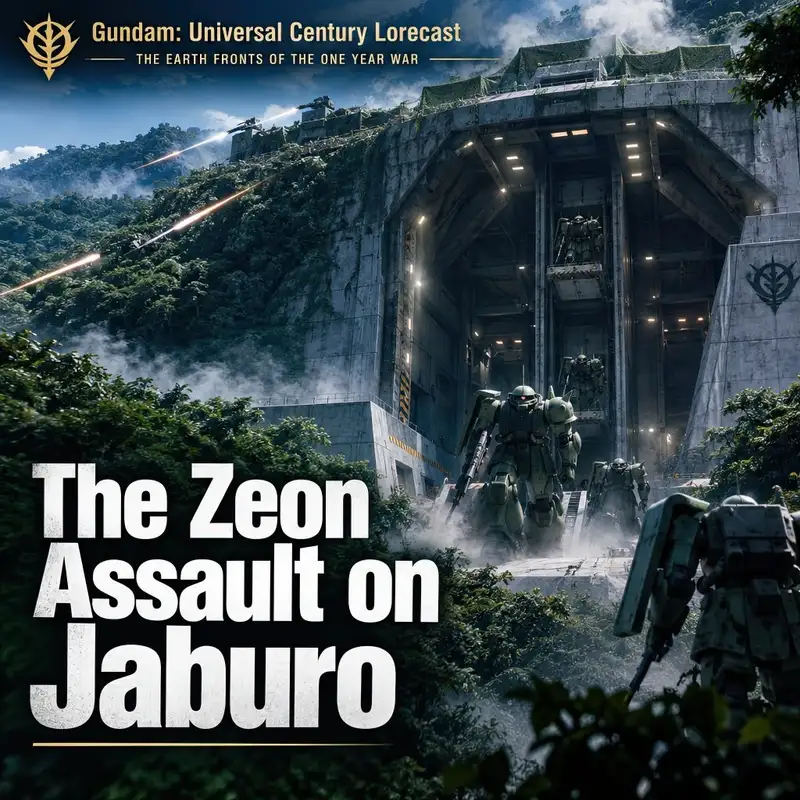
The Zeon Assault on Jaburo
Char Aznable’s reconnaissance force found something that no map was supposed to reveal: a way into Jaburo. The Earth Federation’s headquarters in South America had been built to disappear into its surroundings, protected by terrain, concealment, underground infrastructure, and the simple difficulty of finding a usable route through a continent-sized defensive environment. But any fortress that feeds aircraft, launches spacecraft, receives transports, moves troops, and maintains vehicles must have entrances. It must have roads, waterways, shafts, docks, service passages, and access points. Hidden does not mean sealed. When Zeon detected the signs of an entrance, it found a weakness in the Federation’s most important Earth-based military center.
For an attacker already losing strategic freedom, that discovery was difficult to ignore. Jaburo was not merely a command bunker. It was a headquarters, a communications center, a logistical hub, a protected repair and staging area, and a place where the Federation’s military recovery was becoming visible. The Federation had spent much of the war reacting to Zeon’s initial offensive. It had lost territory, suffered enormous destruction, and watched Zeon mobile suits reshape the character of combat. Yet the Federation still possessed population, industry, manpower, and territory on a scale Zeon could not easily match. If that potential was being organized at Jaburo, then Jaburo was more than a base. It was evidence that the Federation was still capable of turning survival into counteroffensive action.
That made an assault rational, even if it was extraordinarily dangerous. A successful attack might have disrupted command, damaged production, destroyed stored equipment, killed senior personnel, and shaken confidence in the Federation’s ability to protect its own center of power. It might also have removed the White Base and the Gundam, two assets that had become unusually troublesome to Zeon operations. No single strike could guarantee the collapse of the Federation war effort, and Jaburo was not the Federation’s only military or industrial facility. But damaging it at the right moment could have bought Zeon time. By late in the One Year War, time was becoming one of Zeon’s scarcest resources.
The problem was that finding a door is not the same as taking the building behind it. Zeon’s reconnaissance success offered a route, not a complete operational picture. It did not provide a reliable map of Jaburo’s interior. It did not reveal every fixed defense, security detachment, mobile-suit unit, underground route, reserve force, command post, or production area. It did not tell Char exactly how quickly the Federation could move troops through passages it had designed and occupied for years. A concealed access point was a valuable intelligence discovery. It was not a substitute for the large and sustained force needed to seize, hold, or demolish a prepared headquarters.
White Base’s arrival made the situation more urgent. The ship had spent much of the war moving through contested territory under conditions that should have destroyed it several times over. It had survived because of the competence and endurance of its crew, the effectiveness of its prototype mobile suits, the help it received along the way, and no small measure of luck. It had also drawn attention. The ship’s record had become known to Zeon commanders, particularly to Char. White Base was no longer simply an experimental Federation vessel carrying an untested machine. It was an operational problem with a reputation.
That reputation mattered. Military intelligence is often less tidy than later history suggests. Commanders may not possess a complete technical assessment of an enemy weapon, but they do recognize patterns. White Base appeared repeatedly at places where Zeon operations went wrong. The Gundam had defeated or disrupted experienced Zeon units. Amuro Ray’s personal ability was part of that record, but so was the machine’s durability, its armament, and the way White Base kept placing it in combat. To destroy the ship and its mobile suits at Jaburo would have had tactical value. It would also have removed a symbol that Zeon forces had learned to associate with setbacks.
The Mad Angler formation followed that trail toward Jaburo. Its submarine-based approach was appropriate to the task. A conventional surface advance toward a concealed headquarters would have been exposed to air attack, reconnaissance, and defensive fire. The waterways and underwater approaches around Jaburo offered concealment and a possible way to bypass some of the defenses intended to stop a direct assault. When Zeon’s scouts detected the metallic signs of a concealed access route, they had found something useful. They had not found certainty. The route might lead into the base, but it might also lead into a prepared killing ground.
That distinction mattered because Jaburo’s concealment shaped both sides of the battle. For Zeon, concealment created the possibility of surprise. For the Federation, it created the advantage of defending familiar approaches from prepared positions. The defenders knew which passages mattered. They knew where equipment was stored, where troops could be moved, which tunnels led toward important facilities, and which routes could be blocked. A hidden fortress is difficult to locate from outside. Once fighting begins, however, it can become an unusually complex environment for an attacker. The defender possesses interior lines, local knowledge, fixed infrastructure, and the ability to shift forces through routes that may not be obvious to the invading force.
Zeon’s operational idea therefore combined two kinds of assault. From above, airborne forces could create pressure on Jaburo’s approaches. Gaw carriers and associated aircraft could deliver troops and mobile suits, attack visible defenses, and force the Federation to respond across a broad area. From below, the Mad Angler force could exploit water routes and concealed entrances with amphibious mobile suits. The goal was not simply to win a clean battle in the open. It was to overload the defense, create confusion, and send penetrating units through the gaps before the Federation could concentrate its strength.
It was a sensible concept for a force trying to attack a protected underground installation. Airborne attack could distract and suppress. Amphibious systems could approach from directions less suitable for ordinary ground forces. Mobile suits could bring armor, weapons, and mobility into terrain where tanks or infantry alone might struggle. The operation also reflected Zeon’s willingness to use specialized equipment for specialized environments. Amphibious mobile suits were not ornamental variations on the Zaku. They answered a real problem. Rivers, flooded approaches, docks, underwater routes, and coastal terrain created opportunities for machines designed to move through water and then fight on land.
But specialized equipment does not erase the difference between access and control. An amphibious mobile suit might reach a waterway that a conventional land machine could not use. It could not automatically navigate a defended underground complex, clear every passage, identify every target, carry enough explosives for a strategic demolition mission, secure a route for follow-on forces, and defend itself against mobile suits, security troops, fixed weapons, and counterattacks. The closer Zeon came to Jaburo’s core, the more the problem shifted from movement to control. Moving through a narrow route is one task. Holding that route while other forces pass through it is another. Finding a production facility is another. Destroying it decisively, and surviving long enough to exploit the damage, is another still.
The Federation did not greet the attack as an institution caught entirely asleep. Jaburo’s defenders responded with organized fire, mobile-suit deployments, security personnel, and the advantages of a base built for war. Concealment had protected Jaburo from easy targeting. Prepared defenses protected it once the attack began. The Federation could defend the air approaches, contest access routes, move personnel within the installation, and concentrate on threats that had already revealed themselves. The base was not invulnerable. No headquarters of that size could be. But it was not a single command room behind one door, either. It was a military system with multiple layers of defense and support.
Here, the attack’s scale becomes important. The Federation did not need to destroy every Zeon machine at once. It needed to prevent Zeon from establishing a durable corridor into critical areas. It needed to keep its command structure functioning. It needed to preserve enough of its facilities and personnel to continue the wider war. A defender in such a position can absorb damage that would cripple a smaller or less prepared force. A damaged airfield, a disrupted tunnel, or a destroyed defensive position may be painful. It is not necessarily decisive if the headquarters can still communicate, shift reserves, and continue operating.
That burden fell heavily on the attackers. Gaw carriers could deliver forces toward the battle, but delivery was not the same as sustaining them. Aircraft could strike and distract, but they could not seize tunnels. Amphibious mobile suits could exploit waterways, but they could not create a secure landing zone for the entire attacking force. A submarine formation could conceal the approach, but it could not replace the need for ammunition, recovery, repairs, navigation, and reinforcement once combat became prolonged. Zeon had assembled tools suited to opening a breach. It had not solved the harder problem of feeding enough force through that breach to defeat the system beyond it.
The outer battle around Jaburo was therefore a contest over access. Zeon needed to suppress the Federation’s visible defenses, generate confusion, and protect its penetrating elements long enough for them to reach targets of operational importance. The Federation needed to prevent those penetrating elements from becoming a larger breakthrough. Every defensive action that delayed the attackers mattered. Every approach route that remained contested forced Zeon to spend time, fuel, ammunition, and attention. The deeper an assault force went, the more dependent it became on the routes behind it. If those routes were insecure, then every advancing unit risked becoming isolated.
Char’s role illustrates both the strengths and limitations of the operation. He personally leads an amphibious penetration in his custom Z’Gok, using the machine’s mobility in water and its ability to operate across the boundary between underwater and land combat. That is an appropriate use of a commander with Char’s experience. He had a talent for reconnaissance, initiative, and rapid tactical adaptation. He understood that a narrow opening could matter more than a broad but heavily defended front. In a war shaped by Minovsky interference and mobile-suit maneuver, a commander willing to take risks at the point of contact could sometimes create opportunities that a more cautious officer would miss.
Char’s penetration was real. It mattered because it exposed a defensive seam. It forced the Federation to respond to threats closer to the base’s interior. It proved that Jaburo’s concealment and fixed defenses could not make it entirely inaccessible. But the significance of penetration has to be measured carefully. A force can enter a defended area and still fail its mission. It can destroy local targets and still fail to destroy the headquarters. It can reach a tunnel, a dock, or an internal route and still lack the mass required to seize a production complex, hold a command post, or conduct systematic demolition.
Jaburo’s defense revealed another development that mattered far beyond the immediate fighting. The Federation now fielded RGM-seventy-nine GM mobile suits. Their arrival was strategically more important than any single exchange of fire. Earlier in the war, the Gundam had stood out as an exceptional prototype. It was unusually capable, unusually durable, and operated by an unusually capable pilot. The danger for the Federation was that such a machine might remain a singular achievement. A prototype can win battles, collect data, inspire confidence, and alarm the enemy. It cannot by itself equip an army.
The GM represented movement away from that dependency. The television series establishes that the Federation was beginning to deploy mass-produced mobile suits from Jaburo. It does not require us to claim that every Federation formation across Earth or space had already been reequipped, or that the GM was identical in capability to the Gundam. The historical meaning lies elsewhere. The Federation had begun transforming mobile-suit technology from an exceptional project into an institutional capability. That required more than blueprints. It required factories, technicians, spare parts, weapons, trained pilots, maintenance systems, command structures, transport capacity, and units prepared to employ the machines together.
For Zeon, that was a dangerous signal. Zeon’s early mobile-suit advantage had been powerful because it combined technology, doctrine, training, and surprise. The Federation had been forced to respond under wartime pressure. Once the Federation began producing and integrating its own mobile suits, Zeon faced an enemy that could increasingly contest the war on the same technological ground while retaining greater depth in population and industry. The GM was not important because it was a glamorous machine. It was important because it suggested repeatability. A military can lose a prototype and replace it with difficulty. It can lose a standardized machine and replace it through a system.
When the open assault failed to produce a decisive breakthrough, Zeon adapted. The second phase of the Jaburo operation shifted from seizure and penetration toward sabotage. This made military sense. Capturing a vast underground headquarters would require an enormous commitment of troops, supplies, and time. Destroying a critical facility might require only a small infiltration team, accurate intelligence, explosives, and enough time to escape or at least complete the mission. Sabotage is often the weapon of a force that cannot hold ground but still seeks strategic effect.
Acguy units and Zeon commandos operate within that logic. Their task is no longer to force their way through every defensive layer in a visible assault. It is to exploit confusion, move through the base area, and plant time bombs near Federation GM production facilities. The choice of target is revealing. Zeon did not need to destroy every room in Jaburo. It needed to damage the part of Jaburo that represented the Federation’s future ability to field mobile suits in quantity. If the assault could not remove the headquarters as a whole, perhaps it could cripple the industrial process that gave the headquarters meaning.
Sabotage, however, has its own demands. The infiltrators require accurate target information. They need access. They need explosives that can damage what they are meant to damage. They need timing that prevents discovery before detonation. They need a plan for withdrawal, or at least a plan for what happens after the explosion. Most importantly, they need to understand the target. A production facility is not simply a large room full of machines. Its importance may lie in tools, assembly lines, stored components, power systems, technical personnel, records, or transport connections. Damage can be severe without being decisive. It can also be repaired if the defending side retains control of the site.
The sabotage effort shows that Zeon remained dangerous even after the main attack had been repelled. A failure to seize a base does not mean every infiltrator disappears. A defender can win the outer battle and still face internal security threats. Jaburo’s size, complexity, and mixed population made that problem more difficult. It was not only a battlefield. It was a functioning military installation with crews, administrators, technicians, injured personnel, dependents, and people displaced by the wider war. Such places develop routines, blind spots, and assumptions. Security is strongest where everyone expects danger. It is weakest where people assume the battlefield has ended.
Katz, Letz, and Kikka become entangled in precisely that vulnerability. Their role should not be romanticized. They are children caught inside a military institution during an active enemy operation. They are not trained commandos, and the danger they face is not a charming adventure. Their presence demonstrates a difficult social fact about the One Year War. White Base had carried not only military personnel, but also children whose lives had been disrupted by combat, displacement, and the collapse of ordinary civilian protection. By the time White Base reached Jaburo, the Federation was trying to sort military service, family responsibility, and wartime administration into separate categories. The war did not cooperate.
The children’s discovery of the sabotage threat does not mean Jaburo’s security system worked perfectly. It means the system had been penetrated far enough that untrained dependents encountered the consequences. The eventual prevention of disaster is important, but it should not obscure the risk. A military base can become a refuge because it has food, medical support, transport, walls, and armed guards. Those same features make it a military target. When the enemy comes, the people who sought safety within its perimeter are still exposed to the violence directed at the institution around them.
This is also why the sabotage phase should be understood as part of the same operation as the aerial and amphibious attack. Zeon’s first effort sought to overload the base’s defenses and push forces inside. The second sought to exploit the access already achieved, using smaller teams against a more limited target. Both phases were attempts to transform a tactical opening into strategic damage. Neither succeeded in changing the larger direction of the war. The bombs threatened the GM production facilities, but the Federation retained control of Jaburo. Its command structure survived. Its ability to organize and deploy forces continued.
White Base’s status after the battle reinforces that point. The ship and its crew had reached the headquarters they had been trying to reach, but arrival did not mean release from military obligation. If anything, Jaburo’s survival made the crew more valuable. The Federation could now absorb White Base into a formal command structure and assign it within a larger fleet. Bright Noa’s authority, formed under emergency conditions and constant pressure, became more clearly institutional. The crew’s combat experience became an asset the Federation could direct rather than merely observe from a distance.
Even so, the Federation had enough resilience to make use of White Base. That mattered more than whether every official treated the crew fairly. A military organization at war is judged not only by its ideals, but by whether it can learn, absorb experience, and place useful forces where they can affect the campaign. White Base had become useful in ways that extended beyond its guns and mobile suits. Zeon associated the ship with the Gundam. That association created an intelligence and deception opportunity. An enemy that expects White Base to appear in one place may shift attention and resources accordingly. Reputation can become a military asset, even when it begins as an unwanted consequence of surviving too many battles.
Zeon’s interest in the ship and Gundam was therefore not simply a personal contest between Char and Amuro. Their rivalry existed, and it shaped individual decisions. But Jaburo demonstrates that the wider military value of the ship was larger than personal animosity. White Base had become a known operational actor. Its presence could draw reconnaissance, provoke command attention, influence enemy planning, and serve as a visible symbol of Federation adaptation. The ship mattered because institutions on both sides had begun to treat it as something more than an isolated vessel.
Why, then, did Zeon lose the operation? In the immediate fight, the assault achieved genuine successes. Zeon found a usable approach. It launched a combined airborne and amphibious attack. It penetrated selected routes. Char’s force reached areas that should have been difficult to access. Infiltrators planted explosives near important production facilities. These were not imaginary accomplishments. They showed skill, courage, and an ability to exploit the terrain and the Federation’s vulnerabilities.
Across the campaign, however, those successes could not be converted into a decisive result. Zeon could not maintain secure corridors for follow-on forces. It could not coordinate the dispersed components of the assault well enough to create a sustained breakthrough. It could not destroy Jaburo’s command structure. It could not reliably eliminate the facilities that mattered most. It could not defeat the base’s prepared defenses quickly enough to prevent the Federation from bringing its own resources to bear. The operation reached inside the fortress, but it did not gain control of the fortress.
Intelligence was central to that failure. Zeon discovered an entrance. It did not discover Jaburo as a whole. The difference is enormous. An operational plan built around incomplete intelligence can succeed only if its follow-on forces are capable of adapting once uncertainty becomes reality. Zeon’s assault force had some ability to adapt. Char’s leadership demonstrates that. But adaptation has limits when the force lacks maps, reserves, secure communications, protected supply routes, and the strength to occupy what it enters. A concealed route can surprise the defender once. It cannot replace knowledge of the terrain beyond it.
Logistics also mattered. Zeon’s amphibious machines were useful during the approach, but specialized systems do not sustain themselves. They require maintenance, weapons, fuel or propellant, recovery, and routes through which damaged machines can be withdrawn or replaced. The attacking force was operating against a major Federation base, far from Zeon’s principal industrial foundations in space. Every machine lost was harder to replace than a defender moving within an established military complex. Every delay favored the side with reserves, workshops, stockpiles, and interior lines.
Command limitations compounded the problem. Char was effective at the point of penetration, but no field commander can be everywhere at once. He could not personally synchronize aerial strikes, supervise submarine approaches, direct every mobile-suit engagement, coordinate infiltrators, and manage withdrawals across a fragmented battlefield. The operation required a level of combined coordination that was difficult under the conditions of the war and especially difficult once the attack fractured into separate fights. Boldness can create an opening. It cannot by itself establish unity of command.
The surviving Jaburo complex changed the war because it preserved the Federation’s ability to continue organizing its recovery. The base remained a headquarters and support center. Its command infrastructure endured. Its military personnel remained available. Its facilities could continue to receive, repair, stage, and deploy forces. The Federation had not been spared damage, danger, or embarrassment. A hostile force had found a way in. That was serious. But serious is not the same as decisive. Jaburo’s survival meant that Zeon had failed to remove the institutional center it needed to cripple.
The industrial consequence was equally important. The GM production effort survived the sabotage attempt. That did not mean the Federation’s mobile-suit program was free of difficulty or instantly mature. It meant that the Federation retained the capacity to move toward scalable mobile-suit warfare. Zeon had demonstrated the value of mobile suits at the beginning of the war. Jaburo now showed that the Federation was learning how to reproduce that capability within a larger industrial and military structure. The Gundam remained important as a prototype and combat asset. The GM mattered because it suggested that the knowledge represented by exceptional machines could become available to ordinary units.
Politically, Zeon failed to produce the shock it needed. The destruction of Jaburo might have created a crisis of confidence, disrupted Federation planning, and strengthened the impression that Zeon still controlled the initiative. An attack that fails instead gives the defender a different story to tell. The Federation could present Jaburo as proof that it had withstood Zeon’s boldest effort and remained capable of defending its central institutions. Such narratives do not win wars alone, but they matter. They support morale, justify mobilization, and reassure allies, personnel, and civilians that the state can still function under pressure.
The operation also revealed the limits of strategic raiding against a large and resilient opponent. A raid can destroy a specific target, gather intelligence, or impose costs. It becomes less likely to alter a war’s direction when the defender possesses depth, redundancy, and the ability to absorb damage. Zeon needed a result large enough to offset the Federation’s growing advantages. Jaburo offered the possibility of such a result. It did not offer an easy path to it. The attack was a gamble born from a real strategic problem. Its failure did not make the gamble foolish. It showed how high the standard for success had become.
For the people caught within Jaburo, the battle carried a different lesson. Headquarters, factories, and military bases are often described in strategic language: nodes, facilities, command centers, production sites. Those terms are useful, but they can hide the human reality. Jaburo contained people working shifts, repairing machines, moving supplies, treating injuries, issuing orders, raising children, and trying to establish some form of ordinary life inside a war zone. The assault turned that environment into a battlefield. The sabotage phase proved that even after the guns outside began to quiet, danger could remain in the corridors and work areas where people assumed the fighting was elsewhere.
The Zeon assault on Jaburo was not irrational. It was a high-risk attempt to use surprise, amphibious mobility, and sabotage against the institutional center of a recovering enemy before that recovery became irreversible. Zeon found an entrance, achieved penetration, and threatened important facilities. But it could not turn access into control. Jaburo survived not because one famous Gundam was simply stronger than Zeon’s machines, but because prepared defenses, surviving command structures, emerging mass production, and the inability of an improvised penetration force to sustain itself all worked together. The battle demonstrated the difference between reaching a fortress and defeating the system inside it.