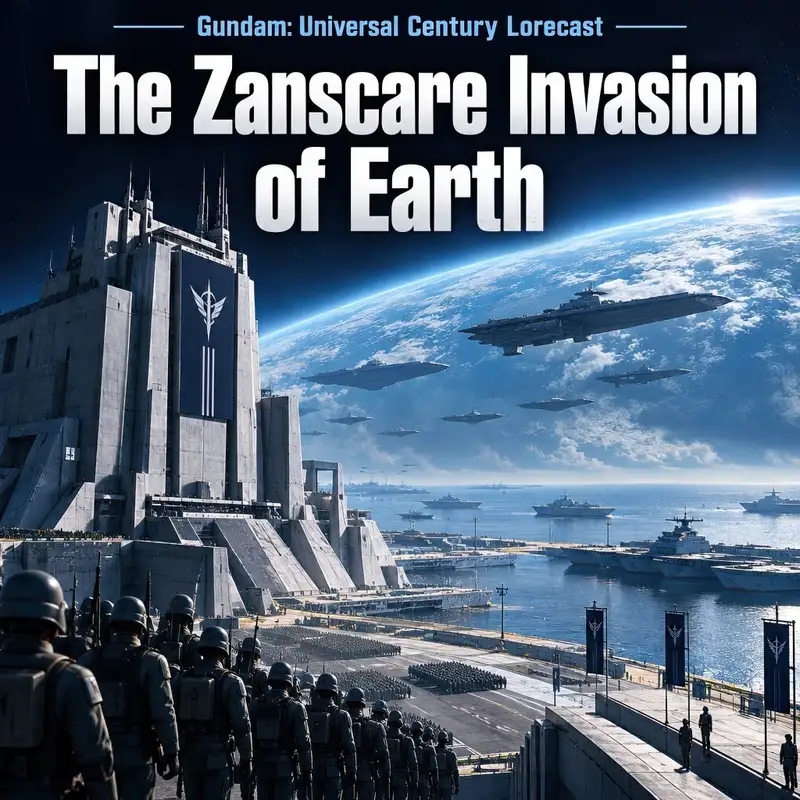
The Zanscare Invasion of Earth
Uwig was not a fortress. It was a residential area, a place where civilians lived under the assumption that distance from a formal front might still mean something. That assumption did not survive Zanscare’s opening operations on Earth. The settlement also concealed a League Militaire workshop, and that made it a military target in the eyes of an invading force. But the destruction of Uwig reveals the character of the campaign more clearly than a map of landing zones ever could. Zanscare was not first meeting a unified planetary army in open battle. It was locating communities that sheltered resistance, destroying the infrastructure that allowed opposition to exist, and forcing survivors into decisions no civilian population should have to make. They could flee, hide, cooperate, inform, or take up arms. In the East European settlements around Kasarelia, the war arrived as air raids, mobile suits, shattered homes, and the sudden discovery that an ordinary neighbor might be connected to an underground military network. The League Militaire’s factory at Uwig was important because it supported resistance weapons and repairs. Yet the people living around it were not spare parts in a military equation. They were the human terrain of an occupation war. Zanscare could destroy a workshop. It could kill or scatter its defenders. It could make an example of a district. None of that automatically gave it control over the survivors, the roads beyond the district, or the communities that now had fresh reasons to resist. That distinction runs through the entire Zanscare invasion. Raiding territory, occupying territory, terrifying territory, and governing territory are four different achievements. Zanscare proved remarkably capable of the first three. The fourth was always more difficult.
Earth was vulnerable because the Earth Federation remained formally sovereign without demonstrating the ability, or perhaps the political will, to provide rapid and credible security everywhere under its authority. The television record does not establish that the Federation had disappeared. It does not show every Federation formation standing idle, and it does not provide a reliable global order of battle from which to calculate the balance of forces. What it does show is a political center too weak and disengaged to prevent local crises from becoming local wars. Zanscare did not need to conquer the entire planet in one coordinated stroke. It needed to identify weakly defended areas, concentrate its forces at selected points, disrupt transportation, punish resistance, and exploit the delay between a local emergency and any larger institutional response. That is a familiar advantage for a smaller, more focused aggressor. Size matters in war, but concentration matters too. A large state with scattered forces, uncertain command relationships, and little appetite for intervention can be vulnerable to an opponent that knows exactly where it intends to strike. Zanscare’s Earth campaign benefited from this mismatch. Its leaders could select objectives. Local defenders had to react to threats against homes, transport routes, workshops, and communities. The Federation’s weakness created a security vacuum, and security vacuums rarely remain empty. They are filled by irregular forces, local militias, criminal networks, private armed groups, or, in this case, a resistance organization struggling to become something more than a collection of desperate local efforts. The League Militaire emerged because Earth’s official institutions were not enough. That was a strategic failure for the Federation. It did not mean that Zanscare had solved the much harder problem of replacing Federation authority with an accepted government of its own.
Zanscare claimed that it had a political answer. The empire emerged from Side Two under the public authority of Queen Maria and the ideology known as Mariaism. Its language promised order, protection, and a moral restoration of society. Maria’s image mattered because occupation cannot rely on weapons alone. An army can compel movement. It can seize a road, a port, or a launch facility. It cannot sustain rule indefinitely without some explanation for why people should obey when no mobile suit is standing in the street. Mariaism supplied that explanation, at least in official rhetoric. It placed maternal authority, social order, and moral discipline at the center of Zanscare’s public identity. But the regime’s actual structure was more complicated. Queen Maria possessed immense symbolic importance, yet the state was not simply her personal government. Fonse Kagatie was the central political strategist and architect of the militarized system operating in her name. BESPA, Zanscare’s armed force, carried out the practical work of conquest, surveillance, executions, and counterinsurgency. Individual officers had their own ambitions, loyalties, and doubts. Soldiers did not all need to be doctrinal believers to serve the regime. Some could be career officers. Some could be opportunists. Some could be convinced that harsh methods were necessary to restore order. Some could simply have nowhere else to go. The important point is that Mariaism gave coercion a language of virtue. It allowed the regime to frame obedience as protection and dissent as disorder.
That language was not incidental decoration. It was part of the campaign plan. When a government promises peace while expanding its security forces, citizens must ask whose peace is being protected and who is expected to pay for it. On Earth, the answer became visible quickly. Zanscare’s version of order required residents to accept military rule, political intimidation, and the disappearance of any meaningful distinction between public safety and submission.
The guillotine made that distinction impossible to ignore. When Zanscare captured figures such as Count Oi and placed execution at the center of its occupation methods, it was doing more than removing an opponent. Public execution was political theater. It announced that Zanscare possessed the authority to decide who remained inside public life and who could be cut out of it. The weapon was deliberately archaic in appearance, but its function was modern enough. It was a tool of intimidation, information control, and social isolation. A guillotine did not merely threaten the person beneath its blade. It threatened relatives, neighbors, local officials, workers, and anyone considering contact with the resistance. It encouraged people to calculate the cost of sympathy. It made collaboration appear prudent. It made silence seem like survival. The Yellow Jackets and other Zanscare security elements extended that pressure beyond execution sites. Mobile suits, battle-bike units, air-mobile forces, and armed patrols gave the occupation a reach that local communities could not easily match. These were not simply battlefield formations. They supported pursuit, convoy attacks, raids, and the rapid concentration of force against suspected resistance activity. Battle bikes and related systems could be configured for combat against mobile suits or against personnel, a reminder that occupation warfare needs weapons suited to both military opponents and unarmored populations. Yet terror has an operational weakness. It can destroy visible organizations, but it also changes the information environment. Civilians may become more frightened, but fear does not reliably become loyalty.
A village subjected to raids may stop speaking openly, conceal supplies, move people through back routes, and learn exactly which uniforms to avoid. Repression can deny the resistance a safe public presence. It can also drive resistance underground, where identifying friend, enemy, and neutral becomes even harder. Zanscare could impose silence. It could not be certain what that silence meant.
The League Militaire survived because it was not initially built like a national army. It had no secure capital, no broad tax base, no dependable territorial rear area, and no guarantee that a regular state military would arrive to rescue it. It was a distributed resistance network composed of technical personnel, concealed workshops, transport groups, civilian sympathizers, former military figures, local fighters, and crews willing to operate whatever ships or machines they could obtain, repair, or adapt. That structure created serious limitations. A decentralized movement struggles to concentrate forces. It has difficulty standardizing maintenance, protecting supply routes, replacing trained crews, and maintaining a unified chain of command. Every hidden workshop can be discovered. Every transporter can be stopped. Every civilian contact can be threatened or turned. But decentralization also gave the League resilience. Destroying one factory did not eliminate every technician. Capturing one route did not reveal every safe location. A small group could withdraw, reappear elsewhere, and continue the work of resistance if it retained tools, local knowledge, and the trust of people willing to hide it. The Victory Gundam became the League’s most visible weapon, and its capabilities mattered. A high-performance mobile suit could disrupt a raid, protect an evacuation, or give a small force a chance against better-equipped enemies. But the machine was not an army by itself. It needed maintenance crews, components, ammunition, transport, intelligence, and places to recover. Its pilot, Uso Ewin, was only thirteen years old.
That fact should not be celebrated as evidence of youthful genius triumphing over impossible odds. It reveals a manpower crisis. A resistance movement that places a child in an operational cockpit has already been forced into terrible compromises. Uso’s successes mattered, but they rested on a network of adults and civilians whose labor was less dramatic and no less essential. The League’s strength was not that it possessed one exceptional pilot. Its strength was that Zanscare could not easily separate that pilot, or any other resistance fighter, from the larger population that sustained them.
That need for movement brought the conflict toward Arty Gibraltar. Gibraltar mattered not merely as a recognizable piece of geography, or even as a port to be seized and defended. It was a node connecting Earth’s surface to the wider war in space. Transport, resupply, repairs, launch access, and the movement of people between atmosphere and orbit all passed through facilities of this kind. An invasion force that can occupy towns but cannot sustain its own routes remains an expeditionary force with a short future. A resistance movement that can hide in the countryside but cannot move equipment, personnel, and information across larger distances remains strategically isolated. At Gibraltar, Zanscare pressure therefore had an operational purpose. The empire needed to control the vertical dimension of the war. It needed to connect its space-based position with terrestrial operations, secure staging areas, and deny the League access to routes that could bring aid, matériel, or escape. The presence of neutral or civilian traffic complicated the problem. In an occupation zone, transport is never just transport. A freighter can carry refugees, spare parts, weapons, food, intelligence agents, or all of those things in different compartments. A vessel may be neutral in law, cooperative in practice, frightened into compliance, or secretly supporting one side. Zanscare’s forces had to identify threats without alienating every civilian actor whose cooperation they required. The League, meanwhile, had to use ordinary infrastructure without exposing the people who operated it.
For that reason, the early Earth struggle cannot be reduced to scattered mobile-suit fights. It was a contest over access, movement, and the ability to link local resistance with a broader military effort. Zanscare’s occupation would remain vulnerable as long as the League could preserve those connections. The League would remain vulnerable as long as Zanscare could threaten every route that connected Earth to space.
The war’s movement back into space did not end the invasion of Earth. It prepared a more ambitious version of it. The struggle around Kairas Giri showed that Zanscare understood the relationship between orbital power and terrestrial coercion. A space fortress could support renewed operations against Earth, provide a base for forces moving between theaters, and protect the infrastructure needed to sustain another descent into the atmosphere. The political dimension was becoming more important as well. Shakti Kareen’s connection to Queen Maria gave the regime a deeply personal stake in events that might otherwise appear only military. Shakti was not important merely as an individual caught between factions. Her existence touched the public image through which Zanscare justified itself. The empire’s symbolic order, its dynastic legitimacy, and its coercive institutions were becoming increasingly entangled. That mattered because regimes at war often treat political symbols as operational assets. A person can become a hostage, a rallying point, a source of legitimacy, or a problem to be concealed. But Kairas Giri should not be mistaken for the whole story of Zanscare’s strategy. It was part of a larger effort to retain the ability to intervene on Earth from space. The next phase would not resemble Yellow Jacket policing in Eastern Europe. It would be a purpose-built offensive, organized around specialized assault ships, mobile ground formations, and an ideological promise that concealed its actual method. Zanscare was preparing to impose order on a much larger scale. The name it gave that effort, Earth Cleansing, was itself a warning. Military language often tries to make destruction sound sanitary. Cleansing is not a neutral description when the objects being cleared are roads, settlements, infrastructure, and human communities.
The Motorad fleet represented Zanscare’s attempt to turn technological specialization into strategic momentum. Its core vessels, including the Adrastea and the Lysithea-class ships, were not ordinary cruisers that happened to operate near the ground. They were assault platforms designed around movement across terrestrial terrain. Their immense wheel structures transformed them into mobile formations capable of advancing along roads and across open ground while carrying weapons, mobile suits, troops, and the support needed to continue the offensive. The smaller and more maneuverable Lysithea-class vessels formed much of the fleet’s body, while the larger vessels embodied the campaign’s distinctive visual and operational logic. This was not simply naval power brought down from orbit. It was a form of armored invasion that treated infrastructure as both route and target. Duker Iq’s enthusiasm for battle-bike warfare and what he imagined as a biker’s paradise may have been personal, even eccentric. In another setting, it might have remained an officer’s peculiar obsession. Under Zanscare’s military-industrial system, it became part of a serious assault doctrine. Battle bikes, Einrad support systems, mobile suits, and wheel-based assault ships offered speed, protection, and the ability to concentrate force where conventional defenders were least prepared. An Einrad could increase a mobile suit’s mobility and defensive potential, but it was not a magical solution. It required a trained operator, terrain that allowed it to function, maintenance, and protection from close attack. The same was true of the Motorads themselves. Their size was intimidating, but it also tied them to landing zones, usable routes, repairs, ammunition, and an uninterrupted ability to move.
Specialized machines are never just machines. They represent a doctrine, a production decision, a maintenance burden, and a bet about the battlefield. Zanscare bet that it could descend, advance rapidly, break local defenses, and turn physical destruction into political submission. The fleet could certainly destroy. Whether destruction could create submission was another matter.
The Motorad fleet entered Earth’s atmosphere around the Tampico and Gulf of Mexico region before advancing inland through North America. This was an impressive demonstration of operational reach, but reach should not be confused with control. Bringing large forces from a space-based theater through atmospheric entry and onto a continental campaign route requires planning before the first wheel touches the ground. Landing areas must be selected. Forces must be organized after descent. Damage from entry and combat must be repaired. Mobile suits need servicing. Crews need rest, medical care, ammunition, food, and communications. Roads and open terrain must be usable, or at least breakable. Bridges, dams, settlements, and rail lines become military considerations because they either sustain the advance or obstruct it. Zanscare’s specialized vessels gave the fleet the means to impose itself on this environment. Its assault ships could roll through terrain that would have slowed or destroyed more conventional formations. Its mobile suits, battle bikes, and support elements could screen the advance, attack opposition, and pressure communities along the route. But every kilometer gained created new obligations. The fleet had to secure its rear, maintain the flow of supplies, control local movement, identify resistance cells, and prevent small attacks from accumulating into operational paralysis. A vast planet is difficult to conquer precisely because it contains so much space in which an enemy can avoid decisive battle. The Motorad campaign did not establish that Zanscare ruled North America, much less Earth.
It established that Zanscare could conduct a destructive penetration into inhabited territory. For civilians in the path of the fleet, the distinction could feel academic. A town does not need to be permanently occupied for its homes, roads, water systems, and families to be destroyed. Yet for the invader, the distinction was decisive. Breaking infrastructure may open a route. It does not create the administrators, police, local allies, food distribution, medical systems, and political consent required to hold what lies beyond that route.
The League Militaire faced an especially difficult problem in trying to stop the Motorads. In a conventional battle, the obvious answer might be to destroy the enemy’s largest and most dangerous platforms. But the fleet’s nuclear-powered vessels operated through inhabited terrain. A direct attack that catastrophically damaged a reactor could inflict the very kind of civilian disaster the League existed to resist. That constraint was not a convenient excuse for inaction. It was a real operational and moral limitation. Resistance fighters had to consider where a ship would fall, what would happen if its power systems ruptured, which settlements lay nearby, and whether a tactical success would poison or devastate the ground beneath the enemy. Zanscare’s doctrine exploited this dilemma. The more the fleet moved through populated areas and vital infrastructure, the more costly it became for an opponent to use indiscriminate force against it. The League therefore had to pursue less direct methods. Sabotage, route disruption, selective attacks on mobility, intelligence gathering, interference with support elements, and attempts to separate vulnerable units from the larger formation all became more important. Operations involving dams and transport corridors illustrate the kind of choices involved. Infrastructure could be used to slow the enemy, channel movement, or create openings for attack, but it could also endanger civilians downstream or destroy the same resources communities would need after the battle. This is the burden of fighting an invader that turns civilian geography into a shield and a weapon at the same time.
The League’s fighters required local knowledge, timing, contacts, and discipline. They could not simply charge the largest target on the horizon and call it victory. They had to preserve the population while denying the enemy the freedom to continue its advance. That is slower work. It is also work that rarely produces clean triumphs. Zanscare’s fleet could keep moving in part because the League could not afford to fight with Zanscare’s disregard for the terrain and people caught in the campaign.
The destruction around the Adrastea, and the death of Uso’s mother, Myra Miggelle, showed the human cost of that doctrine with terrible clarity. It is tempting to view Myra’s death only through Uso’s grief, because the series places us close to his experience. But the event has a wider meaning. A damaged mobile suit, a massive assault vessel, collapsing space, and an inhabited area became part of one chain of violence. This is what happens when an invasion force treats roads, towns, and civilian surroundings as terrain to be crossed at speed. The death was not an isolated tragedy detached from the campaign. It was the campaign made personal. Motorad warfare could transform ordinary places into impact zones. It could make escape routes dangerous, turn damaged machines into hazards, and ensure that even a battle aimed at military targets threatened anyone living nearby. Zanscare’s offensive achieved substantial destruction and imposed heavy pressure on its opponents. It demonstrated that the empire could project force far from Side Two and force its enemies into painful choices. Yet it did not produce a decisive political settlement. Soon after this phase of the campaign, the Earth Federation and Zanscare announced a cease-fire. The announcement did not mean that the invasion had been harmless, or that the damage could be reversed by diplomatic language. Nor did it mean that the broader Zanscare War had ended. Zanscare remained dangerous, and its forces would continue to serve wider strategic purposes, including the defense of Angel Halo.
But the cease-fire exposed the limit of the Motorad offensive. A force can devastate a region and still fail to dictate a durable political future. Military destruction may change the facts on the ground. It does not necessarily settle who has the right, the capacity, or the public acceptance to govern afterward.
For that reason, the Zanscare invasion of Earth must be understood as both an impressive military operation and a strategic failure of political control. Zanscare succeeded at several levels. Tactically, its forces destroyed resistance infrastructure, conducted raids, used mobile formations effectively, and imposed terror through visible coercion. Operationally, it exploited weak local defenses, threatened transport routes, connected space-based power to ground campaigns, and demonstrated that a smaller empire could penetrate a declining Federation’s territory. The Motorad fleet, in particular, showed real design capacity and doctrinal imagination. Its assault ships, battle bikes, mobile suits, and Einrad-supported formations were built for a specific purpose: to move rapidly through Earth’s terrain while breaking the systems that allowed organized opposition to function. But tactical and operational achievements did not become strategic conquest. Zanscare never demonstrated uncontested control of the planet. It exposed Federation weakness without replacing the Federation with a stable, accepted order. It created fear without producing durable legitimacy. Its executions and raids could compel outward obedience, but they also produced displaced people, hidden networks, collaborators of circumstance, and new recruits for resistance. The League Militaire could not match Zanscare in mass or regular supply, yet its dispersed structure made it difficult to destroy completely. It survived because communities, technicians, crews, and local fighters continued to resist even when formal institutions failed them. The invasion proved that Earth could be penetrated and terrorized by a focused space-based imperial force. It did not prove that Earth could be durably conquered through mobility, executions, and destruction. Zanscare could break roads, settlements, and local defenses, but it could not convert the ruins into consent.