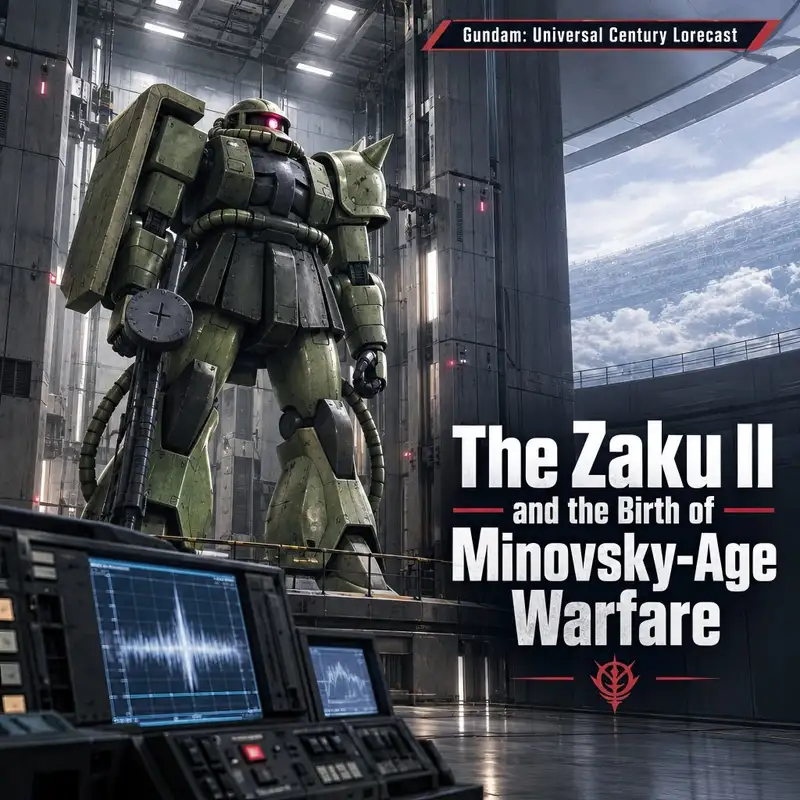
The Zaku II and the Birth of Minovsky-Age Warfare
A Federation warship commander in the opening months of the One Year War faced a problem that older naval doctrine had not prepared him to solve. His ship still had guns, missiles, armor, trained crew, and a place in a larger formation. What it no longer possessed was confidence. Long-range radar and communications had become unreliable under Minovsky particle conditions. Guided weapons could not be trusted in the way planners had expected. Reports arrived late, imperfectly, or not at all. A contact that might once have been a symbol on a display could now become a shape against the stars, closing from an angle the ship’s defenses had not fully covered. The Zaku II mattered because it was built for that world.
It was not simply a powerful machine, and it was not the first mobile suit. It was a practical answer to a battlespace in which fleets could no longer depend on distant detection, centralized control, and stand-off fire alone. Minovsky particles did not make every sensor blind or every transmission impossible. Optical systems, local communications, visual observation, and other methods still mattered. But the particles severely disrupted the electromagnetic systems on which modern fleet warfare had come to rely. That changed command. It changed reconnaissance. It changed formation keeping, identification, missile employment, and the time available to make decisions. Combat moved closer. Local initiative became more valuable. A pilot who could see, maneuver, identify, and fire in a confused environment gained importance that had previously belonged more securely to ships, staffs, and remote weapons.
Zeon did not merely discover this scientific condition. It built an armed force around it. The Zaku II was the most visible part of that force, but it was only one part. Behind it stood industrial planning, training systems, transport ships, maintenance crews, ammunition stocks, pilot replacement, doctrine, and a government willing to use military innovation in pursuit of political aims that extended far beyond battlefield defense.
The Principality of Zeon had good reason to seek an asymmetric military advantage. It confronted the Earth Federation, a state with greater population, deeper territory, wider industrial resources, and access to Earth itself. Zeon possessed important industrial centers, technical talent, and strategic positions in space, but it could not expect a simple contest of aggregate resources to favor it over time. If the war became a long struggle of replacement, shipbuilding, training, and economic endurance, the Federation’s advantages would become difficult to overcome. Mobile suits offered a way to alter the terms of competition.
In a Minovsky environment, a comparatively small combat machine could move through three dimensions, approach enemy ships at close range, exploit blind arcs, carry weapons suited to the immediate mission, and force larger vessels to defend themselves against threats they had not been designed to face in such numbers. This was not magic, and it was not a substitute for strategy. It was an attempt to create operational leverage before the Federation could organize an answer. The political context matters because Zeon’s military choices cannot be separated from the state that made them. Colonial grievances against Federation rule were real. Political power, wealth, and security remained unequally distributed across the Earth Sphere. But the Principality did not pursue its goals through democratic reform or limited defense. Under Zabi rule, it became a dictatorship that combined the language of Spacenoid autonomy with aggressive war, occupation, coercion, and mass killing.
The Zaku II gave that state a flexible weapon for conquest. It could protect a fleet, seize an installation, raid a colony, support an invasion, intimidate civilians, and hold ground. The requirement, then, was not simply to build a machine that could win a duel. Zeon needed a weapon system that could be manufactured in meaningful numbers, operated by ordinary trained personnel rather than a handful of exceptional pilots, maintained away from the factory, and integrated into fleets and field commands. The Zaku II became standard because it met that institutional requirement well enough to reshape an entire military.
The detailed prewar chronology of Minovsky research and early mobile-suit development comes mostly from later official reference material, not from the dialogue of the original television series. Those records should be used with care. They are useful for understanding the broad development of the Zaku system, but they are not a complete, uncontested wartime archive. What they consistently suggest is a progression from scientific theory, to military application, to early mobile-suit experimentation, and then to a more mature production system. The MS-05 Zaku I was an important step in that progression.
It demonstrated that Zeon could produce and field a practical mobile suit, while exposing the inevitable problems of an immature weapon: reliability, standardization, armament, pilot training, maintenance, and the gap between a promising concept and a system ready for war. The Zaku II, identified as the MS-06 series, was the successor shaped by those lessons. It was a general-purpose machine intended to operate across different missions and environments. That description can sound ordinary, but in military history, ordinary is often decisive. A weapon that can be built, repaired, adapted, and issued to many units may matter more than a more impressive machine that remains difficult to produce or sustain.
Later reference material associates Zeonic with the central Zaku development effort and identifies other Zeon industrial concerns, including Zimmad and MIP, as competitors or participants in parallel military development. The exact relationships shifted across publications, and there is no need to turn them into a neat corporate chart.
More important, Zeon’s mobile-suit revolution was institutional. It required designers, factories, test programs, procurement officials, transport networks, and military commands able to agree on a standard machine. Standardization made training more repeatable. It simplified parts support. It allowed crews to learn common maintenance practices. It gave commanders a baseline for planning. A Zaku II unit could still face shortages, mechanical failure, and local modification, but it belonged to a system larger than an individual pilot’s skill. That was the real advance from experiment to standard weapon.
The Zaku II’s shape is so familiar that it can obscure the military problem it was solving. Its humanoid form was not inherently the perfect answer to combat. No weapon shape is universally optimal. In the Minovsky-era environment, however, the combination of a human pilot, articulated limbs, maneuvering verniers, sensors, armor, and interchangeable handheld weapons offered a useful degree of flexibility. In space, the machine could alter its attitude, maneuver around structures, operate near warships and colonies, use its hands to carry equipment, and fight from changing angles. In a cluttered battlespace, those capabilities mattered. A mobile suit could pass through the same environment as a ship while exploiting spaces a ship could not use effectively.
It could approach a hull, defend a docking area, investigate a visual contact, or shift from a rifle to a heavier weapon according to the task. Its manipulators were not merely visual decoration. They supported the use of tools, weapons, cargo, and improvised solutions in environments where the next mission might not resemble the last. The Zaku’s weapons reflected that practical flexibility. It could carry firearms, missiles, heat weapons, and equipment selected for a particular assignment. That did not make it self-sufficient. Ammunition had to be loaded. Weapons had to be maintained. A machine configured for one mission might be poorly suited to another. Still, the ability to adapt a common platform gave Zeon more options than a fleet organized solely around specialized ships and fixed armament.
The mobile suit also returned the human being to the immediate tactical loop. In a sensor-degraded environment, the pilot’s judgment, visual awareness, and willingness to act under incomplete information became operationally significant. That was a strength, but also a vulnerability. Human pilots tire, misidentify targets, lose orientation, panic, and die. A Zaku could maneuver more freely than a cruiser, but it could not carry the cruiser’s endurance, stores, medical facilities, command staff, or strategic range. It was an instrument of local action. Its value depended on placing it in the right place, at the right time, with enough support to keep it fighting.
That support usually began with ships. The image of a Zaku drifting alone in space is dramatic, but the history of the machine is inseparable from carrier operations and fleet logistics. A mobile suit needed transport to reach distant theaters. It needed a hangar or base for inspection and repair. It needed crews to prepare weapons, replenish ammunition, check seals, service propulsion systems, and recover damaged machines. Pilots required briefings, communications, medical care, rest, and a command structure that could tell them what mattered amid the confusion of Minovsky interference. A ship that launched mobile suits also had to survive long enough to recover them.
It had to protect its hangars, manage its fuel and stores, coordinate escorts, and make decisions when contact with other formations was uncertain. The Zaku changed naval warfare because it placed new demands on every warship in the battlespace. A vessel could no longer think only in terms of enemy ships beyond the horizon of its guns. It had to defend vulnerable engines, bridges, sensor arrays, launch areas, and exposed arcs against small, maneuvering threats. It needed its own mobile-suit screen, point defense, escorts, and procedures for fighting at close range. In that sense, the Zaku extended the fleet’s reach while also increasing its burdens. Mobile suits could scout, intercept, raid, escort, and strike targets that a larger ship might struggle to engage directly. But they did not make warships obsolete. Guns remained useful. Missiles remained useful where conditions allowed.
Ships still carried the supplies, command authority, and firepower that made sustained operations possible. A fleet could win a close engagement and still fail strategically if it could not hold its route, protect its transports, or sustain its forces. The Zaku was not an independent knight roaming the void. It was a fleet weapon, and like every fleet weapon, it depended on an organization capable of launching, supporting, and replacing it.
That organization gave Zeon a sharp early advantage in the One Year War. The Federation did not begin the conflict with an equivalent operational mobile-suit force ready for broad deployment. Its warships, fighters, tanks, artillery, and existing command systems were not worthless, but they had been designed around assumptions that Zeon’s mobile-suit program had disrupted. The result was not simply that Federation forces encountered a stronger machine. They encountered an enemy operating with a different understanding of space combat. Zeon pilots could close distance under conditions that weakened long-range warning. They could attack in three dimensions. They could threaten ships in ways that demanded immediate local response.
Federation crews had to adapt while under fire, often with limited intelligence and without a doctrinal vocabulary for what they were seeing. The early shock of mobile-suit warfare was real, but it should not be exaggerated into a story in which the Zaku II single-handedly defeated the Federation. Zeon’s initial successes also depended on strategic surprise, preparation before the war, political decisions made at the highest level, the geography of the Earth Sphere, and Federation complacency. The Federation was larger, but size does not guarantee readiness. A large institution can be slow to recognize a threat, slow to revise doctrine, and slow to move resources where they are needed. Zeon exploited that delay. In early space operations, mobile-suit superiority gave it local advantages against Federation formations not prepared to counter them. It changed the calculation of fleet combat and helped create the impression that Zeon possessed an almost unanswerable weapon.
Yet surprise is a wasting asset. The first time an enemy encounters a new system, it confronts uncertainty. The next time, it brings observations. Then it develops procedures, weapons, training, and competing systems. Zeon’s challenge was never merely to win the first encounters. It was to convert early operational superiority into a strategic outcome before the Federation’s larger industrial and institutional resources could recover. The Zaku bought Zeon time. It did not guarantee that Zeon knew how to use that time.
The Zaku II’s flexibility also reveals the moral character of the war it served. During Operation British, Zeon transformed a colony into a weapon of mass destruction. That operation should not be remembered as an impressive feat of orbital engineering or as a demonstration of mobile-suit prowess. A colony was not empty infrastructure waiting to become a projectile. It was a civilian habitat, a life-support system, a workplace, a home, and a political community. To seize, gas, manipulate, and redirect such a structure was to destroy human lives on a vast scale while converting the remains of a society into an instrument of coercion.
Later technical reference material associates mobile suits with support roles around the operation, including security, defense of work areas, escort duties, and assistance in the dangerous work of altering a colony’s orbit. Those roles make military sense. Any operation involving a massive civilian structure, hostile forces, vulnerable engineering teams, and contested space would require perimeter security and local maneuvering forces. But military usefulness does not distribute moral responsibility away from the people who chose the mission. The Zaku had no politics of its own. It was an instrument. Zeon’s leaders, commanders, and institutions selected the target, authorized the methods, and pursued a strategy that treated civilian life as expendable. This is one reason the Zaku cannot be understood only as a machine that changed tactics. It enabled state power to operate at multiple levels. The same platform that screened a fleet or attacked a warship could guard a work site, intimidate a population, seize a facility, or support a mass-casualty operation.
Its adaptability made it militarily useful because it reduced the number of separate systems needed for different tasks. That same adaptability made it politically dangerous in the hands of a dictatorship willing to erase the distinction between military objective and civilian catastrophe. Zeon’s mobile-suit revolution created operational possibilities. Its government decided how to use them, and those choices would poison any claim that military innovation alone could secure a legitimate Spacenoid future.
The invasion of Earth tested whether the Zaku’s advantages in space could survive contact with gravity, weather, terrain, and the far less forgiving requirements of occupation. On the surface, the machine offered Zeon a powerful combination of mobility, armor, weapons, and psychological effect. Forces unprepared for mobile suits could find their tanks, artillery positions, roads, and defensive lines threatened by a machine able to cross broken terrain, carry heavy weapons, and strike from positions conventional formations had not planned to defend against. The Zaku’s height and silhouette could be intimidating, especially to troops and civilians confronting it for the first time. But intimidation is not the same as control, and mobility is not the same as logistical independence.
A mobile suit operating on Earth had to contend with gravity, ground pressure, terrain obstacles, weather, visibility, fuel or propellant, ammunition, mechanical wear, and the difficulty of moving a large machine across roads, bridges, cities, forests, deserts, and mountains. A damaged Zaku still needed recovery. A unit still needed mechanics, spare parts, supply vehicles, local bases, and routes that could actually support its operations. Infantry remained essential for searching buildings, holding ground, guarding prisoners, identifying threats, and interacting with civilians. Engineers mattered for bridging, demolition, repair, and route clearance. Artillery and aircraft could still shape a battlefield. Tanks did not vanish because mobile suits appeared. They faced a crisis of adaptation. Supporting animated accounts of Earth fighting, including MS IGLOO 2, show Federation armored forces struggling against Zeon mobile suits while also seeking ways to resist them.
The exact local incidents in such side stories should not be mistaken for a complete record of the ground war. Their broader lesson is sound: conventional forces learned. They adjusted ambush tactics, weapons employment, terrain use, and anti-mobile-suit doctrine. The Zaku was formidable, particularly when backed by surprise and combined arms. It was not invulnerable, and it did not eliminate the need to coordinate armor, infantry, artillery, reconnaissance, and logistics. On Earth, as in space, its greatest strength was not that it replaced every other weapon. It forced every other weapon to adapt.
The many forms associated with the Zaku II are often presented as a parade of names and colors. Historically, they are better understood as evidence of friction. Later reference classifications identify early nuclear-war equipment, space-oriented machines, ground-use machines, command types, and other specialized variants. The C type, F type, J type, S type, and related configurations are useful labels, but they should not be treated as a precise ledger proving that every unit received exactly the same equipment at exactly the same time. Wartime records and later technical publications do not always support that degree of certainty. What the categories do show is that one standard weapon still had to be adjusted for different environments and missions.
A machine intended for space did not automatically meet the needs of a ground formation. A command unit required more than a distinctive appearance if it was to support command and control. Equipment for exceptional weapons or specialized missions created separate training, maintenance, and security demands. Each new variant could solve a local problem while complicating supply. Parts had to be stocked. Technicians had to understand the configuration. Pilots had to learn its limitations. Commanders had to know what machines were actually available, rather than what a manual claimed might exist. Standardization was therefore not the absence of variation. It was the ability to manage variation without destroying the system’s usefulness. The ordinary Zaku pilot depended on a large and usually invisible workforce.
Mechanics checked the machine before launch. Armorers loaded weapons. Ship crews positioned the carrier. Supply personnel delivered parts and ammunition. Recovery teams retrieved machines that had lost mobility or suffered damage. Instructors prepared replacement pilots who might never become famous but had to be competent enough to survive a sortie and obey a plan. This labor was as important as the machine’s armor or weapon. A celebrated ace in a customized Zaku may capture public memory, but an ace’s machine is poor evidence for the average unit. The historical Zaku II was the machine of line formations, garrisons, fleet screens, assault units, and occupation forces. Its significance came from the ordinary people and institutions that could keep it in service.
The Federation did not remain trapped in the first months of the war. Once it understood that mobile suits were not a passing novelty, it began the difficult work of adaptation. That process included improved anti-mobile-suit methods, revised employment of existing forces, intelligence gathering, and the development of its own mobile-suit systems. The Federation’s RX Project and V Operation belong to this response. Their purpose in this history is not to turn the Zaku episode into a celebration of the Gundam. They demonstrate that Zeon’s monopoly on practical mobile-suit warfare could not last. The Federation studied the problem, developed more capable prototypes, and began to connect those prototypes to a wider industrial response.
A superior prototype can be decisive in a particular battle, but prototype superiority is not the same as strategic success. It may depend on rare materials, exceptional technicians, unique parts, or an unusually capable pilot. A war is decided more broadly by whether a state can translate lessons into production, training, maintenance, supply, and replacement. The Federation possessed the industrial depth to do that over time. Its political system was often slow, compromised, and badly prepared, but its material base remained enormous. Zeon, meanwhile, faced the cost of trying to preserve its technological lead while fighting across multiple theaters. The Zaku’s success encouraged further specialization and competition. That could produce innovation, but it could also scatter resources among increasingly complex programs. The Federation’s answer did not require it to duplicate every Zeon design or outperform every Zaku in every circumstance.
It needed to build enough capable systems, organize enough trained personnel, and sustain enough forces to deny Zeon its early advantage. This is the familiar rhythm of military competition. A new weapon creates shock. The opponent learns. The original innovator faces a choice between adaptation and overconfidence. Zeon had achieved something remarkable by creating a mass mobile-suit force before the Federation. But it had also started an arms race against an enemy with deeper reserves. The Zaku II did not end conventional military history. It accelerated it.
What changed, then, was not merely the identity of the strongest machine on the battlefield. The Zaku II altered the structure of warfare in the Earth Sphere. Tactically, it made close-range maneuver in sensor-degraded conditions central to major combat. It rewarded pilots and small-unit leaders who could act under incomplete information. Operationally, it gave fleets a mobile screen, an assault arm, a reconnaissance tool, and a means of fighting around colonies, stations, fortresses, and planetary landing zones. It supported invasions and helped Zeon project force into places where warships alone could not efficiently operate. Industrially, it made mobile suits central military systems rather than experimental curiosities. Factories had to produce them. Depots had to supply them. Ships had to carry them.
Schools had to train their crews. Research organizations had to improve them. Entire chains of command had to learn how to employ them without losing control of the battle. The Zaku also changed political power. A government with a force of adaptable mobile weapons possessed new tools for intimidation, occupation, and coercion. It could move violence closer to civilian populations and vital infrastructure. It could seize facilities that had once been difficult to reach. It could turn close-range tactical flexibility into a means of enforcing political decisions made far from the battlefield. Yet the Zaku did not solve the problems beneath Zeon’s war. It did not create enough industrial depth to match the Federation forever. It did not unify Zeon’s decision-making.
It did not turn a dictatorship’s claims of liberation into legitimate governance. It did not make occupation easy or erase the cost of fighting across Earth and space. It did not prevent the Federation from learning. The machine gave Zeon local superiority, time, and a way to exploit the weaknesses of an unprepared enemy. But military systems are judged not only by their first victories. They are judged by whether their political leaders understand what those victories can and cannot buy.
The Zaku II became the defining early weapon of Minovsky-age combat because Zeon could use it as more than a prototype. Fleets carried it, mechanics sustained it, pilots trained around it, and commanders built missions that exploited its flexibility in space and on Earth. That system gave Zeon a genuine opening advantage and forced every opponent to adapt. The limit was strategic. A standard mobile suit could not replace industrial depth, secure supply, experienced replacements, or political legitimacy. Zeon had built a weapon well suited to the battlefield it expected. The war lasted long enough to become a different problem, one that no single machine, however influential, could solve.