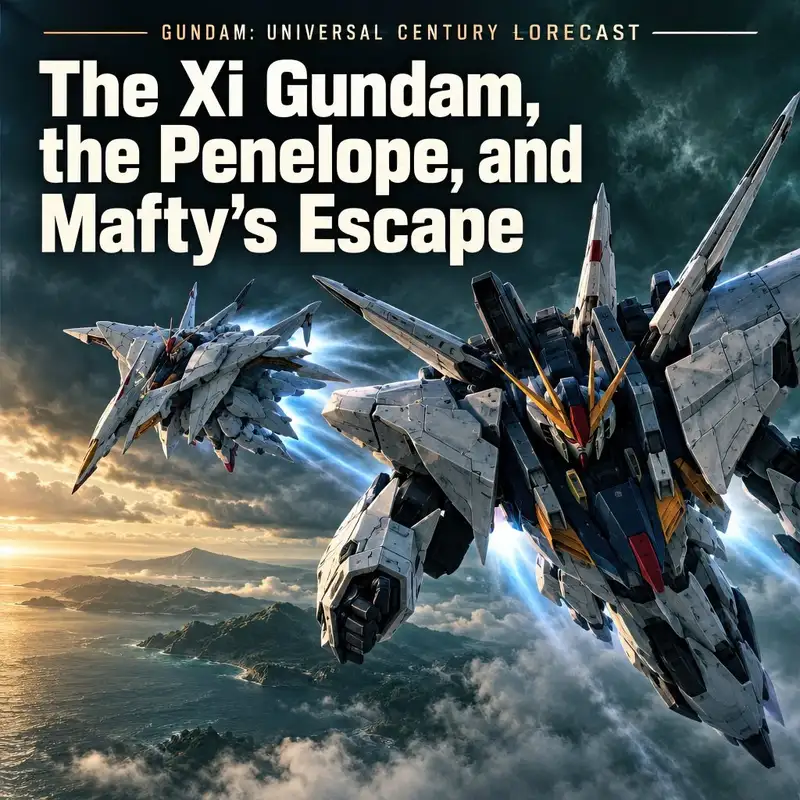
The Xi Gundam, the Penelope, and Mafty’s Escape
The streets of Davao are already telling the story before the Xi Gundam appears. Sirens, fleeing civilians, shattered infrastructure, and mobile suits moving through a populated city reveal the cost of Mafty’s attempted escape. Hathaway Noa needed the Federation to look in the wrong direction long enough for him to disappear into his organization’s support network. Instead, the diversion drew armed attention toward the city, endangered people who had no control over either side, and ended with one of Mafty’s experienced pilots, Gawman Nobile, in Federation custody.
That is the starting point for Mafty’s escape. Not a clean victory. Not the triumphant arrival of a new Gundam. It begins with a compromised operation, a captured operative, a leader whose civilian identity is becoming harder to protect, and a security response that is beginning to improve. The Xi Gundam and the Penelope matter because they enter that crisis. They are not simply two extraordinary machines meeting in the sky. They are the most visible instruments in a contest over intelligence, mobility, political legitimacy, and time.
By Universal Century one hundred five, the Earth Federation still possesses the legal authority, military infrastructure, and industrial access of the dominant state in the Earth Sphere. But authority is not the same thing as legitimacy, and infrastructure is not the same thing as control. The Federation Hathaway depicts is burdened by corruption, environmental decline, and a political class willing to preserve life on Earth for the privileged while compelling others to leave it. The Man Hunting policy, which forces civilians into space, is not merely an unpleasant administrative measure. It is a coercive population policy that turns citizenship, residence, and access to Earth into matters of police power.
The Federation response is also more complicated than a single machine called the state. Civil authorities, local security forces, Man Hunter institutions, police elements, military units, and intelligence personnel overlap in their interests but do not necessarily share one command structure or one understanding of the threat. That fragmentation can create openings for Mafty. It can also create confusion for civilians, who may encounter the Federation not as a constitution or an elected government, but as checkpoints, armed patrols, investigations, and orders they cannot challenge.
For Hathaway, the Davao operation is therefore dangerous on several levels. He is not merely trying to evade a patrol. He must preserve his identity as Mafty Navue Erin, keep the organization’s contacts from being exposed, manage the loss of Gawman, and continue preparing for a larger operation connected to the Adelaide Conference. At the same time, he remains publicly Hathaway Noa, a civilian whose past and family name make him noticeable even before anyone proves his connection to Mafty.
The earlier crisis aboard Haunzen Flight three hundred fifty-six makes that cover more fragile. The hijacking throws Hathaway into direct contact with Kenneth Sleg and Gigi Andalucia. The attackers claim to represent Mafty, but the claim itself does not give the Federation a reliable picture of the real organization. In fact, it adds another layer of uncertainty. A group acting under Mafty’s name may be connected to the movement, may be exploiting it, or may be serving someone else’s political purpose. In counterinsurgency and counterterrorism work, attribution is often the first battlefield. A government that mistakes every use of a name for proof of command can direct force at the wrong people while the actual network remains hidden.
The Haunzen incident still changes the situation. It gives Kenneth an opportunity to observe Hathaway at close range. It places Gigi beside both men. And it forces Hathaway to operate under scrutiny from people who are not simply anonymous security personnel. Kenneth is intelligent, socially adept, and professionally interested in the problem Mafty represents. Gigi is harder to classify. She notices things other people miss, and she becomes suspicious of Hathaway in ways that make his concealment more difficult.
The film does not provide a settled scientific explanation for Gigi’s perceptions. It would be careless to assign her a fixed Newtype category merely because she is unusually intuitive and seems able to see through evasions. What matters operationally is simpler. She is an uncontrolled factor in Hathaway’s security environment. She is close enough to observe him, perceptive enough to make him uneasy, and important enough to him that he cannot treat her as a disposable complication.
That personal concern matters because clandestine command is never entirely impersonal. Hathaway is trying to lead a political movement while maintaining an ordinary public identity. He has to decide when to lie, when to withdraw, whom to trust, and how much risk to accept for people near him. A commander who operates from a hidden identity has certain advantages. He can move through civilian spaces without immediately appearing to be a military target. But he also lives with divided loyalties. Every friendship, conversation, and emotional attachment can become an intelligence vulnerability.
Mafty is built to live with those vulnerabilities. It is not a conventional army holding a front line. It does not possess the Federation’s depth of bases, repair depots, recruitment systems, and legal authority. It cannot afford to lose personnel casually. It cannot establish a permanent headquarters, raise a flag over a region, and expect that position to survive a sustained military response. Its strength lies in movement, concealment, compartmentalization, and selective access to advanced equipment.
Its military force includes Messer mobile suits, support personnel, concealed contacts, and transport assets disguised within ordinary commercial activity. The modified ore carrier Valiant is important not because it is an impressive warship, but because it demonstrates what Mafty actually needs from logistics. It needs a vessel that can carry people and material without announcing itself as a military target. It needs routes that appear routine. It needs crews who can maintain the disguise. It needs access to docking facilities, fuel or propellant, repairs, documentation, communications, and people willing to look the other way.
That is a demanding system. Disguise buys time. It does not create invisibility. A vessel still leaves a schedule, a route, a crew roster, a supply trail, and a pattern of activity. A temporary base still requires food, power, maintenance, medical care, and secure communications. The more capable Mafty becomes, the more support it requires. And the more support it requires, the harder it becomes to hide from a state that can combine military surveillance, commercial records, local police, and political pressure.
Mafty’s connection to Anaheim Electronics adds another layer to that problem. Anaheim can provide sophisticated weapons and technical support because it is one of the great industrial actors of the Earth Sphere. But supplying a machine does not mean controlling every operation conducted with it. The evidence supports a defense corporation serving competing political and military interests. It does not require an all-powerful corporate conspiracy directing both the Federation and Mafty from behind a boardroom door.
The Davao diversion shows the limits of Mafty’s existing force. The Messer attack is designed to generate confusion and force the Federation to react. In theory, that reaction should create a gap through which Hathaway can move. In practice, the Federation response comes quickly enough to prevent the clean extraction he needs. The operation creates motion, but movement is not the same thing as freedom. Mafty has drawn attention to itself, exposed a mobile-suit presence, and lost Gawman.
A captured pilot is more than a missing machine operator. Gawman represents experience that Mafty cannot replace easily. He may know procedures, contacts, communications habits, and the personalities inside the organization. Even if a prisoner reveals nothing, the captor can still study reactions, compare records, watch who attempts a rescue, and use the captive as bait. The danger is not limited to interrogation. It is the possibility that one loss will give the Federation enough fragments to assemble a usable picture of the network.
For Hathaway, Gawman’s capture creates a sharp command problem. He cannot simply sacrifice an experienced comrade without consequences for morale, trust, and future operations. But he also cannot throw the entire organization into a reckless rescue attempt that exposes every hidden route and support cell. Mafty’s larger plans depend on staying alive as an organization. That means Hathaway has to think beyond the immediate emotional demand to recover one man, even when Gawman’s fate matters deeply to the people around him.
This is where clandestine warfare becomes unforgiving. A regular military can sometimes absorb losses by drawing on reserves, institutional training pipelines, and replacement equipment. A small network often cannot. Its most valuable asset may be the knowledge carried by a single pilot, mechanic, courier, or local organizer. Yet the same dependence makes rescue operations dangerous. The enemy understands that an organization with little depth may be compelled to take risks for its people.
Kenneth understands that Mafty is not simply a collection of isolated assassins. He sees that it has organization, equipment, access to expertise, and a political objective tied to the Adelaide Conference. His response is to improve the Federation’s anti-Mafty effort rather than rely on the ineffective habits of the Kimberley Unit. Under Kenneth’s command, the new Circe Unit is intended to be more coherent, better equipped, and more capable of treating Mafty as an adaptive military and political threat.
Kenneth is not an all-seeing counterinsurgency genius. He does not begin with a complete dossier proving Hathaway’s identity as Mafty’s leader, the location of every base, or the loyalty of every contact. Much of his understanding develops through observation, conversation, and inference. He sees patterns. He recognizes that Mafty’s actions have a sophistication beyond simple opportunistic violence. He also recognizes that the organization’s next major operation will matter more than any one arrest in Davao.
His advantages are substantial. He has state authority, military access, air-base infrastructure, security personnel, and the ability to request specialized assets. He can coordinate with institutions that Mafty must avoid. He can bring the weight of Federation procurement to bear. But those advantages do not automatically produce decisive control. Urban operations remain politically sensitive. Security agencies can interfere with one another. Military units may be better at destroying visible targets than identifying concealed networks. And the Federation’s own coercive policies make ordinary civilians less likely to see its security campaign as neutral or trustworthy.
The difference between having authority and having useful intelligence is central to the episode. The Federation can deploy forces around Davao. It can detain suspects. It can monitor routes. It can use a captured Mafty pilot as leverage. But it cannot simply identify every civilian who knows something, every commercial vessel carrying concealed material, or every quiet relationship that makes Mafty mobile. Excessive pressure may even deepen the resentment on which the movement feeds.
Kenneth’s answer is not merely more troops. It is a better tool for the specific military problem Mafty presents. The Penelope is that tool. It is an Anaheim-developed prototype built around the Odysseus Gundam and fitted with the Fixed Flight unit. The machine is designed to operate at a level beyond ordinary ground-bound mobile-suit pursuit. It gives the Federation an interceptor capable of sustained independent atmospheric flight and rapid response against an opponent that may choose to appear, strike, and vanish over distances conventional units cannot cover quickly.
The Penelope’s flight capability matters because gravity is still a military fact. A mobile suit that can move freely through the atmosphere can choose approach routes that would be difficult for conventional ground forces to cover. It can cross terrain without relying on roads or fixed landing fields. It can intercept a target before that target reaches a port, a ship, or a hidden base. In an environment where Mafty’s survival depends on movement, that kind of mobility is strategically relevant.
But the Penelope is not an answer to every problem. Its high-speed performance depends on its flight configuration. Its advanced systems impose complexity. It remains a prototype, not a mature and widely distributed force structure. One state-of-the-art machine can improve an interception mission. It cannot create complete air defense, solve an intelligence gap, or make every pilot and ground crew equally competent. The Federation is adapting, but adaptation is a process, not a switch thrown by a procurement office.
Lane Aim is also part of that process. He is skilled, confident, and selected to operate a demanding machine. But skill does not mean unlimited combat experience, especially in a war against an opponent equipped with a new generation of mobile suit technology. Lane is not a fool because Hathaway survives the encounter. He is a pilot asked to employ an experimental system in a politically sensitive operation against an enemy whose true capabilities are still emerging.
That is a hard assignment. The Penelope has to function as both weapon and message. It must demonstrate that the Federation can reach Mafty wherever it goes. It must help Kenneth convert suspicion into a decisive engagement. Yet it cannot simply devastate civilian territory in pursuit of a hidden network. The more force the Federation employs carelessly, the more it validates Mafty’s political argument that the government treats ordinary people as expendable.
While Kenneth reorganizes his response, Mafty is doing what a small clandestine organization must do after compromise. It moves. Hathaway escapes Davao and reaches the network that can carry him onward. The important fact is not a single secret room or a dramatic hideout. It is the system of temporary shelter, concealed transport, compartmentalized personnel, and carefully limited knowledge that allows the organization to avoid being fixed in place.
A permanent headquarters would be a temptation for any movement. It would provide stable maintenance, reliable communications, storage, training space, and a visible center of authority. It would also provide the Federation with a target. Mafty cannot defend such a target for long. It lacks the force depth to withstand a full-scale security and military operation. So its survival depends on accepting inconvenience as a form of protection. Personnel move. Equipment moves. Bases are abandoned before they become traps.
That mobility has a cost. Every relocation risks exposure. Equipment must be packed, transported, and reassembled. Damaged machines require repair. People must be told where to go, but not too many people can know too much. A courier captured at the wrong moment can compromise a route. A pilot arriving too early or too late can create a gap in the plan. A disguised ship that misses a rendezvous can strand the very people it was meant to protect.
The Valiant and similar support arrangements are therefore not background scenery. They are Mafty’s operational lifeline. A ship disguised as commercial traffic can move through systems that would become hostile if it openly carried military markings. It can hide a military purpose inside the ordinary rhythms of extraction, trade, and transport. But this only works because civilian infrastructure exists around it. Ports, crews, maintenance facilities, schedules, and supply chains are not abstract. They are inhabited by workers and residents who bear the risk when security forces begin looking for hidden insurgent activity.
That creates a moral problem Mafty cannot ignore. Its survival depends in part on blending into the world of ordinary people. Yet its actions can cause the Federation to scrutinize that world more intensely. A clandestine group may see commercial camouflage as prudent operational security. The dockworker questioned about a route, the family delayed at a checkpoint, or the civilian caught near a mobile-suit engagement experiences it as another layer of danger imposed from above.
Hathaway’s immediate goal is not to hold Davao or establish control over any territory. It is to keep Mafty moving long enough to receive the Xi Gundam. That objective is more important than it first appears. The Xi is not just a powerful combat machine. It is intended for Mafty’s future operation around Adelaide. Losing it, exposing it before it can be used, or allowing its delivery route to be compromised would damage the organization far beyond the loss of a single mobile suit.
The transfer of the Xi Gundam occurs under conditions that are already dangerous. Hathaway is receiving a new prototype while the Federation is actively searching for Mafty and while Kenneth is bringing the Penelope into the theater. The transfer itself requires coordination between transport, support personnel, timing, and Hathaway’s own ability to reach the machine without drawing the Federation directly to Mafty’s broader network. A prototype delivered in secrecy is valuable. A prototype delivered under pursuit can become an intelligence beacon.
The Xi Gundam is described as a fifth-generation mobile suit, developed by Anaheim for Mafty’s Adelaide operation. Its defining feature is its integrated Minovsky Flight system. Unlike a machine dependent on an external flight unit, the Xi incorporates its atmospheric mobility into the mobile suit itself. That integration changes what the machine can do in practice. It gives Hathaway a way to operate at high speed and altitude while retaining the flexibility of a mobile suit rather than being confined to a separate support platform.
The practical significance is not that the Xi ignores gravity, maintenance, or pilot workload. No mobile suit escapes those limits. It still requires trained technicians, transportation, parts, weapons support, fuel or propellant, and a network capable of preparing it for combat. It still relies on Hathaway’s judgment. And its advanced systems do not make the organization behind it any less vulnerable to capture, infiltration, or political isolation.
What the Xi does provide is a new ability to choose the terms of contact. Atmospheric mobility changes approach routes. It changes interception windows. It complicates the enemy’s effort to predict where a mobile suit will appear and where it can be pursued. A force that can move quickly through the air can exploit gaps between ground security zones, bypass terrain, and turn a pursuit into a problem of relative position rather than road access.
For Mafty, that mobility is especially valuable because the organization cannot afford prolonged combat. It needs to appear where necessary, accomplish a limited task, and disengage before the Federation can bring greater numbers and more conventional support into the fight. The Xi is therefore not merely an instrument of destruction. It is an instrument of operational escape. It allows Hathaway to turn a shrinking political and security space into a wider physical one.
But there is no such thing as a perfectly secret superweapon once it enters combat. The moment the Xi appears, it gives the Federation something it desperately needs: confirmation. Kenneth may not yet know every detail of Mafty’s command network, but he can now see that the movement possesses a highly advanced machine and the industrial connections required to field it. That knowledge will shape every later attempt to track, counter, and contain Mafty.
Kenneth’s decision to place Gawman aboard the Penelope intensifies that contest. It is a calculated use of a prisoner as leverage. The Federation has an experienced Mafty pilot. Kenneth understands that Gawman may matter to Hathaway and to the organization. By placing him inside the Penelope’s orbit, Kenneth turns the interceptor mission into a test of Mafty’s priorities. Will Hathaway evade and preserve the Xi? Will he expose himself to rescue Gawman? Will Mafty reveal a weakness in its command structure?
It is also a risky decision. A prisoner inside an experimental combat platform complicates Lane’s freedom of action. The Penelope is supposed to intercept and neutralize a dangerous enemy mobile suit. It is now also carrying a human bargaining chip whose presence can affect every maneuver and every firing decision. If Hathaway is willing to risk the Xi to recover Gawman, Kenneth may gain a chance to force an engagement. If the situation becomes chaotic, the hostage can become a liability to everyone involved.
Hathaway faces an equally difficult calculation. He has the Xi, but receiving it is only the beginning of the mission. He must prevent the Federation from tracking Mafty’s evacuation route. He must keep the organization’s future operation viable. He must survive the Penelope. And he must decide what responsibility he bears for Gawman, who was captured during an operation Hathaway ordered. This is not a clean choice between self-interest and loyalty. Losing Gawman could damage Mafty’s cohesion. Losing the Xi could cripple its wider strategy. Losing both could end the organization’s operational usefulness altogether.
Neither side enters the interception with complete information. Kenneth is acting on a strong inference about Mafty’s priorities. Hathaway is trying to prevent the Federation from converting one prisoner and one contact with a new machine into a campaign-ending breakthrough. Lane must operate the Penelope against an opponent whose performance he is discovering in real time. Gawman, meanwhile, is not simply a passive object in a tactical puzzle. His captivity has become the pressure point around which both commanders are making decisions.
The engagement between the Xi Gundam and the Penelope is often remembered as the first clash between two remarkable machines. That is understandable. Both are large, advanced, and built around atmospheric flight systems that set them apart from ordinary mobile suits of the period. But the military significance lies less in visual spectacle than in the conditions of the fight. These are two prototypes moving through an uncertain aerial environment, where weather, cloud cover, speed, visibility, and relative position complicate identification and engagement.
The Xi’s integrated Minovsky Flight system gives Hathaway a major advantage in flexibility. He can use the machine’s mobility to seize local initiative and make Lane react. The Penelope remains dangerous because it is designed for exactly this class of interception. Its Fixed Flight unit gives the Federation a credible means to pursue a threat that would otherwise outrun or bypass more conventional forces. This is not a helpless defender being overwhelmed by an invincible attacker. It is an encounter between two systems built for a new kind of atmospheric mobile-suit warfare.
The difference is that Hathaway has a clearer operational purpose. He does not need to destroy the Penelope, occupy territory, or prove that the Xi is superior in every category. He needs to break contact with the Federation, recover Gawman if possible, and preserve enough distance between the fight and Mafty’s support network. Lane, by contrast, must prevent escape while handling the complications created by the hostage and by the fact that the Federation is only beginning to understand what the Xi can do.
The hostage situation shapes the combat. Hathaway cannot simply treat the Penelope as an enemy machine to be eliminated at any cost. Gawman’s presence affects what he can risk and what he must attempt. Kenneth has made the prisoner part of the battlefield. That decision creates pressure on Hathaway, but it also gives Hathaway a way to identify the Federation’s assumptions. If Kenneth believes Mafty will always choose the larger political mission over an individual pilot, then the rescue of Gawman can become an act of both loyalty and operational defiance.
The film does not require a frame-by-frame reconstruction to establish the result. Hathaway succeeds in regaining Gawman. The Penelope is heavily disabled and forced out of the immediate contest. Lane survives. The Xi remains capable of disengaging. This is a local tactical success for Mafty, and it matters because Mafty’s entire survival plan depends on preserving mobility at moments when the Federation believes it has finally created a fixed target.
Yet tactical success does not erase exposure. The Federation now has direct experience with the Xi Gundam. It has seen a machine capable of advanced atmospheric mobility, operated by a pilot willing to take significant risks for a captured subordinate. It has learned that Mafty’s network can receive and field a fifth-generation prototype under pressure. Kenneth has not captured Hathaway or destroyed Mafty. But he has acquired a clearer picture of the threat he is facing.
That matters because intelligence is cumulative. A security operation rarely succeeds because of one dramatic revelation. It succeeds when fragments become patterns. A captured pilot, an intercepted route, a corporate connection, an observed machine, a conversation that does not quite fit, and a commander’s intuition can eventually produce a workable targeting picture. Mafty escapes before that picture is complete. It does not escape the process by which the Federation will continue trying to complete it.
The Xi Gundam gives Mafty time. It gives Hathaway the physical means to break an interception that might otherwise have closed around him. It helps recover Gawman and preserve the organization’s immediate leadership and operational confidence. It keeps the Adelaide mission alive. But it also changes the scale of the conflict. Mafty is no longer merely a clandestine movement associated with assassinations, Messer raids, and hidden transport. It is now known to possess a weapon system that demands a more serious military response.
The Penelope, meanwhile, demonstrates both the Federation’s capacity and its limitations. Kenneth can improve a failing unit. He can secure an advanced prototype. He can use state resources to pursue Mafty across a wider operational space. That is real adaptation. But better military performance does not resolve the political conditions that enable Mafty to recruit sympathy and concealment. A government that answers environmental inequality and coercive relocation mainly through surveillance and force may become more efficient at arresting opponents without becoming more legitimate in the eyes of those living under its policies.
Anaheim’s role sharpens that contradiction. The company can provide the Xi to Mafty and the Penelope to the Federation because political fracture creates demand for advanced weapons. That makes Anaheim strategically important, but not omnipotent. A corporation can supply tools, technical knowledge, and access. It cannot remove the responsibility of political leaders who establish coercive policies, commanders who employ force, or insurgents who decide where and how to fight.
Mafty escapes with more than a damaged enemy prototype behind it. Tactically, Hathaway has used the Xi to disable the Penelope enough to disengage and regain Gawman. Operationally, Mafty preserves its movement, its support network, and its ability to continue toward Adelaide. Strategically, however, the escape comes at a price. Its most valuable military asset is no longer hidden. The Federation has seen it, survived contact with it, and will adapt.
For that reason, the escape matters. Mafty does not survive because one remarkable Gundam simply defeats another. It survives because Hathaway turns a failed urban diversion into a mobile deception operation before Kenneth can convert superior state resources into complete intelligence control. The Xi Gundam gives Mafty the speed and reach to exploit a brief opening. The Penelope proves that the Federation is learning how to close such openings. Mafty escapes the net, but it leaves behind enough evidence that the next net will be tighter.