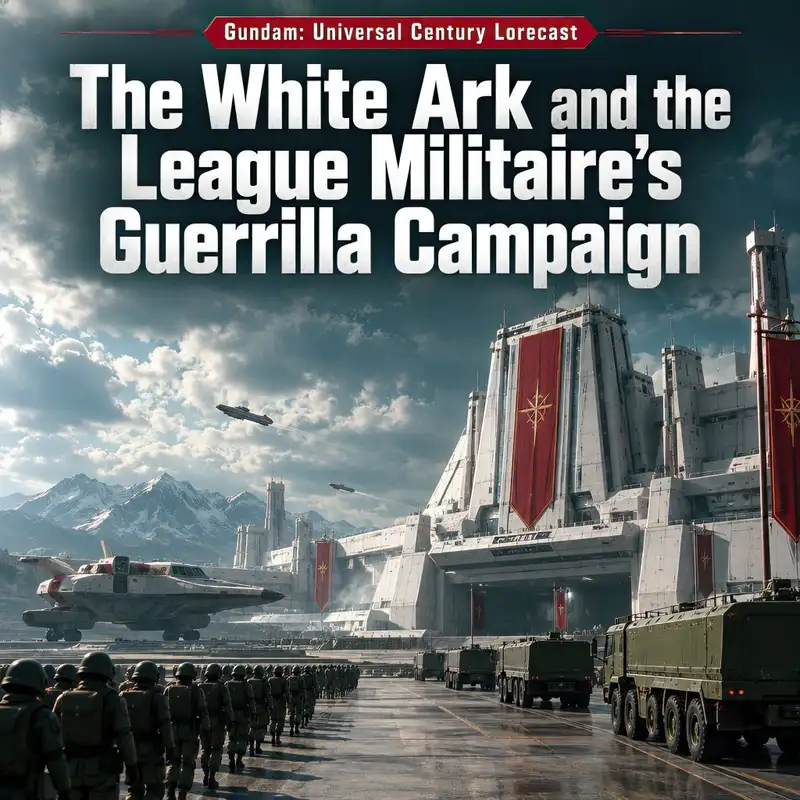
The White Ark and the League Militaire’s Guerrilla Campaign
Near Angel Halo, the White Ark approaches one of Zanscare’s most dangerous strategic weapons while wearing the appearance of something far less threatening: a salvage vessel. That disguise matters because the ship is not trying to overpower the defenses around Angel Halo in a straightforward fleet action. It is trying to get close enough to matter. The maneuver is the mature form of League Militaire warfare. It depends on deception, timing, local judgment, and an enemy’s uncertainty about what deserves immediate attention. A small vessel can sometimes pass through a gap that would close around a battleship. But it can do so only because somebody has built the intelligence network, maintenance system, political trust, and nerve required to exploit that gap.
That was a remarkable position for the League Militaire to reach. The organization had begun the Zanscare War not as a conventional navy or a fully equipped national army, but as a dispersed resistance movement. Its people worked through concealed facilities, improvised transport, sympathetic communities, and a thin collection of skilled pilots and technicians. It had mobile suits, but never enough. It had ships, but not enough to trade losses with BESPA, Zanscare’s military arm. It had political purpose, but no secure state apparatus behind it. The question is not how one small ship became powerful enough to defeat Zanscare. It never was. The more important question is how the White Ark helped a scattered resistance remain alive, connected, and militarily useful long enough to become part of a campaign against Angel Halo.
A force in that position cannot organize its war around a stable front line. It cannot simply place brigades on a map and wait for the enemy to arrive. BESPA could bring greater force to any location it identified with sufficient confidence. The League’s first task was therefore to deny its enemy a single decisive target. Combat power had to be dispersed, hidden, moved, reassembled, and recovered. The resistance had to treat logistics not as a rear-area concern, but as the heart of its military method.
The early League campaign on Earth makes that plain. The organization operated among hidden workshops, civilian roads, local shelters, refugee movement, and rapidly changing contact with Zanscare forces. Valuable equipment could not remain in obvious depots. A known factory could be raided. A convoy could be ambushed. A mobile suit standing ready in one visible hangar might become a target before it ever launched. The League’s answer was not perfect concealment. Nothing in the war suggests it possessed that luxury. Its answer was distribution.
The movement of Victory Gundam components is one of the clearest examples. Instead of transporting a complete machine as one enormous and unmistakable prize, the League moved separated parts through its network. This was not merely a dramatic assembly gimmick. It was a practical adaptation to vulnerability. A distributed weapon system can be hidden in pieces, routed through different channels, and assembled where the tactical situation demands. The machine remains at risk, of course, but the loss of one truck or one workshop does not automatically destroy the entire program.
That method required more than a gifted pilot. It required drivers who could move equipment without attracting attention, technicians who could prepare and assemble parts under pressure, local supporters willing to provide shelter or information, and civilians who understood that military activity around them might bring danger. It also required leaders capable of deciding when to move and when to remain still. A convoy is not simply transport. It is a mobile chain of dependencies: roads, fuel, spare parts, local knowledge, security, food, medical support, and people willing to keep going when the danger becomes obvious.
Minovsky conditions complicated that contest further. Communications could not be assumed to remain clear or secure across a wide battlefield. Long-range detection and command control were limited by the conditions of the era, but not abolished altogether. League forces still needed to authenticate contacts, identify friendly units, coordinate movements, and avoid walking into traps. In such an environment, prearranged rendezvous, visual recognition, local initiative, and personal trust became more important. The League did not possess a perfectly unified command network. It survived partly because subordinate personnel could act when headquarters could not tell them exactly what to do.
A resistance network built on roads, workshops, and improvised bases still needs mobile nodes able to gather its scattered resources. That is where the White Ark becomes significant. It is easy to look at its armament and see another late Universal Century combat vessel. It carries a mega particle cannon, a beam shield, and missile launchers. Official material describes its overall combat capability in cruiser-like terms. But that description should not obscure its actual role in the campaign. The White Ark was too compact and too exposed to function like a major fleet carrier with deep reserves, protected hangars, and the ability to absorb repeated punishment.
Its mobile suits were carried externally on four projecting wings. That arrangement made the ship compact and gave it a practical way to transport and deploy machines, but it also exposed those machines and limited the margin for error. A vessel carrying mobile suits in that fashion is not designed to linger under concentrated enemy fire. It must use movement, timing, and the support of other forces. The White Ark’s strength was versatility. It could relocate personnel and machines, enter the atmosphere independently, provide direct fire when necessary, recover survivors, support limited maintenance, and keep a small force connected across changing theaters.
In practice, the White Ark served as a moving base. It could be a launch platform in one operation, a recovery vessel in the next, a temporary refuge after an engagement, and a command link when local resistance cells needed to reconnect with larger League forces. That is the kind of military value which rarely looks spectacular from a distance. A warship’s gun can be counted. The ability to recover a damaged mobile suit before the enemy reaches it is harder to dramatize, but can be more important. The ability to move technicians, wounded personnel, spare parts, and information may decide whether a small force returns for the next operation at all.
The ship also represented continuity. Resistance movements are vulnerable not only when they lose battles, but when they lose their capacity to reconnect. A dispersed cell may survive a raid and still become useless if it cannot contact allies, replace damaged equipment, or move its people to a new area. The White Ark did not solve every one of those problems. No single hull could. But it made the League less dependent on fixed locations, and fixed locations were precisely what BESPA could identify and destroy.
The people who made that mobility useful were as important as the ship itself. The League’s command structure was deliberately obscured. Hangelg Ewin operated under the identity of Jinn Gehenam, a concealment that reflected both political caution and the need for compartmentalization. In an irregular movement, secrecy protects leaders, sources, and networks. It also creates friction. Personnel may not know who holds ultimate authority. Orders may arrive late, through incomplete channels, or without a full explanation. That can preserve the organization after a security breach, but it can also make coordinated action more difficult.
The League’s field strength was distributed among people with different levels of training, experience, and responsibility. Oliver Inoe provided leadership and operational experience. Gomez commanded under conditions that rarely allowed comfortable planning. Marbet Fingerhat, the Shrike Team, Odelo Henrique, Tomache Massarik, mechanics, drivers, and other personnel all contributed to the force’s ability to fight and survive. This matters because the League was not simply Uso Ewin and a Gundam. Its combat power rested on teams. It rested on people who could brief a sortie, repair damage, guide a ship through danger, move refugees, or keep a frightened younger pilot from breaking under pressure.
Uso’s exceptional ability was real, and it repeatedly gave the League tactical options that it otherwise would not have possessed. But his importance is also an indictment of the conditions around him. He was thirteen years old. A military organization that depends on a child to perform missions beyond the capacity of many trained adults has not discovered an ideal doctrine. It has encountered an emergency. Uso’s talent could help protect others in the moment. It could not justify the system that repeatedly placed him in danger, nor could it compensate for the League’s shortage of experienced personnel and secure replacement pipelines.
That shortage shaped command decisions. Every skilled pilot was difficult to replace. Every technician who understood an unfamiliar machine carried institutional memory that could not be recreated quickly. Every ship commander had to balance the immediate opportunity to strike against the danger of losing the personnel needed for future operations. Conventional militaries also face those calculations, but a large state can sometimes rotate units, draw on training establishments, and replace equipment from organized production. The League had little of that depth. It had to make selective concentration count.
Dispersal preserved the resistance, but forces cannot remain dispersed forever if they wish to influence a wider war. At some point, they must concentrate around an opportunity, a strategic target, or a threatened population. The problem is that concentration makes them visible. It exposes limited ships and irreplaceable crews to the kind of losses that guerrilla methods were designed to avoid. The League’s later transition into broader operations was therefore not a rejection of its earlier methods. It was an attempt to combine mobility and concealment with enough mass to affect the course of the war.
The Macedonia crisis marked a major stage in that transition. The White Ark became more prominent as League operations expanded beyond the early Earth-centered resistance and into wider orbital activity. It joined the Reinforce Junior while carrying the V2 Gundam, placing the ship within a more capable but still improvised League fleet structure. The V2 was a remarkable machine, a product of specialized League Militaire development and technical expertise. Yet its presence did not turn the League into a self-sufficient strategic power. A high-performance mobile suit is useful only if it can be transported, armed, maintained, repaired, and recovered.
The White Ark supplied flexibility within that larger formation. The Reinforce Junior bore heavier fleet responsibilities. It was the vessel expected to carry more of the burden in major engagements, absorb the demands of wider operations, and function as a focal point for League forces. The White Ark could not replace it. But the smaller ship could move where a larger vessel might be less practical, carry additional mobile-suit capability, support dispersed operations, and provide redundancy. In war, redundancy is rarely glamorous. It is simply what keeps one loss from becoming a collapse.
The V2 Gundam also illustrates the difference between technological achievement and military capacity. The League could produce or support advanced systems, but it could not assume that those systems would operate indefinitely through force of design. They depended on trained technicians, specialized parts, access to docking facilities, and crews capable of managing the machine’s needs under combat conditions. A prototype or specialized machine can create an important tactical advantage. It can also impose a maintenance burden that grows more severe the farther it moves from secure support.
That fact became unmistakable at Saint Josef, the lunar city where League personnel sought assistance with repairs to the Reinforce Junior. The stop was not a pause in the campaign. It was part of the campaign. Ships do not continue fighting because their crews have courage. They continue fighting because damaged systems are repaired, hulls are serviced, equipment is inspected, wounded personnel receive care, and replacement parts arrive from somewhere. Every celebrated mobile suit eventually requires a technician, a tool bench, and a supply manifest. The Universal Century has never been able to escape that administrative truth.
Saint Josef also demonstrates why civilian and industrial infrastructure mattered so much to the League. A lunar city could provide access to skilled labor, docks, workshops, supplies, medical treatment, and information. It could make a damaged vessel operational again. At the same time, any community that assisted the League became politically exposed. Zanscare could pressure it directly, target its access to transport, or portray support for the resistance as an act of escalation. The League’s network survived because civilians and local institutions were part of it. That was also why the network could never be treated as an abstract military system detached from the people living inside it.
The League’s dependence on such support did not make it weak in a simple sense. It gave the resistance roots that a purely military expeditionary force might lack. Local knowledge, sympathetic labor, and familiar routes can be powerful advantages. But those advantages were conditional. Communities can be exhausted. Workshops can be destroyed. Skilled personnel can be killed. A ship like the White Ark could move the network’s resources, but it could not manufacture new industrial capacity in empty space. Its mobility made survival possible. It did not make the League independent of society.
As the war intensified, the League was forced into operations where concentration brought both opportunity and danger. The Motorad Fleet campaign is a clear example. League forces sought to exploit a moment when the Adrastea was vulnerable. On paper, that offered a chance to strike a significant BESPA asset. In practice, the operation involved damaged ships, inexperienced pilots, dangerous opposition, and the constant risk that a local success would cost more than the League could afford. A resistance force often has to attack when the enemy is exposed, because such openings are rare. It also has to recognize that the enemy’s vulnerability may be less complete than it appears.
The operation showed the difference between a tactical opportunity and a strategic solution. Damaging or threatening an important enemy vessel can disrupt plans, force caution, and improve morale. It does not necessarily dismantle the larger military system behind that vessel. BESPA could draw upon organized formations, ships, and an established command structure. The League could not casually replace damaged hulls or veteran personnel. Its commanders therefore fought under a harsher arithmetic. A mission could be successful and still leave the organization weaker than before.
Oliver Inoe’s death made that cost painfully clear. The League did not merely lose another name from a roster. It lost a pilot, a leader, a trainer, a source of accumulated judgment, and a person whose relationships helped hold an improvised force together. Large militaries can also be shaken by the death of experienced officers, but resistance organizations often concentrate knowledge in a small number of people. When one of them is lost, the effects spread across planning, morale, instruction, and trust.
The funeral that followed mattered for the same reason. It was not a sentimental interruption from the war. It was evidence that the League was a community as well as a fighting force. The White Ark and Reinforce Junior had to carry not only weapons and mobile suits, but grief, wounded personnel, survivors, and the memory of people who could not be replaced. The crews could not simply erase a loss and proceed as though they were interchangeable parts. Their ability to continue depended on whether they could mourn, reorganize, and still return to duty.
This is where the romantic language of sacrifice becomes dangerous. Courage can hold a line, save a ship, or create time for civilians to escape. It cannot automatically restore the experienced personnel lost in the process. A dramatic death may preserve a mission in the immediate moment, but an organization that relies too often on such losses eventually destroys its own future. The League’s campaign was sustained not by an endless supply of heroic volunteers, but by its ability to avoid unnecessary annihilation while retaining enough people to learn from each battle.
The White Ark’s contribution in these operations extended beyond launching mobile suits. It helped preserve the human and technical remnants after contact. It offered a place to recover damaged machines and exhausted personnel. It moved survivors away from threatened areas. It supported the continued functioning of a force that had no guarantee of a secure rear area. The ship could not neutralize the cost of attrition. It could, however, prevent every setback from becoming final.
The next phase of the war made mobility between space and Earth especially important. League forces, operating alongside the Reinforce Junior, faced the practical demands of reentry and terrestrial movement as they moved toward Underhook and confronted the Motorad Fleet’s wider threat. Reentry is not merely a visual transition between two kinds of battle. Ships must survive the passage, retain control of damaged systems, reconstitute their formations afterward, and determine where their mobile suits and crews can operate effectively. A vessel that arrives intact but without fuel, parts, communications, or a safe location to recover its machines has not completed its mission.
On Earth, the campaign again became a combined-arms problem. Mobile suits mattered, but so did transport, local defenders, roads, civilian infrastructure, ground facilities, medical support, and the ability to move people away from danger. The League could not treat the planet as a blank battlefield. Communities lived beneath the routes its forces used. Any Zanscare strategic operation directed against Earth threatened populations who could not simply evacuate on a military timetable. The urgency of resisting an Earth-cleansing operation came from that reality. This was not only a contest over military positions. It was a fight over whether vast numbers of civilians would be treated as obstacles, hostages, or targets.
The League’s ability to cross between orbital and terrestrial theaters gave it options BESPA could not always predict. The White Ark’s capacity for atmospheric entry was therefore operationally valuable. It helped the League remain a force that could follow the war’s movement rather than being trapped in one environment. Yet that same flexibility came with strain. Every transition demanded planning, maintenance, and coordination. A small vessel could be nimble, but it had less margin for damage, less room for error, and fewer reserves than a major fleet ship.
Political developments did not remove those military realities. At one point, the Federation and Zanscare announced a cease-fire, and personnel connected to the White Ark were temporarily permitted to leave combat operations. On paper, this suggested a pause or even a possible settlement. In practice, a political announcement is not the same as control over every armed formation in the field. BESPA elements continued fighting, and conflict returned in the North Sea and around Largane. The war had not ended because the forces, structures, and strategic ambitions that sustained it had not disappeared.
This is one reason irregular movements tend to distrust settlements that are not backed by enforcement. The League had learned that formal institutions could make promises while communities remained exposed. That does not mean every Federation official acted dishonestly or that negotiation was meaningless. It means that divided authority, weak compliance, and institutional incapacity can turn an agreement into a temporary breathing space rather than a durable peace. For people who have had to hide weapons, move children, repair damaged ships, and bury comrades, the difference is not theoretical.
The resumed fighting demonstrated the limits of what the League could accomplish alone. It could disrupt BESPA, defend particular communities, seize opportunities, and keep resistance politically visible. It could not independently match the full strategic system behind Zanscare’s war effort. A dispersed network cannot indefinitely defeat a state-level military power through endurance alone, especially when that power possesses fleets, production, occupation structures, and strategic weapons. To confront Zanscare at the level of Angel Halo, the League required more than ingenuity. It required mass.
That need brought the White Ark and the Reinforce Junior to the Federation fleet assembled at Hiland. This was not a simple moment of reconciliation. The League had existed because the Federation had failed to meet its responsibilities earlier in the war. Its leaders and fighters had ample reason to distrust the institutions now offering cooperation. But strategic necessity does not wait for moral comfort. The Federation could provide fleet strength, broader logistics, formal military reach, and a capacity to contest targets beyond the League’s independent means.
The revelation that Hangelg Ewin had operated as Jinn Gehenam gave this transition additional meaning. The League had often appeared improvised because much of its work had to be improvised. But it was not without political direction. Hangelg’s concealed leadership showed that the movement had pursued a larger purpose beneath its fragmented surface. It had sought to preserve resistance, expose the costs of Federation inaction, and build enough operational credibility to matter when larger institutions finally committed themselves.
The League brought valuable assets to the coalition in return. Its personnel understood the war at close range. They had experience moving through contested space and atmosphere, operating from limited support, working with local communities, and adapting when formal plans failed. They brought specialist systems, skilled pilots, technical knowledge, and an institutional urgency that a distant headquarters might lack. Most importantly, they brought a clear understanding that Angel Halo could not be treated as an abstract strategic problem. It was the culmination of a war that had already placed ordinary people under extraordinary danger.
The alliance was therefore cooperation, not absorption. The League remained politically distinct because the reasons for its existence had not vanished. Federation fleet mass was necessary, but it did not erase the earlier failure of Federation institutions to resist Zanscare effectively. The League’s role was to contribute the capabilities it had developed under pressure while ensuring that the larger coalition did not forget what was at stake. It had become a bridge between local resistance and formal warfighting, between communities under threat and a fleet finally prepared to act.
Seen in that context, the White Ark’s disguised approach toward Angel Halo is not a return to small-scale improvisation after the arrival of the Federation fleet. It is the integration of guerrilla methods into a broader campaign. The ship could exploit uncertainty, approach under a false identity, carry people and machines into spaces that larger formations might find harder to enter, and provide a flexible platform for reconnaissance, infiltration, recovery, and combat. Its value did not disappear when the League gained allies. It became more useful because the League could now connect its local and tactical actions to a strategic effort with greater reach.
The White Ark was never the answer to Zanscare’s military power by itself. Its weapons mattered, and its ability to carry mobile suits mattered, but its deeper significance was organizational. It was a moving base, a transport platform, a repair and recovery node, a command link, and a temporary refuge for people who could not rely on a fixed sanctuary. It helped the League move between Earth, orbit, lunar infrastructure, and contested battlefields without surrendering the flexibility that had allowed the resistance to survive in the first place.
At the tactical level, that mobility allowed League personnel and mobile suits to reach threatened areas, withdraw from danger, and return to the fight. At the operational level, it helped connect scattered cells, workshops, crews, and larger League vessels across multiple theaters. At the strategic level, it helped preserve the League long enough for resistance to become part of a coalition capable of confronting Angel Halo. Politically, it demonstrated that Federation inaction had not eliminated opposition to Zanscare. It had merely forced that opposition to build its own fragile institutions.
There was also a civilian cost. The same dispersed network that supported resistance exposed technicians, families, refugees, and local communities to danger. The White Ark could carry people away from one threatened place, but it could not remove the war from every place that sustained it. Its crews lived with that contradiction. They fought because Zanscare’s advance threatened civilian life, yet their own survival depended on civilian society remaining willing and able to assist them.
The White Ark demonstrates that guerrilla warfare in the Zanscare War was not the fantasy of a few underdogs defeating an empire through courage alone. The League endured because it turned mobility, concealment, local support, technical labor, and political will into a temporary substitute for the institutions it lacked. But a moving resistance base could preserve a cause only up to a point. To confront Angel Halo and Zanscare’s strategic power, the League ultimately needed Federation fleets, industrial reach, and formal military mass, the very capacities the Federation had failed to employ when the invasion began.