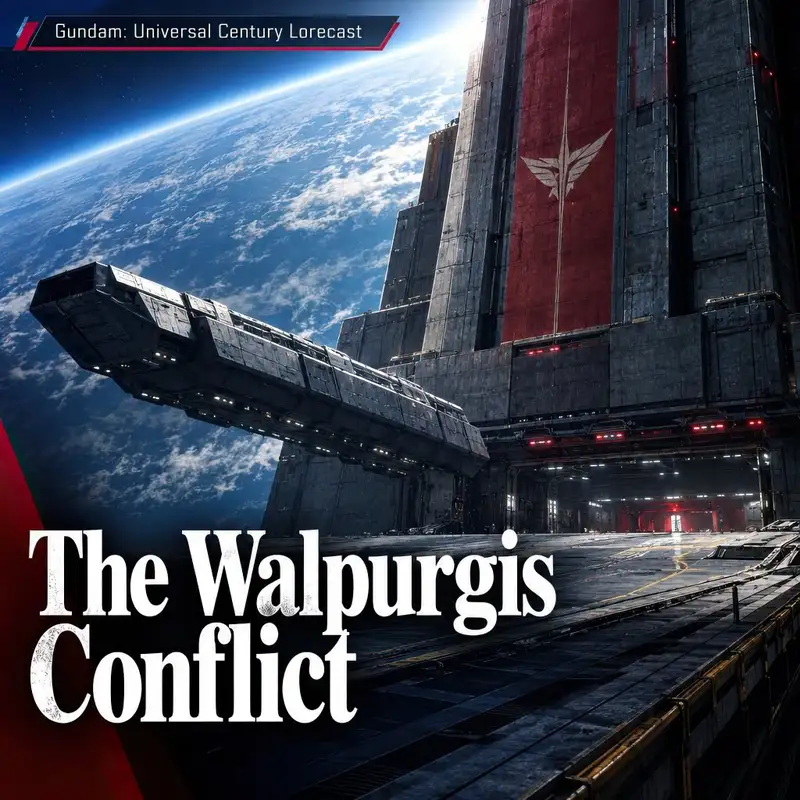
The Walpurgis Conflict [Manga]
Between the Moon and Side Three, a Federation reconnaissance force encountered a problem it could not classify. Neo Zeon units were pursuing an unidentified white mobile suit. The Federation did not know whose machine it was, who was piloting it, or why a remnant force was willing to fight for it so soon after the First Neo Zeon War. The white machine broke through the confused interception and escaped. No grand campaign had been announced. No government had declared a new war. Yet armed forces were already exchanging fire over an object that none of them fully understood.
That encounter is the proper beginning of the Walpurgis Conflict. It was not a conventional war between stable states with clear front lines. It was a postwar crisis, shaped by incomplete intelligence, surviving military networks, private industrial interests, and research projects that should have died with the men who created them. The manga’s title is commonly romanized as Valpurgis, but its story is set in Universal Century eighty-nine, in the uneasy interval after the Gryps Conflict and the First Neo Zeon War. It belongs to its own manga branch. Its events should not be used to overwrite the conclusions of Mobile Suit Zeta Gundam or Mobile Suit Gundam ZZ. But as a study of the Universal Century’s political habits, it is entirely recognizable.
The first warning is that peace had barely begun. The Earth Sphere had endured the One Year War, the Titans’ rise and defeat, and Haman Karn’s Neo Zeon campaign in rapid succession. Governments had changed hands, fleets had been shattered, colonies had been invaded, and countless soldiers had been killed, displaced, or simply absorbed into the next armed organization willing to pay them. A treaty, a victory, or a famous commander’s death could end a particular campaign. It could not automatically dismantle the laboratories, warehouses, clandestine personnel networks, political grudges, and corporate contracts that had made war possible.
The white mobile suit near Side Three was therefore not an anomaly. It was evidence that the machinery of conflict remained in circulation. The manga’s prologue was associated with fixed story material first presented through a mobile game, but its significance does not depend on treating game combat as exact tactical history. The important point is simple. The Federation force lacks a clear picture. Neo Zeon lacks control of the object it pursues. The white machine belongs to neither side in any straightforward sense. This is how a local crisis becomes dangerous. Not when every participant knows the plan, but when several armed institutions act on fragments of it.
Two days later, the story moves to Olympus Colony in Side Two. Olympus is not just a convenient place to park mobile suits and hide a secret laboratory. It is a civilian community, an industrial site, and a political prize. Anaheim Electronics controls the colony. An attached mining asteroid and a rare-metal processing facility give the location real economic weight. It also has ties to families associated with the Anti-Earth Union Group. That combination makes Olympus useful to nearly everyone who arrives with a weapon, a research file, or an old loyalty.
Its population has reasons to distrust all of them. Side Two has already suffered through the wider devastation of the One Year War. It has known the coercive politics of the Titans during the Gryps Conflict. It has also endured Neo Zeon invasion during the previous year. For civilians, this history is not a sequence of cleanly separated conflicts in a military archive. It is a pattern of outside forces arriving with emergency powers, strategic explanations, and assurances that the local population must endure another danger for a larger cause.
Olympus is therefore strategic terrain in the fullest sense. Its processing facilities matter. Its transport connections matter. Its association with Anaheim matters. But its people matter as well. A colony is a pressure vessel, a labor system, a school system, a transport hub, and a home. A mobile-suit battle near its infrastructure is not simply an opportunity to demonstrate the latest prototype. It threatens power, life support, commerce, families, and the already fragile belief that someone is responsible for public safety.
Into this environment comes Mashiro Oaks. He is not introduced as a decorated pilot, a military officer, or the heir to a political faction. He is a student. That distinction is essential. In the Universal Century, young people with unusual sensitivity, reflexes, or intuition are repeatedly discovered by institutions that immediately ask what those qualities can do for a machine, a laboratory, or a military command. Mashiro’s story begins before he has consented to become part of that process.
His father, Tonio Oaks, has imposed an unusual restriction on him. Mashiro is told not to apply himself completely in tests, games, or competitive activity. The instruction is not merely eccentric parenting. It is an effort to suppress visibility. Tonio understands that Mashiro’s abilities may attract attention, and in this period attention is dangerous. The Earth Sphere has developed entire systems for identifying exceptional people, especially people who might possess Newtype potential or unusual compatibility with experimental equipment. A gifted child is not necessarily seen as a person first. He may be seen as a resource.
Mashiro breaks that rule by displaying extraordinary performance in an underground network game called Walpurgis Night. The act is small by military standards. It is not a battle, a declaration, or an act of sabotage. But it becomes the spark for a larger crisis because it reveals that Mashiro may possess the kind of ability other people have been searching for. His performance draws the notice of those who recognize something familiar in him. In the Universal Century, secrecy often fails in just this way. A project may be hidden in a laboratory, but its human subject must still live in society.
Tonio’s attempt to keep Mashiro ordinary is understandable, but it is also unsustainable. Exceptional capacity cannot be concealed forever when institutions are actively looking for it. The problem is not that Mashiro is talented. The problem is that every armed and political actor around him has a reason to interpret that talent as property. One group sees a possible weapon. Another sees the return of a dead commander’s legacy. Another sees a strategic asset that cannot be allowed to fall into enemy hands. Very few begin by asking what Mashiro wants.
This is the central human question of the conflict. Is Mashiro Oaks an individual with agency, or is he a vessel for something built before he was able to choose? The manga deliberately refuses an easy answer. It surrounds him with suggestions of cloning, inheritance, conditioning, technological reconstruction, Newtype resonance, and the return of Paptimus Scirocco’s influence. It does not permit a clean classification that would make the moral problem comfortable. Calling Mashiro simply a clone would make him sound like a finished product. Calling him merely a normal boy would ignore the forces acting upon him. He is a person whose identity has become a battlefield.
The armed interest around Olympus quickly reveals that the colony crisis is much larger than one student. The Anti-Earth Union Group dispatches the cruiser Yulong. The ship is an enlarged Argama-type assault vessel built at Amman on the Moon, commanded by Frederica Herme. Its crew includes navigators, officers, technicians, and mobile-suit personnel. That detail matters. A ship like the Yulong is not an independent symbol that arrives, fires its guns, and solves a political problem. It requires launch and recovery space, maintenance crews, spare parts, trained pilots, navigators, communications procedures, ammunition, and a reliable understanding of who is friend and who is enemy.
The Yulong represents an Anti-Earth Union Group trying to retain relevance after the Neo Zeon war. Its presence does not prove that the organization has restored strategic dominance over the Earth Sphere. It is a limited intervention asset. It can bring mobile suits, trained personnel, and political attention to Olympus. It cannot, by itself, rebuild local trust, settle the authority of the Federation, or erase the grievances left by the Titans and Neo Zeon. Like many forces in the Universal Century, it is strong enough to affect a crisis but not strong enough to resolve the conditions that created it.
Neo Zeon remnants also have an interest in the white machine and the people around it. Their role is complicated by the appearance of a woman claiming the identity of Haman Karn. In the broader television history, Haman’s fate is established by the end of the First Neo Zeon War. The Walpurgis manga does not simply ignore that problem. It turns it into part of its own story. The figure presented as Haman becomes a contested identity, a political claim, and an intelligence problem. Anyone who encounters her must decide whether they are looking at a survivor, an imitation, a constructed successor, or a weaponized symbol.
Anaheim Electronics occupies a different position. Olympus is its colony, and the industrial facilities attached to it give the corporation an obvious stake in the outcome. Anaheim is connected to the infrastructure, technical knowledge, and commercial environment that make the crisis possible. That does not mean Anaheim secretly controls every armed group on the field. The manga does not support such a sweeping claim. Corporations can be deeply involved in a war economy without directing every commander’s decision. In fact, the more useful interpretation is less dramatic and more troubling. A corporation does not need to run every conspiracy if its facilities, contracts, and research dependencies make it indispensable to all of them.
The most important hostile organization is the Clan. It is not the Titans reborn, though it inherits part of the world that produced them. It is not Neo Zeon, despite its willingness to operate in the same political wreckage. It is not Anaheim, though its plans depend on technical and industrial resources that a corporation like Anaheim helps normalize. The Clan is a remnant network formed from former Jupiteris personnel and loyalists of Paptimus Scirocco. Under its leader, Haifan, it seeks to preserve and complete what Scirocco left unfinished.
The Clan’s ambition is not simply to recover an old mobile suit. It is to preserve a vision of political control through exceptional human beings and exceptional machines. Scirocco’s original reputation rests partly on his ability to recognize and manipulate talent. He understood that the conflict after the One Year War would not be decided solely by mass-produced machines. It would also be decided by access to Newtypes, by control over advanced interfaces, and by the political use of people who could perceive or command more than ordinary soldiers.
The Walpurgis Conflict takes that logic to an even more disturbing conclusion. The goal is no longer merely to recruit a gifted pilot or build a better psycommu machine. The goal is to capture, reproduce, preserve, and direct the qualities of a particular person. This is where the white mobile suit, the Over.on, becomes central.
The AGX-11 Over.on resembles a transformed or reinterpreted The-O, the machine most closely associated with Scirocco. Its appearance is therefore political as well as mechanical. A white machine with that lineage is not merely another prototype. It announces a claim to inheritance. But the Over.on is tied to Mashiro in a way that makes ordinary military categories inadequate. The machine is bound to the Grimoire system, a Scirocco-derived technology with a relationship to the human body that is far more intimate than standard cockpit controls.
The Grimoire system should not be collapsed into familiar terms. It is not simply psycho-frame under another name. It is not a conventional psycommu device, a bio-sensor, or a routine enhancement of Newtype equipment. In the manga’s own framework, Grimoire involves microscopic computational elements known as psycommu cells. These can function within a mobile suit, but their significance lies in their apparent ability to operate in or upon human bodies as well. The boundary between pilot, machine, and program becomes uncertain.
The manga associates Grimoire with an effect called Eldridge. In practical terms, it can restrict the movement of nearby machines, interfering with joints or transformation mechanisms while leaving thrusters active. The exact mechanism is not securely explained, and the story does not provide a settled scientific model that should be generalized across the Universal Century. What matters operationally is the effect. A mobile suit can retain propulsion yet lose controlled movement. In space, that is not a minor inconvenience. A machine that can move but cannot properly orient, transform, aim, or stabilize becomes a hazard to itself and to everyone near it.
Eldridge therefore changes the geometry of combat. It can create a form of local superiority without simply destroying the enemy’s armor. It bypasses the familiar contest of weapon range, beam power, shields, and maneuver. But it also raises a larger question. If such an effect depends on Grimoire’s relationship with particular bodies and minds, then it is not easily turned into a standard military capability. The system may be devastating in the hands of a compatible subject and nearly useless without one. It represents the Universal Century’s recurring mistake: mistaking an exceptional and poorly understood phenomenon for a reproducible doctrine.
The Clan’s project is dangerous not because it has invented a clean solution to military problems. It is dangerous because it is willing to experiment on the boundary between identity and command. It treats human consciousness as an engineering resource. It assumes that the traits associated with Scirocco can be preserved through technical means, then installed in machines and people as a source of authority. That is a more ambitious project than building a mobile armor. It is an attempt to make charisma, insight, and political domination survive their original owner.
Mashiro is caught at the center of this effort. His connection to the Over.on and Scirocco’s legacy invites the question of whether he is a reconstructed continuation of Scirocco. The story never allows that question to become a simple laboratory result. Mashiro may be connected by biology, conditioning, resonance, memory, or an imposed technological relationship. The important fact is that other people behave as if the answer has already been decided. They treat him as evidence that Scirocco can return.
That treatment is an act of violence even before the shooting begins. To declare that Mashiro belongs to Scirocco’s legacy is to deny that he can define himself. It transforms a teenager’s unusual ability into a claim of ownership. Tonio Oaks’s secrecy, however flawed, makes more sense in this light. He is not merely hiding a family embarrassment. He is trying to protect Mashiro from a system that has already decided what an exceptional boy is worth.
Fiorina Feeley, generally called Fee, deepens the problem. She is linked to the Clan, the white The-O-like machine, and the Grimoire project. Her twin sister, Conchetta Feeley, also belongs to the web of identities and relationships surrounding the program. Their importance is not that they provide a neat family mystery. Their importance is that the Clan’s plans are built through people who have been shaped, assigned, and interpreted by the project. The conflict repeatedly asks whether an individual can remain separate from an identity created for political use.
The woman presented as Haman Karn raises the same issue on a larger scale. Haman’s name carries military legitimacy, Neo Zeon symbolism, fear, loyalty, and unfinished grief. A claimant to that identity can command attention before she has issued an order. The manga uses this uncertainty carefully. The question is not only whether the woman is physically the historical Haman. The question is what it means when a political movement can make use of a person’s face, memory, and reputation after the original history appears complete.
This is why the Walpurgis Conflict cannot be reduced to a mystery about clones or possession. The manga blurs categories because the institutions inside it blur them. Clone, successor, vessel, memory, conditioning, resonance, impersonation, and political symbol are all different things. But they can be made to serve the same purpose. Each allows an organization to claim continuity with a powerful past. Each offers the promise that authority can be restored without rebuilding legitimacy.
The practical military conflict reflects this confusion. The Clan fields a series of specialized Grimoire-equipped machines, including Dimater, Favnirs, and later the Titania II. The Anti-Earth Union Group responds with the Yulong’s mobile-suit force, including Nemo units, the Zeta Gundam, and Thane Amadio’s ZII V-type. The ZII V-type is especially useful as a reminder that not every advanced machine represents a major procurement success. It is a limited Anti-Earth Union Group unit derived from combat data after the original ZII program failed to gain broad formal adoption. It is not evidence that a new standardized fleet of transformable machines has suddenly entered service.
The Clan’s machines illustrate those dangers. Their value depends on technology that is secret, unusual, and linked to a narrow circle of people. That can produce surprise. It cannot easily produce a stable military system. The same is true for the machines opposing them. The Zeta Gundam carries enormous symbolic and tactical weight, but no one mobile suit can substitute for a coherent order of battle, secure basing, trained replacements, and a political strategy for Olympus. The Yulong can launch advanced assets, but it still has to recover damaged machines, identify threats, protect its crew, and avoid turning an industrial colony into a battlefield ruin.
The conflict escalates through confrontations involving the Over.on, the Favnirs, and modified Scirocco-derived systems. The important change is not that each new machine is more dramatic than the last. The important change is that the parties involved keep responding to uncertainty with another exceptional system. One prototype threatens control, so another prototype is deployed to contain it. One hidden research program is exposed, so a more specialized countermeasure is introduced. This is how postwar militarization perpetuates itself. Every emergency becomes an argument for preserving the next secret weapon.
The Favnirs, derived from the ZZ Gundam lineage, demonstrates that familiar development paths can be repurposed in unusual circumstances. Yet even this does not make the crisis manageable. A machine’s pedigree cannot guarantee command control when the underlying problem is a program operating through hidden identities and poorly understood interfaces. The conflict is not a clean contest between one engineering school and another. It is a struggle between organizations trying to seize control of a phenomenon none of them fully understands.
The danger intensifies when Mashiro comes increasingly under Scirocco’s influence. The language of possession is tempting here, but it should be used carefully. The manga presents an apparent takeover or intrusion tied to the Over.on and the legacy of Scirocco. Whether this should be understood as personality transfer, technological conditioning, Newtype resonance, preserved memory, or some combination of them remains deliberately unstable. The operational fact is clearer. Mashiro’s agency becomes compromised, and the machine’s threat expands beyond what the surrounding forces expected.
The Messala-linked escalation makes that danger visible. The conflict no longer resembles a contained mobile-suit engagement around a colony facility. The Over.on’s connection to other systems suggests that the threat is distributed across machine concepts, technical infrastructure, and the people who understand how to activate them. A commander cannot solve that kind of crisis simply by ordering more firepower onto the field. The target is no longer one machine in one location. It is an entire network of knowledge and control.
The introduction of Delphinium underscores this point. Delphinium is a new mobile weapon capable of shifting between mobile armor and mobile-suit forms, deployed in an effort to halt the Over.on’s rampage. It is a rational military response in one limited sense. A rapidly escalating threat requires a capable interception asset. But the story makes clear that defeating or disabling an immediate manifestation of the Over.on does not end the crisis. Another Over.on can awaken. Other Grimoire-equipped machines remain active. The program has already spread beyond the original confrontation.
The final phase of the conflict brings the Full Armor Over.on, the manifestation of Scirocco’s influence, and the Titania II into direct relationship. It would be easy to describe this as a contest to determine which extraordinary machine is strongest. That would miss the point. Titania II is the Clan’s completion of an unfinished Scirocco-linked concept. It represents an attempt to give institutional form to a legacy that should have ended with the Gryps Conflict. Yet it remains a specialized product of a clandestine organization, not evidence of a widespread new military standard.
The military confrontation matters because it forces the characters to decide whether they are fighting for control of a weapon or for control of themselves. Mashiro’s central struggle is not merely to win a duel. It is to refuse absorption into someone else’s project. Scirocco’s legacy offers a seductive form of certainty. It suggests that Mashiro’s gifts have a predetermined purpose, that his identity can be explained by a predecessor’s ambitions, and that power can be inherited through technical mastery. Mashiro’s resistance rejects that premise.
The manga’s resolution of the Haman identity question belongs to this same framework. Its final revelation addresses the figure presented as Haman within the manga’s own branch. It should not be used to revise the established ending of Gundam ZZ. What matters here is that the story has used the contested identity to expose how political organizations preserve themselves through recognizable names and faces. A movement facing defeat may not need the original leader to continue. It may only need enough people to believe that the leader, the legacy, or the authority has survived.
That is one reason the Clan is more dangerous than a conventional remnant force. A conventional force can be counted by ships, mobile suits, depots, and territory, though even those numbers are often uncertain. The Clan’s real strength is its ability to make the past operational. It preserves personnel from the Jupiteris network, research tied to Scirocco, machine designs that carry symbolic meaning, and human subjects connected to the Grimoire system. It turns defeat into a temporary interruption rather than a final political judgment.
The operational lesson is equally severe. The Yulong’s intervention demonstrates the continuing value of disciplined crews, mobile-suit support, and command infrastructure. The Anti-Earth Union Group can still respond to a dangerous situation with capable personnel and advanced equipment. Yet the crisis also shows the limits of that response. A military force can break an immediate attack without knowing every hidden sponsor, laboratory, or successor project. It can defend a colony without restoring the public trust damaged by repeated interventions. It can defeat a machine without dismantling the political appetite for another machine like it.
The intelligence outcome is perhaps the most important. At the beginning, the Federation reconnaissance force cannot identify the white mobile suit or Neo Zeon’s motive for pursuing it. By the end, the crisis has exposed the cost of compartmentalized knowledge and incomplete postwar accountability. Too many people knew part of the story. Tonio knew enough to fear Mashiro’s potential. The Clan knew enough to build around Scirocco’s legacy. Neo Zeon actors knew enough to pursue the Over.on. Anaheim had an industrial stake in Olympus. The Anti-Earth Union Group knew enough to intervene. But no institution possessed, or perhaps deserved, complete control of the truth.
This fragmentation is not accidental. It is one of the conditions that allows the Universal Century to repeat itself. Postwar governments often classify dangerous research rather than dismantle it. Corporations preserve expertise because expertise has value. Former military personnel survive by joining new employers. Political factions preserve symbols because symbols recruit followers. Families conceal children because public institutions have earned no trust. Every decision can appear reasonable in isolation. Together, they create a society where an unfinished wartime project can reappear before the ruins of the last war have cooled.
The Grimoire system is the clearest expression of that failure. Its battlefield effects are frightening, but they are not its deepest danger. The true danger lies in its underlying assumption: that exceptional human perception can be captured, stored, replicated, and commanded. The system promises to solve the uncertainty of Newtype phenomena by making them controllable. It promises that insight can become equipment, that memory can become doctrine, and that a person can become an interchangeable component in a larger machine.
That promise has appeared in many forms across the Universal Century. Research institutes have tried to produce enhanced pilots. Military commands have treated young people as instruments of strategic necessity. Political leaders have looked for successors who carry a famous name or an inherited claim. Corporations have treated experimental bodies and specialized machines as investments. The details change, but the logic remains consistent. Human potential is valuable, so institutions attempt to own it.
Walpurgis reveals the cost of that logic by making identity itself unstable. Mashiro is pressured to become Scirocco. Fee is tied to a project that makes the body and the machine difficult to separate. The Haman figure becomes a question of political reproduction. The Clan seeks to survive by turning personal legacy into a technical system. None of this creates genuine stability. It creates obedience, fear, and confusion. It may produce an impressive machine, but it cannot create legitimate authority.
The conflict began with a white mobile suit breaking through a line of forces that did not understand what they were seeing. It ends with a clearer understanding of why that confusion existed. The Earth Sphere had declared wars finished without fully demobilizing the institutions that fought them. It had preserved laboratories, industrial dependencies, military specialists, political myths, and wounded people whose abilities could still be exploited. Under those conditions, Scirocco did not need to return in a simple physical sense. His methods could return through anyone willing to treat another person as raw material.
The Walpurgis Conflict matters because it shows that the most dangerous legacy of Paptimus Scirocco is not a single mobile suit, a hidden laboratory, or even the possibility of a surviving personality. It is the institutional conviction that human potential can be owned, replicated, and commanded. Mashiro’s struggle is therefore larger than his battle with the Over.on. It is a refusal to let a damaged postwar society decide that his identity belongs to the next war.