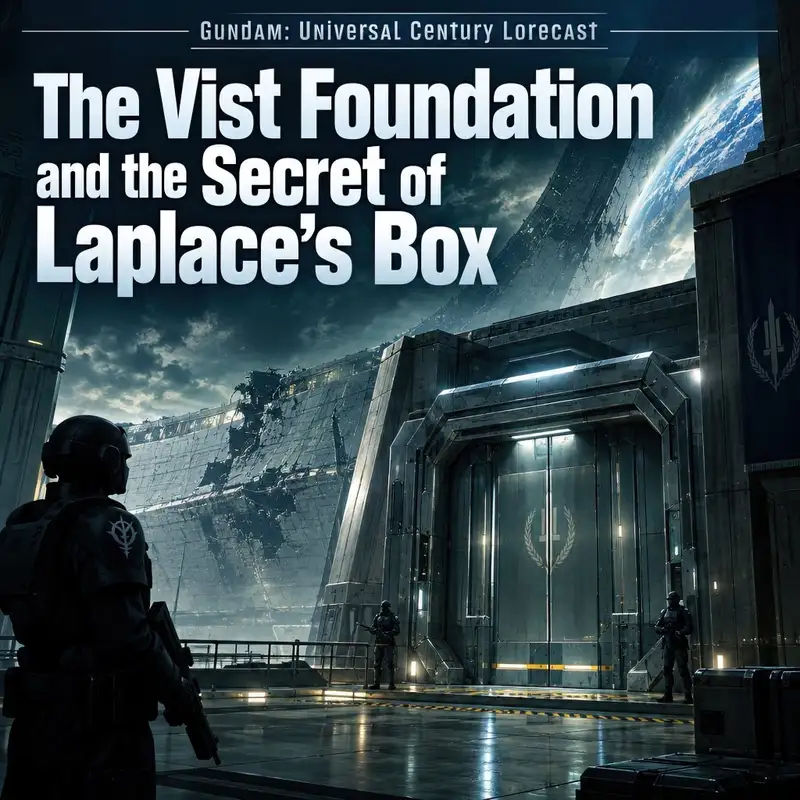
The Vist Foundation and the Secret of Laplace’s Box
Deep beneath Industrial Seven, Syam Vist waits beside the most dangerous object in the Earth Sphere. It is not a nuclear weapon, a colony laser, or a mobile armor. It is a document. Nearly a century old, hidden since the first day of the Universal Century, it can neither seize territory nor fire a shot. Yet warships, mobile suits, political operatives, heirs to Zeon, Federation officials, and the Vist family itself have all converged because of what those pages might mean.
Magallanica is more than a hidden chamber beneath a colony. It is an archive, a refuge, and a carefully prepared final destination. The place contains the physical evidence of a promise made at the birth of a new age, then allowed to disappear from public life. Outside, the conflict has become military. Banagher Links pilots the RX-zero Unicorn Gundam. Riddhe Marcenas approaches in the Banshee Norn. Angelo Sauper and the Rosen Zulu serve the Sleeves. Full Frontal comes to claim the Box for his own political project. Londo Bell, ECOAS, and Federation authorities pursue overlapping missions that are not always identical.
The irony is difficult to miss. Decades of corporate maneuvering, classified research, political bargaining, and armed conflict have been organized around language written on a page. The power of Laplace’s Box does not come from any supernatural quality in the document itself. It comes from authenticity, secrecy, timing, and audience. If the document is genuine, and if enough people accept its meaning, it can expose a gap between what the Earth Federation says it was founded to become and what it actually became.
To understand why that gap matters, it is necessary to return not to the One Year War, nor to the rise of Zeon, but to the opening ceremony of the Universal Century itself. The secret of Laplace’s Box begins with a public inauguration, a terrorist attack, and one survivor who discovered that catastrophe could be turned into leverage.
At the beginning of Universal Century one, the Earth Federation inaugurates a new calendar and, with it, a new political era. The ceremony takes place at Laplace, the Federation prime minister’s residence in space. The symbolism is clear enough. Humanity has expanded beyond Earth. Political life is meant to expand with it. The Universal Century presents itself as an age in which the old boundaries of nation, planet, and class might be reconsidered for a civilization now spread across the Earth Sphere.
Then Laplace is destroyed in a terrorist bombing. The station becomes the site of the Universal Century’s founding trauma. A ceremony intended to project institutional confidence instead demonstrates how vulnerable political legitimacy can be at the exact moment it is being declared. The attack is violent, but the animated record does not provide a full operational history of its perpetrators, their chain of command, or every political motive. It is important not to invent a complete conspiracy simply because the event later becomes useful to powerful people.
Among the survivors is a young Syam Vist. He had participated in the attack, and he emerges from the destruction with access to something more enduring than the operation itself: the original Charter of the Universal Century. That discovery gives him no elected office, no army, and no formal constitutional authority. What it gives him is possession. In politics, possession of evidence can matter as much as possession of territory, especially when the evidence concerns a government’s own founding claims.
The bombing and the charter must be kept distinct. The attack creates the conditions under which the document can disappear. The document creates the political danger that survives long after the attackers are gone. One is an act of violence at a public ceremony. The other is a suppressed question about who the new political order was supposed to include. Their connection is historical, but they are not the same thing.
The language is potentially revolutionary because it recognizes that migration into space may create more than new places to live. It may create new political communities, new human conditions, and new claims to representation. But the clause does not govern by itself. The screen version does not present it as a detailed mechanism for colonial independence, a finished electoral system, or an automatic transfer of power from Earth to the colonies. It does not define every person born in space as a political beneficiary. It does not establish that every Spacenoid is a Newtype, or that every Newtype is legally entitled to a particular office.
Even so, the provision threatens the Federation because it reveals that the Federation’s own beginning contained an expectation of political inclusion that later history did not fulfill. Over the following decades, many colonists experience Earth-centered government as distant, unequal, and unresponsive. Zeon Zum Deikun’s political thought, later Zeon nationalism, colonial unrest, Federation complacency, military repression, and repeated wars all grow in the space between formal unity and lived political exclusion. The charter does not explain every conflict in that history. But it makes the contradiction visible.
A document without an enforcement mechanism becomes powerful when someone controls its release. Syam Vist understands this. His authority rests not on public mandate but on custody. He possesses evidence that the Federation cannot comfortably acknowledge and cannot easily dismiss. That position allows him to bargain across generations. The secret becomes a reserve of political influence, held outside ordinary institutions but always capable of affecting them.
Over time, that leverage becomes part of the Vist Foundation’s inheritance. The Foundation is not the Earth Federation in private clothing, and it should not be treated as an all-powerful government behind every historical event. Its influence depends on wealth, commercial reach, political relationships, secrecy, and the long institutional memory that comes from guarding a secret for nearly a century. Those are considerable assets. They are not unlimited authority.
By Universal Century ninety-six, the Foundation is no longer politically unified in its purpose. Syam remains the old keeper of the secret. Cardeas Vist, head of the Foundation during the Industrial Seven crisis, seeks a controlled transfer of responsibility. His actions suggest that he no longer believes the Box can remain hidden indefinitely, or that private custody alone can give it meaning. Martha Vist Carbine sees the crisis differently. Her priority is the Foundation’s survival, its position, and the containment of consequences that could destroy both.
Neither approach is politically innocent. Cardeas’s plan still assumes that the right people must be chosen to receive the secret. Martha’s plan still treats the secret as an institutional asset to be managed. But their disagreement is meaningful. One looks toward a successor and an uncertain future. The other looks toward control, damage limitation, and continuity. Their struggle is not simply a family dispute. It is a contest over who gets to decide when public history becomes public.
The Foundation does not merely hide the Box in a vault and wait for a suitable moment. It creates a process. That process is the UC Project, and at its center stands the Unicorn Gundam. The machine is remembered for its extraordinary combat capability, its psycho-frame, and its presence in some of the most dangerous fighting of Universal Century ninety-six. But in the history of Laplace’s Box, its most important role is not as a conventional weapon. It is a key.
The RX-zero Unicorn Gundam is a specialized prototype constructed with psycho-frame technology and tied to the La+ Program. The program is designed to guide a qualified user through a sequence of clues leading toward the Box. In practical terms, this means that access cannot be secured merely by stealing a file, occupying a building, or forcing a Vist executive to reveal a single location. The Vists turn the path to the secret into a controlled journey, dependent on the Unicorn, the La+ system, and the person who can activate and follow it.
The system is not foolproof. No system involving a rare prototype, a concealed family secret, and a century of competing political interests could be. But it does show that the Vists understood the difference between possession and use. A document can be held by anyone who can seize it. To interpret and reveal it responsibly is another matter. The La+ Program attempts to ensure that the Box is encountered by someone shaped by the consequences of the conflict around it.
The UC Project also demonstrates the industrial dimension of political secrecy. A machine like the Unicorn does not appear through symbolism alone. It requires research, manufacturing, materials, technicians, transport, testing, maintenance, and access to psycho-frame technology. Anaheim Electronics is connected to the industrial and technical world that makes such a project possible. But it is a mistake to turn Anaheim into an omniscient secret government. The corporation has influence, customers, internal interests, and strategic importance. It does not erase the agency of the Federation, the Vists, the Sleeves, or the individuals operating inside those institutions.
The Unicorn’s very existence is a reminder that a prototype can be strategically unique without being strategically reproducible. It requires specialized support and a rare compatible pilot. Its performance cannot be treated as ordinary Federation capability. The machine must be transported, launched, recovered, repaired, supplied, and protected. It depends on ships such as the Nahel Argama, on technical personnel, on command decisions, and on the survival of a pilot who can operate under conditions that no standard training pipeline can reliably produce.
This matters because the Unicorn is often seen only at the point of contact, when it is fighting. But the machine is not an independent political actor. It is part of an infrastructure built to control access to a secret. Its psycho-frame may respond in ways that exceed institutional understanding, yet its original purpose within the UC Project remains concrete. It is an instrument of custody. A key disguised as a weapon, or perhaps a weapon burdened with the responsibilities of a key.
A carefully designed key becomes vulnerable the moment rival organizations learn there is a lock. That is what happens at Industrial Seven. Cardeas arranges an exchange with the Sleeves, a Neo Zeon remnant organization seeking Laplace’s Box as political leverage. The intended transaction is not a quiet business deal. It is a collision point between military forces, intelligence networks, family strategy, and old political claims that none of the participants can fully control.
The Sleeves understand that the Vist Foundation possesses something important, though their interest in the Box is not identical to every other anti-Federation cause. They seek leverage. For a remnant movement, a founding document that embarrasses the Federation could become a powerful instrument. It might strengthen negotiations, mobilize support, undermine confidence in Federation authority, and provide symbolic resources for a broader political program. None of those possibilities makes the Sleeves the sole or natural guardians of the charter’s meaning.
The Federation, meanwhile, has its own reasons to intervene. Londo Bell and ECOAS operate with military and security missions related to the Unicorn, Banagher, and the prevention of the Box falling into Sleeves hands. Their operational objectives must be separated from the political objectives of senior Federation figures. A military unit may be ordered to recover a prototype or stop an enemy force without possessing the full political history behind the order. In the Minovsky-era battlefield, compartmentalization is common enough. In a crisis involving a document that can destabilize public legitimacy, it becomes almost inevitable.
The Vist Foundation is equally divided. Cardeas has set a transfer into motion, yet he is also trying to guide the secret toward a future he believes can be constructed rather than merely inherited. Martha seeks to prevent the Foundation from being consumed by the consequences. Banagher Links enters the crisis with less information than nearly anyone around him. He is not initially a commander, an intelligence officer, or a constitutional scholar. He is a young man drawn into the machinery built by adults who have spent decades deciding what others are allowed to know.
Audrey Burne is similarly positioned between concealment and political meaning. Her public identity hides that she is Mineva Lao Zabi, heir to the Zabi family’s legacy and a figure of obvious symbolic importance to Zeon movements. Her identity changes the stakes because it gives the conflict a form of legitimacy that the Sleeves can use but do not completely control. Mineva is not merely a dynastic token. Her presence creates the possibility that Zeon’s history might be interpreted by someone other than the armed organizations claiming to speak in its name.
Industrial Seven is also an inhabited colony. That should be obvious, but mobile-suit combat often makes it easy to forget. It is not an empty arena in which elites settle arguments through machinery. Its residents depend on pressure integrity, transportation, power, food systems, emergency services, and public order. A fight around an industrial colony puts all of that at risk. The strategic value of the Box is bound up with political inclusion, yet the route to it threatens the people whose political future is supposedly at stake.
The exchange fails because no participant can separate the document from the armed power gathering around it. The Sleeves cannot obtain the Box without provoking Federation resistance. The Federation cannot contain the crisis without revealing that there is something worth containing. The Vists cannot control the succession process once the Unicorn and its pilot become visible to competing institutions. Every actor knows enough to act, but not enough to dictate the outcome.
This is an intelligence failure in the broadest sense. It is not simply that someone misses a report or overlooks an enemy unit. Each organization operates with partial knowledge and conflicting assumptions. The Sleeves see opportunity. Federation security elements see a dangerous transfer. Cardeas sees a test of succession. Martha sees an institutional emergency. Banagher and Mineva gradually learn that they have been placed at the center of a conflict whose origins precede them by almost a century.
The resulting struggle over the Box is therefore a struggle over custody. Who holds the secret? Who controls its path? Who determines its public meaning? And who bears responsibility for the consequences after revelation? Those questions divide the Vist family before they divide the wider Earth Sphere.
Cardeas’s approach rests on the belief that the Box must pass into the hands of someone capable of using it for the future. That is why Banagher matters. His role is not reducible to piloting skill, nor is he simply a convenient Newtype interface for a machine. He becomes the person through whom the Vist succession plan can move beyond the family’s own closed system. The plan remains fraught with manipulation. A young man does not freely choose a burden when every institution around him has concealed the nature of that burden. But Cardeas is attempting, however imperfectly, to move the question beyond private storage.
Martha’s strategy is different. She acts to preserve the Foundation’s position and to control a political crisis that threatens to expose the family’s role in maintaining the secret. She is not simply defending a document. She is defending an institution built around the power that document has provided. From her perspective, uncontrolled disclosure could destroy the Foundation’s influence, unsettle its relationships, and hand the initiative to armed factions or Federation authorities with little concern for Vist interests.
Ronan Marcenas represents another form of containment. As a senior Federation political figure tied to immigration-policy power, he has an interest in preserving state continuity and preventing the charter from becoming an uncontrolled challenge to the established order. That does not require a single, fully documented conspiracy reaching through every Federation office. Large governments do not need perfect central coordination to defend themselves. Officials can recognize a common threat to institutional legitimacy and act from overlapping interests.
Once the La+ Program points back to Magallanica, that political dispute becomes a military contest. Hidden beneath Industrial Seven, Magallanica is both the destination and the proof of how deeply the Vist Foundation has embedded the Box within its own institutional world. It is not a conventional fortress built simply to dominate surrounding space. Its strength lies in concealment, preparation, and the fact that its meaning cannot be separated from the Vist family history that brought everyone there.
By the final confrontation, several chains of command are operating at once. Londo Bell and ECOAS have immediate operational concerns. Banagher and the Unicorn must be secured or denied to the Sleeves. The Box must not become an enemy asset. Federation political authorities have broader concerns about containment and public consequence. The Sleeves seek access and political advantage. The Vists seek either succession, survival, or both, depending on which member is making the decision.
Those overlapping missions matter because they prevent the battle from being understood as a series of personal duels. The Unicorn, Banshee Norn, Rosen Zulu, and Neo Zeong are powerful systems, but none operates in a vacuum. They depend on carriers, launch platforms, maintenance teams, communications, ammunition, propellant, replacement parts, and crews capable of sustaining operations in a battle that grows increasingly difficult to command. The Nahel Argama is not merely scenery behind Banagher’s sortie. It is part of the support structure that allows the Unicorn to exist as an operational asset at all.
Combat around Magallanica also occurs under conditions of political fragmentation. Riddhe Marcenas carries the pressures of family, Federation authority, and his own deteriorating judgment. Angelo Sauper serves Full Frontal with a loyalty shaped by personal and ideological commitment. Banagher is trying to reach the Box without accepting that access gives him the right to impose its meaning on others. Full Frontal approaches the archive with a larger political purpose. These are not interchangeable motives, and treating them as such would erase the reason the crisis cannot be solved by mere battlefield victory.
The military struggle determines who can reach Syam Vist and the archive. It does not determine what the charter means. A mobile suit can deny an approach route. A warship can transport a claimant. An intelligence team can secure a facility. None of those capabilities can settle a constitutional argument. The machinery of war can control access to a document. It cannot make that document self-interpreting.
Full Frontal understands the Box’s potential as political leverage. His interest is not simply archival. He sees the document as an instrument that can be used to shift power across the Earth Sphere. The charter’s buried provision can become a weapon against Federation legitimacy, particularly if it reveals that the government has abandoned an inclusive promise made at its own founding. In that sense, Full Frontal sees the Box clearly. He recognizes that symbols matter when institutions are already weakened by distrust.
But his political use of the Box is coercive. The point is not merely to invite public debate over representation. It is to reshape the strategic balance through pressure. This is the essential difference between recognizing a constitutional contradiction and exploiting it. A suppressed promise can be brought to light in order to expand political participation. It can also be used as a bargaining chip by an armed movement seeking advantage over its rivals. The document itself cannot choose between those uses.
Full Frontal’s identity remains deliberately unsettled in the animated record. He is more than an ordinary officer and more than a straightforward continuation of any single predecessor. His authority is assembled from memory, image, expectation, and political need. That ambiguity reinforces his relationship to the Box. He is a claimant built around inherited symbols, seeking another inherited symbol that might make his project more powerful. The danger is not that his argument contains no truth. The danger is that truth can become subordinate to the political machinery built to exploit it.
Mineva’s counterclaim is different. Her Zabi lineage gives her public recognition within Zeon’s historical world, but she refuses to allow that lineage to become the property of the Sleeves or of any movement that treats inherited suffering as permission for new coercion. Her importance lies not in a mystical right of blood, but in her ability to speak from within Zeon’s legacy while rejecting the assumption that Zeon’s future must be decided by those who hold weapons in its name.
Mineva understands that the charter concerns more than advantage for one faction. It concerns the political future of humanity in space. That does not make her interpretation automatically complete or legally binding. But it prevents the Box from being reduced to a Neo Zeon instrument. The charter cannot honestly be used to defend inclusion if its revelation is monopolized by an armed group demanding power for itself.
Banagher’s role is equally important, though different. He makes access possible through the Unicorn and the La+ Program, but he does not settle constitutional history through superior piloting. His value is moral and political. He repeatedly resists the idea that the Box should belong to whoever can seize it, whoever has suffered most, or whoever can produce the largest weapon. He helps create the conditions in which disclosure becomes possible without surrendering the document’s meaning to a single faction.
At Magallanica, the archive is reached. Syam, Cardeas’s grandfather and Banagher’s great-grandfather, has guarded the secret across the life of the Universal Century. The moment is not a simple vindication of the Vist family. Syam’s long custody preserved the charter, but it also kept a public question within private hands for almost a century. The family’s achievement and its failure are inseparable. It saved the evidence. It delayed the politics that evidence demanded.
The charter is finally revealed through Mineva’s broadcast. The immediate effect is profound, but it must be described precisely. The revelation embarrasses the Federation. It exposes a historical contradiction. It demonstrates that the founding charter included language recognizing the future emergence of space-adapted humans and their participation in government. It makes it harder to maintain the fiction that the existing political order is the only imaginable fulfillment of the Universal Century’s founding ideals.
What it does not do is equally important. The broadcast does not automatically define who qualifies as a space-adapted human. It does not grant immediate representation to every colony. It does not create a new legislative body, dissolve the Federation government, or establish independent sovereignty for all spacenoid communities. It does not erase the history of Zeon dictatorship, aggressive war, colony gassing, and mass killing. A founding promise of inclusion cannot be honestly used to rehabilitate every regime or movement that later claimed to speak for space.
Nor does disclosure remove the Federation’s existing power. The state retains its military forces, bureaucracy, legal structures, communication networks, economic relationships, and political constituencies. Even a government facing a profound legitimacy crisis does not disappear because a broadcast exposes its historical failure. Institutions survive through routine as much as through belief. Clerks continue to administer. Officers continue to command. corporations continue to contract. Citizens continue to worry about security, livelihoods, and immediate dangers. Political transformation requires more than proof that transformation is justified.
There is also a moral limit to how the charter can be used. The Federation’s concealment or minimization of a promise of inclusion is indefensible as a political practice. But an armed faction cannot claim ownership of that promise merely by exposing the Federation’s hypocrisy. The people whose future is invoked by the charter are not a resource to be traded between governments, corporations, military commands, and remnant movements. That is the principle Mineva’s broadcast attempts to recover.
The revelation therefore creates an argument rather than a new order. It takes something hidden and places it within public history. That is not nothing. Public knowledge changes the terms on which legitimacy is contested. It gives future political actors language, evidence, and a point of reference that had been deliberately withheld. But it cannot by itself produce trust between Earth and the colonies, undo the accumulated trauma of repeated wars, or build institutions worthy of the ideals it discloses.
The immediate aftermath confirms this restraint. In Universal Century ninety-seven, the record shows that the basic political framework of the Earth Sphere has not greatly changed despite the revelation of Laplace’s Box. That outcome is not proof that the charter was meaningless. It is evidence of how resilient established systems can be, especially when the terms of reform remain uncertain and the political environment remains shaped by fear, militarization, and competing claims to authority.
Federation survival should not be mistaken for Federation vindication. The state’s continued existence demonstrates institutional strength, not moral innocence. The revelation matters precisely because it leaves behind a standard against which the Federation can be judged. A government that has survived a legitimacy crisis still has to answer whether it intends to honor the promise revealed by that crisis.
The same is true of the Vist Foundation. Its century-long custodianship preserved a truth that powerful institutions found inconvenient. Yet private guardianship also made that truth dependent on secrecy, inheritance, and the calculations of a wealthy family. The Foundation could protect the Box. It could not make the Box democratic. In fact, by treating a constitutional question as private leverage, it helped ensure that revelation would arrive as a crisis rather than as the beginning of a deliberate political process.
The Unicorn could locate the archive. The Nahel Argama and its allies could sustain the operation that brought Banagher there. The Banshee Norn, Rosen Zulu, and Neo Zeong could fight over access. Full Frontal could attempt to turn the charter into strategic coercion. Martha could seek containment. Ronan Marcenas could defend state continuity. Mineva could broadcast the truth. None of them could create representation, trust, or enforceable reform by force of will.
For that reason, Laplace’s Box could threaten the Earth Federation nearly a century after its creation. It made the Federation answerable to a promise embedded in its own beginning. The danger was not that the charter contained a magic command capable of dissolving the government overnight. The danger was that it exposed the political order as something contingent, incomplete, and at odds with the future it had once claimed to welcome.
Its revelation failed to produce immediate revolution because constitutional ideals need more than discovery. They need public interpretation, organized political power, durable institutions, and people willing to enforce principles even when enforcement threatens entrenched privilege. The Vist Foundation preserved the truth, but preserved it as private leverage. Magallanica made that truth public, without solving the century of exclusion that had made the secret valuable in the first place.