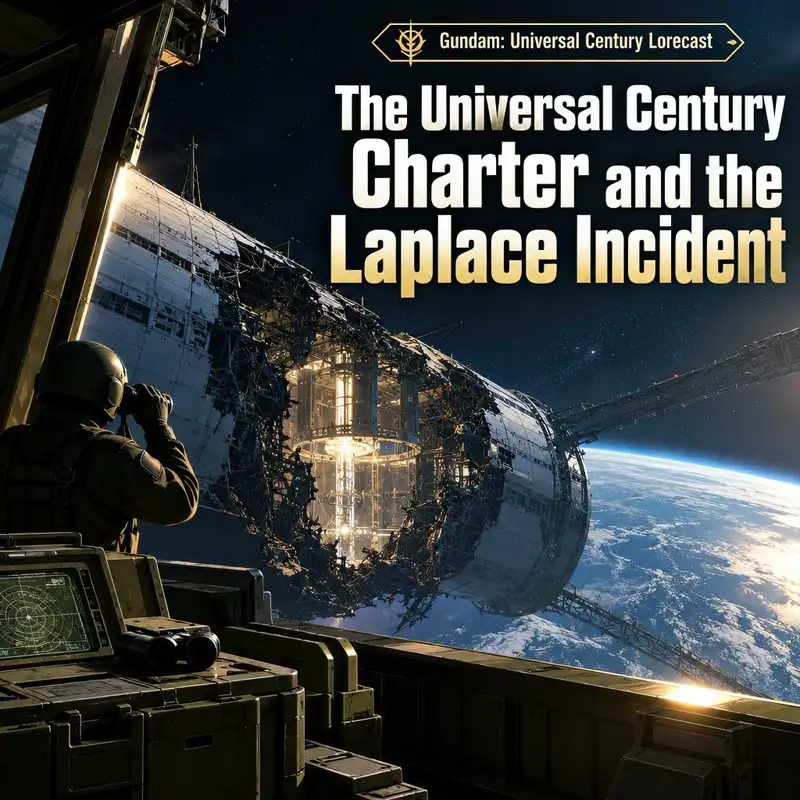
The Universal Century Charter and the Laplace Incident
At Industrial Seven, a private meeting becomes a military crisis before most of the people carrying weapons can explain what they are fighting over. The colony is not a fortress or an abandoned industrial yard. It is a habitat, with students on their way to class, workers maintaining docks and fabrication systems, families living behind pressure doors, and civilians who have every reason to expect that constitutional questions will be settled somewhere other than their homes. Yet in Universal Century ninety-six, a transfer arranged by Cardeas Vist and the Sleeves brings armed Federation intervention, Zeon remnant mobile suits, and the Unicorn Gundam into the colony. The object at the center of the confrontation is called Laplace’s Box. It is not a superweapon in the usual sense. It cannot destroy a fleet, alter an orbit, or force a surrender by itself. It is a hidden section of the Universal Century Charter, the founding document of the Earth Federation’s modern age. That makes it dangerous in another way. It threatens the story the Federation tells about its own legitimacy.
Almost everyone at Industrial Seven is working with incomplete information. Cardeas knows more than most, but not everything. Mineva Lao Zabi, traveling under the name Audrey Burne, knows that the Box could become the excuse for another war. The Sleeves know it may be useful against the Federation, though possession and understanding are not the same thing. Federation forces know enough to regard the transfer as intolerable, but their soldiers and officers are not all participants in the same political calculation. Banagher Links, a civilian student until events force him into the cockpit of the Unicorn, begins with less knowledge than nearly anyone. The crisis is therefore not simply a contest over an object. It is a contest over secrecy, interpretation, and access. Before the Charter can be understood, its custodians, its enemies, and its potential inheritors must first survive the effort to control it.
To see why a document from the beginning of the Universal Century could provoke combat nearly a century later, it is necessary to return to Universal Century one. The setting was Laplace, a space station serving as the residence of the Earth Federation’s prime minister during the inauguration of the new calendar. The Universal Century was meant to mark more than a change of dates. It represented a political claim. Humanity had expanded beyond Earth, and the Federation presented itself as the framework through which that expansion would be governed. The colonies, the Moon, orbital industry, and Earth itself were supposed to belong to one political future.
That future began in violence. During the inauguration ceremony, terrorists attacked Laplace. The station was destroyed, and Prime Minister Ricardo Marcenas was killed. In the wreckage, a young Syam Vist survived. He discovered the original Charter monument, including material that had not entered the public record. That hidden material became the substance of what later generations called Laplace’s Box.
This bombing in Universal Century one must be kept separate from the Laplace Incident in Universal Century ninety-six. The first event created the secret. The later incident was the struggle to expose, suppress, inherit, or weaponize it. The distance between them matters. A terrorist attack can eliminate officials and destroy evidence in hours. The political consequences of what survives can endure for generations. Syam’s discovery gave one private individual access to a fact that should have belonged to the public constitutional order. Whether he saw himself as a guardian, a blackmailer, a witness, or some combination of all three, that possession gave him leverage.
The Charter’s missing language is politically explosive, but it is often simplified into something it does not say. Its relevant section appears in a chapter concerning the future. It contemplates the possibility that humanity’s life in space could produce, or reveal, a population adapted to that environment in ways not yet fully understood. Should such a space-adapted humanity be confirmed, the Charter calls for its priority participation in government. By Universal Century ninety-six, this language is understood through the history of Newtypes: people associated with heightened perception, unusual forms of communication, and, in some cases, the ability to operate psycommu systems with exceptional effect.
That does not mean the Charter creates an immediate independent government for Newtypes. It does not plainly grant every colony sovereign statehood. It does not provide a ready-made legal mechanism by which the Earth Federation automatically ceases to exist. And it does not settle the difficult question of who has the authority to determine that a new form of human adaptation has emerged, or what priority participation would mean in practical constitutional terms. The clause is future-oriented. Its language raises obligations and expectations, but it does not provide a complete governing system for the Earth Sphere.
That ambiguity is part of its power. Constitutions do not matter only when every clause is mechanically enforceable. They also define the principles through which institutions justify their authority. The Federation claimed to govern an expanding human civilization. Its founding Charter contained a promise that the people most changed by life in space would not simply be ruled from Earth as a permanent political afterthought. If that promise was deliberately removed from public view, then the question is not merely whether a court could enforce it a century later. The question is whether the Federation’s later political order was built on a concealed betrayal of its own stated future.
Newtype history gives that question particular force. Across the Universal Century, Newtypes became subjects of hope, fear, research, military recruitment, propaganda, and abuse. Some saw them as evidence that humanity could overcome the old divisions of Earth. Others saw them as weapons, assets, threats, or symbols to be controlled. The Charter does not solve those disputes. It predates most of the institutions that later tried to classify, exploit, and militarize Newtype phenomena. But its missing provision means that the Federation’s constitutional imagination once included the possibility that life in space could demand a different political settlement. By Universal Century ninety-six, that possibility had been suppressed for nearly a hundred years.
The Vist Foundation preserved the secret through that century. Its relationship to power is central to the meaning of Laplace’s Box. The Foundation is connected to the Earth Sphere’s industrial and political elite, including overlapping ties with Anaheim Electronics. But it should not be treated as an invisible government that directs every war, every contract, and every official decision. That explanation is too easy, and it gives institutions more coherence than the record supports. The Federation has its own political leadership, bureaucracies, military commands, security interests, and rival factions. Anaheim is a major industrial power with customers, divisions, commercial interests, and political access. The Vist Foundation is a private custodian of a dangerous secret. These networks overlap. They do not become one perfectly coordinated conspiracy merely because their interests sometimes align.
The more important point is that secrecy itself became a form of power. The Box was not merely hidden. It was held by people who could decide when to threaten disclosure, whom to trust with fragments of knowledge, and which institutions might be vulnerable to exposure. A constitutional document that should have set public limits on power instead became private leverage over power. That inversion is the real scandal. The Federation’s founding promise was no longer a standard by which citizens could judge their government. It became a pressure point managed by those with access to the original record.
Syam Vist embodies that transformation. He is a survivor of the Laplace bombing and the long-term keeper of the Box, but he is not an omniscient historian standing outside the events he describes. He is a participant whose life, fortune, and institutional influence are bound to the secret. He witnessed the beginning of the concealment, but the meaning he assigns to it is still his interpretation. His survival does not make every conclusion automatic. What it does establish is that a private family held material with the capacity to embarrass, compromise, and perhaps reshape the political order of the Earth Sphere.
By Universal Century ninety-six, that potential has accumulated against a century of bitter history. The Earth Federation survived the One Year War, later conflicts with the Titans, the First Neo Zeon War, Char’s Rebellion, and repeated crises involving colonies, lunar cities, industrial centers, and military research programs. Survival gave the Federation continuity. It did not automatically give it legitimacy in the eyes of everyone it governed. Many people living in space had experienced political exclusion, economic dependence, military occupation, forced relocation, or the indifference of Earth-centered institutions. Those grievances did not make the Principality of Zeon’s dictatorship righteous. They did not excuse colony gassing, aggressive war, or the use of civilians as instruments of political terror. Nor did they prove that every anti-Federation movement represented liberation.
But the Federation’s failures were real enough that the Charter could not be dismissed as an antique curiosity. A suppressed promise concerning political participation by a space-adapted humanity would land differently in a society where space residents had repeatedly been asked to bear the costs of wars and policies they did not fully control. The Box mattered because it could be read as evidence that the Federation had not merely failed to solve colonial inequality. It may have buried an acknowledgment that the political order would have to change as humanity changed.
That is a legitimacy crisis, not an automatic revolution. The difference is essential. A government can survive a damaging revelation if it retains control of institutions, armed forces, economic networks, public administration, and the habits of obedience. It can argue over interpretation, delay reform, divide opponents, classify records, and wait for public anger to disperse. A constitutional clause has moral and political force, but it does not deploy a fleet or distribute food or conduct elections by itself. The Sleeves understand this. So do the Federation officials determined to keep the Box from becoming public. They are not fighting over a magical solution. They are fighting over who gets to define the Federation’s past, and therefore who can claim authority over its future.
Cardeas Vist attempts to transfer the Box to the Sleeves because he appears to believe that the existing order is incapable of reforming itself. His decision is not a neutral act of historical preservation. Giving the Box to an armed anti-Federation organization means placing constitutional evidence inside an active political and military struggle. It is an attempt to force movement through pressure. That choice immediately raises the problem Mineva understands better than most. A truth capable of challenging an unjust order can still become a weapon in the hands of people pursuing their own power.
Mineva arrives at Industrial Seven as Audrey Burne because she does not want the Box to become another justification for war. Her position is unusually difficult. She is Mineva Lao Zabi, heir to a name burdened by the history of Zeon and the Zabi family. That identity gives her political significance, but it also means others can use her as a symbol. The Sleeves can invoke Zeon’s memory. Federation authorities can treat her heritage as a security threat. Those who long for restoration can project their own desires onto her. Mineva’s central political act is to resist being reduced to any of those functions. She does not deny the Federation’s failures. She rejects the assumption that inherited grievance and armed leverage are the same thing as a durable political settlement.
The Sleeves pursue the Box for their own reasons. They are not the Principality of Zeon reborn, nor are they identical to Axis Zeon, Haman Karn’s Neo Zeon, or Char’s movement during the rebellion of Universal Century ninety-three. They are a remnant organization operating in the aftermath of earlier defeats, using Zeon symbolism while trying to create new strategic opportunities. Under Full Frontal, their approach to the Box is not limited to historical vindication. The Box can become leverage against the Federation. It can expose vulnerability, alter negotiations, weaken confidence, and support a larger political and economic reordering of the Earth Sphere.
Full Frontal’s significance lies partly in his ability to understand that military victories alone cannot establish a new order. A fleet can seize territory. A mobile suit can win a local engagement. But political power also depends on trade, access, public legitimacy, strategic resources, and the ability to make an opponent accept a new arrangement. His use of Zeon symbolism is therefore not simply nostalgia. It is a means of organizing memory and grievance into political influence. The animated record leaves important questions around his identity and nature deliberately unsettled. That ambiguity should remain. What matters here is the role he plays in the conflict: a leader who recognizes that the Box is valuable because it can change the balance of political pressure.
The Federation’s objective is more defensive. It seeks to stop the Box from becoming an enemy instrument and to prevent the public revelation of material that could damage the legitimacy of the Earth Sphere’s governing system. But the Federation is not one mind. Civilian officials, military commanders, intelligence personnel, and ordinary service members do not all know the same facts or share the same priorities. Some are concerned with containing an immediate security crisis. Some understand that a secret tied to the Federation’s founding could become a catastrophe if disclosed. Some may see the incident through the narrower lens of countering a Zeon remnant force. This compartmentalization produces confusion. It also produces danger. When different organizations act on partial knowledge, they can turn a controlled operation into a battle inside a civilian colony.
Banagher enters this struggle without the authority or preparation of the institutions around him. He is not initially a political leader, a senior officer, or the guardian of a secret archive. He is a young civilian who meets Audrey, becomes entangled in the confrontation at Industrial Seven, and is entrusted with the Unicorn Gundam after Cardeas is killed. His importance is not that he instantly understands the whole history of the Charter. No one does. His importance is that he is placed in the position of deciding whether the machine and the secret it protects must serve the faction that captures them first.
The Unicorn Gundam is central to that question because it is not merely an advanced combat machine. It is also the key to the La-plus system. The Box is not waiting in a simple vault that can be opened by whoever reaches it with sufficient firepower. The system directs its seekers through successive locations connected to the hidden record. It turns legal and historical evidence into an operational problem. To reach the Box, a force must preserve the key, understand enough to follow the path, maintain access to ships and facilities, and survive the efforts of every competing organization to seize or destroy the process.
That design changes the meaning of the Unicorn. In battle, it is exceptional. Its psycho-frame systems and transformation under the N T D designation give it capabilities beyond ordinary mobile suit doctrine. But its strategic value is not simply the ability to defeat other machines. It is an authentication device, a protected archive mechanism, and a means of selecting who can proceed through the La-plus route. The machine’s power helps keep the quest alive, but the quest cannot be completed by mobile suit performance alone.
The Banshee reinforces the same pattern. Its existence demonstrates that advanced psycho-frame technology has become a matter of institutional competition and control. It does not demonstrate that the Federation can field such systems widely, or that their effects are predictable. These machines are extraordinary, difficult to understand, and politically sensitive. They are not standard equipment. Their combat value is inseparable from their symbolic value. Whoever controls them may claim not only military advantage, but the right to decide how the future of Newtypes will be interpreted and used.
The psycho-frame phenomena associated with the Unicorn and Banshee must be handled with caution. The screen record shows events that exceed ordinary military calculation. It shows resonance, perception, and effects that participants cannot fully explain. Those events are real within the story’s presented history, but they do not establish a stable doctrine that any force can reproduce by building another machine. Psycho-frame does not remove the need for command, logistics, training, or political judgment. If anything, the incident shows the opposite. Institutions possessing extraordinary technology remain trapped by ordinary failures of secrecy, coercion, mistrust, and ambition.
As the La-plus route unfolds, the Nahel Argama becomes one of the principal platforms from which the conflict is sustained. Its crew is not operating in the comfort of a clear chain of command. It is pulled between Federation authority, the immediate need to survive, political pressure from above, the actions of the Sleeves, and the uncertain reliability of other Federation-aligned forces. The ship’s commanders must make decisions with incomplete orders and shifting relationships. In one moment, another force may be an enemy. In another, both sides may face a larger threat that makes temporary cooperation necessary. This is not a stable alliance system. It is an operational environment shaped by mistrust.
That fragmentation is one reason the Laplace Incident escalates. No single command structure controls all the relevant pieces. The Vist Foundation possesses knowledge and technology. The Sleeves possess armed force and political ambition. Federation authorities possess legal power, military assets, and a strong interest in containment. Anaheim’s industrial connections give it influence without making it the sole author of events. Londo Bell personnel and other military units must act amid orders that may not reveal the full political stakes. Banagher and Mineva are trying to prevent the Box from becoming a weapon while moving through a battlespace designed by people who believe weaponization is unavoidable.
The battle over Laplace’s Box is therefore also an intelligence war. Its participants compete over several different secrets at once. Who knows the Box exists? Who knows what it contains? Who knows where it is located? Who understands the La-plus system? Who can authenticate the original document? Who can make the public believe the evidence once it is revealed? Possession of a rumor is not the same as possession of proof. Possession of proof is not the same as the ability to distribute it. And distribution is not the same as political reform.
The route toward Megallanica makes those distinctions concrete. Megallanica is not merely the final stage of an adventure or a convenient hidden base. It is the preserved repository of the Box and a vast industrial monument tied to the beginning of the Universal Century. Its existence links the Federation’s founding myth to the infrastructure that made the Earth Sphere possible. That gives it several forms of value. It is a historical archive. It is a physical target. It is evidence that can be seized or destroyed. And it is a strategic location whose survival determines whether the secret remains private.
By the time the conflict reaches Megallanica, the stakes have expanded beyond a transaction at Industrial Seven. The Sleeves seek to retain political leverage. Federation-aligned forces seek to contain the danger. The Unicorn and Banshee are drawn into direct confrontation. The Nahel Argama and other ships must navigate a battle in which the destruction of the objective may appear easier than allowing disclosure. This is the harsh logic of secrecy. Once a document becomes politically dangerous, an institution may conclude that eliminating the archive is safer than answering the questions it raises.
But destruction is not a complete solution. A fortress can be bombarded. A colony can be threatened. A ship can be disabled. People can be coerced into silence. None of that erases an idea once enough people understand it. The Charter’s hidden provision cannot be made harmless merely by denying that it exists. The effort to suppress it only reinforces the central accusation: that the Federation’s political order fears the implications of its own founding promise.
The military danger at Megallanica also reminds us that the stakes are not abstract. Large space installations are inhabited, maintained, and vulnerable. Any attack on such a place risks lives, infrastructure, pressure systems, industrial capacity, and the ability of civilians to survive. The Earth Sphere’s wars repeatedly turn homes and workplaces into strategic objectives. Industrial Seven was one example. Megallanica is another. The fact that a location contains political evidence does not make the people around it expendable. Yet military organizations often behave as if the map contains only routes, targets, and force markers. The Laplace Incident exposes the human cost of that habit.
Full Frontal’s political argument is more sophisticated than a simple demand to restore the past. He recognizes that the Federation’s vulnerability can be used to reshape the balance between Earth and the colonies. The Box is useful because it can expose the Federation’s contradictions and compel concessions. His broader strategy treats economics, political pressure, and strategic resources as instruments of power alongside mobile suits and fleets. That is an important insight. The Universal Century’s conflicts are not decided only by who has the most advanced machine. They are also shaped by who controls access, trade, movement, information, and the terms of political negotiation.
Yet Full Frontal’s approach retains a coercive logic. It assumes that the Box must be captured and used as leverage by a force strong enough to impose its preferred order. Mineva rejects that premise. For her, the Charter cannot become a justification for repeating the pattern in which one faction claims to speak for all people in space while treating civilians, dissenters, and political opponents as instruments. Her opposition to the Federation’s concealment does not require her to endorse the Sleeves’ political program. That distinction is one of the incident’s most important moral and strategic lessons. A true grievance can be appropriated by an organization that offers no better form of rule.
Banagher’s role develops along the same line. He is not merely defending the Unicorn from capture. He is trying to prevent the machine from deciding the political meaning of the Box through force. That does not mean he stands outside politics. Refusing to give the Box to one armed faction is itself a political choice. But it is a choice against the idea that history belongs to whoever can seize it. His actions, together with Mineva’s, create the possibility that the Charter will become public rather than remain a private bargaining tool.
The disclosure of the Box is therefore the decisive event. Mineva publicly reveals the hidden provision of the Universal Century Charter. The secret ceases to belong exclusively to Syam Vist, the Vist Foundation, Federation authorities, or the Sleeves. The immediate military struggle has not solved every political question, but it has prevented one faction from monopolizing the evidence. That is a real outcome.
Tactically, the fight over Megallanica ends without the Box remaining securely under the exclusive control of any single armed organization. At the operational level, the Sleeves lose the ability to employ the secret as a private strategic weapon against the Federation. At the political level, the Federation’s founding narrative is damaged. Citizens of the Earth Sphere now have reason to ask why a future-oriented promise about humanity in space was suppressed, and what that suppression says about the institutions that followed.
But disclosure does not produce immediate constitutional transformation. Later events make that clear. The Earth Sphere’s basic political structure remains in place after the Laplace Incident. The revelation embarrasses and challenges the Federation, but it does not dissolve its government, redistribute power overnight, or create a new representative order for space residents. The Sleeves do not emerge as the unquestioned political heirs of the Charter. The old institutions endure, even if they endure with a more visible wound in their historical legitimacy.
That outcome can seem anticlimactic only if the Box is misunderstood as a legal superweapon. It is not. Constitutional truth alone cannot compel entrenched institutions to surrender power. Governments survive by more than public narratives. They survive through administration, military command, economic patronage, law, public fatigue, fear of instability, and the practical difficulty of replacing a system that reaches across Earth, the colonies, and the industrial infrastructure between them. A document can expose a contradiction. It cannot, by itself, build the coalitions, institutions, trust, and political capacity required to resolve that contradiction.
The Federation can absorb embarrassment more easily than it can reform the conditions that made the Box dangerous. Its leaders can argue over the meaning of the Charter. They can insist that the provision was conditional, outdated, or subject to interpretation. They can contain the immediate crisis and rely on the fact that citizens still need transportation, food distribution, security, employment, and local administration to continue. None of those realities make the concealment acceptable. They explain why exposure and reform are not the same event.
The Laplace Incident also demonstrates why military force is such a poor substitute for political repair. Federation forces can suppress a transfer, seize a machine, or threaten an archive. The Sleeves can deploy mobile suits and fleets to gain leverage. The Vist Foundation can manipulate access to information through its resources and technology. Each can compel action in the short term. None can settle the central question: what political relationship should exist between Earth and the people who live in space?
That question remains difficult precisely because the Charter does not offer a complete answer. Priority participation by a space-adapted humanity is not a finished constitution. It is a demand to confront the possibility that political institutions built around Earth’s authority may no longer be adequate for a civilization spread across the Earth Sphere. The Federation’s error was not simply that it failed to implement one clause. Its deeper error was treating the future as something that could be indefinitely managed from above, rather than negotiated with the people whose lives were changing beyond Earth.
Laplace’s Box did not fail because its contents were unimportant. Its contents mattered enough to provoke assassination, secrecy, military intervention, pursuit across the Earth Sphere, and a final effort to prevent disclosure. It failed to transform the Earth Sphere immediately because no hidden document, however revealing, can force a political order to become more just simply by being read aloud. The Box revealed that the Federation’s crisis was not caused by one secret clause. It was caused by a century in which the promise of political equality in space had been deferred, managed, and repeatedly militarized.