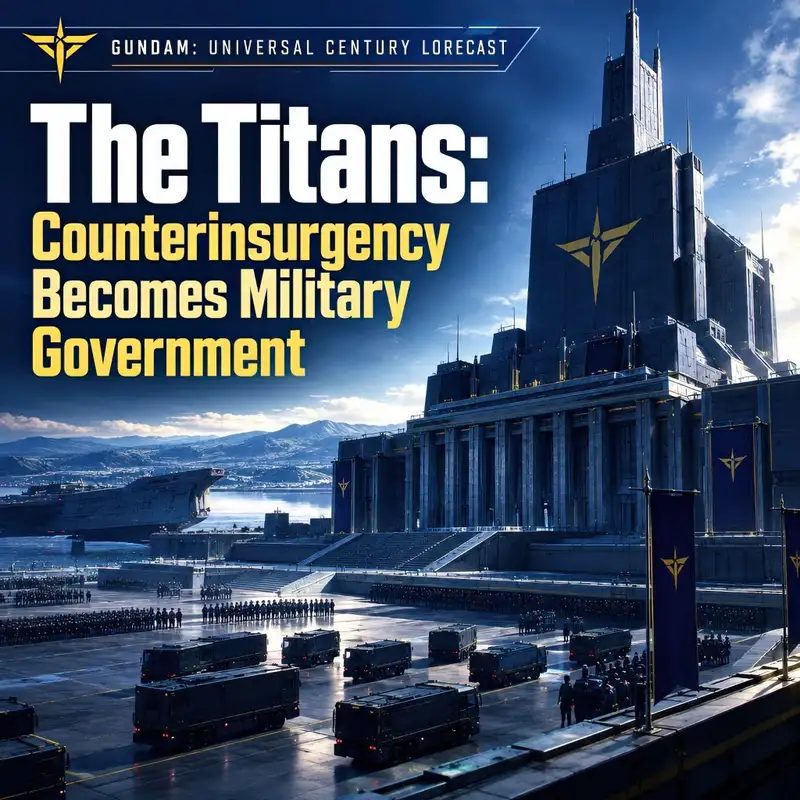
The Titans: Counterinsurgency Becomes Military Government
Poison gas inside a colony is not simply another weapon fired across a battlefield. In a sealed habitat, air is infrastructure. It is shelter, transportation, medicine, food production, work, family life, and the condition that allows a political community to exist at all. To release gas there is to turn the systems that sustain civilian life into instruments of control. During the Thirty Bunch Incident, the Titans used poison gas against a colony associated with anti-Federation protest. The surviving accounts differ on the colony’s population and the final death toll, but they agree on the essential fact. The human cost was catastrophic. More important still, the attack revealed what the Titans had become. A force formed in the name of security had begun to treat a civilian colony as hostile territory and its population as a problem to be subdued.
That is the central problem in the Titans’ history. They did not begin as an openly separate government. Formally, they remained a special organization within the Earth Federation Forces. Their original mission could be defended in the language of postwar security. The One Year War had ended, but armed Zeon remnants remained active, the Federation had suffered serious intelligence failures, and much of the Earth Sphere had reason to fear another crisis. Yet an emergency force can become something more dangerous than a temporary instrument. If it receives exceptional powers, privileged access to information, political protection, and the authority to decide who counts as an enemy, it can begin to govern through military means. The Titans became a de facto military government because they combined counterinsurgency, intelligence control, weapons development, colonial policing, and political coercion without effective accountability.
Jamitov Hymen understood the political value of that arrangement. He was not personally responsible for every field decision, every abusive interrogation, or every atrocity committed in the Titans’ name. Reducing the organization to one man would make its rise seem simpler than it was. Jamitov’s importance was strategic. He helped turn postwar anxiety into a durable power base. Under his leadership, the Titans were not simply a task force designed to finish an unpleasant but limited security mission. They became an institution with its own access to resources, its own command interests, its own classified programs, and its own reason to preserve the atmosphere of emergency that justified its authority.
Counterinsurgency always creates a difficult intelligence problem. Armed resistance can hide among civilian populations. Sabotage and espionage can resemble ordinary movement, labor, or political organization. Commanders must distinguish between a community that is angry, a network that is clandestine, and a force that is preparing violence. That task requires discipline, local knowledge, reliable intelligence, and a willingness to hear information that does not fit the preferred theory of the conflict. The Titans increasingly did the opposite. They treated dissent itself as evidence of enemy action.
Once that assumption takes hold, a security organization begins to manufacture the threat it claims to investigate. Surveillance expands because ordinary political life is considered suspicious. Inspections become coercive because every inspection is assumed to uncover conspiracy. Informants become valuable because institutions reward reports of enemies more readily than reports of legitimate grievances. Censorship becomes necessary because open criticism is treated as assistance to hostile forces. The system learns to see opposition everywhere, and therefore to justify almost any measure against it.
For colonists, this meant that the distinction between civilian administration and military control could disappear very quickly. A colony was not an empty outpost. It was a city and a workplace inside a fragile artificial environment. Its residents depended on life-support systems, transit networks, docks, schools, agricultural sections, hospitals, and commercial supply routes. The arrival of a military inspection force was not just a bureaucratic inconvenience. It could determine who could travel, what could be published, whether local leaders remained in office, and whether people were suddenly classified as suspects.
The Thirty Bunch Incident showed where that system led. The Titans used poison gas against a civilian colony connected to anti-Federation protest. The exact population of the colony and the total number of dead remain uncertain in the available record. Different sources give different figures, and false precision would not make the crime clearer. What matters is that an enormous civilian population was targeted in a sealed habitat. This was not a battlefield accident caused by confused fire or an unavoidable consequence of an assault on a fortified military position. It was collective punishment carried out against a political community.
The operational logic was brutally direct. If a colony’s population could be made an example of, other colonies might be frightened into compliance. If opposition could be described as insurgency, then the people living under that opposition could be treated as its support base. If the public record could be controlled afterward, the institution might preserve the appearance of lawful security while removing those most likely to contest it. In that sense, the information operation was part of the attack. Concealment and misrepresentation were not secondary political problems. They were necessary to the Titans’ method of rule.
Bask Om became the clearest symbol of this coercive culture. Jamitov represented the accumulation of political and institutional power. Bask represented its operational expression. He embodied the Titans’ willingness to use intimidation, hostage-taking, threats against civilians, and chemical coercion when those methods appeared useful. His conduct matters because it shows that brutality was not merely a breakdown of discipline at the edge of a vast organization. It could be exercised by senior authority and protected by the larger system around it.
That does not mean every Titan knew every detail, approved every order, or shared Bask’s appetite for terror. Large military institutions contain career officers, pilots, technicians, administrators, and researchers whose knowledge and complicity differ sharply. Some may have believed they were defending the Federation from another war. Some may have kept their heads down. Some may have understood precisely what their organization had become. The central institutional fact is not that every individual was identical. It is that the Titans could conduct, conceal, and politically survive acts like Thirty Bunch for a time. The organization had created room for such methods and made resistance to them dangerous.
The short-term effect was fear. The long-term effect was the opposite of stability. Terror can silence public activity, but it rarely settles the political question that produced opposition in the first place. Instead, it changes the character of that opposition. People who might have sought reform within Federation structures begin to conclude that those structures cannot protect them. Officers who might have remained loyal begin to question whether loyalty means obedience to an institution that attacks its own citizens. Industrial interests that might have preferred quiet business arrangements begin to hedge against a regime that can seize projects, suppress information, and turn clients into enemies.
That process helped create the Anti-Earth Union Group, the AEUG. It is tempting to describe the AEUG as simply another anti-Federation force, or as a rebranded Zeon movement. That misses its importance. The AEUG included Federation dissidents, colonial opponents of Titans rule, military personnel, and industrial supporters who did not share one origin or one political program. Its formation showed that the Titans had created enemies not only among old Zeon networks but within the Federation’s own political and military order.
The AEUG was not uncomplicated. It fought an armed campaign and operated in an environment where colonies, ships, and civilians could be endangered by military action. It relied heavily on industrial support, particularly from Anaheim Electronics, and that dependence shaped its options. Anaheim was not an all-powerful secret government directing history from behind a corporate desk. It was a major arms manufacturer with customers, divisions, commercial interests, and a strong incentive to remain relevant regardless of which faction appeared likely to prevail. Its support for anti-Titans forces was politically consequential, but it was also business conducted in a civil conflict.
Karaba, the AEUG’s Earth-based partner, demonstrated another failure in Titans strategy. The Titans had framed their mission as the defense of the Federation. Yet opposition to them was not confined to distant colonies or space-based dissidents. Their methods had consequences on Earth as well. A security institution that claims to protect the center while alienating people in both the center and the periphery is not strengthening the state. It is hollowing it out. The Federation’s political crisis had become too broad to contain through raids, arrests, and elite mobile-suit deployments.
The Titans’ ability to impose control depended on much more than ideology or individual commanders. It required infrastructure. Ships transported personnel and machines between Earth orbit, colonies, lunar approaches, and remote facilities. Carriers and hangars generated mobile-suit sorties. Bases stored ammunition, spare parts, fuel, propellant, medical supplies, and the technicians needed to keep advanced machines operating. Communications networks, intelligence offices, classified files, patrol routes, and controlled docking facilities connected local acts of coercion to wider command authority.
This logistical foundation is easy to overlook because the Titans are remembered for their officers, their uniforms, and their high-performance mobile suits. But a mobile suit does not inspect a colony by itself. It requires a ship or base to move it, crews to service it, pilots to brief and recover it, and a bureaucracy to decide where it will be sent. A security force becomes a governing force when it can repeatedly place armed power at politically sensitive locations, control who enters and leaves those locations, and define the legal meaning of resistance after it arrives.
The Titans inherited much of that capacity from the Federation they claimed to defend. Their power rested on access to existing state systems, not on a separate empire built from nothing. That dependence created a paradox. The Titans were strong because they could draw upon Federation resources. But every time they used those resources against Federation citizens, colonial communities, or dissenting officers, they damaged the legitimacy of the state whose authority they invoked. Their strength was real. It was also self-consuming.
Control over military technology expanded their autonomy further. Classified research projects gave the Titans both practical combat capability and institutional prestige. A unit that controls cutting-edge systems can claim that only it possesses the expertise to manage a dangerous strategic environment. The argument becomes difficult for ordinary political authorities to challenge, especially when the technology is secret and the security crisis is portrayed as urgent. Research, procurement, and emergency powers begin to reinforce one another. The organization receives exceptional access because it is elite, and becomes more elite because it controls exceptional access.
The Gundam Mark Two project at Green Noah made this pattern visible. Green Noah was more than a convenient location for a dramatic raid. It was a Federation military facility and a site of classified development under Titans control. The Gundam Mark Two prototypes represented a concentration of authority. They were advanced military assets, but they also symbolized the Titans’ ability to claim state technology, control the personnel around it, and decide who could possess the means of force.
When the AEUG struck Green Noah and seized the prototypes, the immediate result was military. The AEUG gained valuable machines and denied them to the Titans. But the larger significance was political. The raid challenged the Titans’ monopoly on coercive prestige. It revealed that the organization’s control of Federation technology was not the same thing as unquestioned Federation legitimacy. A special force had come to treat state assets as instruments of its own institutional survival, and a rival coalition had demonstrated that those assets could be taken.
The project also showed the limits of technological symbolism. The Gundam Mark Two was important, but it was not a complete war-winning system. Advanced prototypes require specialized maintenance, trained pilots, secure supply, and a support network capable of sustaining them. The Titans’ possession of a sophisticated machine did not guarantee political control of the Earth Sphere. Nor did the AEUG’s capture of such machines solve its own organizational problems. In military history, prototypes often matter most when they reveal priorities. Green Noah revealed that the Titans had made control of elite technology part of their claim to authority.
Their research programs went beyond conventional mobile-suit development. The Titans also operated in a wider Federation environment that included Newtype laboratories, psycho-technical systems, and Cyber Newtype programs. These institutions must be handled carefully. The television record does not establish one single, perfectly unified Titans laboratory system managing every enhanced pilot and research project. Different facilities, commands, and scientific personnel had different relationships to the Federation and to the Titans. But the broader pattern is unmistakable. Human potential became a security resource.
Natural Newtype phenomena remained poorly understood and politically contested. Some individuals displayed extraordinary awareness, empathy, reaction, or an ability to operate psycommu-linked systems. None of that made Newtypes a standardized military category. The Titans and related institutions nevertheless sought to convert uncertain human capacities into repeatable weapons. That effort produced Cyber Newtype programs, in which vulnerable people could be subjected to medication, conditioning, trauma, manipulation, and intense command control in pursuit of combat performance.
The military rationale was obvious enough. In a Minovsky environment, where long-range information could be degraded and close-range judgment mattered, a pilot with unusual perception might offer a serious advantage. Psycommu systems and remote weapons promised to extend that advantage across a broader engagement geometry. But the institutional logic was darker. A security regime accustomed to treating colonies as suspect territory was also inclined to treat human beings as assets to be engineered, deployed, and discarded. The same mentality that classified political disagreement as a threat could classify a damaged young person as material for a weapons program.
This was not simply a moral failure, though it was certainly that. It was also a strategic failure. Coercive enhancement programs produced unstable capabilities at enormous human cost. They did not create a reliable, scalable replacement for sound command, trained personnel, trustworthy institutions, or legitimate political authority. A machine linked to a traumatized pilot might be formidable in a single encounter. It could also be difficult to control, difficult to support, and dependent on secrecy that prevented honest evaluation. The Titans pursued technological solutions to political problems, then found that the technology inherited the violence and instability of the institution that built it.
Their conventional experimental systems followed a related pattern. The Titans fielded advanced mobile suits and test units designed for rapid response, high mobility, and local superiority in both space and atmosphere. The Byarlant is a useful example. Developed at the Kilimanjaro base, it was a Titans prototype intended to operate in the atmosphere without transforming into a separate aircraft form. That capability addressed a real operational problem. A force responsible for security across the Earth Sphere needed machines that could move quickly through different environments and respond to threats where ordinary space-oriented mobile suits might be constrained.
But a prototype’s role should not be confused with a general force structure. High-performance systems impose maintenance burdens. They require trained pilots, specialist technicians, spare parts, protected facilities, and enough operational time to justify their complexity. A machine that performs well in a specific engagement does not automatically become available to every garrison or patrol unit. The Titans’ advanced equipment extended their coercive reach in selected circumstances. It did not give them unlimited strength, and it did not resolve the political damage caused by their methods.
This is where the Titans’ history becomes a caution about military modernization. They were not defeated because they lacked sophisticated weapons. They had formidable mobile suits, strong facilities, access to research, and the ability to concentrate force at decisive points. They were defeated because they treated military capacity as a substitute for political legitimacy. A rapid-response machine can reach a troubled colony more quickly. It cannot answer whether the colony’s people accept the authority that sent it. A psycommu weapon can create a terrifying tactical threat. It cannot persuade a population that surveillance and collective punishment are forms of representation.
By Universal Century eighty-seven, the Titans’ struggle with the AEUG had become open civil war within the Federation’s political space. This was no longer a campaign against isolated remnants. The conflict involved competing armed coalitions, contested facilities, shifting loyalties, and political institutions whose authority had been badly compromised. The Titans still possessed operational strengths. They could defend key locations, deploy advanced units, exploit their intelligence networks, and use intimidation to impose costs on their enemies.
Yet the escalation revealed their changed purpose. A force supposedly created to defend public security increasingly fought to preserve its own power. Hostage-taking, threats involving colonies, attacks on civilian infrastructure, and coercive use of military force were not signs of a confident government restoring order. They were signs of an institution that had lost the ability to distinguish state security from institutional survival. Every such escalation gave the AEUG’s argument more force. The Titans claimed that opposition endangered the Federation. Their own conduct increasingly demonstrated that the Federation was endangered by the Titans.
The conflict also created opportunities for Axis. Axis was neither a neutral observer nor a simple extension of the Titans’ enemies. It was a separate armed and political force with its own interests, and it exploited the breakdown between the Titans and the AEUG. This mattered strategically. A divided Federation security system could not focus its power effectively against outside pressure. The Titans had justified exceptional authority as necessary to prevent instability. Instead, they helped create a weakened political arena in which another major armed movement could maneuver.
Tactically, the Titans could still win engagements. Individual pilots, specialized units, and fortified installations could be highly effective. Operationally, they could contest important theaters and force the AEUG to commit scarce ships, crews, and machines. But tactical and operational performance did not add up to strategic success. The Titans could not isolate the AEUG politically. They could not restore trust among colonists. They could not secure the unquestioned loyalty of the Federation institutions on which they depended. And they could not prevent Axis from turning their civil war into a wider contest for power.
The difference between fear and legitimacy was decisive. Fear can produce compliance in the moment. It can force a ship to stand down, close a port, silence a meeting, or make a local authority cooperate. Legitimacy is what allows a government to obtain information without terror, recruit personnel without constant coercion, move resources without provoking sabotage, and preserve loyalty when conditions become difficult. The Titans accumulated fear. They spent legitimacy. Eventually, they ran out of the latter before they ran out of weapons.
Their defeat did not mean that every problem they had identified disappeared. Zeon remnants, political violence, military technology, and colonial distrust remained real features of the Earth Sphere. The Federation still faced difficult questions about how to secure colonies, regulate advanced weapons, and respond to armed groups without repeating the failures of the One Year War. But the Titans had made those questions harder to answer. They had taught many citizens that emergency authority meant repression, that classified research could hide abuse, and that Federation security institutions might treat their own population as an enemy.
The aftermath seen in Universal Century eighty-eight makes the point with particular force. The Titans had been defeated, but the AEUG that helped defeat them was severely weakened by the conflict. The Federation had survived, yet its political order was damaged rather than renewed. This was a vacuum, not a clean restoration. The destruction of a security institution did not automatically repair the colonial grievances, militarized research programs, bureaucratic weakness, and loss of trust that had allowed it to rise.
For that reason, the Titans should not be understood merely as villains with better uniforms and more advanced machines, nor simply as an unusually cruel faction defeated by more capable pilots. Their danger came from institutional design. The Federation took a real security crisis and gave an elite force exceptional authority. It allowed that force to combine remnant hunting with political surveillance, military research with secrecy, colonial administration with coercion, and public security with the defense of its own power. Once dissent was treated as insurgency, civilians became suspects. Once civilians became suspects, collective punishment became easier to justify. Once the force could conceal its actions, emergency rule began to resemble ordinary governance.
The Titans were defeated because they increasingly treated the Federation’s citizens, colonies, institutions, and political future as territory to be controlled. Their weapons gave them reach, but their methods destroyed the consent, trust, and institutional cohesion that any lasting security order requires.