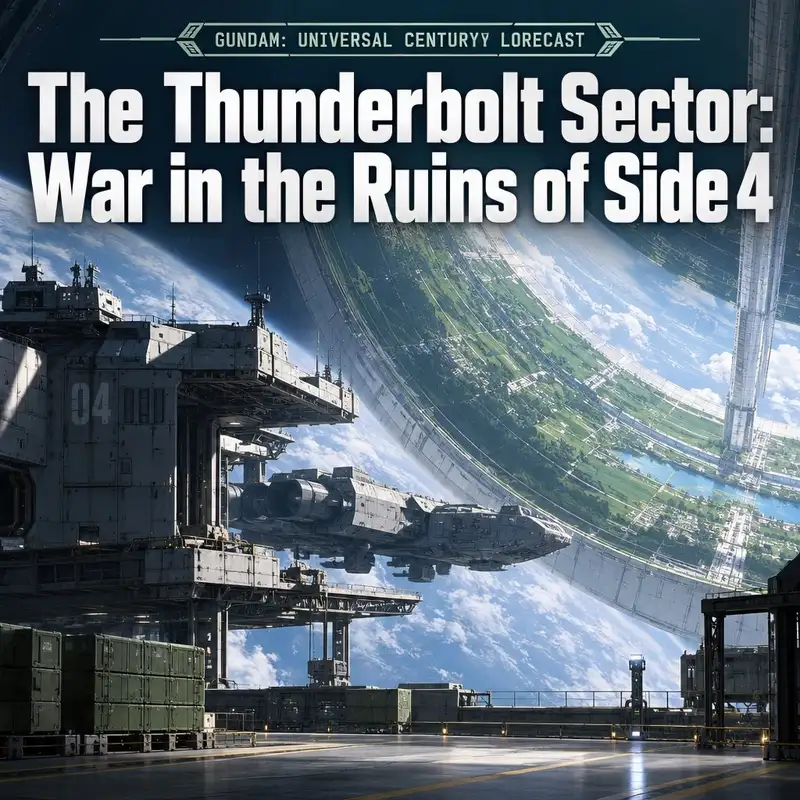
The Thunderbolt Sector: War in the Ruins of Side 4 [Thunderbolt Continuity]
A flash of light crosses the wreckage, then disappears behind a broken colony wall. For a moment, the Thunderbolt Sector seems almost beautiful. Metal fragments drift through black space. Electrical charges flicker across ruined structures. Damaged mirrors, habitation blocks, and shattered industrial sections catch the light like the remains of a city after a storm.
But this is not empty space, and it is not a neutral battlefield. These are the ruins of Side 4, the colony cluster known as Moore. The people fighting here move through what was once a civilian society. Its homes, docks, workplaces, and transport systems have become cover, obstacles, firing positions, and hazards. The destruction of Moore did not end when the colonies broke apart. It continued because the ruins became militarily useful.
Late in the One Year War, the Earth Federation Forces and Zeon both understood that the sector could not simply be ignored. Its debris field offered concealment and defensive depth. It also punished carelessness. A pilot who lost orientation could collide with wreckage. A ship that lingered in the wrong lane could become a target. A mobile suit that fired without understanding its surroundings might expose itself, or trigger a chain of debris that endangered friendly forces.
The battle that followed became unusually destructive not because two exceptional pilots happened to meet there, though they did. It became destructive because the ruins of Moore joined three forces together. The Federation sent survivors of the destroyed colonies into their own graveyard, turning grief into an operational motive. Zeon defended the sector with a formation built partly around wounded soldiers and experimental military medicine. And the terrain rewarded ambush, local knowledge, and individual initiative, while making every failure of command and support more expensive.
The Thunderbolt Sector was therefore a battlefield made from civilian catastrophe. Its combatants did not arrive at an empty frontier. They arrived inside the physical evidence of a destroyed home, carrying institutions that had already decided how much human damage they were prepared to use.
The Federation formation at the center of this campaign was the Moore Brotherhood. It was part of the Earth Federation Forces, but its identity was more specific than its uniform. Its personnel were survivors of Moore. They had lost homes, relatives, communities, and the ordinary civilian world that had existed before the war turned Side 4 into wreckage.
Their formal mission was military. Zeon forces occupied and defended the sector, and the Brotherhood was tasked with driving them out. Yet formal objectives are never the whole story of a unit at war. The Brotherhood was not simply reclaiming a piece of terrain. It was trying to return to a place that no longer existed. That gave the mission unusual emotional force. It also created a severe danger. A force driven by loss can be cohesive, stubborn, and willing to endure hardship. It can also become unable to distinguish a necessary military risk from a sacrifice demanded by memory.
Claudia Peer commanded the Moore Brotherhood under that pressure. Her task was not merely to place mobile suits on a tactical map. She had to sustain discipline among people for whom the battlefield was also a cemetery. She had to manage casualties, inexperienced personnel, damaged equipment, and the constant expectation that Moore had to be avenged. Command in that situation was not a matter of issuing orders from a safe distance. It meant deciding, repeatedly, how much more of an already devastated community could be spent.
The Federation provided the broader military structure, ships, equipment, personnel, and eventually advanced prototypes. But the Brotherhood’s fighting spirit came from Moore itself. That local identity gave the unit real strength. It also made the operation more difficult to control. The Federation had sent a military formation into the ruins. The survivors had brought their dead with them.
On the other side stood a Zeon force whose existence was shaped by a different form of institutional cruelty. The Living Dead Division was not a conventional elite squadron. It was a formation of wounded soldiers, many of them dependent on prosthetics, gathered into a unit that was both a combat organization and a source of research data.
That dual purpose must remain clear. The division was expected to defend the Thunderbolt Sector. Its soldiers fought, patrolled, ambushed, and held positions. Yet their bodies were also part of a military experiment. Their injuries and prosthetic systems were not incidental conditions to be accommodated. They were central to the development of new methods for connecting pilot and machine.
This gave the division a grim kind of military logic. The Thunderbolt Sector demanded pilots able to maneuver through dense wreckage, act quickly under poor visibility, and survive close-range encounters. Zeon researchers and commanders sought a way to make damaged bodies operate mobile suits with greater speed and precision. The wounded veterans assigned to the division became the human material through which that solution could be tested.
Daryl Lorenz was the division’s most capable and prominent pilot. He had lost both legs in earlier combat. He was also an exceptionally skilled sniper, and his ability to exploit the sector’s terrain made him a serious threat to the Moore Brotherhood. But Daryl’s effectiveness should not be understood as a simple tale of individual genius overcoming injury. He had prepared positions, knowledge of the debris field, support personnel, command structure, and a unit organized around the same difficult environment. A sniper is never merely a rifle and a trigger finger. A sniper depends on concealment, observation, timing, escape routes, and a wider formation willing to protect the conditions that make the shot possible.
The Living Dead Division also exposes a more troubling question. What does a military owe soldiers who have already been wounded in its service? One answer is rehabilitation, support, and a serious attempt to restore their place in civilian or military life. Zeon’s program offered another answer. It treated injury as an opportunity to create a new kind of weapons interface.
The Federation entered the sector carrying the grief of Moore. Zeon held it with troops whose injuries had been converted into military utility. Neither side was fighting a normal campaign. The battlefield had already been shaped by what each institution had decided to do with human loss.
The ruins intensified those choices. Minovsky-era warfare already limits long-range detection and complicates communications. Commanders cannot assume that every contact will appear clearly on a distant screen, or that every unit will receive an updated order at the exact moment it is needed. Local observation, prearranged plans, visual confirmation, and subordinate initiative matter more than they would in an environment of reliable long-range surveillance.
The Thunderbolt Sector made those limitations sharper. Wreckage interrupted lines of sight. Fragments created hiding places, false shadows, and narrow firing corridors. Electrical discharges added another layer of uncertainty to a field already crowded with broken structures. A mobile suit could use debris as cover, but it could also be trapped by it. A ship could launch fighters or mobile suits into the sector, but it could not simply command the engagement from a distance as if the wreckage were transparent.
The terrain rewarded the force that understood the local geometry. Where were the safe approach routes? Which hulks offered stable cover? Which openings allowed a sniper to fire and withdraw? Which debris fields were too dense for a heavily armed machine to maneuver freely? Where could a damaged suit be recovered? These were not minor details. They determined whether a patrol became a reconnaissance mission, an ambush, or a rescue operation.
In such an environment, a sniper could impose losses out of proportion to his numbers. An ambush force could delay a larger formation. A pilot who saw first might control the encounter before the opposing unit understood what was happening. But this did not make ships, command networks, or logistics irrelevant. It made them more important. A mobile suit could win a few seconds of advantage in the debris. It could not repair itself, replenish weapons, treat a wounded pilot, or coordinate an entire sector alone.
The first phase of the battle was therefore an attritional struggle for awareness. The question was not simply who had the stronger mobile suit. It was who could identify the enemy, survive the first exchange, recover from losses, and learn faster than the other side.
Daryl Lorenz became a central figure in that struggle because the Thunderbolt Sector suited his method of fighting. He was a sniper in a place where lines of fire could be prepared, where concealment was abundant, and where a target often had only moments to react after exposure. His attacks disrupted Federation movement and damaged morale because they made every route feel uncertain.
A sniper’s effect is often psychological as well as physical. A destroyed machine is a loss of personnel and equipment. It also tells every surviving pilot that the next piece of wreckage may conceal another shot. Units slow down. They bunch together for mutual protection, which can create new vulnerabilities. Or they spread out, which weakens coordination. Commanders begin spending time and resources on locating a threat that may have already moved.
Daryl’s performance was real. Reducing it to propaganda would miss the point. But ace mythology can conceal the system around an ace. The division’s prepared positions, its familiarity with the sector, and its ability to support a sniper campaign mattered as much as one pilot’s talent. The same is true of the Federation response. The Moore Brotherhood did not overcome the problem simply because it found a better pilot. It had to understand what Zeon was doing.
That process of learning was one of the campaign’s most important developments. The Federation began to recognize patterns in Zeon’s dispositions and methods. The problem was not merely that Daryl was dangerous. The problem was that the existing Federation approach gave him the kind of targets he needed. Once that became clear, the answer could not be just more courage or more ordinary patrols. It required a different tactical and technological response.
The Full Armor Gundam emerged from that response. It was not a general solution to the One Year War. It was a concentrated answer to a specific operational problem: how to push through a battlefield where a mobile suit could be exposed from several directions, where survival depended on both mobility and protection, and where a single machine might need enough firepower to break an ambush before it became a killing ground.
Io Fleming was selected to pilot it. He was a Federation pilot attached to the Moore Brotherhood, but he did not fit neatly into the unit’s collective identity. The Brotherhood was bound together by its loss of Moore. Io’s relationship to that inheritance was more complicated. He resisted being defined by family background, social expectations, or the emotional script imposed by a unit fighting for its destroyed homeland.
That resistance did not make him detached from the war. Io was intensely involved in it. He was aggressive, daring, and capable of turning a local opening into a violent tactical advantage. He also brought his own personal intensity to combat, including a habit of using music as a private form of rhythm and control. But the important point is not that Io had an unusual personality. It is that the Federation placed an unusually complex weapon in the hands of a pilot whose strengths and recklessness were closely connected.
The Full Armor Gundam concentrated protection, propulsion, and weapons in one machine. Its armor and shielding increased the pilot’s chances of surviving the first exchange. Its extensive armament offered a way to suppress firing positions, engage multiple threats, and force a path through debris that might otherwise favor an ambusher. Its added mobility helped it maneuver in a sector where a slower response could be fatal.
Those strengths came at a cost. A heavily equipped prototype needs ammunition. It requires technicians who understand its systems. It presents maintenance burdens that a standard mobile suit may not. Damage that a field workshop could manage on a simpler machine might immobilize a complex prototype. The machine’s combat power depended on the ability to launch it, recover it, repair it, and rearm it. A weapon system can be extraordinary and still remain fragile at the organizational level.
Cornelius Kaka represents that hidden reality. As an engineer and one of Io’s close associates, he stands for the technical labor behind the prototype. Pilots receive the public attention because they occupy the cockpit. Engineers, mechanics, ordnance crews, and recovery personnel determine whether the cockpit is ever occupied again. The Full Armor Gundam was not merely Io’s machine. It was the product of people who maintained, configured, and trusted it under combat conditions.
Zeon’s answer to the Full Armor Gundam did not merely add more armor or weapons to an existing Zaku design. It attempted to alter the relationship between pilot and machine. The result was the Psycho Zaku, a high-mobility Zaku variant equipped with the Reuse “P” Device.
The name can be misleading if treated casually. The Reuse “P” Device was not psycommu, psycho-frame, or a Newtype system. It did not depend on the kind of Newtype phenomena associated with later eras of the Universal Century. Its principle was more immediate, and more disturbing. It used a direct interface between prosthetic systems and the mobile suit, allowing an amputee pilot to control the machine with extraordinary responsiveness.
In operational terms, this addressed a genuine control problem. A mobile suit in the Thunderbolt Sector had to maneuver rapidly through dense wreckage. It had to fire, evade, adjust attitude, and respond to threats with little margin for hesitation. The Reuse “P” Device promised a level of integration between pilot and machine that could make those movements more immediate. In the hands of Daryl Lorenz, it produced a formidable weapon.
Yet the system’s apparent sophistication must not obscure its human cost. Prosthetics can restore function. That is one thing. A military program that requires escalating bodily sacrifice in order to create its most effective interface is something else entirely. The Reuse “P” Device did not simply assist wounded veterans. It made their injuries part of the machine’s design requirement.
This is where Karla Mitchum becomes essential to the history of the sector. She was a researcher associated with the device and the broader medical-technological system around it. Reducing her to a villain would be too easy and not especially useful. Military research often involves people who can describe their work in terms of innovation, recovery, national survival, or technical possibility. Those terms are not always false. But they can conceal the moral structure of the program.
The central question is responsibility. What happens when a researcher accepts a system in which wounded soldiers are valuable not despite their injuries, but because their injuries make them suitable for a new weapon? What happens when the military demand for data becomes more important than the person producing it? In the Living Dead Division, battlefield performance and medical experimentation became difficult to separate.
The Zeon command and research culture surrounding the division had found a way to convert disability into combat potential. That could be presented as adaptation. It was also exploitation. The military did not eliminate the vulnerability of its wounded soldiers. It reorganized that vulnerability into a source of tactical advantage.
The Psycho Zaku therefore embodied a grim design philosophy. The Full Armor Gundam sought to survive a lethal environment through protection, redundant weapons, and concentrated firepower. The Psycho Zaku sought to master the same environment through responsiveness and integration, but it achieved that integration by making human damage more central to the system. One prototype concentrated materiel. The other concentrated sacrifice.
Both were highly specialized. Neither represented a routine mobile suit available across the entire war. Neither offered a scalable answer to the political and institutional failures that had produced the conflict. They were solutions to a local tactical problem, shaped by organizations willing to invest extraordinary resources in exceptional pilots.
That is why the apparent duel between Io and Daryl must be understood at a larger scale. Their machines mattered, but the battle was sustained by ships. The Beehive, the Moore Brotherhood’s flagship, was not background scenery waiting for mobile suits to launch from it. It was the formation’s operational base.
The Beehive provided command space, launch capacity, maintenance support, supplies, recovery, medical treatment, and a place where damaged crews and machines could return. It was where pilots received briefings, where technicians assessed battle damage, where ammunition was loaded, and where commanders tried to turn scattered reports into an understanding of the battle. In a sector that disrupted visibility and communication, the ship was a vital center of cohesion.
That cohesion was always vulnerable. A mobile suit lost in the debris could be more than a tactical casualty. It could represent a pilot who could not be recovered, intelligence that could not be collected, and equipment that could not be repaired. A ship damaged or destroyed could remove not only guns from the battle but launch facilities, medical support, technical labor, and command capacity. The destruction of support infrastructure can matter more than the loss of a single famous machine, however powerful that machine may be.
The Living Dead Division had similar dependencies. Its specialized pilots required technicians, medical personnel, prosthetic support, replacement components, prepared positions, and a command structure able to keep its fragile system functioning. The Psycho Zaku may have appeared to turn Daryl into a nearly seamless extension of the machine. But no pilot-machine interface is independent of the people who fit, maintain, monitor, and sustain it.
This is the hidden machinery of the so-called duel. Both sides experienced the conflict through exceptional individuals, and both institutions were willing to give those individuals enormous symbolic weight. But the actual center of gravity was broader. It lay in whether ships could remain operational, whether crews could maintain equipment, whether casualties could be treated, whether damaged machines could be recovered, and whether command could still impose a purpose on the destruction.
As the campaign continued, those conditions became harder to preserve. Claudia Peer faced the burden of command in a formation driven by grief. Every casualty could deepen the Brotherhood’s determination, but it could also erode the discipline needed to fight effectively. Revenge can sustain a unit through fear. It cannot repair a damaged ship, replace trained technicians, or make a commander’s decisions less painful.
Io’s aggression created opportunities. He could seize initiative, break through defenses, and challenge Zeon’s hold on the sector. But aggression has a price when it becomes fixation. A pilot who sees the enemy as a personal target may take risks that appear decisive in the moment while complicating the mission for everyone else. Tactical boldness is not the same thing as operational judgment. The two can coexist in one person, but they do not automatically reinforce each other.
Daryl faced a different kind of pressure. He was a combatant with real skill and commitment, but he was also a wounded veteran whose military value had been redefined by a research program. His success in the Psycho Zaku could make the program appear justified. That is one of the cruelest features of institutions that exploit their personnel. The victim’s competence becomes evidence for the system that endangered him.
Karla Mitchum’s position was similarly entangled. Technical ambition, medical knowledge, military necessity, and personal responsibility do not remain cleanly separate once a program requires people to be harmed in order to function. The more effective the device becomes, the more difficult it may be for its designers to acknowledge the cost built into its success.
Formations do not break only when their machines are destroyed. They break when trust weakens, when the wounded cannot be cared for, when replacement becomes impossible, when commanders no longer believe they can control the battle, and when the original purpose of the mission is overwhelmed by individual rage. The Thunderbolt Sector was beginning to consume not just equipment, but the ability of both sides to hold themselves together.
The campaign therefore escalated beyond sniper engagements and isolated mobile-suit clashes. The Beehive and the Zeon forces defending the sector became part of a broader confrontation in which ships, launches, recoveries, and command decisions mattered as much as the performance of either prototype.
Under Minovsky conditions and amid dense wreckage, command could not assume perfect control. Reports arrived late or incomplete. Units could lose contact. A damaged suit might not reach recovery. A ship under threat had to decide whether to remain available for its mobile suits or protect itself from further attack. Launch timing mattered. So did the availability of technicians, the condition of catapults and hangars, the readiness of rescue crews, and the ability of commanders to distinguish a temporary setback from a collapse.
This was where the promise of prototype warfare met the reality of fleet operations. A Full Armor Gundam or Psycho Zaku could win a local engagement. It could not by itself preserve a carrier, organize a withdrawal, coordinate dispersed units, or replace the casualties accumulating across the formation. If the support system failed, the prototype’s strengths became harder to use. A heavily armed mobile suit with no resupply is finite. A high-mobility machine with no medical or technical support is equally finite.
The personal confrontation between Io and Daryl took place inside that larger crisis. It was not a clean contest arranged apart from the battle. It was the product of a sector already devouring ships, crews, and formations. Their rivalry mattered because each pilot embodied an answer his side had chosen for the immediate military problem. But the rivalry could not escape the institutional conditions that created it.
The Full Armor Gundam represented an attempt to force its way through the Thunderbolt Sector. It brought armor, shielding, propulsion, and an overwhelming variety of weapons to bear on a battlefield designed to punish exposure. Its philosophy was survival through concentration. If the environment favored ambush, then the machine would carry enough protection to endure the first strike and enough firepower to destroy the ambush.
The Psycho Zaku represented a different answer. It sought to make the pilot’s response more immediate than the enemy’s. Its mobility and interface system turned speed, coordination, and destructive potential into the central advantages. Rather than absorbing the battlefield’s violence, it attempted to move through it faster and strike with greater flexibility.
Neither solution was simple. The Full Armor Gundam’s abundance created logistical dependence. Weapons had to be maintained and replenished. Armor and equipment added complexity. The pilot had to manage a machine built around multiple systems in a chaotic environment. Its strength was real, but it was not free.
The Psycho Zaku’s responsiveness carried an even more direct cost. Its performance depended on a pilot whose body had been made compatible with the device through sacrifice. The machine’s effectiveness did not erase Daryl’s injury. It made that injury integral to the system. In this sense, the Psycho Zaku was not merely a weapon with a tragic backstory. It was a weapon whose design converted tragedy into operational capability.
When Io and Daryl fought, both inflicted severe harm. The encounter demonstrated what exceptional pilots could do when paired with highly specialized machines. It also demonstrated the limits of that kind of performance. Their battle did not produce a clean, durable resolution of the sector. It did not restore the Moore colonies. It did not eliminate the need for ships and support crews. It did not settle the One Year War.
Tactically, the prototypes changed what was possible. They could break formations, survive threats that would destroy ordinary machines, and impose extraordinary costs on the enemy. Operationally, however, the fighting damaged the very structures needed to sustain the campaign. Units were depleted. Support systems were strained. Command cohesion deteriorated. The contest became less a path toward decisive control and more a process of mutual exhaustion.
Strategically, the result remained unresolved. The One Year War continued toward its final battles elsewhere. The Thunderbolt Sector was important to the people fighting there, and its losses were real. But no duel, however spectacular, could decide a war fought across Earth orbit, the lunar sphere, colonies, fortresses, fleets, factories, and occupied territory.
What remained after the battle was not a simple victory. The Full Armor Gundam had shown the Federation what concentrated protection and firepower could accomplish in a uniquely dangerous environment. The Psycho Zaku had shown Zeon what a direct prosthetic-linked interface could do in the hands of a skilled pilot. Both machines changed the immediate balance of combat. Neither solved the problem that had made the sector a killing ground.
The operational cost was broader than the destruction visible in any single engagement. Ships and mobile suits suffered. Crews lost the capacity to support one another. Technicians, medical personnel, and commanders were placed under demands that no prototype could relieve. A campaign that began with a mission to remove Zeon from the sector became increasingly shaped by loss, fixation, and the collapse of controlled escalation.
The Living Dead Division revealed another institutional truth. Military technology does not merely emerge from laboratories and blueprints. It emerges from decisions about whose bodies can be used, whose injuries can be repurposed, and which forms of suffering can be described as necessary. Zeon’s experimental system treated disabled veterans not simply as people to be supported, but as resources for a new category of weapon.
The civilian consequence remained present in every piece of wreckage. Moore was gone, but it had not disappeared from the war. Its destruction shaped the identity of the Federation force that entered the sector. Its ruins gave Zeon defenders cover. Its former infrastructure became part of the geometry of battle. The dead and displaced were absent from the cockpits, but they remained central to the campaign.
The immediate animated record leaves Daryl alive after the confrontation, departing the sector rather than providing a neat final answer to the conflict. That unresolved ending is appropriate. The battle could not be cleanly concluded because its causes were larger than either pilot. Io and Daryl had become the visible points of a war driven by destroyed communities, military research, revenge, and institutions willing to spend people for local advantage.
The Thunderbolt Sector was not uniquely destructive because two famous prototypes met among the ruins. It was uniquely destructive because the ruins of Moore gave grief a military geography, because Zeon turned wounded veterans into experimental weapons, and because both sides placed extraordinary faith in individual performance while the real war depended on ships, crews, maintenance, command, and political purpose. The Full Armor Gundam and the Psycho Zaku could dominate moments of battle. Neither could restore Moore, protect the people already lost, or turn tactical brilliance into a durable result.