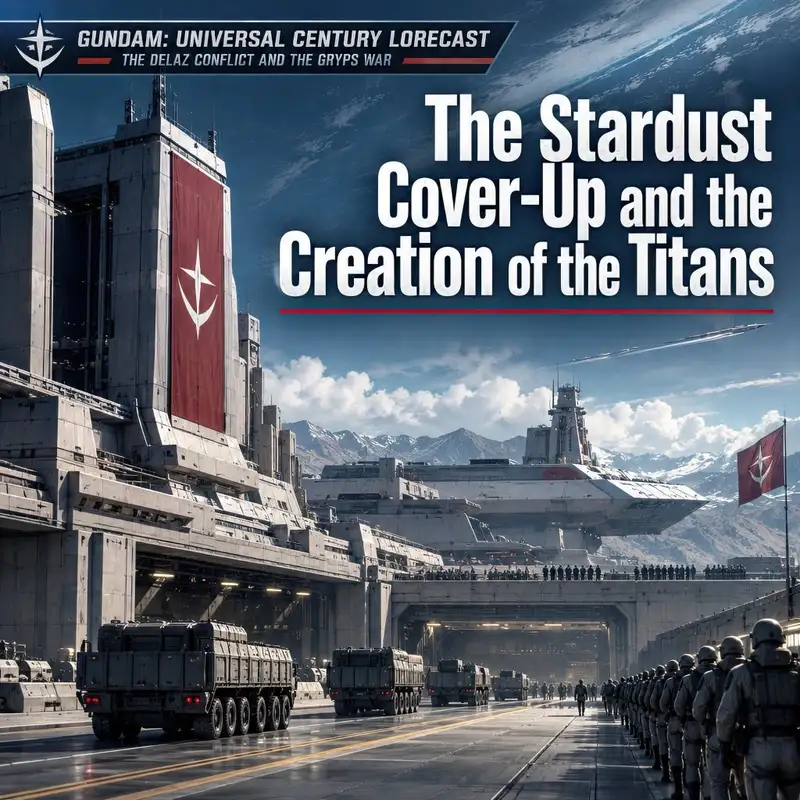
The Stardust Cover-Up and the Creation of the Titans
Months after Operation Stardust, the Earth Federation began turning a military disaster into an official story. Records connected to the Gundam Development Project were suppressed, responsibility was narrowed, and a crisis that had exposed failures in weapons security, intelligence, command, and civilian protection became an argument for stronger internal security. The cover-up did not undo the nuclear strike at Konpei Island or the colony impact on Earth. It shaped which lesson the Federation chose to preserve, and that choice helped create the Titans.
What the Federation was trying to bury had become impossible to ignore at Konpei Island. Anavel Gato arrived in the stolen Gundam GP02A, carrying a nuclear weapon the Federation had built, tested, and failed to secure. His attack shattered the review formation and, with it, the reassuring image the gathering was meant to project. The destruction mattered because the ships were concentrated, but the spectacle mattered almost as much. A victorious government had assembled military power before its own leadership and found that power vulnerable to a small remnant force, a classified weapons program, and failures inside its own command structure.
The attack at Konpei was not simply a dramatic mobile-suit raid. It was the public collapse of a postwar security claim. The Federation had defeated the Principality of Zeon, but it had not secured the political order that followed the war. It had not eliminated armed remnants. It had not resolved the resentment and instability that fed those remnants. And it had not brought its own military reconstruction under sufficiently clear, accountable control.
That combination gave Admiral Aiguille Delaz an opportunity. Operation Stardust was designed to prove that Federation victory had not brought safety, legitimacy, or even reliable control over Earth orbit. The Delaz Fleet did not possess the industrial base, territory, or population needed to restore the old Zeon state. It could not defeat the Federation in a conventional war. But it could use secrecy, concentration, political symbolism, and mass destruction to make a weaker force appear strategically decisive.
The Federation’s response to that challenge became as important as the attack itself. Its leaders faced a genuine security crisis. A Zeon remnant had stolen a nuclear-capable prototype, attacked a fleet review, and prepared an operation against Earth. Yet the institutional answer was not limited to improving security, clarifying command responsibility, or confronting the political conditions that made remnants durable. Instead, the crisis became an argument for stronger internal coercion.
The resulting cover-up did not erase the damage done by Operation Stardust. It could not restore destroyed ships, reverse the colony impact, or remove the memory of the disaster from those who lived through it. What it could do was shape the official explanation. It could suppress embarrassing records, conceal failures in procurement and command, and redirect public anger toward a generalized internal enemy. In that political environment, the creation of the Titans became possible.
Delaz understood how useful the Federation’s postwar insecurity could become. His fleet was not the Principality of Zeon reborn. It was a remnant formation built around former Zeon personnel, ships, mobile suits, hidden support networks, and the memory of defeat. Its members could invoke Zeon’s cause, but they did not govern Side Three, command the resources of a state, or speak for all Spacenoids. Their political language drew strength from real colonial grievances, yet their methods placed those grievances inside a campaign of terror and coercion.
Delaz’s objective was larger than revenge. He wanted to demonstrate that Federation authority was fragile. The Federation claimed to have ended the war and restored order. Operation Stardust would show that a determined remnant could penetrate its defenses, destroy its symbols, and strike the Earth itself. That message could inspire other anti-Federation elements, embarrass Federation leaders, and keep the memory of Zeon’s military challenge alive.
Gato was central to that plan, but he was not the plan by himself. His skill, discipline, and commitment made him an effective executor. He could infiltrate a defended installation, operate an unusual machine, and carry out a mission under extreme pressure. Yet the strategic meaning of his actions depended on a wider system. Hidden bases, ship movements, intelligence, deception, logistics, and political timing all mattered. A single pilot can launch a weapon. He cannot move a colony, sustain a fleet, or create a crisis of legitimacy alone.
That distinction matters because Operation Stardust is sometimes remembered through its most visible images: the stolen Gundam, the nuclear strike, the falling colony. Those images are powerful, but they can conceal the operation’s actual structure. Delaz used a mobile suit as one instrument in a campaign that combined infiltration, strategic attack, propaganda, and orbital coercion. The goal was to make the Federation look helpless before its own population and divided inside its own institutions.
That design became unmistakable at Konpei Island. The naval review assembled Federation ships at a site chosen for political memory. Solomon had once been a major Zeon fortress. By holding a review there, the Federation could demonstrate that the old battlefield had been absorbed into a stable postwar order. It was a display of recovered strength, but displays of strength can also create predictable targets.
A concentrated fleet offers an attacker something valuable: density. Warships are not obsolete because they can be attacked. They remain essential for transport, command, mobile-suit support, firepower, and control of space routes. But ships gathered in a review formation require security, reconnaissance, dispersal plans, warning systems, and credible defenses against specialized threats. The Federation had assembled a symbol. Delaz turned that symbol into an operational vulnerability.
Gato’s nuclear strike destroyed ships within the formation and inflicted a shock far greater than the size of the attacking force would suggest. The exact number of losses is less important than the character of the failure. The Federation had allowed a stolen nuclear weapon to reach a high-value gathering of its own naval forces. It had failed to stop the attacker before release. And it had allowed an enemy remnant to choose the moment when its military weakness would become politically visible.
The tactical result was destruction inside the review formation. The operational result was disruption of fleet readiness, damage to command confidence, and diversion of attention toward crisis response. The political result was even broader. The Federation’s public claim to restored security had been broken by one of its own secret weapons. Its citizens could see that the war had ended on paper without producing a secure peace in practice.
Nuclear use also changed the moral character of the operation. Konpei was a military target, but a nuclear strike is not merely a more powerful artillery round. It carries the memory of mass destruction, the risk of uncontrolled escalation, and the message that the attacker is prepared to use catastrophic force for political effect. Delaz wanted the Federation to feel exposed. He achieved that aim, but he did so through a method that placed any possibility of liberation beneath the logic of terror.
The strike was not Operation Stardust’s end state. It was the shock that distracted, weakened, and disoriented the Federation while the larger operation moved forward. Delaz’s forces seized a colony from Side Seven. At first, the colony’s movement could be read as part of a threat against the Moon. That possibility forced the Federation to consider multiple strategic dangers. But the eventual course made the real purpose clear. The target was Earth.
A colony is not a missile waiting to be aimed. It is a built environment containing homes, life-support systems, transportation networks, industrial facilities, and a political community. Turning one into a weapon requires control over more than propulsion. It requires docking, navigation, timing, maintenance, access to infrastructure, security against intervention, and enough supporting force to keep the operation moving. The scale of that effort tells us that Operation Stardust was not an improvised act of desperation.
The colony weapon also revealed Delaz’s strategic logic. The Federation’s power rested not only on fleets and mobile suits, but on Earth’s population, industry, agriculture, and political centrality. A strike against Earth could threaten material resources while demonstrating that control of orbit did not guarantee the safety of those below. The operation was designed to attack confidence as much as infrastructure.
This was coercion through vulnerability. The Delaz Fleet could not occupy Earth. It could not replace the Federation government. It could, however, force the Federation to acknowledge that the planet remained exposed to orbital attack. That message would resonate with military leaders, Earth residents, colonial populations, and every faction that understood how dependent the Earth Sphere remained on transportation routes and strategic infrastructure.
For civilians, the colony’s movement represented more than a military crisis. Somewhere behind the operational maps were people who understood that a colony had been converted into a weapon. On Earth, agricultural communities and surrounding populations faced the prospect that a war supposedly concluded years earlier could still descend from orbit. The language of strategic necessity often becomes abstract at this scale. The people under the projected impact point do not experience it as abstraction.
The Federation now had to stop the colony. Its answer was Solar System Two, a strategic defense system intended to destroy or divert the approaching threat before impact. The system’s importance was not in a catalogue of technical details. It mattered because it represented the Federation’s last opportunity to use concentrated technological power against an approaching catastrophe. If it worked, the government could show that its military retained the ability to defend Earth. If it failed, the political consequences would be severe.
A defense system can be extremely powerful and still fail as part of an operation. It needs accurate intelligence, secure communications, reliable timing, clear authority, protection from sabotage, and leaders willing to act on what they know. By the time Solar System Two was brought into the crisis, the Federation had already lost the strategic initiative. Delaz had forced it to react after the theft, after the naval strike, and after the colony movement had begun.
The interception effort was compromised by enemy disruption and by divisions within the Federation response. Cima’s actions again demonstrated the danger of relying on actors whose loyalties were contingent and whose interests did not match the stated mission. Her maneuvering helped fracture the defensive effort, but it should not be simplified into a story in which every Federation failure was arranged in advance. The system failed because it faced an enemy operation built around deception and because the Federation’s own command environment was already burdened by secrecy, rivalry, and political calculation.
The final orbital correction made the colony’s impact unavoidable. The OVA presents this as the end of the kinetic struggle. There was no final duel that could restore the lost initiative. Albion and its pilots could still fight, still survive, and still understand fragments of what had happened. But tactical courage could not undo a strategic failure once the colony’s course could no longer be changed.
That is one of the harshest lessons of Operation Stardust. Military organizations often celebrate the moment of contact because it is visible. The decisive failures may have occurred much earlier: when a weapon was secured poorly, when warning signs were discounted, when intelligence was compartmentalized, when command authority was blurred, or when political leaders delayed action because the full truth was inconvenient.
The colony struck North American agricultural land. The record does not support a precise account of casualties, crop losses, or economic damage that can be stated with confidence. What is clear is the strategic meaning. The impact damaged a region central to Earth’s food-producing capacity and demonstrated that orbital attack could threaten civilian infrastructure on a continental scale.
The civilian effects extended beyond the immediate area. Agricultural disruption affects food distribution, labor, transport, local communities, and public confidence. Even people far from the impact site would understand what the attack meant. The Federation had failed to protect its fleet from a nuclear strike. Then it had failed to prevent a colony from reaching Earth. A state that claims authority over the Earth Sphere must be judged, in part, by whether it can protect the people and infrastructure under that authority.
Delaz achieved a spectacular strategic shock. He exposed Federation weakness, damaged its credibility, and proved that remnants of Zeon could still shape the politics of the Earth Sphere. But he did not create a durable settlement for ordinary Spacenoids. He did not liberate colonies from Federation rule. He did not establish a government able to represent the people in whose name Zeon had once claimed to fight.
Instead, the operation created new suffering and gave Federation hardliners an argument they had wanted. Delaz’s attack demonstrated a real danger. The tragedy was that his methods made it easier for the Federation to answer legitimate political tension with repression. A campaign intended to preserve Zeon’s memory helped create an institution that would treat broad categories of colonial dissent as a security threat.
After the impact, the Federation faced a choice about memory. It could investigate the stolen prototype, the nuclear weapons program, the failure at Torrington, the naval review’s vulnerabilities, the breakdown of interception, and the political decisions that had made coordinated defense so difficult. Such an inquiry would have been painful. It could have implicated commanders, procurement officials, project administrators, and senior leaders whose decisions had placed the Federation in danger.
Or it could simplify the story. It could present Operation Stardust primarily as an external assault by Zeon remnants and minimize the Federation failures that made the assault possible. It could protect classified programs from scrutiny. It could preserve the reputations of institutions connected to those programs. It could redirect public fear toward the continued danger of internal enemies.
The Federation chose suppression. Records concerning the Gundam Development Project were erased after the scandal. The official chronology places the formal suppression of relevant records in March of Universal Century eighty-four, after the Titans had already been created. The timing matters. The security institution came first. The archival and political cleanup followed as the Federation settled on the story it wanted to preserve.
The cover-up was not magic. It did not erase every witness, every survivor, or every private memory. It did not make the Albion’s experience unreal. It did not prove that all Federation officers had participated knowingly. Large institutions rarely require universal complicity. Compartmentalization is often enough. Some people know the full picture. Others know only their assignment. Some obey orders because they believe secrecy is necessary. Others recognize the injustice but lack the authority to resist it.
What suppression did was narrow the official record. It protected the Federation officials and commanders whose failures might otherwise have become public. It shielded institutions associated with a politically dangerous nuclear-capable development project. It limited the opportunity for citizens to ask why the weapon existed, why it was vulnerable, why the naval review had been exposed, and why the colony could not be stopped.
It also protected a more general political narrative. If the crisis could be explained mainly as proof that Zeon remnants remained an existential threat, then the solution could be framed as more security, more surveillance, more military authority, and less tolerance for dissent. The alternative explanation was much harder to manage. That explanation would have acknowledged that the Federation had been endangered by its own secrecy, complacency, fragmented command, and failure to build a credible political order after the war.
For the victims, the cost of suppression was not merely historical. An honest public account can identify responsibility, preserve lessons, and give survivors some recognition that what happened to them mattered. A managed narrative does the opposite. It converts disaster into administrative language. It makes errors disappear into classification. It leaves the public with fear but without a clear understanding of who failed, who benefited, and what reforms were necessary.
For that reason, the Stardust cover-up was more than bureaucratic embarrassment. It was a contest over legitimacy. A government that admits failure can lose prestige, but it may also rebuild trust through accountability. A government that conceals failure can preserve authority in the short term, especially when citizens are frightened. Yet it also teaches its institutions that protecting themselves matters more than learning from catastrophe.
The Titans emerged from that environment. According to the official chronology, the organization was created on December fourth, Universal Century eighty-three, in the immediate aftermath of Operation Stardust. Its stated mission was to hunt Zeon remnants and suppress anti-Federation threats. On its face, that mission had an obvious appeal. Armed remnants were real. Gato had demonstrated that they could penetrate defenses, use strategic weapons, and endanger Earth itself.
The Titans were not identical to the entire Earth Federation Forces. They began as a specialized formation inside the Federation military, created to deal with a defined security problem. That difference changes the analysis. The Federation still contained regular military branches, civilian authorities, local commands, and personnel who did not share the Titans’ methods or political priorities. But a specialized security force can become unusually powerful when it is formed during crisis and granted broad authority in the name of preventing another disaster.
The institutional danger lay in the mission’s elasticity. Hunting a clearly identified armed remnant is one task. Suppressing anti-Federation forces is much broader. It can include sabotage cells, insurgents, political opponents, labor unrest, colonial protest, and communities suspected of disloyalty. Once a force is permitted to define broad political opposition as a military threat, the boundary between defense and repression begins to weaken.
That boundary is especially dangerous in the Universal Century. The conflict between Earth and the colonies was never only a matter of armed remnants. It involved representation, economic dependence, class, citizenship, military power, and the belief among many colonists that Earth-based institutions treated them as subjects rather than equal partners. A government that answered every expression of that crisis through elite military policing would intensify the very resentment it claimed to contain.
Hardliners within the Federation understood how useful Stardust could be. The operation had created public fear, damaged confidence in existing security arrangements, and made stronger measures easier to defend. Jamitov Hymem and Bask Om would later become closely associated with the Titans and their coercive direction. But the evidence does not require the claim that they designed the entire Delaz operation from the beginning. Exploiting a disaster is not the same as orchestrating it.
That distinction is not a technicality. If every crisis is explained as a perfect conspiracy, then institutional failure disappears into melodrama. The harder and more useful question is how a government can turn a real attack, committed by real enemies, into a justification for power that reaches far beyond the original threat. Stardust did not need to be invented for the Titans to benefit from it. It only needed to be interpreted in a way that made accountability seem less urgent than coercion.
The Titans’ founding logic placed security above political restraint. The Federation had been humiliated. Its military had been penetrated. Its Earth territory had been struck. In that climate, calls for patience, legal limits, colonial reform, or public investigation could be portrayed as weakness. The organization’s early legitimacy came from the widespread belief that the old system had failed to defend the Earth Sphere.
But emergency institutions do not remain limited simply because their original justification was real. They develop their own command structures, patronage networks, intelligence systems, and political interests. They reward personnel who demonstrate zeal. They accumulate classified information. They learn that broad definitions of danger make it easier to expand their authority. And they begin to view oversight not as a safeguard, but as an obstacle.
The later history shown in Mobile Suit Zeta Gundam demonstrates what that process produced. The Titans turned their authority against Spacenoids and anti-Federation opposition with escalating brutality. Their actions included atrocities such as the Thirty Bunch incident, where colonial civilians were treated not as people with political rights, but as a population to be intimidated and controlled.
Stardust did not mechanically predetermine every later Titans crime. Institutions are made of decisions, and different people could have chosen differently. The Delaz Fleet did not force the Titans to commit atrocities years later. Neither did the mere existence of Zeon remnants. What Stardust did was normalize a premise: that security in the Earth Sphere could be achieved through exceptional military authority directed inward, especially against colonial populations already regarded with suspicion.
That premise was fatal. It treated the political problem of the colonies as a policing problem. It treated fear as evidence that restraint was dangerous. It treated public accountability as a luxury that could be postponed until after security had been restored. In practice, security was never restored, because the methods used to impose it created new enemies and deepened old grievances.
The Delaz Fleet won a spectacular strategic attack. It demonstrated that the Federation could be struck, embarrassed, and forced into crisis. Federation hardliners then converted that crisis into institutional power. The Titans, created to defend Federation order, eventually became one of the clearest threats to the legitimacy of that order.
The Stardust cover-up was therefore not merely an attempt to hide embarrassment. It transformed failures of procurement security, intelligence, command, and civilian protection into a simpler political story about internal threat. Delaz proved that the Federation was vulnerable. Federation hardliners ensured that the lesson drawn from that vulnerability was not accountability, reform, or a more credible settlement with the colonies, but exceptional coercive power.
The Titans were born from a real security crisis. Their later brutality showed how quickly a government can mistake the protection of its authority for the protection of its people.