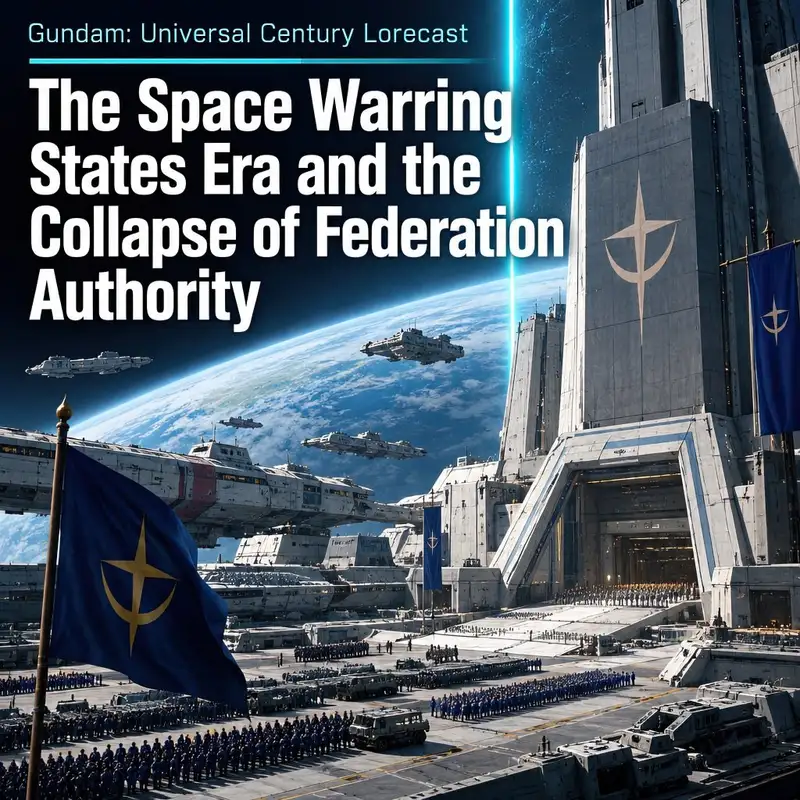
The Space Warring States Era and the Collapse of Federation Authority
When the Crossbone Vanguard struck Frontier IV in Universal Century one hundred twenty-three, the most important fact was not that another force had found a way to attack a colony. The Earth Sphere had seen that before. The important fact was that the attack could become a political reality before the Earth Federation could protect the people who lived there. Frontier IV was not an empty station or a military target floating in isolation. It was a functioning colony, with docks, transport routes, communications, homes, schools, life-support systems, and civilians whose lives depended on those systems continuing to work. To seize it was to make a claim over an entire community.
The Federation was still the recognized sovereign power. Its institutions still existed. Its military still possessed ships, personnel, facilities, and a long institutional memory of interplanetary war. But at Frontier IV, the immediate defense came down to an understrength training ship, the Space Ark, inexperienced personnel, civilians caught in the fighting, and a small number of exceptional machines. That is not proof that the Federation had ceased to exist. It is evidence of something more historically significant. The state remained present in law while becoming unreliable in practice.
The Crossbone Vanguard understood the value of speed. A rapid assault against a colony did more than eliminate defenders. It created a fait accompli. Once an attacking force controlled ports, communications, local government buildings, and access routes, the question was no longer whether an outside power could intervene. The question was whether it could intervene without destroying the place it claimed to save. Reinforcements arriving after the seizure faced a more complicated mission. They had to distinguish enemy troops from civilians, avoid damage to fragile habitat infrastructure, restore local administration, and persuade frightened residents that the old authority still had meaning.
That was the military problem at the heart of the late Universal Century. The Earth Federation had once dominated the Earth Sphere through its scale, population, industrial capacity, and formal political authority. By the era of Mobile Suit Gundam F91 and Mobile Suit Victory Gundam, those advantages had not disappeared completely. What had weakened was the Federation’s ability to convert them into dependable authority across a vast and politically fractured human civilization. It could still issue laws. It could still claim jurisdiction. It could still field forces in particular places. But it could no longer reliably guarantee security, enforce decisions, settle disputes, or convince colonial populations that help would arrive when it mattered.
That condition is often described as the Space Warring States Era. The phrase evokes an older pattern of fragmented political authority, competing armed powers, shifting loyalties, and local rulers who possessed enough military strength to challenge a nominal center but not enough legitimacy or capacity to establish lasting peace. It is useful language, provided it is not treated as a single, neatly documented constitutional event. The principal animated record does not show the Federation formally dissolving in one year, nor does it establish a universal declaration of colonial independence. The Federation survives. Its authority simply becomes increasingly nominal in places where authority must be demonstrated rather than announced.
A government can endure on paper long after it has lost the practical tools of government. It may retain diplomatic recognition while failing to protect shipping. It may tax territory without securing it. It may keep military commands on organizational charts while those commands lack readiness, transport, intelligence, political direction, or public trust. It may promise equal citizenship while distant populations experience only neglect, emergency rule, or the arrival of troops after the danger has passed. The late Federation’s decline was not the disappearance of a flag. It was the widening gap between formal sovereignty and effective power.
The distinction matters because it prevents an easy but false explanation. The Earth Federation did not collapse because it lost one decisive battle. It did not vanish because one rival faction defeated it. Nor did every colony simply rise together and choose self-government. The process was slower and more uneven. Different regions acquired different degrees of autonomy. Some local powers pursued genuine self-rule. Others built aristocratic systems, military governments, private security structures, ideological states, or survival networks organized around access to transport, industrial repair, and armed force. A weakening center did not produce one alternative order. It produced a contest over who would rule in its place.
The roots of that contest lay in older failures. For generations, the Federation had governed an Earth Sphere transformed by migration into space without creating a political order that gave colonial society equal confidence in representation, security, and influence. The One Year War had shown the terrible consequences of that failure. Zeon’s dictatorship exploited real colonial grievance while pursuing aggressive war, occupation, and mass murder. The Federation survived, but survival was not the same as reform. It restored its position without fully resolving the political conditions that had made separatist nationalism, military expansion, and authoritarian rule possible.
Later crises reinforced the same pattern. Char’s Rebellion demonstrated that the Federation remained strategically formidable, yet politically incapable of settling the divide between Earth and the colonies through credible reform. The Axis Shock ended the immediate campaign, but it did not create a durable settlement. The Laplace Incident exposed historical contradictions in Federation legitimacy and revealed how deeply the system’s foundations had been shaped by exclusion and secrecy. Yet disclosure did not automatically reorganize institutions, redistribute power, or restore public confidence. A government can survive scandal. It can even survive military disaster. What it cannot survive indefinitely is a public belief that its promises are ceremonial and its protection conditional.
This was not only a matter of corruption, though corruption mattered. It was also a problem of distance, administration, readiness, and political attention. The Earth Sphere is not a compact nation-state. It is a system of planetary surfaces, orbital routes, lunar cities, colony clusters, asteroid bases, industrial centers, and inhabited cylinders separated by vast distances and different strategic conditions. Governing such a system requires more than a central legislature and a fleet headquarters. It requires transport, communications, local legitimacy, trained administrators, reliable military basing, intelligence networks, maintenance capacity, and commanders who know what they are authorized to do before a crisis becomes irreversible.
A state that must move forces from far away is always vulnerable to rapid local action. In the Minovsky era, that vulnerability became sharper. Particle interference complicated long-range detection, communications, and command control. It did not make armies blind, but it placed greater value on local warning, prearranged plans, visual identification, nearby forces, and commanders able to act without waiting for every instruction from a distant headquarters. Intelligence warning without a ready force nearby is not protection. A report that reaches the capital after an enemy has seized the docks is not a defense plan.
The Federation’s problem was therefore not simply that it had too few ships or too few mobile suits. The available record does not support neat totals, and totals alone would mislead. A force may exist but be dispersed. It may be well equipped but poorly trained. It may be trained but politically constrained. It may have ships but lack forward bases, replacement crews, reliable local intelligence, or the authority to intervene before a colony government asks for help. It may arrive with enough firepower to win a battle but not enough legitimacy to restore order afterward. The Space Ark’s role in the F91 crisis is significant because it shows the local expression of that broader weakness.
The Space Ark was not designed to carry the burden of restoring Federation authority over a threatened region. Its personnel were not a fully prepared field army waiting for a major political seizure. The ship’s importance came from necessity. In a hollowed-out security environment, whatever force was present had to improvise. Civilians became involved because there was no clean separation between military terrain and civilian life inside a colony. Trainees were forced toward combat responsibilities because experienced units were not immediately available. A prototype became strategically important because ordinary readiness had failed. This is how declining authority often appears on the ground, or in this case inside a colony. Not with a formal announcement of collapse, but with people discovering that the institutions meant to protect them have left them to improvise.
That experience made local rearmament seem rational. A colony that could not trust the Federation to respond quickly had strong reasons to seek its own mobile suits, patrol ships, militia formations, industrial contracts, or alliances with stronger neighbors. No governor wanted to be the official who waited for distant assistance while hostile forces took control of the airlocks and communications grid. No local political movement wanted to remain unarmed if its rivals possessed ships and trained personnel. In a system where central guarantees had become doubtful, local defense became a practical necessity.
But local defense creates a familiar security dilemma. The mobile suits purchased to protect one colony’s port can threaten another colony’s transport lanes. The patrol ship built to deter raiders can escort an invasion force. The repair yard established for emergency maintenance can sustain a regional fleet. A militia raised to resist occupation can become the armed arm of a local oligarchy. Each decision can be defensible in isolation. Together, they produce a political environment in which every neighbor must assume that another community’s defensive preparation may become offensive capacity.
Mobile suits were especially suited to this kind of militarized local power. They were flexible weapons systems. They could defend a dock, patrol a colony exterior, operate in urban terrain, escort transport, raid infrastructure, or serve as visible symbols of political control. Their presence mattered because they allowed relatively compact organizations to field credible force without building an entire traditional army around tanks, aircraft, artillery, and large formations. But mobile suits did not create independence by themselves. They required pilots, technicians, hangars, spare parts, propellant, weapons, transport, training, medical support, and secure communities able to sustain their use. The issue was not whether a colony possessed one advanced machine. The issue was whether it could maintain a military system.
That requirement encouraged the spread of power beyond the Federation’s central institutions. Technical knowledge, industrial capacity, and military experience no longer rested exclusively in the hands of one government. Corporations, local governments, aristocratic houses, resistance movements, former military personnel, and regional coalitions could acquire pieces of the system needed to sustain armed force. They did not all possess equal resources. Many remained dependent on larger patrons. But the monopoly of violence had weakened. Once that happens, political autonomy can become inseparable from the ability to arm, repair, supply, and defend oneself.
Cosmo Babylonia emerged from this environment as an answer to Federation weakness, but not a democratic one. The Rona project did not merely argue that the Federation had become distant, corrupt, and ineffective. Those criticisms had force because many people could see the failures around them. The project offered hierarchy, order, competence, and a new political identity centered on aristocratic rule. Maizzer Rona’s ideology of Cosmo Aristocracy presented inherited status and disciplined leadership as a remedy for the failures of mass politics and bureaucratic government.
It is easy to understand why such an argument could appeal in a period of institutional exhaustion. When a government appears unable to defend its citizens, calls for order become powerful. When political institutions seem unresponsive, claims that society needs more decisive leadership can sound persuasive. When economic and social inequality are already present, aristocratic language can be repackaged as merit, responsibility, and cultural renewal. But the political meaning of Cosmo Babylonia becomes clear when one examines the methods used to establish it. This was not a local self-defense association seeking autonomy within a negotiated framework. It was a dynastic project backed by an organized military force.
The Crossbone Vanguard served as that force. It was not identical to the ideology of Cosmo Aristocracy, and it was not simply a collection of colonial citizens protecting their homes. It was an armed instrument built to seize territory and impose a political order. Carozzo Rona’s role demonstrates the danger of separating political vision from military method. An aristocratic movement that claims to restore competence can still depend on terror, coercion, and the destruction of civilians who do not fit its vision of order. The gap between rhetoric and practice was not an accident at the margins. It was central to the project’s character.
The Bug system is the clearest evidence. Its use against civilian populations shows that Cosmo Babylonia was not merely trying to win conventional battles against Federation units. It was prepared to turn inhabited space into a killing ground in pursuit of political control. That matters because the late Federation’s weakness can otherwise tempt observers into treating every anti-Federation movement as a liberation struggle. The failure of an existing government does not make its challengers humane. A movement may identify real injustice and still answer it with hereditary rule, militarized hierarchy, and mass violence.
For the people living in the Frontier colonies, these grand theories were experienced through much more immediate questions. Who controlled the exits? Who controlled the communications network? Which district was safe? Could families evacuate? Would life support remain intact? Were local officials still in office, or had they been replaced by armed men claiming a new authority? A colony is a political community, but it is also delicate infrastructure. Military seizure places civilians under pressure not only from weapons but from the risk that transportation, food distribution, medical access, and air itself may become tools of coercion.
The defense mounted around the Space Ark and the F91 could disrupt an enemy operation and preserve lives. That mattered. Tactical resistance matters, especially when civilians are trapped inside a battlefield. A capable pilot, a well-handled ship, and a high-performance prototype can force an attacker to revise plans, abandon a position, or pay a greater price for occupation. But the F91 was not a substitute for a functioning regional defense system. No prototype, however advanced, can replace reserves, training pipelines, logistics networks, local intelligence, civilian administration, or political legitimacy.
This is the prototype problem in military history. Exceptional machines often become symbols because they appear at moments when ordinary institutions have failed. Their performance can be real. Their crews can be courageous. Their technology can influence future design. Yet their very uniqueness reveals the limits of their strategic value. A single advanced mobile suit cannot patrol a region, train replacements, protect every transport route, or persuade a population that its government can keep commitments. The more a state relies on exceptional improvisation, the more it advertises the weakness of its normal systems.
The events surrounding F91 therefore should not be treated as the beginning of a simple chain leading directly to Zanscare. The available animated record does not support a clean year-by-year account of every political development between Universal Century one hundred twenty-three and one hundred fifty-three. Nor should Cosmo Babylonia be imagined as the direct parent of every later regional state. What F91 provides is something more valuable than a false chronology. It provides an early, visible example of the institutional condition that later became more widespread: a Federation whose formal authority remained broad, but whose practical ability to defend and govern particular communities had become uncertain.
Later reference frameworks often associate the Space Warring States Era with the period around Universal Century one hundred forty. That label can help organize the historical pattern, but it should not become a fictional constitutional date. There was no single morning when every colony declared independence and the Federation’s authority evaporated. The political map changed unevenly. Some areas remained connected to Federation institutions. Others became increasingly autonomous. Some were controlled by local elites. Some became bases for ambitious military movements. Some were caught between stronger powers. In many places, the question was less whether a colony was formally independent than who actually controlled its security and economy.
This kind of fragmentation creates armed jurisdictions. A local government may possess legal authority but depend on corporate repair facilities. An aristocratic house may claim political legitimacy but rely on a private fleet. A military command may occupy territory without the ability to feed or administer the population. A resistance group may defend communities but lack the capacity to govern them after victory. A Federation official may hold a title while negotiating with powers that no longer treat central law as binding. Authority becomes layered, improvised, and contested.
The result is not necessarily decentralization in a democratic sense. Fragmentation often creates new concentrations of power. A weakened empire can be replaced by regional empires. A distant bureaucracy can give way to a local military regime. A political vacuum can reward groups that already possess weapons, industrial access, or a disciplined chain of command. The central state’s decline may create opportunities for communities to demand self-rule, but it also creates opportunities for people who believe they can rule more effectively without asking for consent.
By Universal Century one hundred fifty-three, Mobile Suit Victory Gundam presents the mature form of this crisis. The Earth Federation still exists, but the Sides have increasingly pursued their own paths, and Federation authority no longer functions as a dependable system of common security. The Zanscare Empire rises from Side Two as one of the major powers able to turn regional resources, ideology, and military organization into an expansive political project. Its existence demonstrates that the weakness of Federation control did not produce a peaceful federation of autonomous colonies. It created space for a new empire.
Zanscare must be understood as both an ideological and military system. Mariaism offered a vision of social order centered on Maria Pure Armonia and the promise of a more humane, stable political future. Such language had appeal in a society exhausted by neglect, inequality, and recurring conflict. It suggested that a new moral order could replace the Federation’s distant and compromised authority. But ideology cannot be separated from the institutions that enforce it. Zanscare’s military arm, the Battlefield Support and Patrol Arm, better known as BESPA, was not simply a defensive service protecting a vulnerable Side. It was the instrument through which Zanscare expanded power.
BESPA’s operations show what a regional state could accomplish when it possessed coherent leadership, military organization, and the will to act. The seizure of Largane in Europe gave Zanscare an operational foothold on Earth. That fact has significance beyond the local campaign. Earth had once been the Federation’s political center, the place from which authority supposedly radiated outward into space. By the Zanscare War, even Earth could no longer be assumed to be a secure core territory. A regional power based in Side Two could project force across the Earth–space boundary, establish positions on the planet, and challenge the Federation’s claim to control its own center.
Such an operation required more than dramatic mobile-suit combat. Forces had to move between space and Earth. They had to be supplied after landing. They required command arrangements, transport, maintenance, intelligence, local access, and some means of controlling territory once taken. The ability to seize a foothold did not mean Zanscare had solved every problem of occupation. But it demonstrated that the Federation lacked the unified readiness needed to prevent regional challengers from creating new facts on the ground. Once an attacker has landed, secured infrastructure, and organized local defense, removing it becomes more difficult, more costly, and more dangerous for civilians.
Zanscare also reveals why fragmentation should not be romanticized. It was not merely a movement for Side Two self-determination. It combined political symbolism with coercive state power and imperial ambition. The language of renewal could coexist with surveillance, indoctrination, intimidation, and violence. This is a recurring pattern in the late Universal Century. When people lose faith in a distant government, they may accept new rulers who promise security and meaning. But security offered without accountable institutions can become another form of control. A population may exchange neglect for mobilization, and distant bureaucracy for immediate coercion.
Against Zanscare stood the League Militaire, another product of the Federation’s weakened authority. The League was not a conventional national military simply replacing the Federation in miniature. It was a coalition of civilians, technical personnel, local networks, sympathetic or former Federation-linked individuals, and communities unwilling to accept Zanscare rule. Its existence shows how military capacity had migrated into spaces between formal state institutions. Resistance was possible because people could draw upon skills, workshops, intelligence contacts, transport, and industrial support outside a single centralized command.
The Victory Gundam is important in this context not because it proves that one machine could defeat an empire, but because it demonstrates the distributed character of late Universal Century military power. Advanced equipment could be developed and fielded by a network that was not the Federation’s central military establishment. Technical knowledge, production access, and political commitment could combine in unexpected ways. The old state no longer possessed an exclusive claim on sophisticated weapons development. That gave resistance movements a chance to survive. It also meant that the tools of high-intensity war were no longer confined to governments with broad public accountability.
Even a resistance organization needs a support system. The League Militaire required pilots, mechanics, spare parts, transport, medical care, intelligence, safe communities, and people willing to risk their homes by assisting it. Its operations depended on more than courage. Civilians who sheltered personnel, technicians who maintained machines, and local networks that moved information all became part of the war. That can be necessary in the face of occupation. It can also be dangerous. When resistance and civilian life become intertwined, occupiers may treat entire communities as hostile. The burden of war falls most heavily on people who did not choose the strategic conditions that made resistance necessary.
The League’s legitimacy in opposing Zanscare does not mean that resistance alone solved the deeper institutional problem. It could contest occupation, defend local populations, and build military capability. It could not automatically create a stable political order simply by defeating an enemy. This is the central difficulty of the Space Warring States Era. The old system had lost credibility, but no universally accepted successor had emerged. Every armed organization faced the question of what would come after survival. Who would govern? Under what law? With whose consent? And with what means of protecting ordinary people once the immediate military emergency ended?
For civilians, the era was defined by repeated demands for loyalty and endurance. Colonies and towns became terrain to be held, supplied, watched, and sometimes sacrificed. Infrastructure was seized because it had military value. Communications systems became instruments of both administration and propaganda. Transportation routes determined who could flee and who remained trapped. Young people were drawn into political movements, military service, technical labor, or resistance activity because the line between public life and war had narrowed. In such conditions, even neutrality became difficult to maintain.
Independence did not answer these problems by itself. A colony may gain freedom from distant Federation administration and still face rule by a local military command. A Side may escape the reach of a central bureaucracy and become dependent on a corporation, aristocratic family, ideological party, or armed patron. A community may demand the right to govern itself while discovering that its own security forces answer to leaders who do not tolerate dissent. Political autonomy is meaningful only when it is paired with institutions capable of law, accountability, public services, and protection from private or factional violence.
The civilian cost of fragmentation is therefore not confined to spectacular battles. It appears in uncertainty. People do not know which authority will control their neighborhood next month. They must decide whether to cooperate with an occupier, assist a resistance group, or keep their families quiet and hope to be ignored. They may be subject to conscription, surveillance, political education, or forced movement. They may watch their workplaces become military facilities and their transport routes become targets. The pressure is especially severe in colonies, where civilian survival depends on technical systems that armed groups can control without firing a shot.
For that reason, the phrase Space Warring States Era should not be understood as a picturesque age of independent powers and colorful regional armies. It describes a failure of political order. The Federation’s decline opened room for local initiative, but it also removed the framework that might have regulated armed competition. Local sovereignty became militarized because there was no trusted system capable of guaranteeing security without force. Each community had reason to arm. Each armed community gave its neighbors reason to fear. The result was not freedom from power. It was a multiplication of powers claiming the right to command.
The collapse of Federation authority, then, was not the death of the Federation state. It was the failure of authority to mean protection, response, and credible obligation across the Earth Sphere. A government cannot remain effective merely by preserving its offices and symbols. It must be able to act before local crises become permanent political changes. It must provide security without reducing every problem to military occupation. It must offer representation strong enough that communities do not seek armed patrons as substitutes for public institutions. And it must convince citizens that the law applies before violence decides who governs them.
The Space Warring States Era emerged because the Federation could no longer meet those tests consistently. Its weakness created opportunities for regional powers, but those powers did not inherit a peaceful world waiting to be organized. They inherited suspicion, armed infrastructure, political grievance, and populations accustomed to being treated as strategic terrain. Cosmo Babylonia offered aristocratic order. Zanscare offered ideological empire. The League Militaire offered resistance and local survival. None of them existed in a vacuum. Each was shaped by the absence of a trusted authority capable of settling disputes without force.
That is the late Universal Century’s hard lesson about collapse. The failure of an unjust central order does not automatically create freedom. Without institutions able to turn autonomy into law, security, accountability, and public trust, the vacuum fills with armies, dynasties, ideological states, and resistance movements that must fight simply to exist.