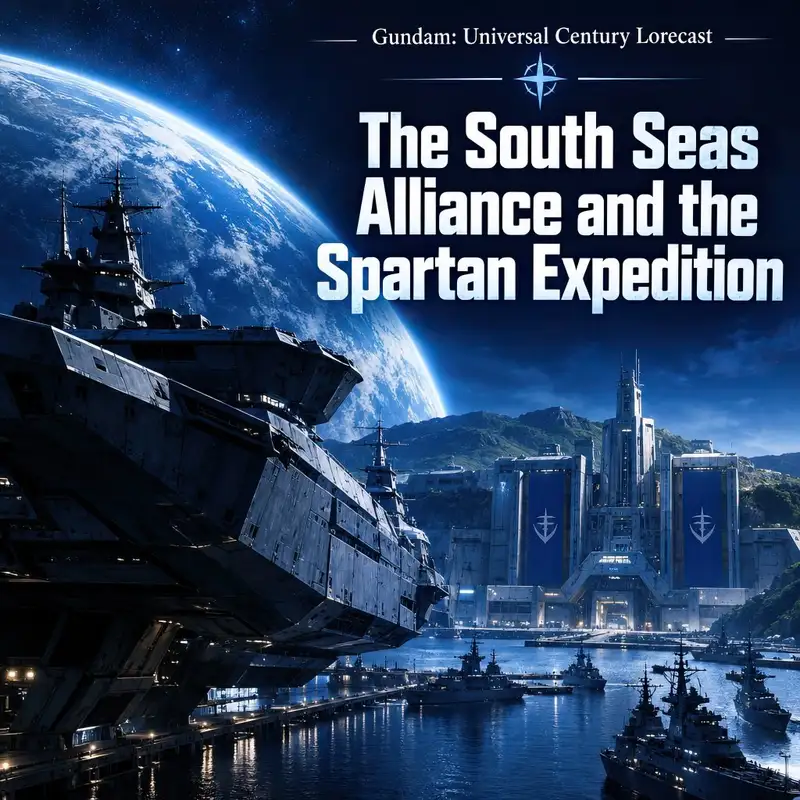
The South Seas Alliance and the Spartan Expedition [Thunderbolt Continuity]
The Spartan moved through dangerous southern waters toward territory the Earth Federation officially regarded as part of its own political sphere. Yet nothing about the mission resembled routine internal security. It was a Pegasus-class assault landing ship, carrying an experimental mobile suit, an ace pilot, a senior operational commander, intelligence personnel, support crews, and the supplies needed to fight across sea, ice, coast, and jungle. Its destination was the South Seas Alliance, an armed movement with defended territory, religious leadership, refugees, deserters, and access to one of the most dangerous bodies of military knowledge left by the One Year War.
That contradiction is the point. The Federation had defeated the Principality of Zeon, but victory over Zeon had not restored uncontested authority across the Earth Sphere. It had not collected every weapon, absorbed every former soldier, rebuilt every damaged community, or settled every grievance that war had sharpened. And it certainly had not secured every laboratory record, prototype component, or trained specialist scattered by the collapse of a wartime military system. The Spartan expedition was not simply an attack on a local faction. It was an admission that the postwar order was already fractured.
This account follows the broader Spartan campaign in the Mobile Suit Gundam Thunderbolt manga continuity. Thunderbolt presents its own Universal Century record, with its own military scale, technologies, and postwar conditions. The animated compilation Bandit Flower covers the earlier phase of this expedition, including the Spartan’s movement toward South Seas Alliance territory and its confrontation with the Alliance border defenses. The manga continues the campaign much farther, into the Alliance’s maritime refuge network and later operations against concealed production infrastructure. Those accounts overlap, but they are not a single scene-for-scene record.
The Federation’s problem was not that the South Seas Alliance could simply replace Zeon as a rival state. The available record does not support that conclusion. The Alliance was better understood as a militarized faction operating within the Federation’s broader political space, rather than a clearly established sovereign government. It controlled territory, maintained organized defenses, and possessed its own leadership and strategic program. But its political character was mixed. It was a refuge for displaced people and deserters. It was also an armed organization willing to protect its autonomy through force. Those facts were not mutually exclusive. In the Universal Century, they rarely are.
The Psycho Zaku had emerged from the brutal conditions of the Thunderbolt Sector during the One Year War. It was not merely another mobile suit with unusual weapons or an exceptional pilot. Its significance lay in the relationship between pilot, machine, and the Reuse P Device. The system was associated with the use of amputee pilots whose prosthetic connections could be integrated into an unusually direct control arrangement. In Thunderbolt’s wartime record, that arrangement gave a specialized machine a level of responsiveness and combat potential that conventional forces could not casually reproduce.
But the Federation’s concern was not limited to one surviving Psycho Zaku. A single exceptional weapon can be hunted, damaged, captured, or destroyed. A body of technical knowledge is more dangerous because it can travel. It can be copied into records, carried by engineers, memorized by technicians, hidden in workshops, or divided among different organizations. The important question was not whether the South Seas Alliance had already built a force capable of transforming the balance of power. The evidence does not justify that claim. The question was whether it possessed the knowledge, personnel, facilities, and time to develop such a capability.
For that reason, Operation Thunderbolt had the character of counterproliferation. The Federation’s declared purpose was to obtain or destroy information connected to the Psycho Zaku and the Reuse P Device. This was a mission centered on technology denial. It sought to prevent a specialized wartime system from becoming a durable military program outside central Federation control. Such operations are rarely clean. Information is harder to seize than a fortress. A facility can be bombed. A machine can be disabled. But plans, expertise, and institutional memory may already have moved elsewhere.
The difference matters because it separates potential from certainty. The Psycho Zaku was not a standard capability available to every Zeon remnant, every Federation unit, or every Alliance formation. Nor was the Reuse P Device a simple conversion kit that could be installed on any mobile suit by any field mechanic. Specialized systems require suitable pilots, medical or technical support, compatible machinery, maintenance, training, and an organization willing to bear the human and political cost. Still, the Federation had reason to fear what could happen if those requirements began to come together under a hostile or autonomous command.
The Federation therefore faced a decision common to postwar powers. It could accept uncertainty and allow a difficult regional movement to retain control over dangerous military knowledge. Or it could send an expedition to seize or destroy that knowledge, knowing that the intervention itself might deepen resentment, expand the conflict, and expose how little authority had actually been restored. The Spartan was the instrument chosen for that second course.
Colonel Monica Humphrey commanded the operation from the Spartan. Her position mattered because this was not a private duel, an improvised pursuit, or a raid conducted by a handful of pilots. It was an organized military expedition with a defined intelligence objective and a substantial logistical burden. Humphrey selected Io Fleming to pilot the Atlas Gundam, placing an exceptional combatant and an advanced machine at the sharp end of the force. That choice reflected the expected danger of the mission. It also reflected the Federation’s willingness to use scarce high-performance assets in a politically sensitive campaign.
Io’s presence gave the expedition tactical striking power, but it did not make the Spartan self-sufficient. A mobile suit pilot can exploit an opening, defeat an enemy machine, or protect a landing force during a critical moment. He cannot fuel the ship, repair damaged equipment, interpret intelligence reports, handle prisoners, navigate difficult waters, maintain communications, or decide what to do with a civilian population caught near a military objective. The Spartan depended on its bridge crew, hangar crews, mechanics, medical personnel, support pilots, technicians, and staff officers. Like every carrier-centered operation, its combat machines were only the visible edge of a larger system.
The Spartan’s design and role made it particularly suited to the campaign’s changing environments. As an assault landing ship, it served as a mobile command post, transport, carrier, and repair base. It could move mobile suits and personnel between theaters that did not share the same operational conditions. The expedition would not remain in open water, where ships and amphibious units could dominate movement. It would pass through polar conditions, approach coastlines, enter contested waters, and then fight in terrain where jungle cover, shallow approaches, narrow routes, and local knowledge could reduce the advantages of a technically superior attacking force.
That mobility was valuable, but it came with constraints. A ship is a base only as long as it can remain supplied, protected, and able to recover its forces. Mobile suits launched from the Spartan still needed maintenance, replacement parts, ammunition, and recovery after damage. Pilots still needed rest, briefing, medical treatment, and a command system capable of operating under combat pressure. A force operating far from established bases becomes increasingly dependent on the ship that carries it. The Spartan gave the Federation reach. It also created a critical center of gravity that the enemy could seek to locate, isolate, or overwhelm.
The approach through the Antarctic Ocean made clear that the Federation was not entering an undefended policing zone. Zeon submarine forces threatened the route. Their presence showed that the old war’s military networks had not simply disappeared with Zeon’s surrender. Former Zeon personnel, equipment, and operational experience remained available to actors pursuing their own interests. In this theater, underwater warfare had a particular value. A submarine could conceal movement, threaten a surface vessel, gather intelligence, or complicate a route without needing to win a conventional naval battle.
The sea also imposed a different form of uncertainty from space combat. Detection conditions changed with water, weather, depth, ice, and the limits of what a ship’s crews could observe. Underwater approaches complicated identification and response. A mobile suit built for land or space could not automatically solve an anti-submarine problem. Amphibious machines, naval escorts, sensors, aircraft where available, and disciplined watchstanding all mattered. The exact force composition of these encounters is not securely established, and there is no need to invent it. Their significance lies in what they revealed. The Federation’s route was contested before it reached the Alliance border.
The Antarctic passage also challenged the assumptions of postwar security. A state that has won a major war often expects resistance to become fragmented and local. But fragmented forces can still create serious operational problems when they exploit geography. A submarine does not need to control an ocean to threaten a transport route. A small garrison does not need to defeat an expedition outright to delay it, damage it, or force it to reveal its intentions. A clandestine network does not need a capital city to move technical information from one refuge to another.
Zeon remnants in this theater were not simply allies of the South Seas Alliance. Their relationship to the Alliance was shaped by overlapping interests, not automatic loyalty. The same Psycho Zaku knowledge that alarmed the Federation attracted former Zeon personnel who saw in it a possible path to renewed military relevance. That included Daryl Lorenz, the former Living Dead Division ace whose wartime experience with the Psycho Zaku placed him near the center of the struggle over its legacy.
Daryl’s role is important because it turns Operation Thunderbolt into a three-sided contest. The Federation sought to recover or deny the technology. Zeon remnants sought access to the same knowledge, whether for survival, restoration, revenge, or renewed military capability. The South Seas Alliance sought to preserve its own security, autonomy, and control over the program. Each side wanted information. Each side had reasons to conceal what it knew. And each side had incomplete knowledge of where the relevant records, machines, specialists, and facilities were located.
This is the kind of conflict in which intelligence becomes more important than possession of a map. A commander can seize ground and still fail if the files, personnel, and components have already been moved. An infiltrator can gain access to a facility and still misunderstand which documents are authentic, which machines are operational, or which engineer holds the crucial knowledge. A defending movement can hide a program inside civilian infrastructure, but it cannot be sure whether an outsider has already learned enough to expose it. The contest is not only over weapons. It is over the ability to identify what matters before it disappears.
Daryl’s involvement also complicates any simple Federation-versus-Zeon interpretation. The South Seas Alliance was not merely a Zeon remnant in another uniform. It had its own internal purpose and leadership. Zeon operatives could cooperate with it, exploit it, or become entangled in its plans without controlling it. The Federation, meanwhile, could treat every connection to former Zeon personnel as evidence of a larger hostile conspiracy, even when local motives were more varied. Postwar intelligence work often suffers from this tendency. Governments look for a single enemy structure because a single enemy is easier to target than a field of overlapping loyalties.
The South Seas Alliance’s border defenses demonstrated that it possessed more than secrecy and ideological commitment. In the animated Bandit Flower account, the Spartan enters Alliance-controlled territory and confronts the border garrison commanded by Lieutenant Colonel Peer. The presence of a named commander and organized defensive position matters. It indicates a command hierarchy, territorial awareness, prepared resistance, and an ability to treat Federation penetration as a military threat rather than a distant political dispute.
A border is not made real by a line on a chart. It becomes real when people enforce it, when routes are watched, when defenses are prepared, and when local commanders can act on orders or initiative. The Federation may not have recognized the South Seas Alliance as a sovereign state, but the Alliance behaved like a territorial power in the ways that mattered to an approaching expedition. It controlled access, organized armed resistance, and made entry costly. From the Spartan’s perspective, the mission had become an assault against a defended political space.
That did not settle the question of legitimacy. The Federation could argue that it was pursuing dangerous military technology within territory under its legal authority. The Alliance could argue that an outside armed force was entering a refuge zone whose people had already suffered through the One Year War. Neither claim erased the other. The Federation’s strategic concern was real. So was the danger that a technology-denial campaign would be experienced by residents as collective punishment, occupation, or an attack on a community that had chosen separation because conventional authority had failed it.
Terrain sharpened those political stakes. Amphibious and jungle operations favor defenders who understand local routes, concealment, water conditions, landing areas, and the practical limits of heavy equipment. Dense vegetation reduces visibility. Waterways can become transport corridors or obstacles. Shorelines constrain where forces can land and where damaged machines can be recovered. Prepared positions can remain difficult to identify until an attacker is already committed. Under such conditions, a mobile suit’s firepower is useful, but it can also become a liability if the pilot lacks clear observation, reliable maps, infantry support, or secure lines of withdrawal.
The expedition crossed a sequence of environments that demanded different forms of military competence. Open water required naval security and anti-submarine awareness. Polar movement imposed strain on crews, machinery, and supply arrangements. Coastal operations required coordination between shipborne forces and units moving ashore. Jungle fighting required patience, reconnaissance, and an appreciation for terrain that could conceal defenders almost until the moment of contact. The Spartan could carry sophisticated equipment through all of these environments. It could not make them identical.
This is where Thunderbolt’s campaign differs from a simple mobile-suit spectacle. The Atlas Gundam may be the most conspicuous weapon on the Federation side, but it does not eliminate the need for combined arms. The expedition still required ships to move forces, crews to sustain them, reconnaissance to reduce surprise, and local decisions made under imperfect information. A damaged mobile suit still had to be recovered or abandoned. A wounded pilot still had to be treated. Ammunition, spare parts, food, water, and fuel or propellant did not appear because the plot required them. They had to come from the Spartan or from whatever infrastructure the Federation could secure along the way.
Environmental conditions also shaped the defender’s choices. The South Seas Alliance did not need to meet the Federation in a symmetrical battle where the Spartan’s mobility and superior assets might be most effective. It could use distance, concealment, and prepared ground to delay the expedition. It could move information through places the Federation did not yet understand. It could exploit the fact that the attacking force had to distinguish military targets from refugee communities, support networks, and ordinary civilians. A government can call a target internal. The people living around that target still experience bombardment, raids, searches, and displacement in very direct terms.
The deeper strength of the South Seas Alliance was therefore not only in its fighters or its political message. It was in the infrastructure that allowed a dispersed movement to endure. The manga’s later campaign makes this especially clear at the Rig, material that lies beyond the principal screen coverage of Bandit Flower. The Rig was a floating city formed from repurposed oil platforms. It provided a place where deserters and displaced people could gather outside normal Federation administration. It was not merely a hideout. It was a social and logistical system.
A structure like the Rig can serve several functions at once. It can house civilians, receive people fleeing war, store supplies, repair equipment, support communications, move people and material across maritime routes, and provide concealment through complexity. It can also become a military objective because all those civilian functions create logistical value. The very features that make a refuge viable can make it useful to armed forces. That is the central difficulty of counterproliferation campaigns fought among displaced populations. The attacker sees a possible support node. The residents see homes, shelter, and survival.
The presence of refugees and deserters should not be used to assume that everyone on the Rig supported the South Seas Alliance leadership or the Psycho Zaku program. Mixed communities are not politically uniform. Some residents may have been committed supporters. Others may have been dependent on the Alliance because no safer authority was available. Some may have been trying to avoid all military organizations. A serious military analysis cannot turn every civilian into a collaborator merely because a clandestine project operates nearby. Nor can it ignore the possibility that military organizations use civilian spaces to complicate attack and intelligence collection.
For the Federation, this created an operational and moral problem. If it treated the Rig as purely civilian, it risked allowing people, records, and equipment to move beyond reach. If it treated the whole structure as an enemy base, it risked creating casualties, resentment, and fresh recruits for armed resistance. There was no technical solution that made this problem disappear. Better intelligence could reduce uncertainty. Discipline could reduce indiscriminate harm. Clear objectives could limit mission creep. But once the Federation chose force against a mixed civilian-military environment, it accepted responsibility for consequences that could not be measured solely in captured documents or destroyed machines.
The Rig also revealed something important about postwar authority. The Federation had won a war of states and fleets, but it had not rebuilt every social space shattered by that war. A floating refuge built from oil platforms was a sign of improvisation, but also of institutional absence. It existed because people could not rely on normal systems to provide security, housing, or political belonging. The Alliance could draw strength from that absence even if not every person within its territory shared its ideology.
The campaign’s industrial stakes became clearer at Taal Volcano, in later manga material. There, the conflict moved from a search for information toward an assault on concealed infrastructure connected to Psycho Zaku production or preparation. The distinction is essential. The record supports the idea that Psycho Zakus were being produced or prepared for evacuation under Federation pressure. It does not establish that the Alliance had already achieved unrestricted mass deployment or possessed a fully mature strategic arsenal. But a hidden base represented something more important than an isolated weapon cache. It represented organizational continuity.
A production or preparation site requires people with specialized skills. It requires tools, parts, storage, security, transport, power, records, and procedures. It requires some way to protect damaged equipment and move completed machines or components before an enemy arrives. Even a limited facility can preserve a program through disruption. A government trying to stop proliferation must therefore target more than finished weapons. It must understand the network that permits those weapons to exist, including the technicians and institutional knowledge that cannot be destroyed as easily as a warehouse.
For the Federation, the operational objective at Taal Volcano was shaped by urgency. Seize what could be seized. Destroy what could not be removed. Prevent machines, records, and personnel from escaping. Those are familiar goals in raids against dangerous military programs. They are also difficult to accomplish simultaneously. A force moving quickly enough to stop an evacuation may lack time to search thoroughly. A force that destroys a site may eliminate evidence needed to understand the program. A force focused on recovery may expose itself to rearguard resistance while the enemy moves the most important material elsewhere.
Daryl Lorenz’s rearguard actions must be understood within that larger contest. They were not simply another opportunity for a celebrated pilot to prove his skill against Io Fleming. Daryl’s military value lay in his connection to the Psycho Zaku legacy and in his ability to help preserve, move, or protect a capability that the Federation wanted denied. In a campaign built around technical knowledge, a skilled pilot can matter as an escort, a delaying force, a guide, or a symbol to other fighters. But his individual performance still depended on the wider network that supplied intelligence, machines, routes, and political purpose.
The Alliance’s effort to evacuate Psycho Zaku assets showed that it understood the same strategic logic as the Federation. A facility can be lost. A program may survive if its key machines, personnel, and records escape. The Federation’s assault could disrupt production, capture material, and damage the Alliance’s ability to operate openly. It could not automatically guarantee that all expertise had been erased. Military institutions often confuse the destruction of visible infrastructure with the destruction of a capability. The two are related, but they are not the same.
Taal Volcano also exposed the limits of treating technology as separate from politics. The Federation saw a dangerous weapons program. The Alliance saw a means of security and autonomy in a world where conventional power had repeatedly abandoned or exploited vulnerable communities. Zeon remnants saw an opportunity to regain relevance. Those different interpretations did not make the Psycho Zaku program harmless. A system built from the bodies and trauma of wounded veterans carried its own moral burden, regardless of which faction controlled it. But understanding why different actors wanted it was necessary if the Federation hoped to do more than destroy one facility and wait for the next program to emerge elsewhere.
The civilian cost of that contradiction fell most heavily on people with the least control over the campaign. Refugees, deserters, local workers, and families living around Alliance infrastructure had to navigate a war that had supposedly ended. They faced the possibility that the Federation would regard their community as a military threat, that the Alliance would demand loyalty or secrecy, and that Zeon remnants would use their territory for another attempt at military revival. Their vulnerability was not incidental to the operation. It was one of the conditions that made the Alliance possible and made the Federation’s response so difficult.
The Spartan expedition therefore matters not because it produced a simple Federation victory or because it proved that one advanced Gundam could settle a postwar crisis. It matters because it showed the character of the conflict that followed the One Year War in Thunderbolt continuity. This was not a clean continuation of wartime fronts. It was a struggle over scattered expertise, displaced populations, armed autonomy, and the authority to decide who could possess military power after the old war had ended.
The Federation needed the Spartan expedition because it faced a security problem that was technological, political, and institutional at the same time. The South Seas Alliance was dangerous not because it could automatically become a new Zeon, but because it showed how a regional armed movement could combine refugees, former soldiers, concealed infrastructure, territorial defense, and specialized military knowledge beyond Federation control. The Psycho Zaku program turned that autonomy into a counterproliferation crisis. The Federation answered with force because it had no confidence that ordinary administration could contain the threat.
But force could only address part of the problem. It could seize ground, destroy facilities, intercept evacuations, and deny the enemy some immediate capability. It could not by itself rebuild trust, absorb the displaced, or erase the conditions that made armed refuge communities appear necessary to their inhabitants. The One Year War had ended as a formal conflict before it ended as a political condition. The Spartan could fight for control of the weapons the war had scattered. It could not, by itself, restore authority over the fractured society left behind.