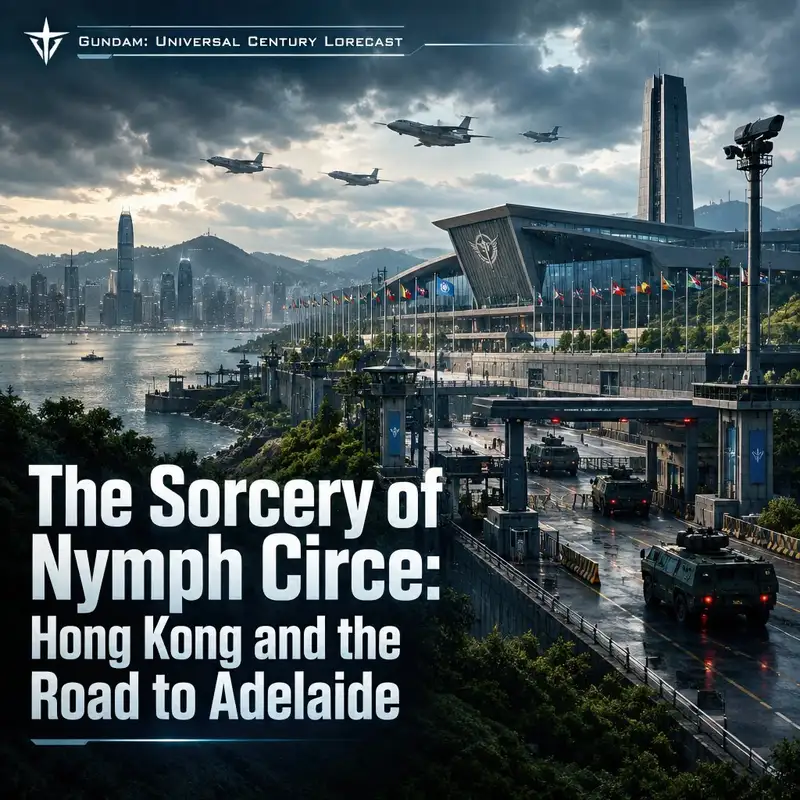
The Sorcery of Nymph Circe: Hong Kong and the Road to Adelaide
The evidence did not stay in Oenbelli. Recordings of Kimberley Heyman’s suppression operation escaped the cordon and moved through independent media before the Federation could give the event a cleaner name. What should have been presented as the destruction of an armed anti-Federation group instead became proof of a punitive campaign against a population already living under political pressure. The tactical situation may have looked simple to the officers who planned it. An irregular armed force had assembled. It used Mafty’s name. It appeared to threaten Federation authority. But the people caught in the operation were not interchangeable with the men carrying weapons, and the images of brutality made that distinction impossible to ignore. Kimberley’s force could clear ground, seize prisoners, and break local resistance. It could not control the meaning of what it had done once the record reached the wider public.
Oenbelli was not a Mafty base in the ordinary military sense. It was an independent anti-Federation private army, built around its own grievances, local loyalties, and anger at the Federation. Its leaders had adopted Mafty’s name because the name carried force. Mafty Nabiyy Erin had become a symbol of resistance to the Earth Federation’s political order, particularly its increasingly restrictive control over who could remain on Earth. The Oenbelli leadership hoped that the real Mafty, and especially the elusive Quack Salver, would recognize them as allies. That hope was not the same thing as command integration. They had not been absorbed into Hathaway Noa’s clandestine organization. They did not share his intelligence network, his operational discipline, or his understanding of the campaign he was trying to build.
The distinction matters because Hathaway arrives at Oenbelli after the massacre, not before it. He does not come to rescue a prepared allied formation or to take command of a reliable local garrison. He arrives to find survivors, armed men operating under borrowed political colors, and a Federation operation that has created an opening through its own excess. Mafty’s mobile suits defeat the remaining Kimberley forces and capture Kimberley himself. On the tactical level, it is an impressive intervention. The Xi Gundam gives Hathaway the ability to strike with speed and force that a conventional guerrilla movement could not match. But even at that moment, the real problem is not whether Hathaway can win a mobile-suit engagement. It is whether he can turn a moment of anger into a disciplined operation without being consumed by the disorder that produced it.
Fabio Rivera, the Oenbelli leader, represents that problem. He expects contact with Quack Salver and assumes that Mafty’s arrival confirms the connection he has imagined. Hathaway has every reason to use Fabio’s people. They know the local environment. They have weapons, recruits, and the political energy created by the Federation’s violence. Yet Hathaway cannot safely mistake that energy for unity. A clandestine movement that absorbs every sympathetic armed group inherits their local feuds, their weak security, their unreliable information, and their exposure to infiltration. It also inherits responsibility for their actions. The name Mafty is useful precisely because it has become larger than the organization behind it. That is also dangerous. A symbol can attract support faster than a command structure can control it.
The immediate result at Oenbelli is therefore both a success and a warning. Mafty demonstrates that Federation repression can create its own political counterweight. Kimberley’s brutality damages the legitimacy of the state operation, and Hathaway is able to present himself as the force that punished the men responsible. But punishment is not governance. It does not feed displaced families, protect witnesses, build secure communications, or create a political program that can survive the loss of a charismatic commander and an exceptional machine. Hathaway can use Oenbelli’s anger. He cannot assume that anger will carry the movement all the way to its strategic objective. Adelaide will require secrecy, planning, transport, repair, intelligence, and a degree of discipline that indignation alone does not provide.
That objective is the Adelaide Conference and the Earth Return Special Law under consideration there. The law is not merely a technical matter of residency policy. It is a proposal to reserve residence on Earth for those approved by the system, tightening the exclusion of people who lack the right documents, the right status, or the right political protection. In Universal Century one hundred five, Earth is still treated as a privileged space. It is environmentally valuable, socially prestigious, and politically guarded. Access to it is not distributed equally. For the wealthy, connected, and legally secure, Earth remains a place of estates, travel, education, and influence. For unauthorized residents, it can become a place of surveillance, removal, and fear.
Mafty’s planned strike at Adelaide is meant to attack that political structure at its center. Hathaway is not attempting to conquer Australia or hold the continent against the Federation. His movement does not have the manpower, industrial base, or open political authority required for that kind of war. Instead, he seeks to disrupt a conference, threaten the people advancing the law, and expose the coercive order behind it. This gives Mafty’s violence a political logic. The operation is intended to demonstrate that the Earth Federation cannot legislate exclusion from behind secure walls without consequence. Yet the logic contains its own limit. Destroying a conference or killing officials may disrupt a decision. It does not automatically create a new political settlement, and it does not tell the frightened civilians around the target what kind of order will replace the old one.
That is the central contradiction of Hathaway’s campaign. The Federation’s policies create real grievance. The Man Hunter system gives that grievance a human face in raids, detentions, removals, and families forced into uncertainty. But a movement that responds through clandestine violence has to contend with more than the justice of its cause. It has to decide whom it represents, whom it risks, and whether its methods can gain lasting trust rather than only attention. Mafty needs the Federation to recognize that Earth cannot remain a preserve for the politically favored. At the same time, Mafty needs to reach Adelaide without becoming simply another armed force whose operations place civilians, workers, travelers, and local communities in danger.
New Hong Kong provides a sharp contrast to this world of raids and clandestine movement. Gigi Andalucia travels there from Davao to prepare the residence of Count Boundenwood. She moves through a protected social space of wealth, access, and connection. Her mobility is managed, but it is also assumed. Doors open for her. Travel is available. Elite residences can be prepared and occupied while other people are being hunted from the land beneath their feet. The contrast is not subtle, and it is not accidental. Earth has not become inaccessible to everyone. It has become selectively accessible. The people protected by money, patronage, and political standing experience the Federation’s order differently from those who live under the threat of removal.
Gigi’s time in New Hong Kong is not merely a pause between battles. She contacts Amada Mansan’s circle and leaves word that she wants to meet Hathaway in Adelaide. Her actions link elite society, personal influence, and the underground campaign developing across Australia. She is neither a formal Mafty operative nor a Federation officer. That makes her difficult for both sides to categorize. She has access to people and spaces that Hathaway’s organization cannot approach openly. She also has a personal interest in Hathaway that cannot be reduced to espionage or political calculation. In a conflict shaped by secrecy, she moves across boundaries that are supposed to remain separate.
Her presence also forces a harder look at the political geography of Earth. The Earth Return policy is not only about law. It is about who is allowed to move, who is allowed to stay, and who is treated as belonging. In New Hong Kong, privilege turns mobility into a matter of convenience. In the Man Hunter zones, mobility becomes flight, concealment, or deportation. Mafty draws strength from this inequality. Its propaganda can point to the gap between the protected and the hunted. But that does not mean Mafty has solved the problem. Hathaway can identify the cruelty of the system, but his organization remains secretive, armed, and dependent on a narrow network of trusted contacts. It can expose exclusion. It cannot yet offer open security to the people excluded.
Kenneth Sleg understands that Mafty is more than a collection of mobile-suit attacks. As commander of the newly designated Kilke Unit, he is trying to defeat an opponent that operates across political, military, and psychological terrain. His force benefits from advantages that do not look as dramatic as the Xi Gundam in flight, but matter far more over time. The Federation has bases, aircraft, transport networks, communications systems, medical support, maintenance facilities, food, fuel, personnel replacements, and the authority to move through territory without hiding from every checkpoint. It can coordinate police operations with military deployments. It can collect reports from local officials, security agencies, and surveillance systems. Even when those institutions are inefficient or corrupt, they give the Federation a depth that Mafty lacks.
Kenneth also works with Hundley Yeoksan and the Criminal Police Organization. Their cooperation shows how the Federation’s civilian security structure and military response are beginning to overlap. The Man Hunters and the police apparatus are not simply background villains standing outside the campaign. They shape the environment in which Mafty operates. Raids against unauthorized residents can disrupt local networks, create fear, and make communication more difficult. They can also generate resentment, new recruits, and a population less willing to trust official accounts. Counterinsurgency is never only a matter of killing or capturing armed opponents. It is a contest over movement, information, shelter, and legitimacy. The Federation can control many of those systems. It also damages them when its agents treat ordinary people as a problem to be cleared away.
The Adelaide Conference therefore becomes an intelligence problem before it becomes an assault problem. Information begins to circulate suggesting that the conference may shift away from Adelaide toward Kowloon or Guangzhou. The apparent change is useful to the Federation whether it is believed or merely discussed. It forces Mafty to reconsider its routes, its targets, and the deployment of its limited forces. Fabio Rivera is more inclined to accept the new information at face value. That is understandable. Oenbelli’s organization does not have access to the intelligence picture Hathaway has built. Its members are eager to act, eager to believe that the enemy can be caught off balance, and less prepared to distinguish a genuine change in plan from an attempt to shape their behavior.
Hathaway is more cautious. He judges that Adelaide remains the real target and that the report of a move eastward is intended to draw Mafty away from Australia. Rather than simply ignore the false information, he decides to use it. His answer is an attack on Darwin Airport. The purpose is not to seize the airfield, destroy the Federation’s entire transport system, or win a conventional battle in northern Australia. The purpose is to make the Federation believe that Mafty has committed itself to the alternate route. If the attack looks like preparation for a strike toward Kowloon or Guangzhou, then the movement south toward Adelaide may gain time and space.
This is an intelligent use of deception, but deception is expensive for a small organization. It requires disciplined subordinates who understand that the immediate action is not the real objective. It requires timing. It requires secure communication. It requires confidence that the enemy will interpret the action in the desired way. And it requires the ability to accept that the force carrying out the diversion may be exposed or sacrificed without receiving the satisfaction of a decisive victory. Hathaway gives Oenbelli forces Mafty-supplied weapons and sends them toward Darwin. In effect, he is asking a newly connected, imperfectly controlled armed group to perform a carefully calibrated role in a much larger operation.
That request reveals both Hathaway’s skill and Mafty’s vulnerability. A larger regular force could create several diversions, reinforce them, recover the survivors, and absorb the loss of equipment. Mafty cannot. Every weapon transferred, every contact exposed, and every fighter committed at Darwin reduces the margin available for the main effort. The organization is trying to make the Federation see a larger and more geographically flexible enemy than it really is. But the Federation’s institutions are built to test, compare, and respond to competing reports. Mafty may create confusion. It cannot assume confusion will last.
Bynoe Harbor becomes one of the essential nodes in this hidden campaign. It is not important because it is a grand fortress or a famous battlefield. It matters because it can serve as a place of resupply, staging, concealment, and rendezvous near the northern Federation security network. A campaign against Adelaide cannot be sustained by willpower alone. Mobile suits need ammunition, propellant, parts, technicians, and a way to recover from damage. Personnel need transport, food, medical care, and secure means of communication. Wounded people must be moved. Damaged machines must be repaired or abandoned. A force that can strike brilliantly once but cannot reload, refuel, or withdraw is not conducting an operation. It is spending itself.
Mafty divides its support structure to reduce the risk of a single catastrophic discovery. Gawman Nobile, Fencer Mayne, Sivet, and Lulu travel by another route with the support vessel Sea Lack. Hathaway and other elements continue with the Valiant and associated forces. This dispersal is sensible. If the Federation destroys one vessel or identifies one route, the entire movement may not collapse at once. But the same arrangement creates new problems. Separate groups are harder to coordinate. They may receive information at different times. They may be unable to assist each other when intercepted. A delayed rendezvous can become a lost rendezvous. In a clandestine force, redundancy is necessary. It is also a burden that consumes people, vessels, and trusted intermediaries.
The Xi Gundam does not remove these constraints. It is a fifth-generation mobile suit with extraordinary mobility and combat capability, but it remains part of a system. It needs support. It needs maintenance. It needs a pilot capable of operating under immense physical and psychological pressure. Its performance may allow Hathaway to break an encirclement or serve as a rear guard against stronger numbers. It cannot replace a sunken transport, repair another unit from a distance, or create a secure political network across a continent. The exceptional machine gives Mafty options. It does not give Mafty the durable infrastructure of a state.
The Darwin attack shows the value and the weakness of Hathaway’s deception. Oenbelli forces strike Darwin Airport in an effort to convince the Federation that Mafty is concentrating on the false route. The operation creates disruption and danger. It forces the Federation to respond to the possibility that aircraft, transport routes, and local infrastructure are under threat. Yet it does not produce the clean strategic surprise Hathaway needs. A Federation transport formation avoids the attack in part because Gigi’s warning influences the response. The diversion has an effect, but the enemy is not frozen in place. It adapts.
Gigi’s role at Darwin is operationally consequential, but it should not be turned into a simple technical category. Kenneth increasingly treats her as a kind of victory goddess, a person whose intuition seems to point toward danger before ordinary intelligence has completed the picture. The temptation to make such a person into a doctrine is understandable. Commanders under uncertainty are always looking for an edge, especially when the enemy’s next move may be hidden behind false reports and Minovsky interference. But the film does not establish that Gigi possesses a fully understood predictive ability. It shows that she is perceptive, that her instincts matter, and that her presence changes decisions. It does not provide a reliable scientific mechanism or prove that she can be used as a dependable strategic sensor.
That uncertainty matters because Kenneth’s reaction carries its own risk. A commander who treats intuition as evidence may gain an advantage when the intuition is correct. He may also begin to shape his operations around a person whose perceptions cannot be measured, repeated, or fully explained. Gigi is not equipment, and she is not a remote sensor array. She has her own motives, desires, and relationship to Hathaway. Her wish to reach him is personal as well as politically significant. Kenneth can use the information she provides, but he cannot completely control its meaning. In that respect, she resembles the campaign itself. Everyone is trying to turn incomplete knowledge into action. No one possesses enough certainty to do so without risk.
Darwin also reminds the listener that insurgent violence is never confined to the intentions of its planners. Hathaway sees the attack as a diversion. The people at the airport, on nearby transport routes, or working in local facilities do not experience it as an abstract intelligence operation. They experience danger, disruption, and the sudden militarization of civilian infrastructure. Mafty may be targeting the Federation’s capacity to move forces. It is still operating in places where the line between military function and civilian life is not clean. The Federation’s Earth Return policy creates victims through administrative coercion. Mafty’s campaign creates its own victims when it turns public spaces into instruments of deception.
As the movement continues south toward the central Australian rendezvous, the campaign begins to pay the price of exposure. Hala Morley and Rod Hein are lost in engagements with Federation forces. The details of each loss matter to the people who knew them, but their larger significance lies in what small organizations cannot replace. Mafty does not have an endless pool of trained pilots, experienced mechanics, secure vessels, and trusted operatives. Every casualty takes knowledge out of the organization. Every destroyed machine removes more than a machine. It removes the technicians who understand its condition, the spare parts assigned to sustain it, the pilot who knows its limitations, and the operational role it was expected to fill at Adelaide.
The sinking of the Valiant is even more serious. A support ship is easy to overlook beside a mobile-suit duel, especially when the Xi Gundam and Penelope-class machines dominate the visual record. But the Valiant is part of the operational backbone of Mafty’s campaign. It carries personnel, supplies, coordination capacity, and the ability to move equipment through a hostile environment. Its destruction reduces repair capability and makes recovery more difficult. It narrows the options for evacuation. It weakens communications between dispersed elements. It can leave damaged machines without a place to return to and wounded personnel without a secure route away from the fighting.
Uluru, also known as Ayers Rock, becomes the next point of pressure. It is a central rendezvous location and a place where dispersed forces hope to reconnect, not a fortress built for prolonged defense. Its importance comes from geography, timing, and concealment. In a campaign of hidden movement, a recognizable landmark can serve as a reference point. It can also become a trap once the enemy identifies its relevance. Mafty needs the location to consolidate what remains of its force and continue toward Adelaide. The Federation needs only to make that consolidation costly, delayed, or impossible.
Gigi’s desire to visit Uluru becomes part of Kenneth’s calculation. He recognizes that her request may be connected to Hathaway’s position or movements. Again, the evidence is not a complete intelligence report. It is a clue shaped by her personal connection to Hathaway and by her unusual sensitivity to the developing situation. Kenneth does not abandon his larger mission to follow her blindly. He sends a protected group toward the location while continuing separately toward Adelaide. This is a disciplined response. He acknowledges the possibility that Uluru matters without allowing one uncertain indication to pull the entire Federation effort away from the conference it is meant to defend.
Hathaway, meanwhile, is not preparing a triumphant stand. He is trying to withdraw a damaged and scattered force under pressure. The Xi Gundam becomes a rear guard. Its role is not simply to defeat every Federation machine in reach. It is to buy time. Rear-guard actions are among the most demanding missions in war because they require a force to remain exposed while others disengage. The commander has to judge how long to fight, where to break contact, and how much risk can be accepted before the rear guard itself is cut off. Hathaway’s success depends not only on the Xi Gundam’s performance, but on whether the people behind him can use the time he creates.
He destroys a Gustav Karl Type-00 and then confronts Lane Aim in the experimental TX-ff104 Alyzeus. The engagement is visually dramatic, but its military importance lies in the circumstances surrounding it. Lane is not merely another opponent in a personal rivalry. He is part of the Federation’s attempt to field and test advanced mobile-suit capabilities against Mafty’s fifth-generation threat. Hathaway cannot afford to treat him as an irrelevant obstacle. Lane threatens the withdrawal corridor and the time Mafty needs to escape. Yet Hathaway also cannot afford to remain in combat longer than necessary. Every minute spent pursuing a decisive kill is a minute during which his surviving forces remain vulnerable.
Alyzeus is an important machine precisely because it is not standard Federation equipment. It is an improvised training and flight-test mobile suit built around a modified mass-production Nu Gundam core, with external components associated with the Penelope development program. Its propulsion relies on multiple shelf-nozzle units as a substitute for an unfinished Minovsky Flight system. That makes it a transitional machine, a test bed and a training instrument rather than evidence that the Federation has already solved the production, maintenance, and doctrinal problems of widespread advanced flight-capable mobile suits. It is dangerous because it is in the hands of a determined pilot and because it represents a serious institutional effort. It is not proof of a mature fleetwide capability.
The encounter also exposes Hathaway’s personal vulnerability. When Alyzeus is damaged and its outer structure no longer conceals its Nu Gundam-derived silhouette, Hathaway is confronted by an image that pulls him back toward the trauma of Char’s Rebellion. In this film continuity, that trauma is bound to the animated history of Amuro Ray, Quess Paraya, and the violence surrounding Hathaway’s own actions during that earlier conflict. The memory is not a detached flashback. It disrupts his judgment in the middle of a mission where judgment is the difference between withdrawal and disaster. The past is not over because a commander has chosen a new political purpose. It remains present in the body, in recognition, and in the moment when an old shape appears through damaged armor.
There is no need to impose a settled supernatural explanation on that reaction. The film shows a psychological rupture with Newtype-like emotional intensity, but it does not provide a laboratory model that explains every element of it. Hathaway’s trauma is real whether it is understood as memory, resonance, perception, or the collision of all three. What matters militarily is that it interrupts his ability to act cleanly. A pilot operating a machine as powerful as the Xi Gundam carries enormous responsibility. If memory can destabilize that pilot at the decisive moment, then the machine’s exceptional capability becomes inseparable from the fragility of the person inside it.
Gigi’s voice or intervention prevents Hathaway from finishing Lane. That choice preserves Lane’s life, but it also confirms that the Uluru engagement has not produced the clean freedom of action Hathaway needed. He wins the immediate fight. He does not erase the Federation pursuit. He does not restore the Valiant. He does not recover the people already lost. He does not transform Oenbelli into a disciplined political base. The tactical victory matters because it allows survival and withdrawal. It does not repair the campaign’s deeper problems.
By the end of the film, Hathaway and Gigi reunite at Uluru while Kenneth reaches Adelaide first. Kenneth prepares the Federation’s defenses around the conference, including substantial communications and electronic equipment. This is not the end of the campaign, but it is a clear measure of the ground each side has gained and lost. Hathaway remains alive, still in command of the Xi Gundam, and still capable of threatening the political center he set out to strike. Kenneth has not destroyed Mafty, but he has forced it to spend personnel, equipment, time, and secrecy before it reaches its objective. The Federation retains the advantage of preparation at the place that matters most.
The results differ depending on the scale of analysis. Tactically, Hathaway survives Uluru and defeats formidable immediate opposition. Operationally, Mafty’s movement toward Adelaide has been badly weakened by the loss of personnel and the destruction of the Valiant. Intellectually, Hathaway’s Darwin deception creates uncertainty, but does not produce complete surprise. The Federation adapts, and Gigi’s intervention contributes to that adaptation. Logistically, Mafty’s dispersed network proves both necessary and brittle. Without separate vessels, contacts, and rendezvous points, the organization could not move at all. With them, it becomes vulnerable to delay, isolation, and attrition.
Politically, the Federation has not solved the problem that Mafty represents. Oenbelli and the Man Hunter system reveal a government willing to defend an exclusionary Earth through coercive means. Kimberley’s operation shows how easily security policy can become a public-relations disaster when armed authority loses restraint. The proposed Earth Return law gives Mafty a cause that many people can understand even if they do not support its methods. Yet Mafty has not solved its own legitimacy problem either. It can expose the Federation’s violence and exploit the anger it produces. It cannot automatically turn that anger into stable public authority. Its dependence on secrecy, exceptional machines, fragile supply routes, and selective violence leaves it unable to openly govern the people in whose name it claims to act.
Kenneth’s success is equally double-edged. He can defend Adelaide because he commands institutions Mafty does not possess. He has bases, transport, communications, police cooperation, maintenance, and access to the administrative machinery of the Earth Federation. But those same institutions include the Man Hunter system and the Earth Return policy that make the Federation’s authority appear cruel, distant, and selectively humane. The Federation can contain Mafty because it has a state behind it. It also keeps producing the conditions in which another Mafty can emerge. The road to Adelaide does not prove that revolutionary violence can overthrow that order, nor does it prove that security power can make the order legitimate. It shows a movement strong enough to expose injustice, and a state strong enough to endure it, both trapped by the failures neither side has yet overcome.