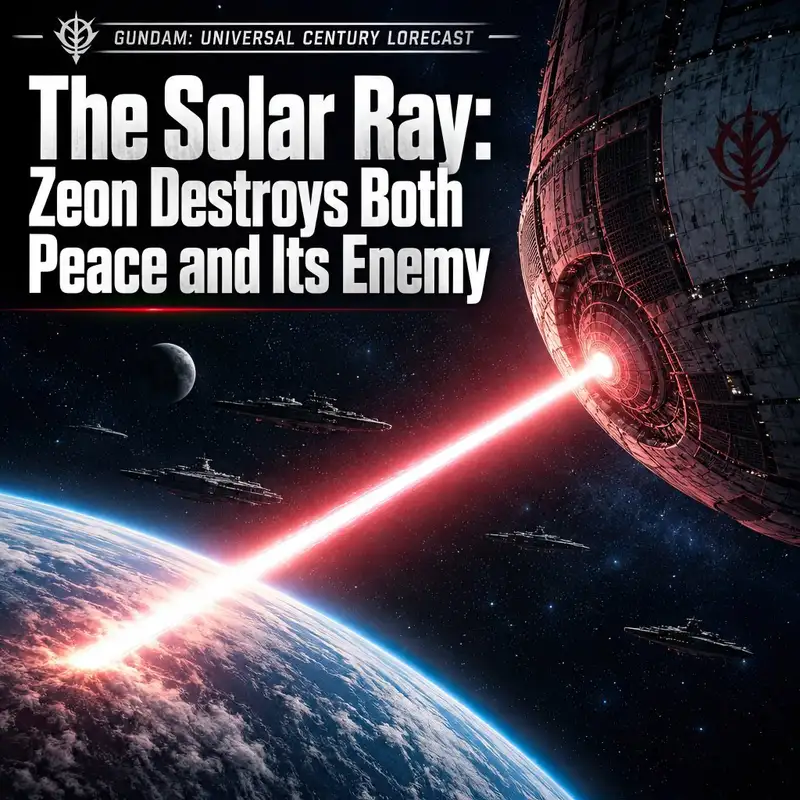
The Solar Ray: Zeon Destroys Both Peace and Its Enemy
Two flagships moved toward one another at the end of a war that had already consumed colonies, fleets, and any easy claim to innocence. Degwin Sodo Zabi, sovereign of the Principality of Zeon, approached the Federation force led by General Revil aboard the Great Degwin. Their meeting did not guarantee peace. Degwin was not suddenly absolved of the dictatorship and war conducted under his family’s rule, and Revil alone could not have signed away the Federation’s war aims. But their contact offered something rare in the final days of Universal Century seventy-nine: a chance to test whether the fighting could stop before the last great assault.
Elsewhere, technicians prepared Solar Ray. The weapon’s line of fire would not distinguish between the Federation commander, Zeon’s sovereign, the ships around them, or the political purpose of their rendezvous. That was not an accident of a battlefield weapon used under uncertain conditions. It was the point. Gihren Zabi, Zeon’s effective ruler and supreme commander in the final phase of the war, chose to turn a possible negotiation into a target.
The resulting blast is often remembered as one of the war’s most overwhelming displays of destructive power. It was that. Solar Ray shattered a major portion of the Federation fleet and killed two men whose continued existence might have opened a path away from annihilation. But the weapon also exposed the weakness beneath Zeon’s final defense. It could destroy an approaching fleet formation. It could not restore Zeon’s exhausted strategic position. It could not repair the distrust within the Zabi family. And it could not substitute one act of mass destruction for a functioning political settlement.
Solar Ray was not simply a superweapon. It was the physical expression of a regime that had begun to consume the people, institutions, and political options it needed in order to survive.
The weapon itself had once been a colony called Mahal, part of Side Three. That fact matters more than any uncertain figure for output, range, or energy collection. Mahal was not an empty shell waiting to become military hardware. It was a habitat, an economy, a transport node, and a community of colonists. Its conversion required the removal of its residents and the redirection of its infrastructure toward a single military purpose.
The televised record establishes the broad result: a colony had been transformed into a massive directed-energy weapon. Later technical accounts add descriptions of solar-collection systems, specialized components, and elaborate preparations, but the essential historical point is simpler and better supported. Zeon took a piece of civilian space infrastructure and made it into an instrument intended to erase fleets in one stroke.
That conversion reveals the contradiction at the center of the Principality’s war. Zeon had justified its political existence in the language of spacenoid autonomy, dignity, and liberation from Earth’s domination. Those grievances were real. The Earth Federation’s political order had concentrated power on Earth while leaving colonial populations dependent, underrepresented, and vulnerable. But by the final stage of the war, Gihren’s state treated one of its own colonies as expendable military material.
A government can mobilize civilian industry during war without erasing the distinction between society and weapon. Shipyards build warships. Factories make weapons. Transportation networks move troops and supplies. Those choices may be burdensome, coercive, and destructive in their own ways, but they still leave a society capable of recovery. Solar Ray went further. It converted an inhabited world into a strategic firing platform. Mahal’s people had already paid the price of that decision before the weapon fired a shot.
This was emergency mobilization at its most concentrated. Zeon had lost Solomon. The Federation was advancing toward A Baoa Qu, the fortress that had become Zeon’s final major defensive position. In that setting, Solar Ray offered a way to use fixed infrastructure, accumulated energy, and prepared geometry against an enemy that had to gather its forces for a decisive attack. It was an answer to an immediate military problem. It was also evidence that the regime had chosen to spend its remaining resources on a narrow and catastrophic gamble.
The Federation assault created exactly the kind of target Solar Ray needed. A Baoa Qu was not a raid target or an isolated outpost. It was a heavily defended fortress and a political center of gravity for a Zeon state under mounting pressure. To attack it, the Federation had to bring together warships, mobile suits, command personnel, transports, communications networks, and the logistical support necessary to sustain a final operation.
Concentration offered the Federation combat power. It allowed commanders to coordinate a large force against a prepared defense. It placed mobile suits close enough to carrier and ship support. It gave the assault a coherent operational purpose. But concentration also created vulnerability. Ships moving along an approach toward a fixed objective cannot disperse without cost. They need common timing, recognizable command relationships, protected routes, and enough cohesion to distinguish friend from enemy under Minovsky interference.
Minovsky particles did not make every sensor blind or every message impossible. They did, however, complicate long-range detection, communications, target identification, and command control. In such conditions, fleet formations depended more heavily on planning, local judgment, visual confirmation, and prearranged intent. A surprise attack against a major concentration could therefore do more than sink ships. It could interrupt the human and institutional connections that allowed the force to operate.
Solar Ray exploited that vulnerability. It was not a weapon designed for a mobile campaign across many fronts. It was built to punish a predictable approach. The Federation fleet had to come toward A Baoa Qu. Zeon knew that. The fortress provided a strategic anchor. The Federation’s need to finish the campaign gave Gihren a firing opportunity. The same operational logic that made the Federation offensive necessary made it vulnerable to a prepared strike.
The key to Solar Ray, then, was not merely its destructive capacity. It was the relationship between a prepared weapon and an enemy forced to concentrate. Yet Gihren’s purpose went beyond attrition. The Federation fleet was a target. Degwin’s peace effort was also a target. Revil’s command authority was another. The weapon was aimed at ships, but it was used to settle a struggle over who would decide how the war ended.
By this stage, Gihren was not merely one senior official among many. He held practical power at the center of Zeon’s war effort. Degwin remained sovereign, but his authority had been hollowed out by the political rise of his children, by the demands of the war, and above all by Gihren’s command of military institutions and ideological messaging. The question was no longer whether Gihren could influence Zeon policy. It was whether anyone could restrain him.
Degwin’s approach to Revil represented a threat to that control. A negotiated end to the war would have required recognition that Zeon could no longer dictate events solely through military force. It might have required concessions, a transition of authority, or at minimum an acceptance that the final decision belonged to more than Gihren’s vision of Zeon. It would have made the sovereign relevant again. It would have given the Federation a counterpart with whom to discuss an end to hostilities.
But openings matter in war. They create alternatives. They introduce uncertainty into plans built around total victory. They allow commanders and governments to test the intentions of their opponents. They may fail. They may be insincere. They may be used for deception. Yet even an imperfect negotiation can reduce the pressure toward continued slaughter.
Gihren did not permit that test. His decision was not irrational in the narrowest sense. By killing Revil, he could decapitate the Federation force at a critical moment. By killing Degwin, he could prevent a political settlement that threatened his authority. By displaying Solar Ray’s power, he could rally Zeon defenders around the belief that victory remained possible. The immediate logic was coherent. The larger consequences were disastrous.
He did not merely accept the possibility that his father would be caught in the firing path. He ordered the weapon fired through it. That distinction is central. In war, commanders sometimes make decisions that expose allied personnel to grave risk. Solar Ray was not such a case. Gihren used the presence of Zeon’s sovereign and the Federation’s senior commander as part of the weapon’s political effect. The attack carried military, dynastic, and diplomatic targets at once.
When Solar Ray fired, the Great Degwin was destroyed. Revil’s flagship was destroyed as well. A large part of the Federation fleet caught along the weapon’s path vanished with them. The television account describes the loss as approximately half of the Federation’s main fleet. Later reference material offers different proportions, and the exact arithmetic is difficult to settle across different accounts of the operation. The important fact is not whether the loss should be called one-third, one-half, or some other fraction. It was catastrophic.
Ships were not merely pieces on a tactical display. Each represented crews, command staffs, technicians, medical personnel, communications specialists, pilots, mechanics, and the stores required to sustain combat. The loss of a fleet formation meant deaths on a scale the surviving officers could not immediately measure. It meant broken communications. It meant damaged coordination. It meant subordinate commanders trying to determine what remained of the plan while the wreckage of the plan was still unfolding around them.
The strike also removed Revil. In the immediate military sense, that was a serious command loss. Revil had been one of the Federation’s most prominent senior commanders, and his presence gave the approaching force a recognizable center of authority. His death came precisely when the assault on A Baoa Qu required unity of purpose and the ability to make decisions under pressure.
Degwin’s death carried a different but equally consequential weight. The ruler of Zeon had been killed by Zeon’s own decisive weapon while seeking contact with the enemy. Whatever Degwin’s motives, whatever terms he might have proposed, and whatever response Revil might have given, the meeting no longer existed. The people who could have explored an immediate political exit had been erased before they could test it.
This was not simply an attack against a military formation. It was an attack against the possibility that military force might no longer be the only way to end the war.
Tactically, Solar Ray worked. Its purpose was to deliver overwhelming destruction along a prepared line of fire, and it did so. The Federation suffered terrible losses. The concentration of ships that gave the assault force its offensive power also made those ships vulnerable to an attack that no ordinary fleet engagement could easily match.
Operationally, the effect was also real. The Federation’s advance was disrupted. Its senior commander was dead. Its surviving vessels had to regroup, reestablish communications, identify surviving formations, assess damage, and decide whether they could still carry out the assault. A Baoa Qu’s defenders gained time. In the final phase of a campaign, time can be as valuable as a reserve squadron. It allows fortifications to prepare, commanders to redistribute forces, crews to organize defenses, and political leaders to make new demands on exhausted personnel.
Gihren had also exploited intelligence. He understood the broad geometry of the Federation approach, and he understood the significance of Degwin’s movement toward Revil. The weapon did not fire into empty space in the hope of finding a target. It was employed against a known concentration at a politically decisive moment. That was effective command of a terrible kind.
The problem was that its success could not answer the larger questions facing Zeon. The weapon could damage the Federation assault. It could not generate new industrial capacity, replace lost fleets, restore conquered territory, reconcile internal power centers, or create a political settlement that made continued war unnecessary. It could buy time. It could not guarantee that Zeon knew what to do with that time.
Solar Ray was also constrained by its nature. It was fixed in place, dependent on extensive prior preparation, and tied to the infrastructure of a converted colony. Its value rested on a narrow window of employment: a major enemy force had to present itself in the right approach geometry, and the weapon had to be ready to exploit that opportunity. It was not a mobile force that could maneuver with the fleet. It could not seize territory, escort transports, pursue a retreating enemy, or occupy a colony.
The system depended on specialized personnel and equipment. It required the enormous diversion of civilian infrastructure at Mahal. It required coordination between the technical organization operating the weapon and the political leadership that chose its target. The televised record shows no second effective Solar Ray firing before the war ended. Later sources offer various technical explanations involving recovery, energy, and the system’s physical components, but the precise engineering details are less important than the operational record. Zeon could not simply fire again whenever it wished.
That limitation shaped the weapon’s strategic value. Solar Ray was not a reusable answer to every Federation move. It was a carefully prepared ambush at theater scale. Once it had fired, Zeon still needed to defend A Baoa Qu with fleets, mobile suits, fortress guns, logistics, technicians, command staffs, and troops who believed their leaders had a coherent plan.
A fortress weapon can be decisive when it breaks an enemy’s will or destroys the force necessary to continue an operation. It becomes less decisive when the enemy retains enough command cohesion and material depth to proceed anyway. The Federation had suffered a staggering blow. But it had not lost every ship, every commander, every mobile suit, or every reason to continue the operation.
For the surviving Federation force, the decision was grim. Retreat or delay might have seemed prudent after such losses. A commander concerned only with preserving surviving ships could have argued that the assault should be suspended until communications were restored and reinforcements assembled. That choice would have reduced immediate exposure. It would also have given Zeon time.
A Baoa Qu remained a formidable defensive position. Delay could allow its defenders to consolidate, redistribute their surviving forces, prepare more thoroughly for the assault, and perhaps restore Solar Ray to some degree of readiness. Even uncertainty about a second firing mattered. The Federation could not safely assume that the weapon had become irrelevant merely because it had already fired once. A force that remained near its target while the enemy possessed an unfinished but still threatening strategic weapon was taking a substantial risk.
Federation commanders chose to regroup the surviving force and advance.
That choice demonstrated organizational resilience. Revil’s death was a severe blow, but a military institution cannot depend entirely on one commander if it expects to survive a major war. The Federation retained subordinate command structures, surviving ships, crews who understood the broad mission, and an industrial base that still mattered even after a concentrated disaster. Its forces had enough continuity of purpose to resume the operation.
White Base and its crew were part of that surviving force. They mattered as operational participants and witnesses to the battle that followed, but they were not the reason the Federation assault recovered. The final operation involved institutions far larger than one ship, however extraordinary that ship’s crew had become. Solar Ray had struck a fleet. The Federation response came from the remaining structure of a war effort, not from a single mobile suit or a handful of famous pilots.
The Federation’s continuation denied Gihren the clean outcome his attack required. He had damaged the enemy. He had killed its senior commander. But he had not compelled withdrawal. He had not secured a negotiated surrender. He had not prevented A Baoa Qu from becoming the next battlefield. Instead, he had made the coming battle more desperate while removing the possibility that Degwin and Revil might have found another path.
Degwin’s death was more than a family tragedy, though it was certainly that. It removed Zeon’s formal sovereign at the moment when the state faced military collapse. It also removed the clearest available senior figure attempting to halt the war through contact with the Federation. Degwin’s authority had been compromised and weakened, but he still carried institutional and symbolic weight. His existence meant that Gihren was not the only possible voice at the top of the Zeon state.
After Solar Ray, that restraint was gone.
Gihren’s authority became more nakedly personal. He could no longer claim, even in the limited sense of wartime hierarchy, that he was executing the sovereign’s will. He had demonstrated that formal rank, family relationship, and dynastic position offered no protection when they conflicted with his military and ideological objectives. That may create fear. It does not create stable command.
Military organizations need more than obedience in a moment of crisis. They need trust that orders serve a recognizable political purpose, that commanders will not casually sacrifice their own institutions for private power, and that chains of authority mean something when the situation deteriorates. Solar Ray damaged all of those conditions. It showed senior Zeon figures that the supreme commander could eliminate the state’s own ruler if the ruler became inconvenient.
This is why Solar Ray’s political effect inside Zeon mattered as much as its destruction of Federation ships. Gihren had removed a rival center of authority, but he had also made every remaining center of authority more aware of the danger he represented. He concentrated power at precisely the moment when Zeon needed cooperation among its surviving leaders.
Kycilia Zabi was one of those leaders. She commanded major forces and possessed her own political interests, intelligence networks, and military following. She was not a neutral defender of constitutional government, and she should not be treated as one. Her conflict with Gihren was bound up in power, family rivalry, and competing visions of how Zeon should be controlled. But she understood what Solar Ray revealed.
Degwin’s presence in the firing path was too significant to dismiss as an unfortunate accident. Gihren’s action showed that he was willing to destroy his own father in order to prevent negotiation and preserve control. For Kycilia, that was not merely a moral revelation. It was a warning about her own position. If Gihren could remove Degwin, then no family relationship, command title, or past service could be assumed to restrain him.
The result was a poisoned command structure. Zeon entered the battle for A Baoa Qu with external pressure from the Federation and internal distrust at the highest level. Its defenders still had weapons, ships, mobile suits, fortifications, and skilled personnel. But military capability is not simply the sum of equipment on hand. It depends on command relationships, confidence in orders, and a shared understanding of what the force is trying to achieve.
That mattered because the assassination of a supreme commander in the middle of a final defensive battle is not merely a personal act. It is an institutional rupture. It leaves subordinates uncertain about succession, authority, and the meaning of their orders. Solar Ray helped prepare the conditions for that rupture by proving that the highest command had become incompatible with any durable internal restraint.
Gihren tried to answer this political damage with propaganda. After the blast, he presented Solar Ray’s destruction of the Federation fleet as proof that Zeon remained righteous, powerful, and capable of victory. In the short term, this had an obvious military function. The defenders of A Baoa Qu needed to believe that they were not simply waiting for defeat. They needed a reason to hold their positions, launch their mobile suits, man defensive systems, and accept further losses.
Propaganda works most effectively when it attaches itself to something real. Solar Ray had inflicted genuine devastation. Federation ships had been destroyed. Revil was dead. The enemy’s operational rhythm had been broken. Gihren did not need to invent the blast. He needed to define what it meant.
His definition was that destruction proved legitimacy. The Federation had been struck, therefore Zeon’s cause was vindicated. The sovereign had died, therefore the sovereign’s political initiative no longer mattered. A possible peace effort had been erased, therefore continued war became the only honorable course. That was the propaganda logic. It transformed a strike against Zeon’s own political structure into a demonstration of Zeon’s strength.
But morale built on such a claim is fragile. It requires the enemy to remain defeated. It requires subordinates to ignore the cost of the decision. It requires internal rivals to accept that their own vulnerability is the price of unity. And it makes compromise harder, because any attempt to negotiate after proclaiming total victory can appear as weakness or betrayal.
The operational reality was less favorable than Gihren’s speech suggested. The Federation was damaged, not destroyed. A Baoa Qu was still threatened. Zeon had lost its sovereign. Its leadership was more divided than before. The weapon had produced a dramatic moment of apparent dominance, but it had not resolved the campaign’s underlying imbalance.
Solar Ray therefore destroyed more than ships. It destroyed political options. Before the firing, a negotiation between Degwin and Revil might have failed, produced only a temporary pause, or led nowhere at all. But it existed as a possibility. After the firing, that possibility was gone. The war had been driven back into the logic of final battle.
Measured narrowly, Solar Ray was a devastating success. It destroyed part of the Federation concentration, killed Revil, disrupted the assault, and bought Zeon time before A Baoa Qu. Yet the same shot exposed the limit of strategic destruction. The Federation still possessed enough ships, commanders, crews, and institutional momentum to regroup and continue. Zeon could impose a catastrophe, but it could not convert that catastrophe into a stable military or political advantage.
The cost inside Zeon was just as serious. Solar Ray erased the Degwin-Revil channel before it could be tested, revealed how little restraint remained around Gihren, and deepened the fracture with Kycilia at the moment unified command mattered most. Mahal had also been turned from a civilian colony into a weapon, making the system itself part of the human cost. The shot proved how much destructive capacity Zeon could still concentrate. It also left the regime with fewer leaders, fewer choices, and no answer to the Federation’s decision to keep advancing.
Solar Ray proved that Zeon could still inflict catastrophic losses. It also proved that Gihren’s regime had confused destruction with victory. By killing Revil, Degwin, and the possibility of an immediate political exit while failing to stop the Federation advance, the weapon left Zeon with fewer leaders, fewer choices, and a final battle it could no longer control.