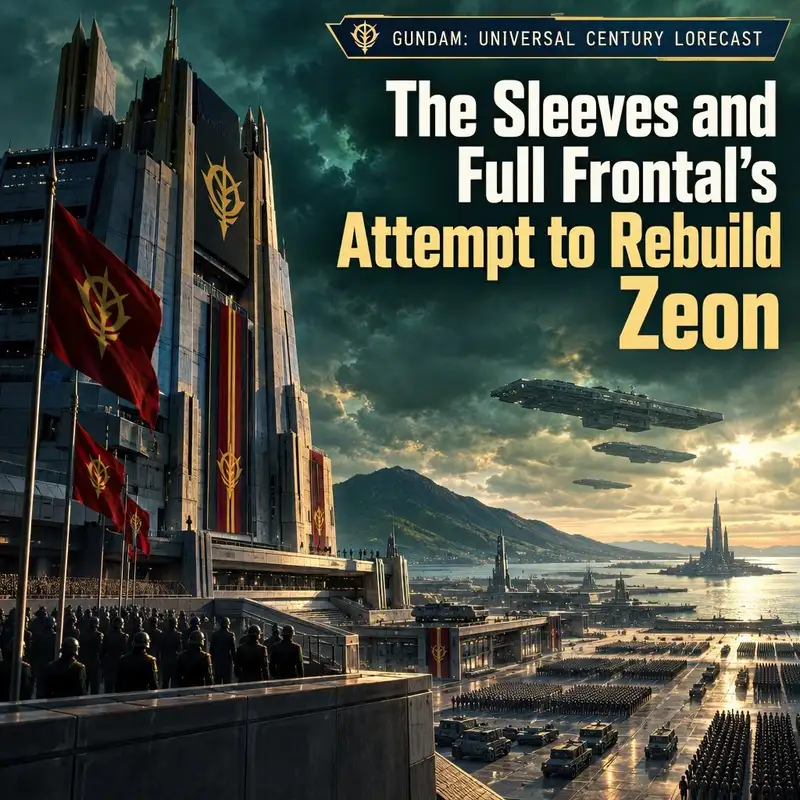
The Sleeves and Full Frontal’s Attempt to Rebuild Zeon
Palau looked, for a moment, like the beginning of a restored Zeon. The resource satellite sheltered a fleet, housed armed personnel, and served as the stronghold of the Sleeves. It held Banagher Links, the pilot capable of awakening the Unicorn Gundam, and therefore a living key to the route toward Laplace’s Box. Full Frontal had elite guards, a red mobile suit, prisoners, secret intelligence, and the disciplined bearing of a commander who expected history to make room for him. Federation forces closing on Palau saw an enemy base. Supporters could see a liberated refuge. But a refuge is not a capital, and a fleet anchorage is not a country. The question facing Full Frontal was larger than whether he could hold Palau or defeat a pursuing task force. Could a remnant organization, built from defeat and memory, turn sanctuary, fear, and symbolism into sovereignty?
In Universal Century ninety-six, that question carried the weight of several wars. The Principality of Zeon had been destroyed at the end of the One Year War. The Republic of Zeon remained, but under conditions that did not satisfy every former soldier, nationalist, refugee, or survivor of the old regime. Axis Zeon, Haman Karn’s Neo Zeon movement, and Char Aznable’s rebellion had each tried, in different ways, to overturn the postwar order. Each had also demonstrated how easily spacenoid grievance could be absorbed by militarism, dynastic politics, and mass violence. Three years after Char’s Rebellion, the Sleeves emerged from that exhausted political landscape. They did not inherit a functioning state. They inherited symbols, veterans, weapons, grudges, and unfinished arguments about Earth’s authority over space.
The Sleeves were a Neo Zeon remnant organization, not a restored Principality of Zeon and not a government in waiting with a complete civil administration behind it. They had ships, mobile suits, bases, personnel, and networks of support. What they did not visibly possess was just as important. There is no established Sleeves tax system, no broad territorial bureaucracy, no secure national industrial base, and no demonstrated authority over a population comparable to the old Zeon state. A movement can command soldiers without commanding a society. It can conceal a warship without collecting revenue. It can seize a hostage without administering a school, regulating trade, repairing colony infrastructure, or persuading civilians that its rule will be safer than the alternatives.
That institutional weakness explains the importance of appearances. The Sleeves used Zeon’s imagery because imagery organized memory. Their name, their uniforms, their machines, and their use of old political language reminded supporters that Zeon had once been more than an army. It had been a state, a cause, and for some, the promise that people living in the colonies could possess real political dignity. That memory was powerful because the Federation had never solved the underlying problem. Earth still held disproportionate political authority. The Moon and the colonies remained economically vital but politically subordinate. The Federation’s failures gave Zeon symbolism room to survive. Yet symbolism also carried the burden of Zeon’s history: dictatorship, conquest, occupation, colony gassing, and a war that devastated the Earth Sphere.
Within the Sleeves, loyalty did not flow from a single clean chain of command. There were senior figures, elite guards, ship crews, technical personnel, local contacts, and associated remnant forces with their own histories and priorities. Some were committed to a political future for space. Some had been shaped by battlefield defeat. Some had lost families, homes, or comrades. Some found purpose in the survival of a military culture that no longer had a recognized country to serve. Such networks could be formidable in a crisis. They were less suited to the slow work of building legitimate institutions. A coalition held together by shared grievance may act together when the enemy is close. It may fracture the moment someone asks who will pay, who will obey, and who will be protected.
Full Frontal was valuable precisely because he could make that fractured inheritance appear coherent. Officially, he was known as the leader of the Sleeves and as the second coming of Char. That title was not a minor flourish. It was a political weapon. Char Aznable had become a symbol large enough to contain contradictory meanings. To some, Char represented military brilliance, resistance to Federation complacency, and the refusal to accept Earth’s permanent dominance. To others, he represented catastrophe, manipulation, and the willingness to gamble civilian lives on grand political gestures. Full Frontal did not need every observer to agree on Char’s meaning. He needed them to recognize the image immediately.
The animated record keeps Full Frontal’s exact identity deliberately unsettled. He is not simply to be treated as Char Aznable returned under another name. The important historical fact is that he could occupy Char’s symbolic space. He possessed the mask, the composure, the red machine, and the tactical ability required to make the association credible under combat conditions. In a fragmented remnant movement, that had real value. He could compress decades of history into a single visual message. Zeon was not dead. The Federation’s old enemy had acquired a face again. A movement that otherwise might have appeared as scattered veterans and illicit arms caches could present itself as the heir to a continuing political struggle.
The Sleeves therefore faced a strategic problem familiar to many defeated military movements. They could not match the Earth Federation in a conventional war of attrition. The Federation retained larger resources, a broader industrial base, regular military forces, and the ability to deploy major warships and mobile-suit formations. Its weakness was not an absence of material power. Its weakness was political caution, secrecy, divided responsibility, and a recurring tendency to protect institutions before confronting the grievances those institutions had created. Full Frontal’s task was not to defeat the Federation fleet by fleet. It was to make the cost of ignoring the Sleeves politically unacceptable.
That required a military method built around small-force credibility. The Sleeves emphasized mobility, clandestine movement, intelligence, surprise, elite machines, and the ability to exploit a larger opponent’s hesitation. They needed secure approaches to targets, reliable contacts, and enough maintenance capacity to keep selected units operational. They needed ships that could move personnel and machines without immediately exposing the organization’s wider network. They also needed local forces willing to act under broad Zeon symbolism, even when those forces did not belong to a unified Sleeves command. Their strength lay in concentration at decisive moments. Their vulnerability lay in everything that followed those moments: resupply, repair, replacement, and political control.
The Garencieres operation at Industrial Seven showed that method clearly. Disguised as a freighter, the ship entered a setting where commerce, civilian infrastructure, corporate interests, and political secrecy overlapped. The Sleeves were not trying to seize Earth or storm a Federation capital. They were seeking access to Laplace’s Box, a hidden political asset held through the Vist Foundation. That objective rewarded concealment and intelligence more than raw mass. The Garencieres did not need to overpower every Federation force in the Earth Sphere. It needed to reach the right location, at the right time, before the people guarding the secret could secure it or destroy the trail leading to it.
Minovsky-era warfare made such operations possible, but not effortless. Particle interference limited some forms of long-range detection and communications, increasing the importance of local initiative, direct observation, and prearranged plans. A small force could sometimes move through uncertainty more effectively than a large formation that depended on a clear operational picture. But Minovsky conditions did not make logistics disappear. The Garencieres still required fuel, crew endurance, supplies, repairs, ammunition, and a place to recover damaged mobile suits. Palau mattered because raiding forces need somewhere to return to. A hidden stronghold can extend operational reach. It cannot replace the industrial depth required for a prolonged war.
At Palau, Full Frontal’s possession of Banagher and the Unicorn Gundam gave the Sleeves a temporary concentration of leverage. Banagher was not merely a prisoner. He was linked to a machine whose activation could advance the search for the Box. The Unicorn was not merely a powerful mobile suit. It was part of a political contest over who could reach, interpret, and use buried history. Frontal’s approach to Banagher was characteristic. He did not simply rely on confinement and guards. He sought cooperation. He presented a political choice, trying to bring Banagher into a framework that would make the Sleeves’ pursuit of the Box appear as the natural expression of spacenoid interests. Banagher refused, and the refusal mattered because it exposed the limits of coercive persuasion.
The Federation’s response also exposed those limits. Its effort to recover Banagher and the Unicorn turned Palau into a battlefield. Banagher objected because he understood that a rescue operation could endanger people living and working around the satellite. That is the recurring civilian problem of the Universal Century. A resource satellite, colony, or industrial installation is never merely terrain. It is infrastructure, employment, life support, transport, and home. The Sleeves could condemn Federation intervention as oppression, and often with reason. Yet their own decision to use inhabited or economically important places as bases and bargaining positions placed civilians inside the military contest. Liberation rhetoric became less convincing whenever ordinary people were asked to absorb the risk created by armed political theater.
The Sinanju was the Sleeves’ most effective piece of theater because it was also a genuinely formidable weapon system. Its origins reveal the organization’s real military economy. The machine began as the Sinanju Stein, an Anaheim Electronics prototype that was stolen and then modified into Full Frontal’s red personal mobile suit. That sequence is important. The Sleeves demonstrated an ability to acquire advanced technology, adapt it, and place it in the hands of an exceptional pilot. They did not demonstrate the ability to design, manufacture, standardize, and field an entire force of equivalent machines. Possession of one advanced prototype is not the same as possession of a defense industry.
Frontal’s Sinanju communicated before it fired a shot. Its red color, speed, and association with the Char image told allies that Zeon still possessed excellence. It told Federation personnel that a familiar threat had returned. It told uncertain observers that the Sleeves were more than scavengers with aging equipment. The machine’s battlefield performance gave that message credibility. But its political value exceeded its reproducible military value. A rare elite unit can influence a battle, protect a retreat, or force an opponent to take precautions. It cannot establish parity with a larger military unless the organization behind it can replace losses, train pilots, maintain parts, and sustain operations across multiple theaters.
The wider Sleeves arsenal reflected that problem. Their forces drew on inherited Neo Zeon equipment, refurbished older machines, salvaged systems, local modifications, and a limited number of advanced assets. Some equipment was modernized for specialized conditions. The Zee Zulu, developed from the Geara Zulu line for amphibious operations and supplied to terrestrial remnants, showed that the Sleeves could adapt designs to particular missions. But adaptation should not be confused with strategic self-sufficiency. Refitting a machine, assembling a limited batch, or supporting a specialist unit requires different resources from maintaining a broad, standardized armed force. An army becomes durable through depots, training pipelines, parts commonality, shipyards, and predictable supply. The Sleeves had access and ingenuity. They did not possess secure independence from the systems they opposed.
For that reason, Laplace’s Box mattered more than any mobile suit. The Box promised the possibility of changing the political environment itself. It contained evidence connected to the founding Universal Century Charter and to a suppressed constitutional history that could challenge the legitimacy of Earth’s dominance over the colonies. Full Frontal did not seek the Box simply because secrets are valuable. He sought it because verified knowledge, revealed at the right time and to the right audience, could compel political movement without requiring the Sleeves to conquer the Federation militarily. It was an intelligence objective with strategic consequences.
The struggle over the Box began with custody and access. The Vist Foundation possessed the chain of secrecy surrounding it. Industrial Seven became important because it stood at the intersection of private power, Federation authority, and the surviving record of a founding political compromise. The Sleeves needed to find the Box, follow its clues, and prevent the Federation from sealing the matter away. The Federation, by contrast, had reason to treat the revelation as a threat to institutional continuity. That did not mean every Federation officer or official shared the same motives. Londo Bell personnel confronted an immediate security crisis. Senior political leaders faced the prospect that an old secret could weaken the system they served. Those are not identical responsibilities, and the difference created room for manipulation.
Full Frontal understood that a government can be militarily strong and politically vulnerable at the same time. The Federation could field warships and mobile suits far beyond Sleeves capacity. It could not easily defend a claim to political legitimacy if the evidence showed that the Universal Century’s founding order had deliberately narrowed the future of colonial representation. Suppressing the information might preserve short-term control, but suppression also confirmed the accusation that Earth’s rulers feared an honest political settlement. Frontal’s strategy exploited that contradiction. He sought to make the Box a lever against the Federation, not a historical curiosity filed away after a ceremonial disclosure.
The deeper objective was to alter the relationship between Earth and space. Frontal’s proposal, the Side Co-Prosperity Sphere, imagined a stronger economic and political bloc linking the Moon and the colony Sides while excluding Earth and reducing Federation influence. Its appeal was not difficult to understand. The Moon and the colonies were not empty outposts. They contained industry, labor, shipping, scientific expertise, and communities that had long been treated as peripheral to Earth-centered authority. The proposal acknowledged that these societies possessed economic weight and should not remain permanently subordinate to institutions dominated from the planet below.
But the Side Co-Prosperity Sphere was not presented as a fully developed governing system. The animated record establishes Frontal’s political concept, not a tested constitution with representative institutions, revenue arrangements, courts, enforcement mechanisms, or a broad public mandate. That distinction is decisive. A political bloc can sound plausible as a corrective to dependency while remaining unclear about who speaks for its members, who bears its costs, and how it prevents strong actors from dominating weak ones. The more Frontal depended on the shock of the Box and the threat of renewed conflict, the more his proposal resembled coercive realignment rather than consensual reconstruction.
Mineva Lao Zabi understood the difference. Her name gave her enormous symbolic value. As a Zabi heir, she could be used to claim continuity with Zeon’s old political legitimacy in a way that Full Frontal, however compelling his image, could not manufacture by himself. That made her useful to every faction seeking to turn memory into authority. Yet Mineva was not a ceremonial seal to be placed on someone else’s program. She had political judgment, and she refused to endorse Frontal’s vision simply because it invoked the grievances of space. Her disagreement was not merely sentimental or moral. It was strategic.
Mineva recognized that excluding Earth did not automatically create justice for the colonies. It could create a new division of the Earth Sphere into rival economic blocs, each convinced that security required vigilance against the other. Such a system might weaken Federation centralization, but it would also deepen the security dilemma that had already driven so many wars. If the Moon and the Sides organized through coercive separation, Earth would have every incentive to rearm, intervene, and seek leverage of its own. The result would not necessarily be self-determination. It could be a prolonged cold war conducted across inhabited space, with smaller colonies and ordinary civilians caught between the larger powers.
Frontal needed Mineva because military memory could mobilize fighters, but dynastic continuity could broaden the appearance of political legitimacy. Mineva’s refusal therefore struck at the center of his project. A restored Zeon without her consent would look less like national reconstruction and more like a military movement using Zeon’s history for its own purposes. The point was not that bloodline alone grants legitimate authority. Zeon’s history had already shown the danger of treating a family name as a substitute for accountable government. The point was that Frontal’s coalition lacked even the symbolic unity he wanted to claim. He could gather remnants under a banner. He could not compel the most important bearer of that banner to believe in his settlement.
The Garencieres crew demonstrated another limit on Frontal’s authority. Suberoa Zinnerman and those around him were bound by grief, survival, loyalty to Mineva, and their relationship with Marida Cruz. Their connection to the Sleeves was real, but it was not reducible to obedience to Frontal’s political design. Ship crews often become their own moral and operational communities. They share danger, depend on one another for survival, and carry memories that outsiders cannot easily command. Zinnerman’s network gave the broader remnant movement reach and experience. It also showed that a coalition can contain loyalties stronger than its central leader’s agenda.
That mattered when the crisis widened to Earth. The conflict around Torrington revealed the difference between mobilizing anger and controlling armed action. Terrestrial Zeon remnants led by Kirks were distinct from the Sleeves, even when they received support or political encouragement connected to Frontal’s broader campaign. Their grievances were local, their equipment and personnel were shaped by a different operational environment, and their choices reflected years of defeat, concealment, and resentment on Earth. Broad Zeon symbolism could connect such groups to the Sleeves. It could not erase their separate command relationships or guarantee disciplined coordination.
The Shamblo operation brought that risk into brutal focus. A powerful mobile armor and an emotionally wounded operator did not create a disciplined instrument of liberation. They created a weapon system in which trauma, grievance, and destructive capacity became tightly fused. The tragedy was not that anger existed. Anger had causes. The problem was that political movements and military organizations repeatedly treated damaged people as containers for strategic violence. A machine designed to overwhelm defenses cannot distinguish between a carefully considered political objective and the emotional collapse of the person operating it. The result was not a path toward sovereignty. It was an escalation that placed civilians and soldiers alike at greater risk.
Torrington also exposed the weakness of simple liberation language. The Federation had long failed many people living beyond Earth’s favored centers of power. That failure was real. Yet an attack on a military installation in a populated region still creates danger for surrounding communities. Retaliation, emergency security measures, damaged infrastructure, and military panic do not remain neatly inside a base perimeter. The people who suffer may include those with no loyalty to the Federation and no connection to the attacking force. A movement that claims to speak for the oppressed must answer for how its operations endanger the people it says it represents. It is not enough to identify an unjust system. The method used against that system matters.
Full Frontal’s strength lay in recognizing that crisis could create temporary alignments. When his fleet intervened against the Federation’s General Revil, the Nahel Argama and the Sleeves were pushed into a contingent joint front. This was not reconciliation, and it was not the beginning of a stable alliance. The groups had different histories, different goals, and deep reasons to distrust one another. But the Federation’s effort to eliminate the immediate problem created a situation in which cooperation became necessary for survival. Frontal could exploit such moments because he understood that a stronger power often becomes politically clumsy when it attempts to solve every problem through suppression.
This was coercive diplomacy rather than normal statecraft. Frontal did not need the Nahel Argama to trust him in a lasting sense. He needed the crew and its allies to recognize that the Federation’s immediate actions threatened them more directly than temporary cooperation with the Sleeves. That was an impressive ability to set the agenda of a crisis. It was not territorial consolidation. A commander can force an adversary into a short-term arrangement without winning their political allegiance. The distinction becomes especially important when the immediate danger passes. Once survival no longer requires cooperation, unresolved mistrust returns, and the coalition’s internal contradictions reappear.
The Side Co-Prosperity Sphere was Frontal’s effort to turn those temporary disruptions into a new strategic order. He offered a future in which the Moon and the colony Sides would organize their productive power apart from Earth. In one sense, this was a direct challenge to the Federation’s old assumptions. Earth had benefited from treating the colonies as dependent extensions of a political center rather than as communities entitled to equal influence. Frontal recognized that the balance of economic life in the Earth Sphere had changed. The colonies and lunar cities were no longer peripheral in any practical sense. They had the labor, industry, and infrastructure to demand a different settlement.
Yet Frontal’s model depended on a political shock severe enough to force that settlement into being. Laplace’s Box would delegitimize the Federation. Sleeves military power would demonstrate that resistance remained possible. The Char image would unite those ready to believe that old Zeon strength could return. The proposal gained force from pressure, not from a clear process of representation or consent. This was the central flaw. A political order built primarily through leverage may win concessions. It may even force a government to retreat. But it struggles to establish rules that its own supporters will accept when their interests diverge.
The proposed sphere also depended on a simplified division between Earth and space. That division had emotional power because Earth’s institutions had long privileged residents of the planet. But neither Earth nor space was politically uniform. Not every colonist supported Zeon. Not every lunar resident would accept remnant military leadership. Not every person on Earth benefited equally from Federation dominance. A system that treated Earth as a single enemy risked reproducing the same kind of political flattening that had made Federation rule so brittle. It could replace one center of power with another without giving ordinary people meaningful influence over either.
Mineva’s rejection therefore carried strategic weight. She did not deny that Earth’s dominance was unjust or that the Federation had concealed truths. She rejected the idea that another militarized bloc, built through intimidation and historical grievance, would resolve those problems. Her position demanded something more difficult than Frontal’s program. It required political change that did not depend on making a new enemy permanent. It required revealing history without turning revelation into a license for another war. It required treating the people of Earth, the Moon, and the colonies as participants in a shared political crisis rather than as pieces assigned to opposing camps.
The final struggle around Magallanica brought those arguments to a point. Magallanica was not important merely as a location hidden at the end of a trail. It became the place where the meaning of the Universal Century’s founding legitimacy could no longer remain an internal secret. The conflict over the Box was not resolved by determining which mobile suit had superior performance. The Sinanju, the Unicorn, and the forces surrounding them mattered because they protected people, threatened opponents, and shaped access to the truth. But the political question remained larger: who would be allowed to define the past, and what would that definition require of the present?
Full Frontal needed the Box to produce realignment. His strategy depended on turning revelation into a renewed Zeon-centered political force capable of challenging the Federation. Mineva and Banagher reached a different conclusion. The fact that the Federation had suppressed a foundational truth did not mean Zeon’s militarized traditions should inherit the future. The failure of one political order did not make a remnant coalition automatically qualified to replace it. That was the most difficult point in the crisis. The Federation’s legitimacy was compromised, but the alternative offered by Frontal still rested on coercion, elite military power, and an unresolved claim to speak for millions of people.
Full Frontal’s final meaning remains deliberately unsettled within the animated record, just as his identity remains unsettled. What is clear is that his political project reached its limit at the point where symbolism had to become consent. He could make Zeon relevant again. He could force the Federation to confront a secret it preferred to bury. He could lead elite forces effectively and make old fears immediate. But none of those achievements proved that the Sleeves could govern the Earth Sphere, speak for the colonies, or produce a durable peace after the shock had passed.
At the tactical level, the Sleeves were dangerous. Their elite pilots, high-performance machines, intelligence work, and ability to concentrate force gave them the power to seize initiative and impose real costs. At the operational level, Palau, the Garencieres, and associated remnant networks gave them reach beyond what a simple scattered insurgency could manage. But their sustainment remained limited. Their equipment depended on inheritance, salvage, modification, and access to systems they did not fully control. A stolen prototype and a celebrated ace could alter a battle. They could not substitute for shipyards, factories, standardized maintenance, trained replacements, and secure political territory.
At the strategic level, Laplace’s Box was Frontal’s great equalizer because it threatened the Federation where material superiority could not easily protect it. It exposed the weakness of a political order that had relied on secrecy and inertia. But strategic leverage is not the same as sovereignty. To become a state, the Sleeves would have needed more than fear of the Federation and nostalgia for Zeon. They would have needed a governing settlement accepted by people with different histories, different interests, and different memories of what Zeon had done. Mineva’s refusal showed that even the movement’s most valuable symbol would not validate that settlement.
Full Frontal rebuilt Zeon in the narrower sense that he made it politically dangerous again. He combined remnant networks, Char’s image, elite weapons, and the constitutional threat of Laplace’s Box into a pressure system capable of compelling attention from institutions far stronger than his own. But he could not turn coercion into consent, salvage into industry, personal devotion into accountable government, or historical grievance into a settlement that included the people his movement claimed to represent. He rebuilt a symbol and a weapon of political pressure, not a country capable of ending the conditions that had produced Zeon’s wars.