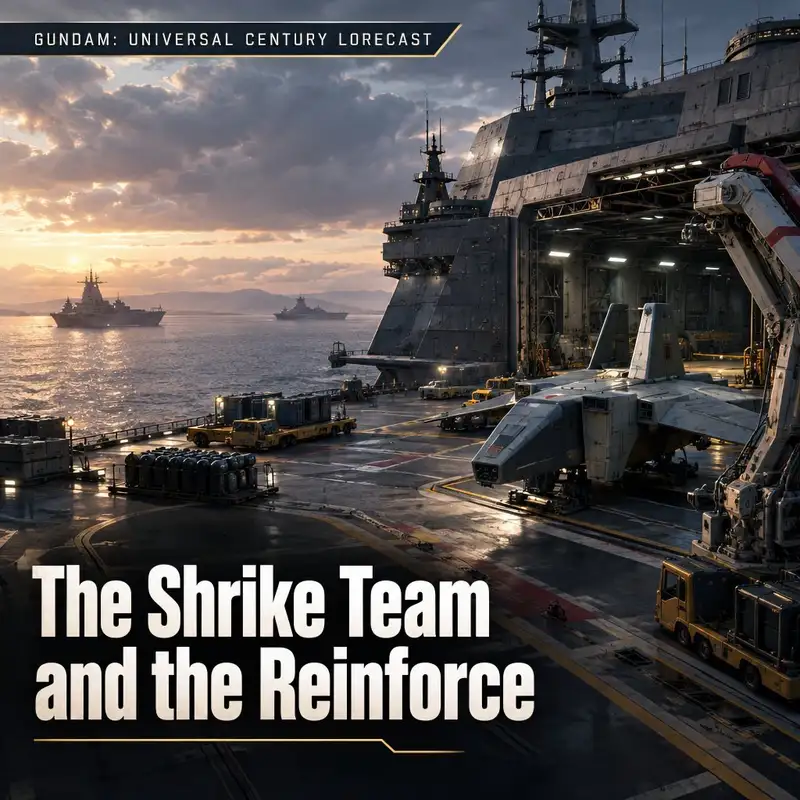
The Shrike Team and the Reinforce
The Reinforce Junior goes into the atmosphere already wounded. Its hull has taken punishment, its people are evacuating, and the ship that carried the League Militaire through the hardest part of the Zanscare War is no longer being preserved for another campaign. Older crew members remain at their stations while younger personnel escape. Captain Gomez stays. Jinn Jahanaam stays. The ship turns toward the BESPA Motorad fleet, using the reinforced power of its bow and its beam shield in a final attack. On screen, it is a spectacular act of defiance. Militarily, it is something harsher. A resistance movement is deliberately spending one of the few assets that has allowed it to function as more than a collection of local cells. The Reinforce Junior had been a command post, a mobile-suit carrier, a repair space, a transport, a refuge, and a home for people who had no reliable rear area. Destroying it could remove an immediate enemy threat. It could also erase trained crews, accumulated knowledge, equipment, and organizational continuity that the League Militaire had spent the war struggling to assemble. That final charge occurs in the fiftieth episode of Mobile Suit Victory Gundam, before the separate sacrifice of the Jeanne D’Arc in the war’s closing moments. Keeping those events distinct matters. The Reinforce Junior’s loss was not simply one more dramatic ship destruction in a final battle. It was the endpoint of a particular military system. The Shrike Team and the Reinforce had become effective because the League Militaire concentrated its best available people, its usable machines, and its fragile logistical capacity in one moving force.
That concentration let the resistance act with a reach far beyond what its scattered bases and volunteers should have permitted. It also made every loss dangerous. When the ship made its final attack, the League was not throwing away an expendable battleship. It was consuming the infrastructure that had made its veteran pilots, mechanics, commanders, and younger survivors operationally useful. To understand why the final charge carried that weight, we have to begin with what the League Militaire did not possess.
A local cell might ambush an occupier or shelter refugees. It could not easily coordinate operations across orbital distances, protect a group of mobile suits between missions, or move people out of a threatened region. Political legitimacy and military capability were separate problems. The League could earn support by resisting Zanscare, but support alone did not give it the means to turn courage into sustained combat power. The resistance had to improvise institutions while fighting. It had to make fighters, ships, transport, medical care, communications, and command relationships out of whatever it could preserve, acquire, capture, or repair. That is the environment in which the Shrike Team became valuable. The team was not simply a collection of skilled pilots. It was concentrated experience in an organization where experience could not be replaced quickly.
The Shrike Team enters the television series during the early League Militaire campaign, appearing first as the resistance needs a force capable of taking on missions beyond the capacity of inexperienced local defenders. It is an all-female mobile-suit formation associated at first with Oliver Inoe and later led in practical operational terms by Junko Jenko. Calling it an elite squadron is tempting, but it can obscure more than it explains. The Shrike Team does not matter because it is presented as a perfectly resourced special unit with a stable establishment behind it. It matters because its members have the cohesion, judgment, and combat experience to do difficult work under conditions where the League cannot afford a long chain of approval or a prolonged period of training. They screen vulnerable forces, escort personnel, provide cover during movement, penetrate hostile positions, conduct rescues, and hold dangerous ground or space long enough for somebody else to survive. Those are not glamorous assignments in the narrow sense. They are the work that keeps a resistance force from breaking apart under pressure. Their Gun-EZ mobile suits are useful not because they represent a singular technological miracle, but because they are combat machines the League can employ, maintain, and understand. A weapon system that can be launched, repaired, armed, and recovered is often more valuable than an exceptional prototype whose parts, pilots, and technical support exist in only one place. The team’s gender is notable, but it should not be converted into a simple symbolic statement about women in war.
The series shows women performing dangerous, technically demanding combat labor in a force that cannot afford to reserve risk for anyone else. The League needs experienced pilots, and the Shrike Team provides them. Its members are not sheltered from attrition because they are valuable. They are exposed to it precisely because they are valuable. That is a familiar military dilemma. The people best able to solve an emergency are sent to solve it. Their success makes commanders more likely to use them again. Over time, competence becomes a route toward exhaustion. The Shrike Team could act quickly because its members understood one another and could operate under pressure. But a mobile-suit team cannot live in the field indefinitely. It needs a place to receive orders, prepare machines, treat wounded personnel, resupply, rest, and return from missions. The League Militaire needed more than pilots. It needed a mobile foundation.
That foundation began to take shape when the League acquired the Reinforce. In the sixteenth episode, the old Federation vessel becomes the means by which a ground-based resistance can move into space while under Zanscare attack. It is easy to look at the ship and see only a warship joining the cast. That misses its real military importance. The Reinforce gives the League mobility, and mobility is not simply speed. It is the ability to choose where to concentrate force, to withdraw from a threatened area, to move personnel between theaters, and to avoid being trapped inside a single occupied region. More importantly, it gives the League a moving headquarters and a service base. A mobile-suit carrier must do more than launch machines. It needs people who can inspect damage, replace components, load weapons, manage stores, assist injured pilots, maintain communications, and decide which mission deserves the next sortie. It must provide living space for crews who remain on alert while others fight. It must carry the burdens of command in an environment where bases can be discovered, bombarded, or cut off. The Reinforce is not important because it is a pristine model of late Federation naval design. It is not a standard against which every other Federation vessel should be measured. Its value comes from the fact that it can be used. For the League Militaire, an old ship with usable hangars, command spaces, engines, communications, and support facilities is a strategic asset because it converts dispersed people and machines into an operational force.
The Shrike Team’s mobile suits require launches and recoveries. They require propellant, ammunition, parts, mechanics, and medical support. Pilots cannot simply drift from battle to battle as independent knights in space. A damaged machine needs to be brought back. A pilot who survives a mission may still be injured, exhausted, or unable to fly again without treatment. A machine that returns with a broken limb, damaged cockpit systems, or depleted weapons needs a workshop and trained labor. The Reinforce provides the minimum institutional structure needed to make those realities manageable. Its departure into space also changes the League’s war. On Earth, resistance can draw on terrain, local populations, and concealment. In space, the League gains access to broader routes and targets, but it also faces fleet actions, orbital movement, and a harsher dependence on shipborne support. The ship gives the League reach. It also becomes a single point of failure that BESPA can identify, pursue, and attempt to destroy.
As the campaign expands, the Reinforce operates within a fragile network rather than as a lone heroic vessel. Other ships, support craft, improvised bases, friendly colonies, and temporary allies matter because a resistance cannot survive on one hull alone. Yet the Reinforce becomes the center of gravity for a growing part of League Militaire activity. It moves people and machines between operations. It helps connect ground resistance to space operations. It enables mobile suits to appear where BESPA does not expect them, and it allows the League to retain a measure of continuity when local positions are lost. Under Minovsky conditions, that continuity is especially valuable. The interference created by Minovsky particles does not make every sensor or communication system useless, but it reduces the certainty and speed that a large military prefers. Long-range detection becomes less reliable. Formations can lose contact. Orders may arrive late, or not at all. Identification can become difficult in the confusion of a fleet engagement. In such conditions, a ship’s crew must work from prearranged intent as much as from real-time instruction. Pilots and officers need enough shared understanding to act when headquarters cannot supervise every movement. That is where experienced teams like the Shrikes become more than an escort force. They can make local decisions without waiting for a perfect picture of the battle. But the same conditions increase the value of the ship that gathers information, distributes orders, receives damaged units, and preserves operational memory.
The Reinforce is also a moving community. It carries not only officers and mobile-suit pilots, but mechanics, support staff, younger personnel, civilians, and people displaced by the fighting. A resistance warship has a political role because it is one of the few places where the resistance can keep people alive, organized, and connected across distance. Its hangars and corridors are not merely scenery between sorties. They are where a volunteer force becomes, however imperfectly, an institution. This creates a burden as well as an advantage. Every person brought aboard needs food, medical care, space, and protection. Every additional mission risks damage to a ship that cannot be casually exchanged for another. The League’s growing mobility does not erase scarcity. It carries scarcity with it. The limits of that arrangement become clear when the League attempts to turn tactical seizure and battlefield salvage into a more durable form of combat power.
The campaign around Keilas Guilie offers a sharp example of the difference between capturing an opportunity and solving a strategic problem. Keilas Guilie is not just another target in a sequence of battles. It is a strategic weapon and a major threat, the kind of installation that can shape an entire operational theater. The League’s actions around it include the capture of the Squid One, a BESPA vessel whose later components become important to the Reinforce’s reconstruction. That capture demonstrates initiative, intelligence, and the ability to exploit an opening. A smaller force can sometimes seize something larger and more valuable than itself if it acts at the right moment, understands the enemy’s vulnerabilities, and accepts risks that a more conventional command might reject. But capture is only the beginning. A ship has to be secured. Its systems must be understood. Damage has to be assessed. Crews need to know which components can be used, which parts cannot be maintained, and which unfamiliar systems may create more trouble than they solve. A strategic installation has to be disabled, defended, or brought under control. None of that happens automatically because a boarding action or raid succeeds. The Keilas Guilie operation also reveals the human cost behind the League’s tactical flexibility. Junko Jenko dies while attempting to disable the weapon. Her loss is not merely a tragic incident attached to a major battle. It removes a leader whose value rests in accumulated combat judgment, team cohesion, and the trust of those around her.
In a large military, the loss of a veteran commander can be serious but manageable if a replacement pipeline exists. In the League Militaire, a replacement may be younger, less experienced, or already committed elsewhere. The same force that needs its best people at the point of danger has no safe way to preserve them. Resistance warfare can produce dramatic local success because its personnel are willing to accept risks in defense of a community or cause. But willingness does not produce replacements. It does not create a new training cadre, a fresh command staff, or a reserve of equally experienced pilots. The League could neutralize an immediate threat and open a path forward. It could seize matériel from BESPA. It could not make the loss of Junko or other veterans disappear. Its answer to the material problem was therefore not large-scale construction. It was reconstruction from damaged and captured resources, carried out wherever the resistance could find the industrial shelter to attempt it.
At La Vie en Rose Four, the Reinforce undergoes the transformation that produces the Reinforce Junior. This is not a routine refit, and it is not simply an old ship receiving a new name. The League rebuilds it using major components from captured Squid-class matériel, creating a vessel with greater combat reach, greater capacity to support mobile-suit operations, and a beam-shield-equipped bow that later becomes central to its final attack. The exact mechanical details are less important than the process. The Reinforce Junior represents salvage turned into operational capability. It shows that the League possesses technical skill. Its mechanics and engineers are not merely keeping damaged machines alive through improvised repairs. They are participating in a wartime reconstruction effort that combines surviving equipment, captured technology, labor, and an available industrial site. That is impressive, but it should not be mistaken for strategic self-sufficiency. Salvage is not the same as a secure shipbuilding industry. Captured parts are not the same as standardized production. A rebuilt ship can be formidable while still depending on components that are difficult to replace, technicians who are already overworked, and facilities that may be threatened or temporary. The Junior’s existence tells us both that the League can adapt and that it has been forced to adapt. A state with secure industrial depth can build a class of ships, train crews for them, stock spare parts, distribute manuals, and establish depots across multiple theaters. The League must make one unusually capable vessel out of the wreckage and opportunities left by war.
Its ingenuity produces an asset that can carry out missions a weaker ship could not. But it also creates a concentration of risk. The more missions the Reinforce Junior can perform, the more likely commanders are to rely on it. It becomes a carrier, assault platform, command center, transport, workshop, and symbol of continued resistance. Those roles reinforce each other. A successful operation increases confidence in the ship. Increased confidence brings more demanding missions. More demanding missions create more damage and more pressure on its crew. The beam shield at the bow is a useful example. It gives the ship a means to force an attack through danger in circumstances where ordinary armor and guns may not be enough. It is an operational feature, not evidence that ramming has become ordinary fleet doctrine. No sensible naval organization builds its campaign plan around the deliberate destruction of hard-won carriers. The beam ram becomes meaningful only because the League eventually reaches a point where the ship’s survival is no longer judged more valuable than the immediate danger it can remove.
The Shrike Team and the Reinforce Junior therefore function best when understood as one system. The team supplies concentrated combat labor. The ship makes that labor usable across a wide area. The Junior launches the mobile suits, receives them when they are damaged, carries their support personnel, and provides the command framework within which dangerous missions can be assigned. The Shrikes, in turn, protect the ship, screen vulnerable movements, intercept attackers, penetrate hostile formations, assist in rescue operations, and conduct rear-guard actions that prevent local disasters from becoming complete collapse. Their work is not always separate from the missions of Uso Ewin, whose extraordinary ability becomes important to the League’s operations. But Uso’s ability does not make him self-sustaining. He is still a thirteen-year-old pilot operating within a war that demands more from him than any child should be asked to provide. Even when his skill changes the outcome of a battle, he depends on launch crews, mechanics, commanders, escorts, recovery operations, and comrades willing to place themselves between him and the enemy. The Shrike Team repeatedly demonstrates that dependence. A gifted pilot may be able to strike at a critical target. He cannot simultaneously screen a carrier, rescue a disabled ally, manage the wider formation, and maintain a damaged machine. No individual, however capable, replaces a force structure. The League’s difficulty is that its most reliable people become the answer to every urgent problem. If an evacuation requires cover, the Shrikes are useful.
If a penetration mission needs disciplined pilots, they are useful. If a mobile-suit force has to hold off BESPA long enough for a ship to withdraw, they are useful. If Uso needs support during a dangerous operation, they are useful. This is tactically rational. It is also the beginning of an attritional trap. A conventional force tries, when possible, to rotate units, preserve cadre personnel, and avoid placing the same experienced formation in every crisis. The League has less freedom to do that. Its best unit is repeatedly exposed because lesser forces may fail. Its ship is repeatedly committed because no other available platform combines the same mobility and support capacity. The system works because the team and the ship are dependable. It weakens because dependability becomes a resource consumed faster than it can be renewed.
Over the course of the war, the Shrike Team’s losses make that cost visible. The important point is not to recite every death as though the team’s history were only a memorial list. The point is to understand what each loss does to the organization. Peggy Lee’s sacrifice during the Amelia operation, Junko Jenko’s death during the effort against Keilas Guilie, Juca Meilasch’s death in the Angel Halo assault, and Connie Francis’s final-battle attempt to support Uso all belong to a pattern. The team keeps being sent into situations where its members must trade their own survival for time, access, protection, or an opening for someone else. Those choices can be militarily meaningful. A rear guard can save a carrier. An escort can keep a rescue mission from becoming a massacre. A pilot who delays an enemy attack can allow civilians, wounded personnel, or younger combatants to escape. But each successful sacrifice also destroys knowledge that the League needs for the next crisis. Veteran pilots carry more than flight skill. They understand the habits of their enemy, the limits of their machines, the way a particular commander reacts under pressure, and the informal methods by which a damaged force keeps functioning. They know which mechanic can solve a difficult repair, which junior pilot needs guidance, which communications procedure still works when the planned one fails. They carry trust. That kind of institutional memory is difficult to record and nearly impossible to replace in the middle of a campaign.
The Shrike Team’s protective role around Uso has a real emotional and military meaning. They see that his talent makes him essential to the immediate fight. They also understand, more clearly than a detached command chart can show, that no child should be reduced to a weapon system. Yet the League’s circumstances repeatedly force exactly that contradiction. The resistance must use the people it has. Its leaders cannot always wait for a better option because a better option may never arrive. Angel Halo makes the contradiction impossible to avoid. The League is trying to defeat a major threat while preserving enough of its people to have a future after victory. The Reinforce Junior’s final mission emerges from that dilemma. It is not an isolated act of courage detached from the war around it. It is the final expression of a force that has survived by turning sacrifice into a substitute for reserves.
When the Reinforce Junior makes its attack on the Motorad fleet, the operational situation has already stripped away easier choices. The ship is damaged. Evacuation is underway. The crew knows that the vessel may not survive the battle regardless of what it does next. In that moment, the question is not whether ramming is an elegant or desirable doctrine. It is whether the remaining combat value of the ship can be converted into an effect large enough to justify the loss. The answer the crew reaches is yes. The older personnel remain aboard while others are sent away. Gomez and Jinn Jahanaam continue with the ship. The bow’s beam shield gives the Junior a means to drive into enemy vessels and turn its final movement into a weapon. The result disrupts and destroys elements of the Motorad fleet at a critical point in the Angel Halo campaign. Tactically, the attack succeeds in removing enemy vessels and creating immediate dislocation. Operationally, it helps reduce a threat that could otherwise interfere with the wider effort against Zanscare’s final position. Strategically, however, it does not win the war by itself. The collapse of Zanscare’s war effort comes from the broader struggle, the defeat and disintegration of its leadership, the operations of multiple forces, and the failure of the empire’s political project. The Reinforce Junior contributes to that outcome. It does not replace it. The institutional result is more severe. The League loses a command platform and carrier that had enabled operations far beyond the capacity of its original dispersed resistance cells.
It loses senior crew members, technical expertise, familiar working relationships, and a physical space that had carried the organization through the war. The destruction is not cost-free merely because it is effective. It is the kind of decision commanders make when they judge that preserving an asset for a future campaign is less important than preventing an immediate catastrophe. Such judgments can be necessary. They are still evidence of failure somewhere larger in the system. A movement that had possessed deeper reserves, secure facilities, and alternate carriers might have found another way. The League does not have that luxury. The production gives the sequence a deliberate escalation, allowing the losses among gun crews, bridge personnel, and senior figures to register as separate stages rather than one anonymous explosion. That dramatic construction matches the military meaning. The ship does not vanish in a single abstract sacrifice. It is expended piece by piece, by people who understand that they are preserving the survival of others at the cost of their own.
The Shrike Team and the Reinforce became the League Militaire’s backbone because the League had no stable military establishment to fall back on. Their cohesion, mobility, technical adaptability, and willingness to act under pressure allowed the resistance to survive missions that a more cautious force might have abandoned or a weaker one could not have attempted. The Shrikes concentrated veteran skill where BESPA formations were vulnerable. The Reinforce, and then the Reinforce Junior, gave that skill a place to launch from, return to, repair within, and carry across the war. Together, they transformed volunteers and scattered assets into temporary but genuine operational power. Yet they were never a substitute for secure logistics, replacement pipelines, industrial depth, or a political order capable of defending its people without consuming them. Their successes exposed that limit as clearly as their losses did. Every emergency solved by the Shrikes spent experience that could not easily be restored. Every demanding mission assigned to the Reinforce Junior increased dependence on a ship the League could not replace. Their final destruction was militarily meaningful, and it helped make survival possible for others. But it also revealed the price of a world in which resistance had become the last functioning form of public defense. A force can win decisive moments through courage, improvisation, and sacrifice. Building a durable peace requires that it no longer has to spend its best people merely to keep the future alive.