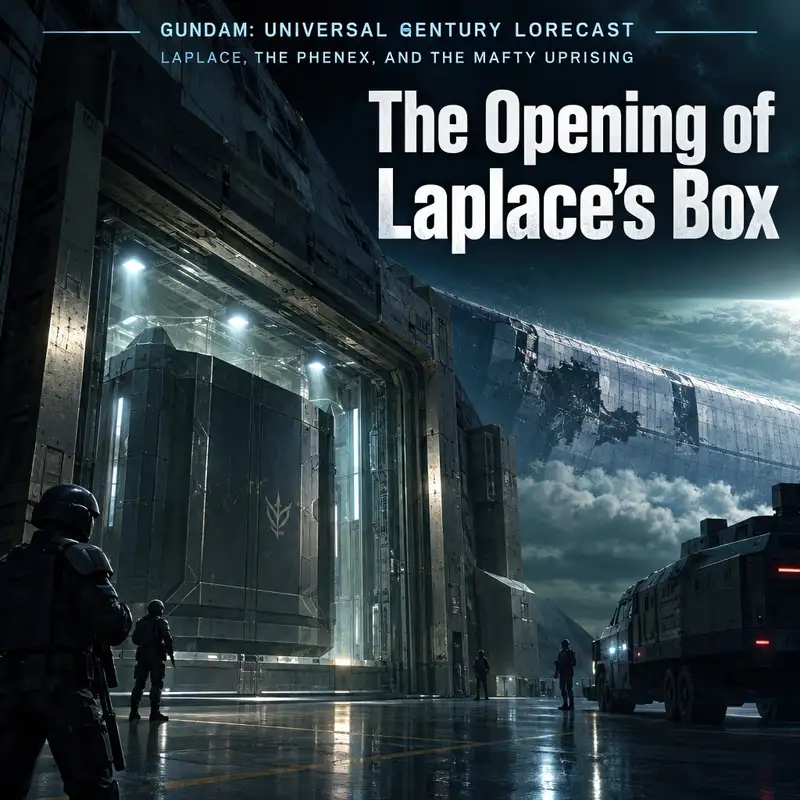
The Opening of Laplace’s Box
In Universal Century one, the new calendar began with an explosion. The Earth Federation’s prime minister had chosen the orbital residence called Laplace for a ceremony of inauguration, a stage-managed declaration that humanity’s expansion into space had entered a new political age. Then terrorists destroyed the station. The ceremony became wreckage, bodies, emergency lights, and debris moving through orbit around the Earth. Among the survivors was a child named Syam Vist. In the remains of Laplace, he found something that had survived the people who had intended to announce it. That object, or rather the information bound to it, would become known as Laplace’s Box.
The animated record does not provide a full public accounting of the attackers, their organization, or every political motive behind the destruction. That absence matters. Laplace’s destruction is not presented as a solved historical case. It is the beginning of a long act of concealment. A political order that had just named its era was immediately confronted by evidence that could compromise its founding story. The attack destroyed a residence. The secret that survived it threatened something more durable: the legitimacy of the government that claimed to represent the new age.
Syam Vist understood, or at least recognized, the value of what he had found. Information can be more portable than territory, more survivable than a fleet, and more dangerous than a weapon if it exposes the terms on which power has been built. A warship can be sunk. A base can be captured. A government can lose an election, replace a ministry, or survive a military defeat. But a government that loses the credibility of its own origin can face a deeper problem. Its laws may still be enforceable. Its soldiers may still obey. Its bureaucracy may still function. Yet the story that makes those institutions seem rightful begins to come apart.
For nearly a century, the Vist family preserved control of the Box. They were not impartial archivists guarding a public trust. Their custodianship gave them leverage over governments, corporations, and political movements that had reason to fear what the secret might mean. The Box became part of a private inheritance. It passed through a family whose wealth, industrial influence, and access to classified projects made it capable of operating beside public institutions without ever fully becoming one of them.
That arrangement is one of the central contradictions of the Laplace affair. A secret connected to the legitimacy of the Earth Federation was not held securely by a transparent public body, a court, a legislature, or an accountable historical archive. It was held by a private family. The Federation had power, armed forces, and a century of administrative continuity. The Vists had possession. Neither side could openly admit the full nature of the relationship without exposing the reason the Box mattered in the first place.
By Universal Century ninety-six, the secret had become too important to remain dormant. The Earth Sphere had endured the One Year War, the Gryps Conflict, the First Neo Zeon War, and Char’s Rebellion. Three years had passed since Char’s final attempt to force a political transformation through mass destruction. The immediate emergency had ended, but stability remained shallow. The Federation had survived again. It had not solved the political exclusion, colonial resentment, institutional secrecy, and recurring militarization that had made its enemies possible.
The Federation understood the danger in similar terms. Its concern was not merely that an enemy might obtain classified information. Governments regularly survive intelligence leaks, stolen weapons plans, and embarrassing disclosures. Laplace’s Box was different because it was tied to the Federation’s foundation. The possibility that its contents could become public threatened to turn historical memory into a strategic weapon. A secret of that kind could affect public confidence, colonial politics, alliance relationships, and the loyalty of people who had already spent decades wondering whether the Earth Sphere’s institutions could represent them fairly.
This was the setting in which Cardeas Vist decided to act. As head of the Vist Foundation and chairman of the Anaheim Electronics Industrial College, Cardeas stood at the intersection of family power, industrial capacity, and political secrecy. He planned to transfer Laplace’s Box to the Sleeves. In practical terms, it was a handover between a private custodian and an armed remnant movement. In political terms, it was an attempt to force a secret into motion after nearly a century of containment.
Cardeas’s decision was not the policy of a unified Vist Foundation. The family and its associated interests were divided. Syam Vist, the original survivor of Laplace, had his own relationship to the secret and to the power it gave the family. Martha Vist represented another set of calculations, shaped by corporate and political interests. Alberto Vist opposed Cardeas’s course. The Foundation was not a single hidden government directing events with perfect discipline. It was a powerful private institution fractured by inheritance, fear, competing loyalties, and different ideas about what the Box should be used for.
Cardeas appears to have believed that the existing order could not be reformed through ordinary channels. The Box had been concealed for too long. Its continued suppression had made the secret itself part of the machinery of rule. But his method revealed the same habits of control that had preserved the problem. He did not simply publish the information. He arranged a secret transfer to an armed anti-Federation force. He chose the timing, the location, and the intended recipient. He meant to end the Vist family’s custodianship while still directing the manner in which the inheritance would be released.
Industrial 7 was selected as the site of the transfer. It was not an empty rendezvous point in open space. It was a manufacturing colony associated with the Vist Foundation, a place of industrial work, education, transport, housing, and civilian routine. Located at Lagrange Point One, between Earth and the Moon, it occupied a useful position within the traffic and infrastructure of the Earth Sphere. Its connection to Vist interests also gave Cardeas a measure of local access and familiarity. He was attempting to conduct a controlled political transaction inside an environment he believed he could manage.
But industrial control is not the same as political control, and a colony is not a private conference room. Industrial 7 contained workers, students, technicians, families, instructors, and people with no role in the struggle over Laplace’s Box. Its industrial structures depended on power, transport, life support, and pressure integrity. Its residential spaces depended on the same systems. Once armed forces entered the colony, ordinary residents could become witnesses, obstacles, cover, hostages, casualties, or refugees without having made any decision to participate.
The colony’s ordinary life also explains why Banagher Links matters. At the start of the incident, Banagher is not a Federation pilot, intelligence officer, or military cadet. He is a student at Industrial 7. He has no formal place in the command arrangements now converging around the colony. He is not supposed to be a strategic actor. His significance comes from the fact that the institutions involved in the crisis have built their plans around secrets, machines, bloodlines, and exceptional access. When those systems begin to fail, a civilian teenager becomes central to a conflict he neither designed nor fully understands.
Banagher’s first contact with the crisis comes through Audrey Burne. Audrey arrives at Industrial 7 under an assumed public identity. In the wider political reality of the story, she is Mineva Lao Zabi, heir to a name with enormous symbolic weight in the history of Zeon and its successors. But at this point, the important fact is not a later public role or political following. Her immediate purpose is urgent and limited. She has come to stop the transfer of Laplace’s Box because she believes it could ignite another war.
Audrey understands more of the political danger than Banagher does. She knows that the Box cannot simply be handed to the Sleeves without consequence. She understands that the Federation will not accept the transfer quietly. She also understands that an armed remnant movement acquiring such leverage could create pressures that no one at Industrial 7 would be able to contain. Yet knowledge is not the same as control. Audrey has no fleet at her disposal, no authority over the Vist Foundation, and no reliable way to compel the Federation or the Sleeves to abandon their plans.
Banagher, by contrast, understands the human stakes before he understands the historical architecture. He sees a young woman in danger. He sees that forces larger than either of them are moving around Industrial 7. He recognizes that the adults who claim to control events are prepared to place civilians at risk in order to settle a political problem inherited from a century earlier. His response is not based on a complete grasp of Federation law, Zeon history, or the contents of the Box. It is based on a refusal to accept that war is an abstract necessity.
That refusal is not childish simply because Banagher is young. It is politically significant. The Universal Century repeatedly turns young people into soldiers, symbols, research subjects, hostages to inherited causes, or living proof of somebody else’s ideology. Banagher begins outside those categories. His lack of military training is not a gap the story has forgotten to fill. It is evidence of the failure around him. The supposed guardians of order have allowed their system to reach a point where an untrained civilian may become the only available instrument for carrying a secret forward.
Audrey and Banagher do not stop the operation by force of personality. Their intervention collides with arrangements already in motion. By the time they meet, the transfer has attracted several actors with incompatible objectives. The Sleeves want possession of the Box. The Earth Federation wants to prevent that possession and prevent the secret from becoming public. The Vist Foundation is divided over whether the transaction should happen at all. And individuals within each institution are operating on partial information, under compartmentalized authority, with no common command structure capable of controlling the whole crisis.
The Sleeves enter the operation with a direct political objective. They are there to receive the Box, not to conquer Industrial 7 or fight a conventional campaign against the Earth Federation. Their personnel include Suberoa Zinnerman, whose experience gives the force a practical understanding of irregular military operations, and Marida Cruz, a highly capable Cyber Newtype pilot. The presence of a mobile suit such as the Kshatriya demonstrates that the Sleeves are prepared for resistance. But the mobile suit is not the purpose of the mission. It is security for an acquisition effort that could change the political balance.
The Earth Federation’s objective is denial. It does not need to win a war at Industrial 7. It needs to stop the transfer, seize or secure the relevant people and material, and prevent the Box from being opened or carried away. That objective explains the use of ECOAS, the Federation special-operations formation involved in the intervention. Under Daguza Mackle, ECOAS is not conducting ordinary fleet warfare. It is conducting a seizure mission in a politically sensitive civilian environment.
The Vist Foundation adds another layer of confusion. Cardeas has arranged the handover, but he does not command the Sleeves. He has influence at Industrial 7, but he does not control every Vist family interest operating around him. Alberto is not merely a subordinate carrying out orders. Martha’s interests cannot be assumed to match Cardeas’s. Syam’s long relationship with the Box gives him an authority of memory and possession that cannot be reduced to a corporate chain of command. The family has preserved the secret, but it has not created a stable institution capable of deciding what should happen when preservation ends.
This is how secrecy creates escalation. Each participant knows enough to act, but not enough to understand the full plan. The Federation knows that a transfer is coming and sees reason to intervene. The Sleeves know that the Box is important enough to risk a covert operation. Cardeas knows enough to arrange the exchange but cannot control his own family’s reaction. Audrey knows enough to see the danger but lacks the force to prevent it. Banagher knows almost none of the strategic detail, but he is present where the human consequences become impossible to ignore.
Compartmentalization is often useful in intelligence and special operations. It limits the damage when a mission is compromised. It prevents one captured operative from exposing an entire network. It can protect a classified program from broad institutional scrutiny. But it also creates blind spots. When several compartmentalized operations collide in the same location, no one has a complete picture. Orders reach the field late or not at all. Personnel act on incomplete assumptions. A mission intended to remain discreet becomes a series of local reactions.
Industrial 7 was especially vulnerable to this kind of collapse. In the Minovsky-era military environment, long-range sensors and communications cannot be treated as perfectly reliable. Forces rely more heavily on visual identification, short-range coordination, prearranged plans, and the judgment of people on the scene. That does not mean everyone is blind or cut off. It means the quality of local information matters enormously. Inside a colony, where infrastructure, civilians, industrial machinery, and armed actors occupy the same spaces, misidentification and delayed decisions can turn a contained operation into a wider engagement very quickly.
The mission also had contradictory requirements. The Federation wanted to stop the transfer without allowing the Box to disappear. The Sleeves wanted to acquire the Box without destroying the source of their leverage. Cardeas wanted to release the secret but maintain enough control over the process to shape its political effect. No one could simply annihilate the site. The objective was seizure, denial, extraction, or controlled release. Those are difficult missions even in empty space. In an inhabited colony, they demand restraint from actors who have already decided that the stakes justify extraordinary action.
Once mobile suits and armed personnel entered the equation, secrecy became impossible to preserve. The battle that followed was not a planned campaign for control of Industrial 7. It was the failure of several attempts at control. Each side was reacting to the others. The colony became a war zone because the political value of the Box outweighed the willingness of the institutions involved to keep military force away from civilians. No declaration of war was needed. No grand invasion plan was required. A covert transaction and an interdiction mission were enough.
This is one of the recurring realities of the Universal Century. Wars are not always opened by governments formally announcing objectives to their populations. They can begin at a dock, in a colony corridor, at a research facility, or during an attempted arrest. They begin when organizations decide that the danger of losing control is greater than the danger of force. By the time ordinary people understand that they are living inside a battlefield, the decision has usually already been made somewhere above them.
The immediate crisis also exposed the fragility of the Vist family’s private system of custody. Alberto Vist confronted Cardeas during the chaos at Industrial 7. Whatever Alberto’s full motives, the act that followed was decisive. He fatally wounded Cardeas. The handover did not simply fail because the Federation intervened or because the Sleeves brought armed protection. It failed because the institution that had held the Box together for generations broke from within.
Cardeas had built his plan around several forms of authority. He relied on his position within the Foundation. He relied on the controlled environment of Industrial 7. He relied on secrecy. He relied on the assumption that he could dictate terms to the Sleeves and manage the consequences of Federation intervention. He also relied on family succession, whether openly acknowledged or not. The revelation that Banagher is his son makes clear that Cardeas had prepared a personal route around the very institutions he no longer trusted.
This was not a clean transfer of responsibility. It was an emergency improvisation. With the handover collapsing and his own life ending, Cardeas entrusted Banagher with the Unicorn Gundam, describing it as the key to Laplace’s Box. The gesture is politically revealing. A century-old secret had passed through family custody, corporate influence, state suppression, and military interest. In the end, its next custodian was not a legislature, a court, or an accountable public institution. It was a teenager who had been given no time to prepare.
Cardeas’s choice can be read as an attempt to place the Box beyond the reach of the people who had turned it into a tool of coercion. Banagher was not an established Federation officer. He was not a Sleeves operative. He was not part of the Vist Foundation’s internal factional machinery. But the choice was also an admission of failure. If the truth of the Federation’s foundation could only be released through an untrained civilian and an experimental weapon system, then the established institutions of the Earth Sphere had already proved incapable of handling it honestly.
The Unicorn Gundam was not a normal mobile suit waiting in a hangar for a trained unit to receive it. It was part of the classified UC Project, a development effort involving Vist interests, Anaheim Electronics capacity, and Federation-connected weapons channels. It was built around psycho-frame technology and equipped with systems whose purpose extended beyond ordinary combat. Its very existence demonstrates what elite industrial and political access could produce when secrecy, money, and military research were aligned.
The Unicorn’s most important feature in this opening crisis is the La+ Program. This system was installed in the first Unicorn unit as a means of revealing successive coordinates connected to Laplace’s Box when activated through the N T D system. It was not an autonomous oracle. It did not simply reveal truth because the pilot desired it. It was a designed program, dependent on conditions established by its creators and linked to a specific chain of locations. The name may sound mysterious, but its function is institutional as much as technological. It turns access to the Box into a controlled route.
That design reveals the Vists’ continuing desire to manage disclosure. Even when Cardeas sought to break the family’s long custodianship, he did not place the truth in an open archive. He embedded the path to it in a machine that could be activated only under particular conditions. The route was distributed, encoded, and militarized. The secret would not simply be released. It would have to be pursued. Those pursuing it would be forced into contact with the very institutions determined to stop them.
The N T D system, the Newtype Destroyer, adds another layer of ambiguity. It is a military system designed around the detection and neutralization of Newtype-related threats. Yet in the Unicorn’s first activation, it is inseparable from the La+ Program and from the extraordinary pressure of the moment. The machine changes state. Its psycho-frame becomes visible. Its performance and presence alter the engagement. But this is not evidence that the system is fully understood, safely controlled, or reproducible in ordinary operations.
Nor does the activation prove that Banagher has suddenly become an experienced pilot. He has not received the training, tactical education, unit integration, or institutional support normally required to employ a mobile suit in combat. He is placed in the cockpit because Cardeas has made him the designated heir to a key, not because a military organization has assessed him as ready for battle. The distinction is essential. The Unicorn does not solve the failure of institutions. It dramatizes it.
Across from Banagher is Marida Cruz in the Kshatriya. Marida is not an ordinary Sleeves pilot. She is an elite Cyber Newtype, a person whose abilities have been shaped by institutional exploitation and military conditioning. Her competence is real. Her machine is formidable. The Kshatriya is a high-end Newtype-use mobile suit designed to exploit the advantages of a pilot capable of managing complex all-range combat systems. But her presence should not be mistaken for a typical Sleeves capability.
Marida represents the opposite institutional answer to the problem embodied by Banagher. Banagher is an untrained civilian suddenly entrusted with an exceptional machine because established authority has collapsed around him. Marida is the result of institutions attempting to manufacture exceptional capability through coercive means. Her skill is not simply a natural gift. It is bound up with a history of treatment, control, trauma, and military use. The Universal Century often treats human perception as a resource to be extracted. Marida shows the human cost of that logic.
The tactical mismatch is obvious. Marida has experience. Banagher does not. The Kshatriya is operated by someone who understands combat, maneuver, and the demands of a Newtype-use machine. The Unicorn is piloted by a civilian who has been pushed into the cockpit during a political emergency. If the engagement were reduced to a contest of individual readiness, Banagher should be at a severe disadvantage. But the battle is not an evenly arranged test. It unfolds amid a collapsing handover, divided command, personal desperation, and a prototype system activating under conditions no one has fully planned.
The Unicorn’s entry into the fight therefore cannot be treated as a conventional sortie. It is not the debut of a trained unit into a prepared combat zone. It is an emergency launch by a civilian who is trying to survive, protect Audrey, and understand what Cardeas has handed him. The machine’s activation into Destroy Mode is extraordinary, but it does not make the situation stable. It makes it more dangerous. A new and poorly understood capability has entered a battle that was already operating beyond the limits of anyone’s original plan.
The confrontation with the Kshatriya drives the fighting beyond the colony. This has immediate tactical importance. Moving the engagement away from Industrial 7 reduces, though does not eliminate, the direct danger to civilians and pressure-sensitive infrastructure. It also changes the geometry of the fight. Outside the colony, mobile suits have more space to maneuver, but they remain dependent on the ships, launch arrangements, recovery possibilities, and command systems behind them. Neither the Unicorn nor the Kshatriya is an independent strategic force. Each is part of a larger military and political network.
The tactical result is survival and disruption rather than decisive victory. Banagher survives the first confrontation. The Unicorn’s existence and activation are revealed to the participants. The planned handover is broken apart. But no side emerges with stable control over the Box. The Sleeves do not simply depart with the secret. The Federation does not make the problem disappear. The Vist Foundation does not retain coherent possession. The conflict has moved from a hidden transaction into an open contest over a political inheritance.
That is the beginning of the Laplace Incident. Its immediate effects can be separated by scale. At the tactical level, Cardeas Vist is dead. The transfer has failed. Industrial 7 has become a combat zone. The Unicorn Gundam has entered active use under conditions that no formal military test program would have accepted. Key individuals have been displaced, captured, separated, or forced into new relationships by the violence around them.
At the operational level, the Federation and ECOAS have prevented a clean handover to the Sleeves, but they have not solved the underlying problem. Denial is not resolution. The secret still exists. The key still exists. The designated pilot is no longer safely contained within a private Foundation facility. The Sleeves have lost the chance for a simple acquisition, but they have gained confirmation that the Box is real, that the Unicorn is central to reaching it, and that the Federation is willing to use force to prevent its disclosure.
At the political level, the attempt to suppress the transfer confirms the Box’s importance. The Federation’s response does not tell the public what the secret contains, but it tells the participants that the state considers its release intolerable. This is a common danger in political secrecy. Efforts to conceal information can become evidence of the information’s value. A government may act to prevent instability. Yet when it mobilizes special operators and accepts military escalation inside a civilian colony, it also demonstrates that the subject cannot be handled through ordinary public institutions.
At the industrial level, a classified psycho-frame prototype has been released from controlled circumstances. The Unicorn is no longer just a project protected by restricted access, design secrecy, and corporate-military compartmentalization. It is active in a political conflict. Every attempt to use it, capture it, study it, or destroy it will now carry consequences beyond the laboratory and the procurement office. Advanced military technology is never merely hardware once rival organizations understand that it may determine access to political power.
At the civilian level, Industrial 7’s residents have paid for a struggle they did not create. Students, workers, and families living in a manufacturing colony have discovered that their home can be transformed into contested terrain because powerful institutions choose to settle old questions through force. Banagher’s involvement is the most visible example, but he is not the only civilian affected. The larger point is that strategic secrecy does not stay contained among elites. When secrecy fails, the consequences spread outward through the places where ordinary people live.
Later events would establish that the contents of Laplace’s Box mattered deeply. But at the opening of this crisis, the crucial fact is not yet the precise document or its final interpretation. The crucial fact is that every major institution involved believes the Box can reorder the Earth Sphere. The Vist family believes it can force history into the open. The Sleeves believe it can provide political leverage against the Federation. The Federation believes its disclosure must be prevented. And Banagher is given the means to pursue it because none of those institutions can be trusted to resolve the question openly.
Laplace’s Box opened first as a crisis, not as information. Cardeas Vist’s failed transfer exposed the central weakness of the Universal Century order: a century of wars, settlements, and military victories had not removed the contradiction hidden beneath its foundation. The Unicorn Gundam was built as a key, but its first activation showed that no machine could safely manage a truth that governments, corporations, remnants, and families had spent generations trying to possess.