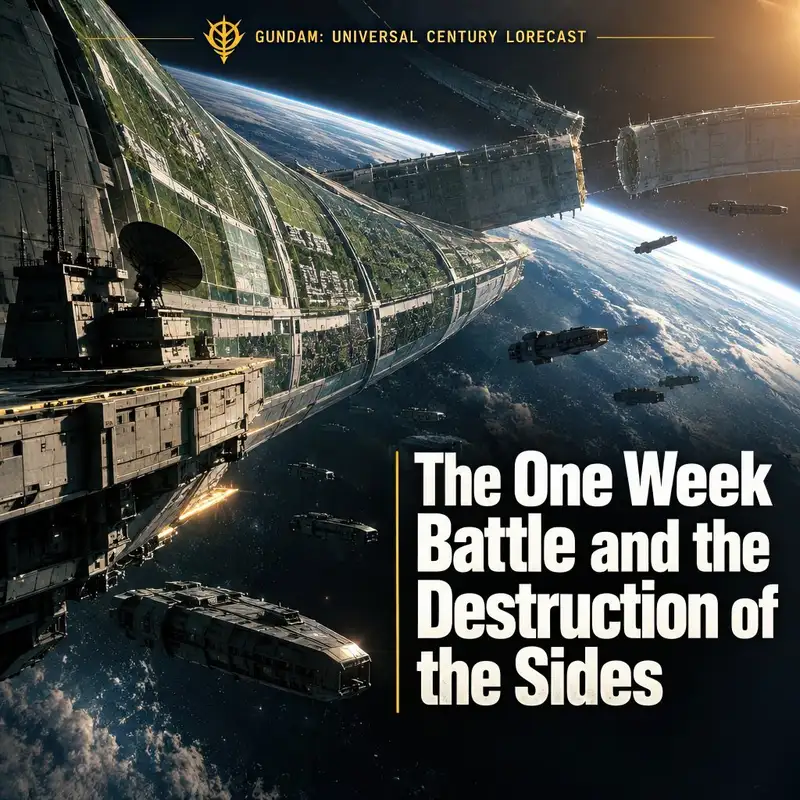
The One Week Battle and the Destruction of the Sides
A colony cylinder is built to keep people alive in a place where nature has made no such promise. It has air, water, agriculture, docks, schools, workshops, hospitals, and the slow routines of ordinary life arranged inside a rotating shell. During Operation British, Zeon turned one of those inhabited structures, Island Iffish, into a weapon aimed at Earth. Before it could be moved, it had to be controlled, emptied through mass killing, altered for propulsion, guided through space, and defended against interception. Mobile suits guarded the work. Engineers made the weapon move. Political leaders accepted the intended result.
The target was Jaburo, the Earth Federation’s subterranean headquarters in South America. A successful strike might have killed senior leadership, disrupted communications, damaged military command, and created the impression that the Federation could no longer protect Earth itself. Zeon hoped for more than destruction. It hoped for collapse. If the Federation government lost its command center and faced a planetary catastrophe at the opening of the war, perhaps it would accept Zeon’s independence on terms favorable to the Principality.
That was the theory. The reality was a colony community murdered and converted into strategic material, followed by devastation on Earth when the attack missed its intended target. The One Week Battle was not simply the first demonstration of mobile suits in combat. It was the moment when Zeon’s war for political separation became a campaign willing to destroy civilian habitats and use their remains as instruments of planetary coercion. And it raises the central problem of the opening war. How could Zeon inflict damage on such a scale, win spectacular early battles, and still fail to win the war it had just begun?
The answer begins with the imbalance Zeon faced before the first shots were fired. The Earth Federation was politically brittle and often indifferent to the grievances of its colonial population, but it remained the larger power. It possessed far greater population, territory, industry, and access to the resources of Earth and the wider Earth Sphere. Side Three had political separation, industrial capability, military preparation, and a concentrated leadership. It did not have the depth required for an easy, prolonged conventional war against the Federation.
That imbalance gave Zeon a powerful incentive to seek a short war. It needed the Federation to be shocked before the Federation could organize its larger reserves. It needed to neutralize Federation space forces, disrupt communications, threaten Earth, and demonstrate that continued resistance would cost more than any political compromise. In practical terms, Zeon needed a decisive opening campaign. A merely successful one would not be enough. It had to force the Federation into a settlement before the strategic balance turned against it.
There were real political grievances behind the conflict. The colonies existed within a Federation system that concentrated political authority on Earth and left many people in space feeling governed rather than represented. Economic dependence, unequal influence, and the social distance between Earth and the colonies were not inventions of Zeon propaganda. But Zeon Zum Deikun’s earlier arguments about Spacenoid autonomy were not the same thing as the policy of the Zabi regime. A demand for political independence does not become more legitimate when it is enforced through dictatorship, conquest, and the destruction of civilian populations.
The Principality of Zeon was not a single person or a single institution. Political leaders made strategic choices. Military commands translated those choices into operations. Fleet officers, mobile-suit pilots, engineers, and occupation personnel carried out different parts of the campaign. Ordinary Zeon civilians did not possess equal knowledge or equal responsibility for decisions made at the top. That distinction matters because it prevents a necessary moral judgment from becoming an indiscriminate one. The responsibility for mass killing belonged first to the system that ordered and organized it, then to the command structures that made it possible.
Zeon’s leaders did not enter the war expecting to conquer every part of Earth through a long campaign of occupation. They understood, at least in broad terms, that Earth was too large and the Federation too deeply rooted for that to be easy. Their answer was coercion. Destroy enough military capacity, produce enough fear, and threaten enough political centers, and perhaps the Federation’s numerical advantage would become irrelevant. It was a theory of victory built around surprise and psychological shock. That made civilian infrastructure not merely collateral to the war, but central to Zeon’s opening plan.
The technology that made this plan seem plausible was the mobile suit. It is easy to reduce that development to a simple claim that Zeon had better machines. That is true only in the narrowest sense. The Zaku was important because it changed the way forces could operate under Minovsky particle conditions. It gave Zeon a maneuverable, heavily armed system that could attack ships at close range, move through complex orbital environments, operate near colony structures, and provide local protection where large warships could not safely or effectively do everything themselves.
Minovsky particles degraded many of the Federation’s familiar advantages in long-range detection, targeting, and communications. They did not make every sensor useless or turn space into complete blindness. Optical observation, local communications, visual identification, and other methods still mattered. But the old expectation that fleets could reliably identify, track, and destroy threats from a distance was badly weakened. Commanders had less time, less certainty, and less ability to coordinate formations through secure long-range networks.
That change favored forces prepared to fight at close range. Zeon had invested in mobile suits, trained crews around their use, and developed tactics that made local initiative more valuable. Federation fleets still had immense firepower. Warships remained necessary for transport, command, bombardment, logistics, and strategic movement. But ships built around conventional assumptions were vulnerable when mobile suits could approach through confused battlespace, exploit blind arcs, and attack before a fleet had developed effective close-defense doctrine or equivalent mobile forces of its own.
The Zaku was therefore not simply a better armored vehicle placed in space. It was part of an operational system. It depended on carriers, tenders, maintenance crews, launch facilities, spare parts, propellant, ammunition, and pilots capable of functioning under intense physical and psychological strain. Its manipulator arms and mobility also gave it value beyond direct combat. A mobile suit could secure a work site, escort engineers, move equipment, inspect damaged structures, and operate around installations too vulnerable or constrained for indiscriminate ship fire. Those qualities would matter greatly during Operation British.
They did not, however, solve Zeon’s strategic problem. A mobile suit could break a patrol screen. It could threaten a warship. It could seize a tactical advantage around a colony. It could not govern Earth. It could not replace lost industrial capacity at the Federation’s scale. It could not create political legitimacy for a regime that had chosen mass killing as an instrument of policy. The One Week Battle would demonstrate both the power and the limit of Zeon’s new weapon system in brutally concentrated form.
Standard reference chronology places the opening of the war on January third, Universal Century seventy-nine. The original television series establishes the catastrophe and its consequences more clearly than it dramatizes every hour of that first week. Later official reference material provides much of the familiar day-by-day sequence. That chronology is useful, but it should not be mistaken for a complete battlefield transcript. What is clear is that Zeon launched coordinated attacks against Federation forces and colony communities in Sides One, Two, and Four, seeking to shatter resistance before the Federation could understand the scale and direction of the offensive.
The phrase destruction of the Sides can obscure what happened. It should not be understood as proof that every colony cylinder in Sides One, Two, and Four was physically erased. The attacks devastated selected colonies, population centers, installations, and industrial communities on a scale so vast that the shorthand became part of the war’s historical memory. But each colony was a distinct place with its own inhabitants, infrastructure, political circumstances, and degree of exposure. The destruction was not less terrible because it was uneven. It was terrible precisely because inhabited communities were selected as targets within a campaign of coercion.
For the Federation, the opening attack created a crisis of information as well as firepower. Garrison commanders, patrol forces, local authorities, and fleet headquarters had to determine what was happening while communications were degraded and Zeon’s intentions remained uncertain. In any surprise offensive, uncertainty multiplies danger. A commander may know that an attack is underway without knowing whether it is a raid, a diversion, an invasion, or the first stage of a larger operation. The Federation had to make decisions while Zeon had already selected the time, the targets, and the initial geometry of battle.
Zeon’s mobile-suit forces benefited from that confusion. They could strike Federation patrols and warships in conditions for which many Federation crews were not prepared. They could operate around colonies where commanders had to consider civilian risk, structural damage, and the danger of turning a defensive engagement into a catastrophe of its own. The Federation’s problems were not caused by incompetence alone. Surprise, doctrinal disruption, unfamiliar enemy systems, incomplete intelligence, and a command structure organized for a different kind of war all mattered.
The opening assault also revealed a hard fact about space colonies. They were not simply settlements beyond Earth. They were strategic infrastructure. A colony could contain population, manufacturing, food production, docking facilities, transport networks, and political institutions. Damage to one could disrupt military supply, destroy industrial output, displace civilians, and create fear across the Earth Sphere. Zeon understood that vulnerability. Instead of seeking to preserve it as territory to be governed, the Principality’s leadership treated it as leverage to be destroyed.
The use of poison gas was central to that transformation. Chemical attack against a colony population was not an unfortunate side effect of a battle fought near civilians. It was a deliberate method of mass killing. It removed inhabitants from structures Zeon wanted to control. It denied the Federation living communities and functioning infrastructure. And in the case of Operation British, it helped prepare a colony cylinder for use as a weapon. The people inside were not obstacles to be evacuated. They were victims of an operation designed around their elimination.
There is a temptation in military history to describe such acts in technical language and let the vocabulary soften the reality. Depopulation, area denial, strategic interdiction, and target preparation can all be useful terms in the right context. Here, they must not hide the human result. Families, workers, children, medical staff, local officials, and people with no role in military command were killed because their habitat had strategic value. The colony became easier to move only after its population had been destroyed. That is the moral fact at the center of Operation British.
Zeon’s leadership may have regarded this as military necessity. A short-war strategy often produces arguments that extraordinary violence is required because time is against the attacker. But necessity is not a magic word. It does not erase agency. Zeon chose to make civilian death part of its plan. It chose to treat habitats as expendable. It chose to make terror a tool of state policy. The Federation’s failures of representation and colonial governance help explain why rebellion found support. They do not explain away the decision to murder colonists on a mass scale.
The political consequences were immediate even where they could not be measured neatly. Fear spread through communities that now understood how vulnerable a colony could be. People who had seen the Federation as distant or complacent could still recognize that the destruction of civilian habitats offered no path to a secure independent future. At the same time, outrage did not automatically unite every population behind the Federation. Colonial resentment did not vanish. Trust in Federation institutions was not restored by Zeon atrocity. The first week intensified existing divisions even as it created new trauma.
The colony impact also revealed the weakness in Zeon’s theory of coercion. Terror can compel attention. It can disrupt planning. It can create panic and force an opponent to divert resources. But terror does not always produce surrender. It can harden resistance, create new demands for mobilization, and convince populations that survival requires the defeat of the attacker. Zeon had demonstrated that it could threaten Earth on an unimaginable scale. It had not demonstrated that it could convert that threat into a stable political settlement.
By the end of the first week, the campaign moved into the Battle of Loum near Side Five. Loum should be distinguished clearly from the earlier attacks on colony populations and from Operation British. It was a major fleet battle, not simply another phase of the colony drop. But it belonged to the same opening strategy. Zeon was still trying to break Federation space power, maintain momentum, and prove that the Federation could not protect either its colonies or its fleets.
At Loum, mobile suits again proved decisive at the tactical and operational level. Federation formations and warships faced an enemy whose machines were designed for the close, confused, Minovsky-affected conditions that now shaped combat. Zeon’s ability to bring mobile suits into battle, concentrate them against vulnerable targets, and exploit Federation unpreparedness inflicted severe losses. The battle helped establish the mobile suit as the defining combat system of the war’s opening phase.
That did not mean the fleet had become obsolete. Loum itself demonstrated the opposite. Mobile suits mattered because fleets, carriers, warships, and strategic routes mattered. Zeon needed ships to transport, support, launch, recover, repair, and command its mobile-suit forces. The Federation’s losses were devastating because fleets remained central to the movement and protection of military power in the Earth Sphere. The lesson was not that one kind of warfare had replaced another. It was that fleets without adequate mobile-suit doctrine had become dangerously exposed.
General Revil’s capture was among the important results of the battle. To Zeon, it seemed to confirm the success of the opening offensive. Federation space forces had been battered. A senior commander had fallen into enemy hands. Earth had suffered a catastrophe. The Federation’s military reputation was badly damaged, and its leadership faced a crisis unlike any it had anticipated. From the perspective of January tenth, Zeon had good reason to believe it had seized the initiative.
But initiative is not victory. Zeon had won tactical engagements and inflicted operational disruption. It had not destroyed the Federation’s ability to wage war. Its greatest strategic blow had missed Jaburo. Its mobile suits had demonstrated a terrifying advantage, but that advantage could be studied, countered, and eventually matched. Its attack on the colonies had destroyed populations and infrastructure, but it had not erased the Federation’s industrial depth or the broader resources available to an opponent fighting from Earth.
This distinction between levels of war is essential. Tactically, Zeon’s opening was formidable. Its mobile suits performed effectively against forces not yet prepared for them. Operationally, Zeon disrupted Federation defenses, destroyed colonies and installations, threatened Earth, and forced the Federation into emergency measures. Politically, the attack created fear and crisis. But strategically, Zeon failed to achieve the outcome its plan required. The Federation did not collapse. Jaburo survived. The war continued.
The longer the war continued, the more Zeon’s structural weaknesses mattered. The Principality had capable industry, skilled personnel, and an important technological lead. It could produce sophisticated machines and organize bold operations. But it could not easily replace every loss in ships, pilots, trained technicians, and mobile suits. It could not match the Federation’s potential to mobilize labor, factories, raw materials, and populations across a much larger strategic base. A state can win the first week of a war and still lose the contest of replacement.
Occupation was an even greater problem. Destroying a colony or defeating a fleet does not create authority over the people who remain. Earth is not a prize that can be collected after one successful strike. It is a vast planet of regions, cities, transport networks, agricultural areas, industrial centers, and populations with their own political loyalties and local conditions. Zeon could land forces and seize ground. It could not easily garrison the whole planet, maintain supply across enormous distances, suppress resistance, and administer a population far larger than its own.
The opening campaign also consumed resources. Mobile suits required support. Fleets required repair. Engineers and specialized equipment used for operations like the colony drop could not be everywhere at once. Combat losses could not simply be replaced by the next shift at a factory. Zeon’s short-war plan assumed that a decisive shock would prevent these burdens from becoming dominant. When Jaburo survived and the Federation continued fighting, the plan’s central assumption failed. Zeon had committed itself to a long war without being built for one.
The Federation, meanwhile, had to learn quickly or face destruction. It had lost ships, personnel, infrastructure, and public confidence. It had been surprised by mobile suits and by the scale of Zeon’s willingness to escalate. But the Federation retained resources that could be organized over time. It could adapt doctrine, develop its own mobile-suit programs, train new personnel, rebuild formations, and draw on industrial capacity that the opening strike had not eliminated. None of this was automatic. Bureaucracies do not become competent merely because they have been attacked. But survival gave the Federation time, and time was strategically valuable.
Zeon’s intelligence advantage was also temporary. Surprise is a wasting asset. Every battle teaches the defender something about enemy weapons, tactics, maintenance requirements, and operational limits. The Federation would not remain permanently ignorant of mobile suits. Once the enemy understood what Zeon had built, the Zaku’s initial shock value could no longer carry the same weight. A weapon system that is revolutionary on its first appearance becomes part of the ordinary military problem once opponents organize to counter it.
The One Week Battle therefore stands as a warning against confusing destructive capacity with strategic success. Zeon could destroy colony communities. It could use chemical weapons. It could move a colony toward Earth. It could batter fleets unprepared for mobile-suit warfare. None of those achievements answered the question that actually mattered. What political order would exist after the attack? How would Zeon compel, govern, and sustain it? The opening offensive had no durable answer.
There was also a cost that could not be calculated in ship losses or industrial output. By making civilian habitats disposable, Zeon altered the moral character of the war. Colonies were no longer merely homes caught between military forces. They had become targets, weapons, and symbols of vulnerability. The people of the Earth Sphere learned that the systems keeping them alive could be turned against them by political and military decisions made far away. That knowledge would shape wartime fear, postwar memory, and the continuing militarization of colonial politics.
The damage to Zeon’s legitimacy was profound, even if legitimacy is never distributed evenly in war. Some people remained committed to the cause of independence. Some may have believed Federation rule had made violence inevitable. Others had little ability to oppose a militarized state once the war began. But the gassing of colonies and the use of Island Iffish as a weapon made clear what kind of regime had taken control of the independence movement. It was not building freedom through political representation. It was asserting power through terror and extermination.
That does not vindicate the Federation’s prewar order. The Federation survived because it retained strategic depth, not because its political system had suddenly become just. Colonial inequality, concentration of power on Earth, and institutional complacency remained real problems after the first week. The Federation’s eventual survival did not heal the grievances that had made separatist politics credible. It only ensured that those grievances would continue within a society now traumatized by war and more willing to rely on military force.
The first week thus produced a grim symmetry. Zeon’s leadership tried to solve a political problem through overwhelming violence and failed to secure victory. The Federation endured the attack but did not resolve the political failures that had made the Earth Sphere unstable in the first place. One side had mistaken coercion for legitimacy. The other had mistaken survival for reform. The war that followed would be shaped by both errors.
Return, then, to Island Iffish moving toward Earth. It was not merely a weapon and not merely wreckage. It was evidence of a decision. Zeon’s leaders decided that an inhabited colony could be emptied through murder, fitted for propulsion, and directed toward a planet in the hope that catastrophe would produce political surrender. That decision required mobile suits, ships, engineers, logistics, intelligence, and command. It was technologically audacious. It was also strategically incomplete and morally indefensible.
The One Week Battle proved that mobile suits could remake the immediate conditions of warfare. They could exploit Minovsky-era uncertainty, expose weaknesses in fleet doctrine, defend complex operations, and give a smaller power a sharp initial advantage. But they could not substitute for industrial depth, occupation capacity, or political legitimacy. Zeon’s new machines helped create shock. They did not give Zeon the means to convert shock into lasting control.
Operation British failed at its decisive objective because Jaburo survived and the Federation did not surrender. Loum reinforced Zeon’s military advantage, but it did not erase the Federation’s ability to mobilize. The destruction of colony populations inflicted wounds that could not be repaired by a battlefield victory, yet it also consumed the very communities and infrastructure that any sustainable political future would have needed. Zeon gained terror, disruption, and temporary momentum. It did not gain settlement.
The destruction of the Sides was therefore not simply an opening victory for the Principality of Zeon. It was the first week’s failed theory of victory made visible. By turning colonies into graves and weapons, Zeon demonstrated the destructive reach of modern war in the Earth Sphere while leaving the underlying contest unresolved. The war would continue because the Federation had not been broken, and because no amount of military innovation could make mass killing into a durable political order.