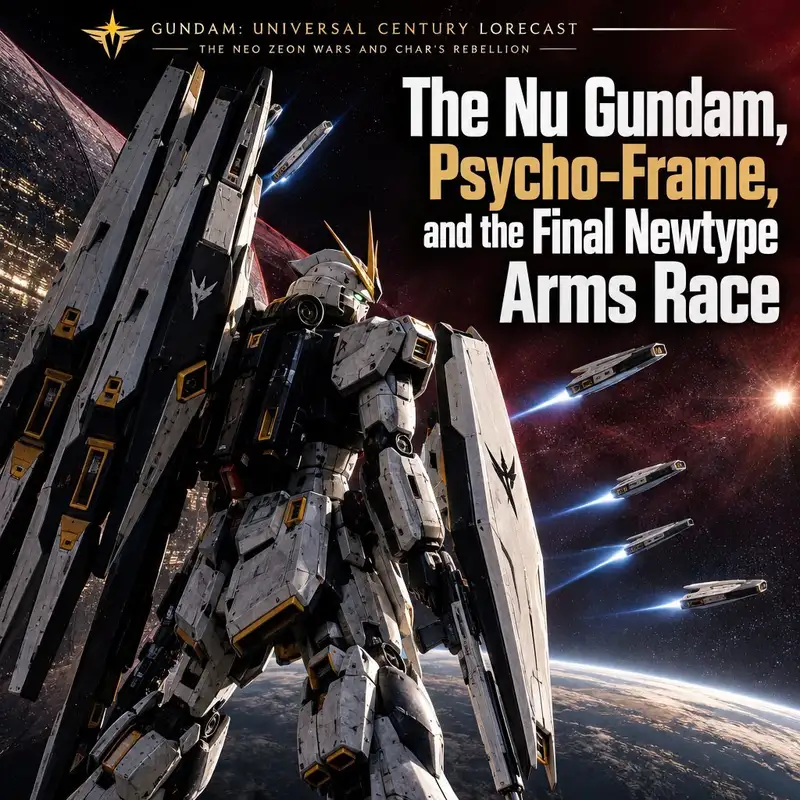
The Nu Gundam, Psycho-Frame, and the Final Newtype Arms Race
Axis was falling toward Earth, and by that point the ordinary answers had failed. Nuclear weapons had already been used against the asteroid. Fleet guns and mobile suits had fought around it. The remaining danger was not a hostile formation that could be routed or a fortress that could be stormed. It was a colossal mass on a collision course, turned into a weapon by a political movement prepared to make the planet itself pay for its refusal to change. Federation and Londo Bell personnel tried to force Axis away by direct effort, using mobile suits and ships against an object far beyond anything those machines had been designed to move.
Then the light changed. The Nu Gundam’s Psycho-Frame glowed, the damaged Sazabi was drawn into the event, and the desperate attempt to alter Axis’s course became something no staff officer, engineer, or pilot could fully account for. Later histories call it the Axis Shock. The name is useful because it describes the institutional effect as much as the visible phenomenon. A weapons technology designed to improve the responsiveness of a Newtype pilot appeared connected to an event on a planetary scale.
That does not mean the Nu Gundam was built to push asteroids. It was not. It was built to give Amuro Ray a fighting chance against Char Aznable during the most dangerous mobile-suit engagement of Universal Century ninety-three. Its purpose was immediate and practical. It had to survive in a confused battle around Axis, confront Char’s Sazabi, employ remote weapons, and still fight as a conventional mobile suit when close-range combat, damaged equipment, and split-second judgment made elegant theories less useful than a rifle, a shield, and a pilot who knew when to use both.
But the crisis around Axis was never just a duel between two exceptional men. Char’s campaign had already demonstrated its strategic purpose with the attack involving Fifth Luna. His objective was to force Earth into an environmental catastrophe severe enough to drive humanity away from the planet. He presented this as a brutal means of human transformation, a way to compel Earth’s privileged population to live under the same conditions as the people in space. In practice, it meant using orbital infrastructure, inhabited space, and planetary ecology as instruments of coercion.
The civilians beneath that trajectory were not spectators in a legend about rival aces. Earth was home to immense populations, agricultural systems, cities, coastlines, and political institutions already strained by inequality and distrust. A successful impact would not have purified anything. It would have imposed mass death, displacement, environmental collapse, and a political future shaped by terror. Char’s grievances with the Earth Federation were real enough. The Federation had preserved colonial inequality, bureaucratic complacency, and a political order that repeatedly treated people in space as subjects to be managed rather than citizens to be heard. None of that transformed an engineered planetary disaster into liberation.
This was the setting in which the Nu Gundam entered service. It was the final major product of an arms competition that had been developing since the One Year War, a competition built around a simple military problem. Minovsky particle conditions had reduced the reliability of long-range detection and communications. Fleets could no longer assume that radar, guided weapons, and centralized command would provide the same certainty they had promised before the war. Combat moved closer. Visual identification mattered. Local initiative mattered. Pilots and small-unit commanders often had to make decisions before higher headquarters could understand the situation.
Mobile suits fit that environment because they combined propulsion, weapons, sensors, and human judgment in a maneuverable platform. Newtype research promised to push that logic further. If some individuals could perceive threats, intentions, or spatial relationships with unusual speed and sensitivity, then military organizations wanted machines that could exploit those abilities. Psycommu systems offered a route toward that goal. They linked a compatible pilot more directly to sensors, weapons, and remote devices. Bits, funnels, and related systems allowed attacks from several directions at once, changing the geometry of an engagement.
The military attraction was obvious. A pilot who could control remote weapons could threaten an enemy from angles that conventional formations struggled to cover. A commander who could react faster under Minovsky interference might gain an advantage when information was scarce and communications were degraded. But the limitations were just as obvious, even when organizations preferred not to emphasize them. Newtype ability was not a standardized qualification. It could not simply be issued with a uniform and a flight manual. Psycommu equipment was demanding, specialized, and dependent on people whose capabilities varied enormously.
Earlier Newtype-use systems often reflected that problem in their size and complexity. They were associated with specialized machines, unusual weapon arrangements, and research programs that treated rare pilots as strategic resources. The technology did not produce a clean progression from one generation of mobile suit to the next. It developed through competing laboratories, military branches, corporate programs, political myths, and human experiments. Some institutions hoped Newtypes would offer a new form of communication. Others saw them as a way to restore tactical control in a battlefield where electronics had become unreliable. Still others treated gifted young people as tools to be conditioned, medicated, and expended.
That was the arms race behind the Nu Gundam. It was not a contest to build the largest machine or attach the most remote weapons to a frame. It was an effort to make exceptional human perception militarily useful inside a mobile suit that could still deploy from a carrier, use conventional armament, survive close combat, and operate within the time pressure of an actual campaign. The question was whether Newtype capability could be compressed into a practical combat system without being trapped inside a rare, fragile, or excessively specialized platform.
Psycho-Frame was the most important answer offered in Universal Century ninety-three. Official setting material describes it as a special material incorporating psycommu functions into the frame or cockpit area of a mobile suit. The key idea was miniaturization. Instead of treating the psycommu as a separate, bulky system added to a machine, Psycho-Frame distributed the interface more deeply through the structure. That reduced the distance between pilot intent, control system, and machine response.
In military terms, that offered responsiveness. A compatible pilot could potentially maneuver, aim, and control remote weapons with less delay and less separation between thought and action. The value was not that the machine became independent of physical constraints. It still needed propellant, weapons, maintenance, launch support, and a pilot who could endure the strain of combat. The value was that a Newtype’s ability to interpret a chaotic battlespace could be translated more effectively into action.
The distinction matters because Psycho-Frame is often discussed as if it were a settled science with a single known effect. The film does not support that certainty. It shows what the technology can do in combat, and it shows an extraordinary phenomenon at Axis. It does not provide a complete theory explaining every later event associated with Psycho-Frame. The material’s practical role is clear enough. Its ultimate limits are not. That uncertainty is not a minor footnote. It is the reason the technology became politically dangerous.
For Amuro, Psycho-Frame promised a machine that could keep pace with Char’s latest capabilities. For Char, it represented an advantage that he was willing to compromise. The Psycho-Frame used in the Nu Gundam originated with Neo Zeon. The film makes clear that the technology reached Amuro’s project through Char’s deliberate authorization. The exact bureaucratic path is not fully documented. We do not receive a complete chart of Neo Zeon laboratories, contractors, security clearances, and transfer orders. What matters is the decision behind the transfer.
A supreme commander preparing a decisive operation normally protects a sensitive technological advantage. Char did the opposite. He allowed his principal opponent access to a capability that could narrow the gap between the Nu Gundam and the Sazabi. On one level, this was personal. Char wanted to confront Amuro under conditions that would make the contest meaningful. He did not want victory reduced to a secret advantage that Amuro could never answer.
But the decision was more than melodrama. It was a command failure with strategic consequences. Char had fused a planetary coercion campaign with a private need for recognition from the one man he considered capable of judging him. He wanted to force humanity into a new political condition, yet he also wanted the confrontation with Amuro to validate his own position. That divided purpose shaped the use of technology, secrecy, and operational risk. A leader who subordinates a sensitive advantage to a personal contest is no longer treating his organization’s security as the first priority.
It also reveals something important about Newtype ideology in the Universal Century. Char spoke in the language of human transformation, of people moving beyond Earth and beyond old patterns of selfishness. Yet the military instrument he chose was coercion on an apocalyptic scale. He relied on a technology associated with heightened understanding while organizing a campaign that denied other people the right to choose their future. Newtype potential did not make him politically wiser. It gave him another language through which to frame decisions that remained authoritarian.
Anaheim Electronics stood at the intersection of those decisions. The company had the industrial capacity, technical access, and political connections necessary to turn advanced concepts into working machines. It could operate in the overlapping military markets of the Earth Sphere, serving different customers while protecting its own commercial interests. That made Anaheim strategically important. It did not make Anaheim an all-powerful hidden government directing every conflict from a boardroom.
The Nu Gundam demonstrates both Anaheim’s capability and its limits. The company could build an advanced Newtype-use mobile suit around Amuro’s requirements and integrate Psycho-Frame into a combat-ready system under severe time pressure. That was a remarkable concentration of industrial competence. It required engineers, production facilities, supply chains, specialized components, testing, transport, and a command structure willing to accept the risks of placing a newly completed machine directly into a crisis.
It was not a mature fleet program. Nothing about the Nu Gundam suggests that the Earth Federation could immediately equip ordinary units with Psycho-Frame machines and expect the same performance. The design depended on Amuro’s experience, his technical input, and his rare ability to use the system effectively. A company can manufacture a frame. It cannot manufacture years of combat judgment, Newtype sensitivity, and the accumulated instinct of a pilot who has fought through the One Year War and its aftermath.
That difference between production and capability is central. The Nu Gundam was a mission-specific system, built for a particular pilot, a particular opponent, and a particular emergency. It was not evidence that the Federation had solved Newtype warfare. It was evidence that, under pressure, a sophisticated industrial base could concentrate enormous resources into one machine. In war, that can matter greatly. It can also create the illusion that a singular achievement is a reproducible doctrine.
The Nu Gundam was built as a balanced combat platform. Its beam rifle, shield, bazooka, beam sabers, and head vulcans were not decorative reminders of older mobile-suit design. They gave Amuro options. A battle around Axis could shift suddenly from long-range interception to close combat, from open space to debris-filled approaches, from remote-weapon engagements to moments when a pilot had to make a conventional shot before an enemy disappeared behind cover or into a crowded formation.
Its fin funnels expanded those options. They allowed all-range attacks, giving Amuro the ability to threaten an opponent from multiple directions without placing the entire mobile suit in direct danger. They could also contribute to defensive field effects under the right conditions. But the funnels did not eliminate the need for positioning, awareness, or ammunition discipline. Remote weapons were valuable because they complicated an enemy’s decisions. They forced a pilot to defend more angles, divide attention, and question what was visible and what was approaching from outside the cockpit’s immediate view.
The Nu Gundam therefore was not a pure funnel carrier. It was a mobile suit designed for uncertainty. Its Psycho-Frame improved the relationship between pilot and machine. Its fin funnels extended the pilot’s reach. Its conventional weapons ensured that it could still fight when the situation became too close, too chaotic, or too damaged for a remote system to decide everything. That was sound operational thinking. Advanced weapons are most useful when they supplement a force’s options rather than replace every older tool on the assumption that the future will behave neatly.
The machine’s strategic reach still depended on Londo Bell. The Nu Gundam did not appear in the Axis battle as an independent knight in space. It required transport, launch facilities, maintenance crews, weapons loading, technical support, command information, and recovery capability. The Ra Cailum and Londo Bell’s other ships gave the machine its operational context. They moved people and equipment through the battlespace. They coordinated attacks. They carried the wounded, sustained crews, and absorbed risks that a single mobile suit could not manage.
Londo Bell itself operated under severe constraints. Bright Noa commanded a task force that had to respond to a crisis of immense scale without the unified political support such a crisis should have produced. The Earth Federation government, the Earth Federation Forces, and Londo Bell were not the same institution. Federation leaders hesitated, calculated, and failed to provide clear backing at moments when speed and unity mattered. Londo Bell had military responsibility without the resources or political freedom normally associated with it.
That affected every level of the campaign. Limited support meant limited available forces. It meant dependence on rapid decisions and on the ability of individual ships to launch, recover, repair, and rearm their mobile suits under pressure. It meant commanders had to work with incomplete information in a Minovsky environment where communications could not guarantee perfect control. It meant a technical asset like the Nu Gundam became more important precisely because the larger system had failed to provide enough depth.
This is where the legend of the lone ace becomes misleading. Amuro’s skill mattered. The Nu Gundam mattered. But neither replaced the fleet, the mechanics, the bridge crews, the pilots in ordinary machines, or the people who kept Londo Bell functioning when political authorities had left it dangerously exposed. A high-performance mobile suit can create opportunities. It cannot create a reserve fleet, repair damaged ships, or repair the legitimacy of a government that has spent decades ignoring the grievances from which its enemies recruit.
Char’s Sazabi represented the opposing side of the same technological competition. It was a Psycho-Frame-equipped command machine built around Char’s abilities and his position as Neo Zeon’s leader. It was not merely the Nu Gundam’s rival in a technical comparison. It was the physical expression of Char’s command role, political ambition, and personal fixation. Its performance mattered because Char had placed himself at the center of an operation whose success was supposed to reshape the Earth Sphere.
The confrontation between the Nu Gundam and the Sazabi was therefore three conflicts at once. It was an operational fight over the attempt to stop Axis. It was a struggle between Londo Bell and Neo Zeon, with both sides trying to shape events faster than the other could respond. And it was a personal confrontation that Char had helped engineer by sharing Psycho-Frame technology with Amuro. Each layer affected the others. The duel mattered because it could remove the commander directing the threat. But winning a duel could not, by itself, halt an asteroid already moving toward Earth.
That was the flaw in Char’s approach. He had built a strategy around terror, political symbolism, and military force, then allowed his own need for a final contest to shape the decisive phase. A commander can carry personal motives into war. No one enters combat as a purely rational instrument. But when private motives alter the protection of classified technology and the employment of strategic assets, they become part of the operational record. Char’s personal rivalry was not separate from his political project. It was embedded within it.
The eventual defeat of the Sazabi removed Char from the immediate battle, but Axis remained the central problem. The asteroid had not become harmless because one mobile suit had beaten another. The crisis reached its most desperate phase only after the duel, when the remaining threat could no longer be treated as an enemy force to be destroyed. The people attempting to push Axis away were confronting mass, momentum, and a shrinking margin for error.
What followed is directly shown in the film, even if its mechanism remains unresolved. Mobile suits and ships made a desperate effort to alter Axis’s course. The Nu Gundam, damaged but still present, was at the center of that effort. The Sazabi, bound up in the aftermath of the confrontation, was also drawn into the event. Psycho-Frame resonance appeared alongside a vast display of colored light. Axis moved away from Earth.
The event was real within the film’s record. The explanation is not settled. It is inaccurate to say that Amuro alone moved Axis. It is equally inaccurate to say that Psycho-Frame by itself acted as a simple engine of unlimited force. The final effort involved many people, machines, collective intent, and an extraordinary resonance occurring under conditions of extreme danger. The Nu Gundam was essential to what happened. It was not the only element present.
The Axis Shock is destabilizing precisely because it cannot be reduced to a normal weapons effect. A system designed to improve responsiveness and remote-weapon control appeared connected to an outcome far beyond ordinary mobile-suit performance. That did not make Psycho-Frame useless as military technology. It made it more dangerous. A weapon that works according to understood limits can be tested, supplied, trained for, and placed within doctrine. A weapon associated with effects that its users cannot confidently predict creates pressure for secrecy, experimentation, and escalation.
It also creates myth. The Universal Century had already spent decades turning Newtypes into symbols. Some saw them as proof of humanity’s potential for greater understanding. Others saw them as military assets, political threats, or tools of legitimacy. The Axis Shock gave every side more material for interpretation. It could be remembered as a miracle, a warning, a scientific anomaly, or evidence that human will could transcend ordinary limits. None of those interpretations automatically explained what had happened.
The civilian meaning was less ambiguous. Axis had been aimed at Earth as an instrument of mass coercion. Its diversion prevented an environmental and human disaster. That is why the event mattered. The asteroid was not an abstract piece of strategic geography. It had been transformed into a weapon against a living planet. The significance of the Axis Shock lies not in the spectacle of colored light, but in the lives that would have been lost if the plan had succeeded.
Universal Century ninety-three therefore proved several things, but not all the things later enthusiasts sometimes claim. Tactically, the Nu Gundam could meet the Sazabi under extraordinary conditions. Its combination of Psycho-Frame, fin funnels, conventional armament, and Amuro’s skill gave Londo Bell a capability it badly needed. Operationally, Axis was diverted, but only through a desperate effort that fell outside standard planning assumptions. No military organization could write a reliable doctrine around repeating that outcome.
Strategically, Char’s coercive program failed. He did not force Earth’s population into the political transformation he claimed to seek. He did not resolve the Earth Sphere’s inequality. He did not establish a just relationship between Earth and space. His operation demonstrated the consequences of those unresolved problems, but it answered them with mass death and authoritarian compulsion. The failure of his plan did not erase the grievances that had made his message attractive to some people. It only ensured that those grievances remained unresolved.
Politically, neither the Nu Gundam nor the Sazabi offered a durable answer. Amuro’s machine represented technical competence, courage, and resistance to an immediate catastrophe. It did not carry a program for reforming the Federation. Char’s machine represented a revolutionary rhetoric that had become inseparable from terror. It did not offer consent, representation, or a workable politics for the people it claimed to liberate. The machines clarified the conflict. They could not solve it.
Industrially, Psycho-Frame had been demonstrated, not standardized. Anaheim had shown that it could build a highly advanced machine. Char had shown that technology could cross enemy lines when personal motives overrode security. But there was no evidence that either side had created a stable mass-production system, a broad pilot training pipeline, or a doctrine that could make Nu Gundam-level performance routine. The technology remained tied to exceptional individuals and exceptional circumstances.
Institutionally, the Axis Shock left behind a more troubling legacy. Military organizations, corporations, and research programs now had evidence that Psycho-Frame might be connected to effects they did not understand. That is a powerful incentive. It invites further development because no institution wants a rival to possess such a capability alone. It also invites concealment because no institution wants to admit that it has created something it cannot safely explain. The arms race did not end with Axis. Its character changed.
By Universal Century ninety-six, the Psycho-Frame lineage had expanded through the Unicorn Gundam and the other machines associated with the UC Project. These were not simply enlarged versions of the Nu Gundam. The project moved toward extensive, movable Psycho-Frame structures, making the material central to the machine rather than a limited enhancement within it. The ambition had increased. The goal was no longer merely to improve a pilot’s response during combat. It was to build systems whose performance could exceed ordinary mechanical expectations when activated by compatible individuals.
That escalation carried the same old institutional temptation. Newtype capability was still treated as something that could be harnessed, directed, and converted into military leverage. Yet the more extensively Psycho-Frame was integrated into these machines, the harder it became to separate engineering from the individual human being operating the system. The machine did not simply express a specification sheet. It responded to a particular person under particular emotional, physical, and political conditions.
This is why later Psycho-Frame technology should not be treated as a straightforward ladder of progress. The Unicorn units demonstrated that the material could be incorporated more deeply and used more ambitiously. They did not demonstrate that governments had learned to manage it responsibly. If anything, the later record suggests the opposite. The technology became more powerful as institutional confidence in controlling its consequences became less credible.
By Universal Century ninety-seven, Gundam Narrative presents the consequences in stark terms. The full-Psycho-Frame Unicorn units had demonstrated powers beyond human understanding and were sealed away. The reappearance of the Phenex, missing for two years, triggered pursuit by several actors with different interests. Some wanted to recover it. Some wanted to understand it. Some wanted to control what it represented. None could treat it as a normal military asset.
Containment is often presented as prudence, and sometimes it is. In this case, it was also an admission. The institutions of the Earth Sphere had spent decades trying to weaponize Newtype potential. They had built laboratories, developed interfaces, trained specialists, coerced vulnerable people into experiments, and commissioned increasingly sophisticated machines. When the results exceeded their understanding, they did not arrive at a stable answer. They arrived at secrecy, competition, fear, and the attempt to lock away evidence.
That does not mean the technology disappeared. It means it became politically radioactive. A state may seal a machine away, but it cannot erase the knowledge that such a machine existed. A corporation may restrict access, but it cannot fully remove the incentives created by a breakthrough. Rival organizations will seek fragments, records, surviving components, and people who know too much. Containment can prevent immediate misuse. It rarely resolves the conditions that made misuse attractive in the first place.
The phrase final Newtype arms race therefore needs to be used carefully. Universal Century ninety-three was the culmination of the Amuro and Char era, the point at which the competition to integrate Newtype perception, psycommu control, remote weapons, and mobile-suit combat reached its most concentrated form. The Nu Gundam was the peak expression of that effort because it placed all of those elements inside a machine built for one extraordinary pilot and one immediate war.
But it was not the end of Psycho-Frame history. Later events show that the technology remained an inheritance, not a conclusion. The Nu Gundam proved that a compact Newtype-use machine could alter the balance of a battle. The Axis Shock proved that the institutions using Psycho-Frame did not understand every consequence of what they had built. Unicorn and Narrative showed the result: continued experimentation, greater ambition, and finally the attempt to contain capabilities that no one could safely normalize.
The Nu Gundam’s real significance is not that it was the strongest machine of its moment. It is that it revealed the limit of strength as an answer. It was an exceptional weapon system, sustained by a task force, built by concentrated industry, and operated by an exceptional pilot against an enemy whose commander had allowed personal motives to compromise strategic judgment. It helped stop a catastrophe. It could not repair the political failures that had made catastrophe imaginable.
Psycho-Frame did not give the Universal Century a stable military revolution. It exposed a widening gap between technical ambition and institutional understanding. The people of the Earth Sphere became increasingly capable of turning human perception into weapons technology, yet remained far less capable of building a political order responsible enough to live with the consequences.