The Neo Zeong and the Final Battle at Industrial 7
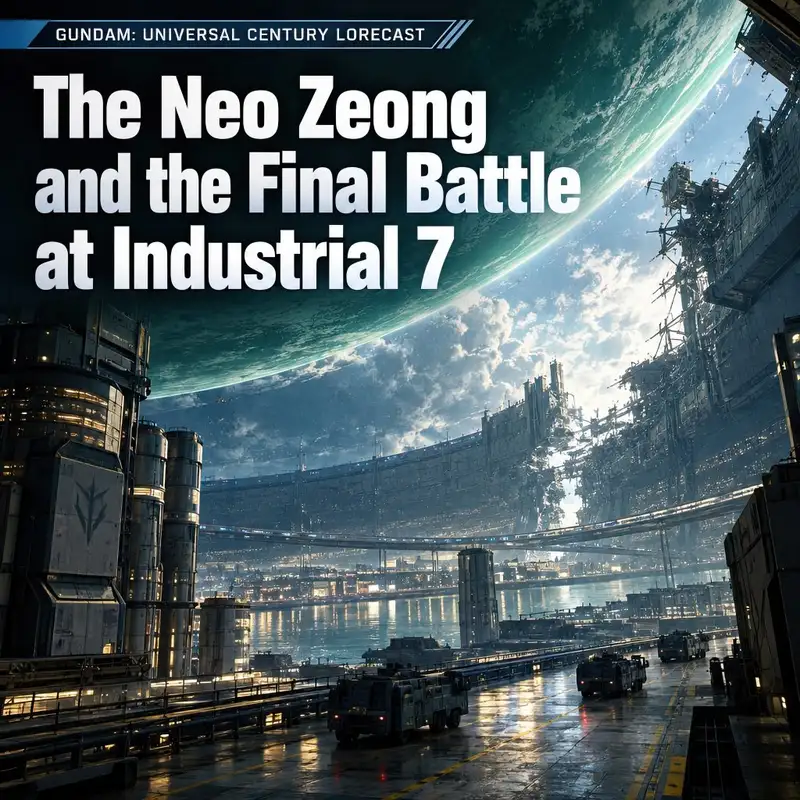
Industrial 7 was never an empty battlefield. It was a manufacturing colony, a place built around work, habitation, transport, pressure systems, docks, and the ordinary routines that allow people to live in space. By Universal Century ninety-six, it had also become the hiding place of Magallanica, the Vist Foundation facility containing Laplace’s Box. That made the colony a military objective of an unusual kind. The prize was not a fortress that could be occupied, a resource depot that could be stripped, or a warship that could be sailed away. It was political information. Whoever reached the Box first might claim the authority to interpret the buried terms of the Universal Century’s founding order.
That distinction mattered when Full Frontal brought the Neo Zeong to Industrial 7. The machine was vast, armed, and built to break through defenses, but its commander could not simply reduce the colony to wreckage. Magallanica, the archive, and the political value of the Box all depended on the survival of the place he was approaching. Every beam weapon fired near Industrial 7 carried a risk beyond the immediate target. A damaged habitat was not merely debris. It meant compromised life support, terrified residents, workers cut off from transport routes, and a civilian community trapped inside the machinery of a political confrontation it did not choose.
The final battle of Mobile Suit Gundam Unicorn is often remembered as a contest between extraordinary machines. It was that, but only in part. The Neo Zeong, the Unicorn Gundam, and the Banshee Norn fought amid a larger struggle over secrecy, colonial legitimacy, Federation authority, and the legacy of Zeon. Full Frontal intended to seize the Box and turn its revelation into a weapon against the Federation. Federation leaders wanted to contain the revelation before it could alter the existing political order. Banagher Links and Mineva Lao Zabi wanted the truth disclosed without allowing either Frontal or the Federation establishment to own its meaning. The weapons battle mattered because it would decide who could physically reach Magallanica. It did not, by itself, decide who could command the future.
For that reason, the Neo Zeong failed. It was designed to turn one commander’s political fatalism into overwhelming military power. It could dominate range, disrupt conventional weapons, and impose shock on a battlefield. But it could not turn force into legitimacy. It could not make the Sleeves into a durable state. It could not make Full Frontal’s bleak interpretation of history inevitable. And it could not solve the central problem at Industrial 7, which was never simply who possessed the stronger mobile weapon. The real question was whether information would remain the property of powerful institutions, or become public before those institutions could bury it again.
Before the Neo Zeong appeared, authority around Industrial 7 was already fractured. Martha Vist Carbine, Ronan Marcenas, and Alberto Vist represented overlapping interests rather than a single, clean chain of command. Martha sought to preserve the Vist Foundation’s influence and protect the political arrangements that had long sheltered it. Ronan, a senior Federation figure with his own stake in the existing order, faced a decision between containment and catastrophe. Alberto arrived carrying the burden of family loyalty, guilt, and the consequences of choices made before the final battle began.
Elsewhere, the Earth Federation’s formal military power did not move as one unified instrument. Bright Noa and the Ra Cailum operated under conditions in which political leaders could issue orders, manipulate information, and seek to eliminate a problem rather than resolve it. Londo Bell, E C O A S, and the crew of the Nahel Argama were connected by common danger, but they did not represent a seamless institution. Some were trying to protect Banagher. Some were trying to protect Mineva. Some were trying to prevent a massacre. Others still believed the safest outcome was to stop the Box from being revealed at all.
Frontal’s objective was more direct. He needed Magallanica, and he needed the Box before Banagher and Mineva could turn it into an independent political act. He presented himself as the inheritor of Spacenoid grievance and Zeon’s unfulfilled promise. Yet his plan depended on more than ideology. It depended on his ability to arrive first, defeat resistance, and force every other actor to react to his initiative. In military terms, he was trying to create a fact on the ground, or rather in the colony, before the political argument could unfold.
Banagher and Mineva pursued a more difficult course. They could not simply destroy the Sleeves and declare victory. The Box was too consequential, the Federation’s history too compromised, and the political meaning of disclosure too broad. Their purpose was to prevent Frontal from monopolizing the revelation while also preventing Federation hardliners from suppressing it. That is a much less tidy objective than seizing a facility. It required survival, access, communication, and an audience. It also required people within opposed institutions to decide that obedience had limits.
The Sleeves remained dangerous because they combined experienced personnel, surviving equipment, political symbolism, and a willingness to take risks that larger institutions often avoided. They had ships, mobile suits, loyalists, and specialized machines. They could maneuver through the gaps created by Federation hesitation. But they were not the Principality of Zeon at the height of the One Year War, nor were they a state with secure territory, established supply lines, and an industrial system capable of replacing major losses without strain.
Their operation at Industrial 7 depended on support ships, mobile-suit elements, communications, maintenance, and the ability to withdraw or regroup if the situation changed. Those mundane requirements did not disappear because Full Frontal possessed an exceptional machine. A mobile armor still needs ammunition, propellant, technical support, protection during preparation, and a force capable of exploiting the opening it creates. A remnant organization can conceal a unique weapon. It cannot easily create a second one when the first is lost.
Angelo Sauper and the Rozen Zulu illustrate the strength and weakness of that arrangement. Angelo was not merely another pilot in a conventional order of battle. His loyalty to Frontal was intimate, hierarchical, and absolute. In combat, that made him a determined protector. Politically, it showed the limits of Frontal’s claim to represent a population. Angelo’s commitment was to Frontal himself, not to a broad civilian institution capable of surviving disagreement, succession, or defeat.
This was the operational environment in which the Neo Zeong appeared. It was not the leading edge of a mass-production program. There is no evidence that the Sleeves could field it routinely, replace it, or sustain a fleet of comparable systems. It was an exceptional concentration of technology and combat power built around the assumption that one decisive operation could compensate for strategic weakness. That is a familiar temptation in military history. When resources are scarce and time is short, leaders often seek a weapon that can reverse the balance in a single blow. Such weapons can be formidable. They can also become monuments to the fact that there is no second plan.
The Neo Zeong was not simply an oversized mobile suit. Official material identifies it as a base-attack mobile armor, a machine built around the Sinanju as its core. Its scale alone made clear that it belonged to a different category of operation. At more than one hundred meters in height, it was not intended to fight as a line mobile suit alongside ordinary formations. It was meant to force a decision. Its mass, propulsion, weapons, and psycho-frame functions were all arranged around a single purpose: to give Full Frontal the ability to break through opposition and impose control at the decisive point.
The machine carried large beam weapons, wired large funnel bits, I-fields, and the Psycho Shard system. Each capability altered the geometry of the fight. Its beam armament gave it the ability to threaten targets beyond the range at which ordinary mobile suits could safely trade fire. Its wired weapons could attack from several directions and complicate the defenders’ attempts to concentrate on one target. Its I-fields made direct energy attacks far less effective. The Neo Zeong did not need to destroy every opposing machine immediately. It only needed to make resistance seem futile long enough for Frontal to reach Magallanica.
The Psycho Shard system represented the most unsettling part of its arsenal. In the battle, it disables or destroys the external weapons of the Unicorn and Banshee. The observed effect is clear. The precise scientific mechanism is not. The episode does not provide a field manual explaining how psycho-frame-derived phenomena can be reproduced at will, what exact conditions are required, or where their limits lie. What it does show is that Frontal possessed a system capable of turning an already uneven engagement into a crisis of survival for the defenders.
Yet the same concentration that made the machine impressive created its central weaknesses. The Neo Zeong was conspicuous, highly specialized, and dependent on one pilot. Its size made it difficult to ignore and impossible to conceal once deployed. Its complexity meant that its loss would be more consequential than the loss of an ordinary mobile suit. Its mission depended on Frontal maintaining initiative and controlling the range of combat. And its political usefulness depended on people concluding that the display of force proved he had the right to determine the future.
That final assumption was the most important. The Neo Zeong could attack a colony, dominate a corridor of space, and crush a smaller machine in a direct exchange. It could not establish consent. It could not persuade civilians that the Sleeves offered a better political order. It could not erase the difference between exposing the Federation’s compromised history and using that history to justify another system of coercion. Frontal’s machine was built to win the argument by making an alternative seem impossible. At Industrial 7, it discovered that force can create silence, but silence is not the same thing as legitimacy.
While the Neo Zeong drew attention, the wider battle continued to depend on ships, crews, reconnaissance, and fire support. The Nahel Argama did not become irrelevant because psycho-frame-equipped machines had entered the fight. Its crew still had to protect the vessel, screen against enemy mobile suits, assess threats, recover damaged personnel where possible, and decide when to commit weapons that might change the tactical situation but also create new risks around a civilian colony.
The use of the EWAC Jegans was especially important. Their role was reconnaissance. In a Minovsky environment, where long-range electronic awareness is degraded and commanders cannot assume a complete picture, finding support ships and identifying targets is often as decisive as possessing heavy weapons. The Nahel Argama’s forces located Sleeves support vessels, and the ship used its Hyper Mega Particle Cannon against them. The battle’s most memorable machines may have been the Unicorn, Banshee, Sinanju, and Neo Zeong, but the operational result still depended on whether ordinary ships could be found, targeted, and destroyed.
There is a tendency to treat the destruction of support vessels as secondary to the duel at the center of the episode. Militarily, it was not secondary. It exposed the Sleeves’ vulnerability. A conventional state might absorb such losses through reserves, nearby bases, fresh formations, and a large industrial system. The Sleeves had less margin. Every support element lost narrowed their options. Every damaged route made withdrawal more difficult. Every ordinary mobile suit tied down protecting the fleet was one less machine available to support Frontal’s advance.
The human cost of holding that line fell heavily on Marida Cruz. Her launch in the repaired Kshatriya was not a ceremonial last stand and should not be treated as one. It was a desperate operational decision. The Nahel Argama remained exposed. Banagher was still trying to reach Magallanica. Riddhe Marcenas, in the Banshee Norn, remained a threat to both Banagher and the people attempting to defend the ship. Inaction would have left the defenders with fewer options, not more.
Suberoa Zinnerman’s decision to support Marida’s sortie reflected that immediate reality. He understood her condition. He also understood the battlefield. Command decisions in such circumstances are rarely clean. There was no safe reserve waiting nearby, no guarantee that the Kshatriya could return intact, and no way to protect everyone by withholding the one capable pilot who might alter the engagement. The choice was shaped by affection and responsibility, but it was still a military choice made under pressure.
Riddhe’s role was equally important because he represented a different fracture in the defense. He began the final approach committed to stopping Banagher. His loyalty to the Federation, his inheritance as a Marcenas, his fear of what Newtype power might mean, and his personal turmoil all shaped his conduct. The Banshee Norn gave him enormous combat power, but it did not give him clarity. A powerful machine can amplify a pilot’s decision. It cannot settle the conflict inside the cockpit.
Marida’s death at Riddhe’s hands changes the battle. The episode then presents an extraordinary experience in which her presence reaches Riddhe, Banagher, Mineva, and Zinnerman. It should be described carefully. The characters experience communication that appears to transcend ordinary distance and death. The event has emotional and operational consequences. It does not provide a settled scientific explanation of consciousness, psycho-frame, or survival after death. The Universal Century repeatedly shows people encountering phenomena that its institutions attempt to weaponize before they fully understand them. Industrial 7 is one of the clearest examples.
For Riddhe, the experience breaks the certainty that had been driving him. He cannot simply return to the prior mission as though nothing has changed. The death he caused is not abstract. It is not a distant casualty report or an enemy marker removed from a tactical display. It forces him to confront the human cost of the path he has taken and the difference between carrying out an order and understanding what that order serves.
That reversal matters beyond personal remorse. Riddhe’s change weakens the effort to keep Banagher isolated and makes cooperation against Frontal possible. The Federation containment position loses one of its most powerful immediate instruments. The Banshee Norn, which had been used to block Banagher’s path, becomes part of the force that challenges the Neo Zeong. In a battle centered on extraordinary machines, the decisive shift begins with a human decision. Riddhe does not become a solution to the Federation’s political failures. He does, however, stop serving one particular logic of control.
Meanwhile, Full Frontal advanced toward Magallanica. Gael Chan attempted to delay him in the Silver Bullet, but Frontal disabled the machine and continued. The exchange demonstrated why Frontal remained so dangerous even before the Neo Zeong’s full appearance. He possessed speed, initiative, and the ability to concentrate superior force against isolated defenders. Gael’s effort bought time. It did not stop the advance.
Frontal’s position contained a deeper contradiction. He wanted the Box because he understood its political value. Yet the method he used to reach it threatened to turn the revelation into the property of another armed faction. If he captured Magallanica by force, he might possess the archive. That did not mean he could command the public meaning of what it revealed. Information can be seized. Interpretation is harder to monopolize, especially once people with different interests have access to the same truth.
Banagher’s return to the Unicorn placed him back at the center of that struggle. The Unicorn was not simply another weapon sent to defeat Frontal. It was connected to the Box’s unlocking mechanism and to the Vist Foundation’s long design. Its role was political as well as military. Banagher’s presence meant that Frontal could not turn Magallanica into a private stage for his own historical verdict without facing someone who rejected that verdict.
At that point, Frontal revealed the Neo Zeong. The purpose of the machine was unmistakable. It was intended to end the argument by force. Instead of allowing Banagher, Mineva, Federation leaders, Vist representatives, and Sleeves personnel to contend over the Box, Frontal would demonstrate that he possessed the power to dictate the terms. It was an attempt to make political uncertainty irrelevant through military superiority.
At long range, the Neo Zeong appeared to justify that confidence. The I-fields deflected Beam Magnum fire from the Unicorn and the Banshee. Against an ordinary target, those weapons carried fearsome destructive potential. Against the Neo Zeong, they could not produce a clean kill. The defenders discovered that their most powerful conventional answer had been denied.
That did not make the Neo Zeong invulnerable. The residual effects of the attacks still damaged its propellant tanks. This is a small but important point. Defensive systems are rarely absolute, even when they seem overwhelming in the moment. An I-field can alter the effect of an energy weapon. It does not erase the physical fact that a massive combat machine has exposed components, stored propellant, moving parts, and a finite ability to absorb damage. The battle did not become simple. It became more difficult.
Frontal then used the Psycho Shard system to disable or destroy the Gundams’ external weapons. The result was immediate. The Unicorn and Banshee could no longer rely on their prior gunnery advantage because they no longer possessed that advantage. Their problem was no longer how to defeat the Neo Zeong from range. Their problem was how to remain relevant in a fight where their conventional weapons had been stripped away.
This is where the Neo Zeong came closest to fulfilling its intended role. It had transformed the engagement. It had neutralized the obvious countermeasure. It had forced Banagher and Riddhe to abandon the kind of battle their machines were equipped to fight. From Frontal’s perspective, this was precisely what a decisive system should do. It did not merely defeat enemy weapons. It imposed a new set of conditions in which only he could act freely.
But such dominance had limits. The Neo Zeong’s advantage depended on range, on the survival of its systems, and on Frontal’s ability to keep the defenders at the distance where their remaining options were weakest. It was a system designed to destroy or disable opposition before opposition could adapt. Once Banagher and Riddhe refused to remain at that range, the logic of the battle began to change.
The defenders moved into grappling range because they had few alternatives. Their external weapons were gone. The Neo Zeong’s I-fields denied a straightforward beam attack. Retreat would have left Frontal free to secure Magallanica. So Banagher and Riddhe attacked the machine’s arms, exposed systems, and the relationship between the Neo Zeong and the Sinanju at its core. This was not proof that close combat is inherently superior to firepower. It was adaptation under pressure.
Close assault exposed the costs of the Neo Zeong’s scale and complexity. A large machine can carry more weapons and stronger defenses, but it also presents more surfaces, more systems, and more ways for an enemy to interfere with its operation. Its standoff defenses cannot cover every angle perfectly once opponents are inside the engagement envelope those defenses were designed to dominate. The machine had been built to overwhelm a battlefield. It was less comfortable when the battlefield collapsed into immediate physical contact.
Banagher and Riddhe also brought something Frontal had not fully controlled: cooperation. The Unicorn and Banshee were not operating as a unified team at the beginning of the confrontation. Riddhe had been an obstacle to Banagher. Marida’s death and the experience that followed changed that. Once the two machines acted together, Frontal no longer faced divided Federation opposition. He faced two psycho-frame-equipped Gundams whose pilots had chosen, however imperfectly, to work toward the same immediate objective.
That cooperation mattered tactically, but it mattered politically as well. Frontal’s strategy relied on the belief that people would remain trapped within the roles assigned by their institutions, families, resentments, and fears. Banagher would remain a dangerous idealist. Riddhe would remain an instrument of Federation containment. Mineva would remain a symbol to be used. The battle demonstrated that those roles could change. Not cleanly, not without cost, and not without loss, but they could change.
The close assault did not simply break armor. It broke Frontal’s expectation that division was permanent. His military system had been designed around concentration. Two opponents, acting in concert and refusing the range at which he was strongest, turned that concentration into a vulnerability. The Neo Zeong still possessed enormous power. But power concentrated in one machine can be outmaneuvered when the people opposing it stop behaving according to the plan that machine was built to exploit.
The physical battle then became inseparable from the episode’s extraordinary psycho-frame event. The Unicorn, Banshee, Sinanju, and Neo Zeong entered a resonance that exceeded ordinary combat technology. The episode presents effects that cannot be reduced to normal sensors, propulsion, or weapons engineering. Consciousness appears to cross boundaries. The participants encounter visions connected to Universal Century history. The battlefield no longer obeys the familiar distinction between machine, pilot, memory, and political symbol.
What it does reveal is the political meaning of Full Frontal’s project. Frontal confronts a vision of Universal Century history and an apparently empty future. His conclusion is that human beings repeat the same cycle. Colonial grievance becomes war. War produces suffering. Victory preserves institutions that create new resentment. Hope becomes another instrument of manipulation. From that perspective, the promise of change is merely a story told to those who must endure the next disaster.
Frontal’s error is not that he sees the pattern. His error is that he treats the pattern as final. He turns historical repetition into a justification for imposing his own conclusion upon everyone else. If hope is false, then force becomes honesty. If institutions cannot be reformed, then the strongest actor has the right to decide which ruins remain. The Neo Zeong is the military expression of that belief. It is built to make resistance futile because Frontal has already decided that resistance cannot produce anything better.
Banagher rejects that certainty. He does not prove that the Federation is innocent. He does not solve colonial inequality in a single battle. He does not offer a finished political program capable of repairing the Universal Century’s institutions overnight. His refusal is narrower and more important. He rejects the claim that suffering makes future change impossible. He refuses to let the evidence of past failure become a license to surrender the future to another armed authority.
The ambiguity surrounding Full Frontal’s identity is relevant here, but it should not be simplified. The animated record leaves questions involving identity, memory, conditioning, symbolism, and the legacy of Char Aznable deliberately unresolved. What matters at Industrial 7 is not a final biological label. It is that Frontal has become a vessel for accumulated disappointment. He embodies a political memory of Zeon, Char, colonial grievance, and failed rebellion. The Neo Zeong gives that memory weapons. It does not give it a future.
The defeat of the Neo Zeong did not end the crisis. In some respects, it exposed the more dangerous phase. Once Frontal’s attempt to seize the Box failed, the Federation’s containment impulse remained. Gryps Two, the colony laser, targeted Magallanica. The threat was no longer a remnant force trying to exploit buried information. It was a state-linked apparatus prepared to destroy the site rather than allow that information to escape control.
Banagher and Riddhe respond with another extraordinary psycho-frame phenomenon, protecting Industrial 7 and Magallanica from Gryps Two’s attack. Again, the event should be described as shown rather than reduced to a stable doctrine. The Unicorn and Banshee generate a defense that preserves the colony and the hidden facility. The immediate result is clear. The mechanism, limits, and reproducibility of that defense are not.
Industrial 7 survives. That survival matters first at the civilian level. The colony does not become another example of habitat infrastructure treated as expendable in the name of strategic necessity. Its residents are not reduced to an acceptable loss on a targeting calculation. The preservation of the colony does not erase the damage, fear, and violence already inflicted. It does, however, prevent the final stage of the crisis from becoming annihilation disguised as containment.
Mineva’s broadcast is therefore the actual decision at Industrial 7. The defeat of the Neo Zeong creates the opening. The defense against Gryps Two preserves the place and the people needed for disclosure. But Mineva’s act changes the political character of the conflict. By beginning the broadcast of the truth contained in the Universal Century Charter, she takes the Box out of the realm of private possession.
The Box matters because it changes the information environment. It exposes the gap between the Federation’s public legitimacy and the concealed history of its founding. That exposure does not automatically reform the Federation. Institutions skilled at secrecy, delay, and self-preservation do not collapse simply because evidence becomes public. Political elites can deny, reinterpret, suppress, or outlast damaging revelations. The broadcast is not a miracle of instant justice.
It does, however, make containment more difficult. Once the truth is heard, the problem can no longer be solved solely by capturing a facility, eliminating a witness, or classifying a record. The political argument leaves Magallanica. It enters the wider Earth Sphere. That is a strategic transformation no beam weapon can easily reverse.
Syam Vist’s death, after seeing the purpose of the Box fulfilled, closes the Vist Foundation’s long and compromised project. Magallanica separates from Industrial 7, physically distinguishing the hidden archive from the colony that had concealed it. Yet the separation should not be mistaken for a clean separation from history. The Federation remains. Colonial inequality remains. The memory of Zeon remains. The institutions that produced secrecy, rebellion, and militarized response remain capable of adapting.
At the civilian level, Industrial 7 survives a battle that could have turned a manufacturing colony into collateral damage. That survival is not a minor detail. The people living inside the colony were not symbols, nor were they merely the scenery around a confrontation between exceptional pilots. Their continued existence is part of the outcome. A political future worth defending has to include the people who must live inside it.
The Neo Zeong failed because it was built to impose an answer to a political crisis through one pilot and one exceptional weapon. It could dominate range, shatter conventional weapons, and frighten a battlefield into submission. But it could not sustain the Sleeves’ fragile military position, prevent adaptation at close range, or turn Full Frontal’s despair into legitimate authority. At Industrial 7, the decisive weapon was not the machine that could seize Laplace’s Box, but the act that made its meaning public.