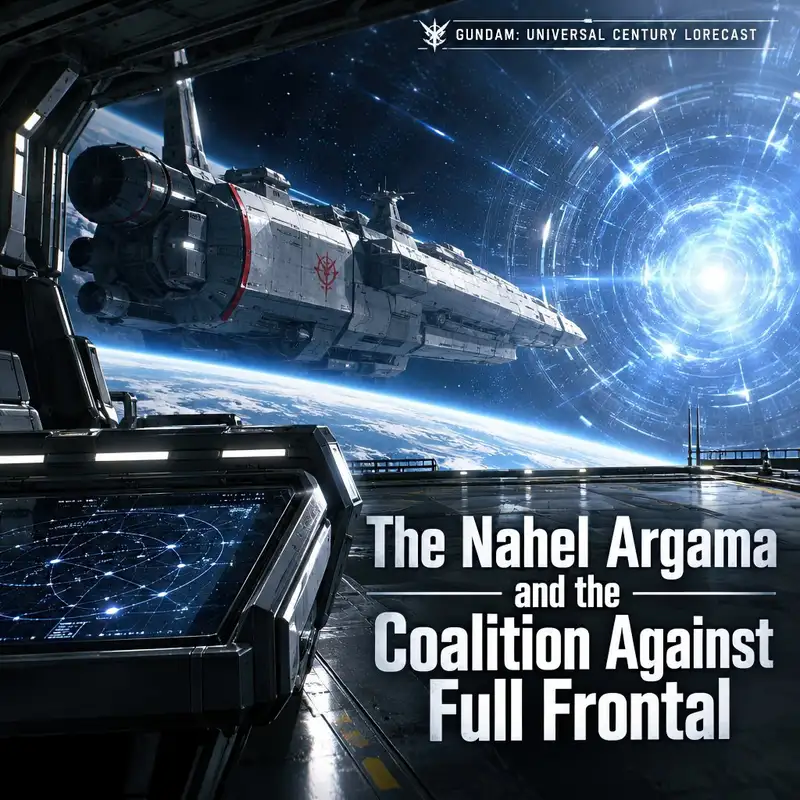
The Nahel Argama and the Coalition Against Full Frontal
The Nahel Argama leaves Palau carrying more than battle damage. In its hangars and medical spaces are the Unicorn Gundam, the disabled Kshatriya, the wounded Marida Cruz, exhausted Federation personnel, and survivors from the Sleeves. Mineva Lao Zabi is aboard. So is Banagher Links, whose connection to the Unicorn has made him valuable to every armed organization in the area. The ship is still formally a Londo Bell vessel of the Earth Federation Forces. In practice, it has become a floating political crisis with engines.
The distinction matters. A warship’s flag tells us who is supposed to command it. It does not guarantee that the ship has somewhere safe to go, a trustworthy superior headquarters, or even agreement among the people standing on its bridge. The Nahel Argama has survived the operation at Palau, but survival has made it more dangerous in another sense. It now carries evidence, people, and equipment connected to Laplace’s Box, a secret whose political value may be greater than the military value of any one mobile suit.
The ship’s material condition also shapes its choices. The Nahel Argama is an assault carrier, a command platform, and a mobile maintenance base. It can launch and recover mobile suits. It can provide medical care, weapons storage, communications, and technical labor. It can keep damaged machines alive long enough to matter again. But none of that makes it self-sufficient. Its ability to continue depends on crew coordination, hangar crews, spare parts, ammunition, fuel, food, medical supplies, and the basic fact that a carrier caught alone by a stronger force has limited options.
The Kshatriya is an especially revealing burden. It is an enemy mobile suit, heavily damaged and carrying a pilot whom some on the ship consider a threat, some a prisoner, and some a person in urgent need of care. The Nahel Argama cannot simply ignore Marida or discard the machine. Her condition affects Zinnerman and the Garencieres crew. The Kshatriya affects the ship’s military balance. Both become part of the larger argument over whether anyone aboard can still be treated as merely an asset.
The Unicorn creates an even larger problem. It is not just a powerful prototype. It is connected to the search for Laplace’s Box, and that makes it an instrument of political access. Whoever controls the Unicorn may be able to shape the next stage of the crisis. Whoever loses it may lose more than a machine. The Federation knows that. The Sleeves know that. Mineva knows that the Box could challenge the political history on which the Federation’s authority rests. Banagher knows enough to understand that everyone is asking him to carry a burden he did not choose.
Under ordinary conditions, a Federation ship in distress would expect relief from a Federation force. The approach of the General Revil should therefore be reassuring. It is not. The Nahel Argama’s officers can see a superior Federation vessel closing in, but they cannot assume that its mission is rescue. The ship has become entangled with classified programs, an unauthorized search for the Box, and a politically explosive figure connected to Zeon’s history. From the perspective of a command concerned with control, the Nahel Argama is not simply a friendly vessel that needs help. It is an uncontrolled container for dangerous information.
Captain Otto Midas is caught inside that uncertainty. He is not a rebel commander who has abandoned the Federation. He remains responsible for a Federation warship, its crew, its passengers, and its weapons. Yet he must make decisions without knowing whether his own side intends to protect the ship, seize its cargo, silence witnesses, or all three in some combination. This is not the sort of command dilemma solved by a clean declaration of loyalty. Loyalty to an institution becomes difficult when the institution’s immediate demands may conflict with the lives and judgment of the people under one’s command.
The Nahel Argama’s escape becomes possible only because its recent enemies are trapped in the same crisis. The Garencieres, Zinnerman’s Sleeves vessel, has its own reasons to flee the approaching Federation force. It cannot remain beside the Nahel Argama indefinitely, and it cannot expect the Federation to distinguish between the central command of Full Frontal’s Sleeves and every person who happened to serve aboard it. The Garencieres takes on the role of decoy, drawing danger away from the larger ship long enough for its people to transfer.
The destruction of the Garencieres is not a triumphant sacrifice in the usual military sense. It is an admission of material weakness. A ship is not merely a hull and a weapons platform. It is quarters, stores, workshops, records, personal effects, familiar routines, and the place where a crew has learned how to survive together. When its crew abandons it, they do not smoothly become part of the Nahel Argama. They become displaced armed personnel aboard a ship that has every reason to fear them.
Suberoa Zinnerman’s position helps explain the limits of Sleeves unity. He has served a cause, commanded armed men, and participated in operations under the broader banner of the Sleeves. But his immediate priority is Marida. Her survival is not an abstract political question to him. It is personal, protective, and urgent. That does not make him politically innocent, and it does not erase the violence of the conflict around him. It does mean that he cannot be treated as a simple extension of Full Frontal’s strategic program.
The same is true of the Garencieres crew. They are armed and dangerous, but they are not interchangeable pieces on a map. They have lost their ship. They are dependent on a Federation vessel whose people may despise them. They know that a change in control over one hatch, one weapon locker, or one bridge access point could decide whether they are prisoners, partners, or corpses. Coalition warfare is often described in the language of grand strategy. At the deck-plate level, it is frequently about where people sleep, who has access to weapons, and whether anyone believes the other side will honor an agreement after the immediate danger passes.
Full Frontal changes the immediate military balance. His intervention, together with Angelo Sauper’s support, prevents the Federation pursuit from ending the crisis at once. The details matter less than the operational effect. The approaching Federation force is forced back. The Nahel Argama gains room to maneuver. Its crew and passengers are not immediately captured or destroyed. In a narrow sense, Frontal has helped save them.
But protection can create dependence. Frontal does not intervene as a neutral rescuer, and the Nahel Argama does not receive help without cost. He has demonstrated that his force can shape the ship’s survival. He has also placed the Federation crew in the uncomfortable position of owing their continued existence to a commander they have been trained to regard as the enemy. That is a useful form of power. It does not require formal occupation if the protected party understands that refusing the protector may bring back the danger that was just removed.
Frontal’s military strength is therefore only one part of his leverage. He also has the political advantage of appearing to offer clarity at a moment when the Federation’s command structure appears evasive. The Nahel Argama has evidence that the Federation fears exposure. It has a captain who cannot trust the intentions of the larger force pursuing him. It has civilians and irregular personnel aboard. It has a unique mobile suit whose value has attracted every major actor in the area. Frontal can present himself as the man who understands what all of this means.
For Mineva, the Box concerns legitimacy. She is not merely a passenger with a famous name. Her position is inseparable from the history of Zeon, from the crimes committed in the name of Spacenoid liberation, and from the political uses other people make of her identity. She understands that a revelation about the founding of the Universal Century could be used to challenge Federation authority. She also understands that a truth revealed under the control of a new coercive power could become another instrument of domination.
Banagher’s connection to the Unicorn places him at the center of this contest, but he is not its commander. He does not control the Nahel Argama’s course, command its crew, or negotiate on behalf of the Federation. His importance is different. He represents an inconvenient variable in every attempt to turn the crisis into a simple inheritance of old loyalties. He is a Federation-linked civilian who has fought beside people from Zeon. He has seen Marida as a person rather than a target. He has encountered Mineva not as an emblem of a defeated dynasty but as someone trying to choose a political future.
When Mineva reveals the next direction in the search, she connects it to Industrial Seven and Magallanica. That disclosure matters because it shifts the mission from escape to purpose. The Nahel Argama is no longer merely trying to survive the pursuit. It now has a destination tied to the truth Frontal seeks, the truth the Federation fears, and the truth Mineva believes must not be buried. The ship’s route becomes political geography. Every decision about fuel, pursuit, weapons, and command is now connected to whether it can reach that next stage intact.
Frontal responds with a vision that is larger than a raid or a mobile-suit battle. His proposed Side Co-Prosperity Sphere is an economic and political strategy. Its basic logic is that the colonies and space-based populations possess collective leverage over Earth. If space withdraws from the Federation’s political and economic system, Earth can be isolated and pressured. The plan is not simply to defeat the Federation fleet by fleet. It seeks to change the balance of power by changing the economic relationship between Earth and space.
There is a reason such an argument can appeal to people in Universal Century ninety-six. The Earth Federation has endured, but endurance is not the same as reform. Its political structure has repeatedly failed to resolve the grievances of people living in space. Colonial dependence, unequal representation, and the concentration of power on Earth remain part of the setting’s political reality. The Federation defeated the Principality of Zeon, survived the Titans, endured Neo Zeon wars, and still has not created a system widely trusted by the people expected to live under it.
Frontal’s proposal draws strength from that failure. He does not need to prove that the Federation is flawless because no one aboard the Nahel Argama believes that. He needs only to argue that reform is exhausted, that the old order cannot correct itself, and that the colonies must create a new bloc capable of imposing consequences on Earth. His language turns economic dependence into strategic leverage. It treats trade, access, labor, and political coordination as weapons in a conflict that no longer needs to begin with a fleet engagement.
That is not an irrational observation. Space is not a decorative frontier. It is a network of colonies, industrial centers, transport routes, dockyards, and populations whose relationship to Earth has always been political as well as economic. A coordinated space-based movement could create serious pressure on the Federation. But the word coordinated carries the entire burden of the plan. Coordination requires leadership. Leadership requires consent, coercion, or both. A bloc that claims to speak for space must decide who gets to define its interests, who bears the costs of withdrawal, and what happens to those who refuse.
Frontal’s strategy therefore contains an enforcement problem. If all colonies freely embraced the project, it would still impose hardship. Economic separation is not bloodless merely because it is described in the language of commerce. It affects food, transport, employment, access to medicine, industrial supply, and the lives of people who did not write the political program. If some colonies resisted, then the supposed unity of space would have to be created by pressure. The plan could become another system in which ordinary people are told that sacrifice is necessary because history has already chosen their side.
This is where Frontal’s emotional distance becomes politically important. He presents a future in which the old conflict has become inevitable, almost mechanical. Earth and space have failed to reconcile. The Federation cannot change. The colonies must therefore form a counterweight strong enough to force a new order. Such certainty can be attractive in a crisis. It relieves people of the burden of imagining alternatives. If the future is already determined, then coercion becomes practical administration and human cost becomes an unfortunate but predictable line item.
Mineva rejects that logic because she recognizes the historical trap inside it. She does not defend the Federation’s conduct. She does not ask anyone to forget what Earth-centered power has done to the colonies. Her objection is more fundamental. A political structure built on coercive separation would reproduce the same relationship of domination under a different flag. It would not abolish the cycle of Earth and space treating each other as populations to be disciplined. It would merely reverse who held the stronger hand for a time.
Mineva’s position is not the same as Zeon Zum Deikun’s philosophy, Zabi dictatorship, or Frontal’s use of Zeon symbolism. Those histories overlap, but they are not identical. Deikun’s ideas about the future of humanity and the political dignity of space colonists were later captured by the Zabi family’s authoritarian state. The Principality’s rhetoric of liberation coexisted with conquest, repression, colony gassing, and mass killing. Frontal inherits the language of Spacenoid grievance, but he turns it toward a new program of managed pressure and political inevitability.
Mineva refuses to let the name Zeon settle the argument for her. That matters because her identity gives her every reason to understand how dangerous inherited symbols can be. Others see her as a Zabi heir, a possible sovereign, a propaganda asset, or a key to reviving an old legitimacy. She insists instead on the harder proposition that historical suffering does not authorize a new system of compulsion. The Federation’s failures are real. The answer cannot be to build a structure that depends on making someone else powerless.
Banagher responds to Frontal in a similarly personal but less formal way. He is disturbed not only by the content of Frontal’s proposal, but by the assumption behind it. Frontal treats people as though they are trapped inside roles assigned by history. Earthnoid and Spacenoid. Federation and Zeon. Victim and oppressor. He offers movement only through a system that will assign new roles and demand obedience to them. Banagher’s resistance is not a complete political program. It is a refusal to accept that people cannot choose differently from the categories inherited by war.
That refusal has practical value aboard the Nahel Argama. The ship is full of people who have been assigned identities by someone else. Federation sailors are expected to obey command. Sleeves personnel are expected to follow Frontal. Marida has been treated as a military instrument. Mineva has been treated as a political symbol. Banagher has been treated as the Unicorn’s pilot before he is treated as a person. The possibility of cooperation begins when some of them refuse to let those assignments decide every action.
The limits of that cooperation become clear when a Federation patrol ship approaches in response to distress from within the Nahel Argama. The signal is an important reminder that the ship’s internal crisis is not invisible. People aboard resist Sleeves control. Others fear what will happen if the ship disappears under enemy influence. The approaching patrol vessel may not know the full significance of the Unicorn, Laplace’s Box, or Full Frontal’s political designs. Its crew may simply be responding to a call for help from fellow Federation personnel.
Angelo Sauper’s answer is direct. The patrol ship must be destroyed. From his perspective, it is an obstacle. It could expose the Nahel Argama’s position, interfere with the forced arrangement aboard, or bring the Federation back into the crisis before Frontal has obtained what he wants. Militarily, the logic is familiar. Remove the threat before it can act. Politically, it reveals the cost behind the rhetoric of a new order. People who have not been briefed on the grand strategy become expendable because they are inconvenient to it.
Otto’s refusal to treat the patrol ship as a legitimate target is therefore more than hesitation. It is a command decision. He understands that firing on another Federation vessel would cross a line that cannot be explained away as temporary cooperation. The Nahel Argama would cease to be merely a compromised Federation ship under pressure. It would become an active participant in an attack on its own side. That might secure short-term survival, but it would also give Frontal and Angelo greater control over the ship’s future.
Otto’s choice does not rest on naïve faith that the Federation patrol ship will solve everything. He has already learned that Federation authority is not automatically trustworthy. His concern is that once the Nahel Argama accepts Angelo’s order, it loses the remaining space in which its crew can exercise independent judgment. A captain’s responsibility is not fulfilled by keeping the hull intact at any cost. It includes deciding which costs destroy the mission’s moral and political purpose.
The patrol-ship crisis also exposes the vulnerability of every person caught beneath the level of grand strategy. A crewman on a patrol vessel may not know why the Nahel Argama is being pursued. A sailor aboard the carrier may not know what Laplace’s Box contains. A technician may understand only that armed Sleeves personnel now control part of the ship. Yet each can be killed because commanders and political actors have classified them as obstacles, witnesses, or risks. Secrecy does not remain abstract when it reaches a ship’s weapons controls.
At this point, the struggle aboard the Nahel Argama becomes a security operation. It is not a conventional battle between fleets, and it cannot be understood as one. The decisive terrain is internal: access points, compartments, communications, weapons storage, control rooms, corridors, and the bridge. A warship under divided control is a series of enclosed spaces connected by doors. Whoever controls those doors can separate leaders from subordinates, isolate armed groups, block reinforcements, and turn a nominally friendly passageway into a fatal choke point.
Formal rank matters, but it is not enough. Otto remains captain. The Sleeves have armed personnel aboard. The Federation crew knows the ship’s systems. The Garencieres survivors have their own loyalties and fears. The special operations personnel of E C O A S bring training suited to precisely this kind of confused and compartmentalized environment. Their original mission had centered on recovering Banagher and the Unicorn. By this stage, the more immediate requirement is restoring enough control over the ship that its captain can make decisions without an enemy officer standing over him.
Daguza Mackle is no longer alive to lead that effort. His earlier death is part of the burden carried by the remaining E C O A S personnel. Conroy Haagensen becomes the crucial operational figure among them, but this is not a story of one man winning a ship by personal skill. The counteroperation depends on people using local knowledge, surprise, timing, and the fact that Sleeves control is never complete. Frontal’s forces can impose pressure, but they cannot instantly transform a mixed crew into a disciplined, unified command.
The presence of hostages and contested loyalties makes brute force a poor solution. A shipboard firefight can damage life support, power systems, communications, or access routes needed by everyone aboard. It can also kill people whom one side hopes to rescue or convince later. This is why compartment control matters more than spectacle. The goal is not to destroy the Nahel Argama. The goal is to deny the Sleeves the ability to use the ship as a captive platform and to recover the freedom to decide its course.
The operation succeeds because Frontal’s coalition is built on coercion, not trust. Angelo can issue orders, but he cannot make Otto’s crew believe in them. He can threaten the patrol ship, but he cannot erase the distinction between a tactical necessity and a political crime. He can hold parts of the Nahel Argama, but he cannot convert Zinnerman’s concern for Marida into unquestioning loyalty to Full Frontal’s agenda. The more control depends on immediate pressure, the more vulnerable it becomes when that pressure is challenged at several points at once.
Angelo’s withdrawal with the remaining Sleeves forces is therefore a limited defeat, not the collapse of Full Frontal’s political project. The Nahel Argama has broken the immediate hold on its internal command. It has retained Banagher and the Unicorn. It has avoided being compelled into the destruction of the patrol ship. These are meaningful achievements. They allow the vessel to proceed. They preserve a path toward Industrial Seven and Magallanica. But they do not eliminate Frontal, resolve the Federation’s secrecy, or create a durable political settlement among the people who remain aboard.
The Nahel Argama’s response to this danger is not retreat into purity. It is preparation. Takuya Irei helps assemble a heavily armed configuration for the Unicorn using weapons and equipment available aboard the ship. This is the Full Armor configuration, but its significance is often misunderstood if it is treated as a standard production model or a clean display of military doctrine. It is neither. It is an improvised response to a ship that expects to face superior pressure and cannot assume that it will receive orderly resupply.
A carrier’s stores can create options that an isolated mobile suit does not possess. The Nahel Argama carries weapons, equipment, technicians, and the physical space to fit the Unicorn for a more heavily armed role. That is a practical advantage of having a mobile workshop and support ship. It also reflects the unusual nature of the vessel. The Nahel Argama has inherited equipment, personnel, and institutional experience from several earlier eras of Federation and anti-Federation conflict. Its mixed inventory is not evidence that every Londo Bell ship could produce the same result.
The Full Armor configuration has costs as well as advantages. More weapons can increase striking power, but they add complexity, weight, maintenance demands, and ammunition requirements. They also make the Unicorn more dependent on the very ship that is trying to escape pursuit. This is not a procurement success story in which a superior design smoothly enters service. It is field adaptation under pressure. The crew is using what it has because it cannot wait for a better-organized military system to provide a safer answer.
That improvisation mirrors the larger political condition aboard the Nahel Argama. The ship is assembling a workable defense from incompatible parts. Federation sailors, E C O A S personnel, former Sleeves crew, civilians, wounded combatants, and a unique mobile suit all remain aboard for different reasons. There is no doctrine manual for this. There is no clean chain of command that resolves every loyalty. What exists is a series of decisions by people who understand that waiting for institutions to become trustworthy may mean allowing those institutions to bury the truth first.
Otto’s final position deserves careful attention. He does not simply reject orders because he dislikes them. He does not proclaim himself independent of the Federation in a romantic gesture. He recognizes that the ship has reached a point where obedience without judgment would make it an instrument of concealment. If the truth about Laplace’s Box is suppressed by fear, force, or bureaucratic convenience, then future generations will inherit another manufactured history. They will be asked to trust institutions that have once again protected themselves by withholding the conditions of legitimate judgment.
The General Revil remains a pressure point in this decision. The Federation has not vanished from the story just because the Nahel Argama has regained internal control. The larger vessel represents the continuing power of a command structure that sees the Unicorn and the Box as matters to be contained. Its presence ensures that the Nahel Argama cannot mistake temporary freedom of movement for safety. A damaged carrier with an improvised coalition and a politically dangerous mission remains vulnerable to a better-equipped force acting under official authority.
Then Riddhe Marcenas launches in the Banshee. The significance of that launch is not merely that another Gundam-type mobile suit has entered the field. Riddhe is a Federation pilot, connected to the political world from which the Nahel Argama is increasingly estranged. His deployment shows that Federation pressure can take personal as well as institutional form. The ship has escaped one immediate form of control, only to face another before it can complete its course toward Industrial Seven.
The Nahel Argama has not won a final victory. It has gained time, retained the Unicorn, and refused to become entirely subordinate to Full Frontal’s coercive arrangement. It has also exposed the weakness of every claim to unquestioned authority around it. Frontal can protect the ship, but he cannot make protection legitimate when it depends on threats. Angelo can seize control, but he cannot build loyalty through fear. The Federation can send superior force, but it cannot demand trust while treating its own people as containers for dangerous secrets.
The coalition against Full Frontal becomes possible because individuals and small groups refuse the immediate logic imposed on them. Zinnerman refuses to reduce Marida to a weapon. Mineva refuses to let Spacenoid grievance become a license for another hierarchy. Banagher refuses to accept that inherited categories make cooperation impossible. Otto refuses to fire on fellow Federation personnel merely because doing so would simplify the tactical picture. Conroy and the remaining E C O A S personnel act to restore control without pretending that formal authority alone will solve the crisis.
None of that creates a stable alliance. The people aboard do not share a government, a history, a command structure, or even a common political destination. They cooperate because they recognize that Full Frontal’s plan would make each of them either a tool or a casualty. That is enough to defeat coercion aboard one ship. It is not enough to resolve the conflict between Earth and space. Shared emergency can produce courage and temporary solidarity. It cannot, by itself, produce legitimacy.
The Nahel Argama proceeds toward Industrial Seven as an improvised political space rather than a liberated vessel. Its crew has not escaped history. It carries the consequences of the One Year War, Char’s rebellion, Federation secrecy, Zeon memory, and the continuing failure to build a just relationship between Earth and the colonies. But for the moment, the ship belongs to people who have chosen responsibility over the orders designed to use them, and that choice keeps open the possibility that truth may become the beginning of a different future.