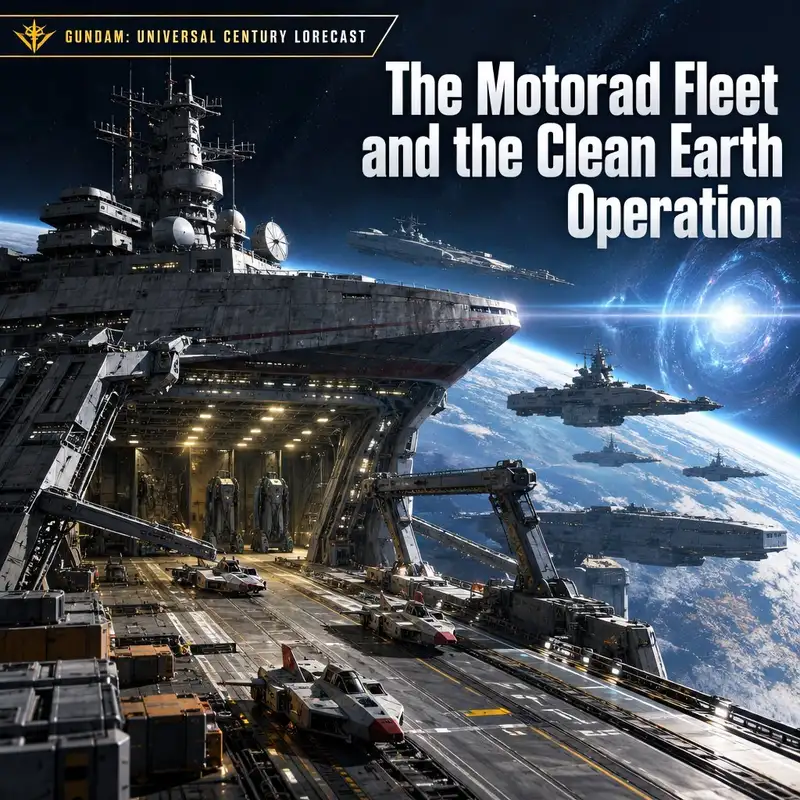
The Motorad Fleet and the Clean Earth Operation
The Motorad Fleet came out of the sea and began rolling across Earth. Its ships did not merely land troops, bombard a coast, or seize a port. Their enormous armored wheels carried them forward over inhabited ground, crushing towns, roads, and the people caught beneath them. In Universal Century one hundred fifty-three, the Zanscare Empire called this the Clean Earth Operation. The name was not a description of sanitation, reconstruction, or even territorial administration. It was the language of purification applied to military violence.
At first glance, a fleet of land battleships built around colossal tires can seem almost absurd. That reaction is understandable, but it misses the point. The Motorad Fleet was not an engineering joke. It was a coherent, if brutal, answer to a particular military and political problem. Zanscare needed a force that could descend from space, survive atmospheric combat, move across difficult terrain, carry mobile suits and heavy weapons, and terrorize civilian populations without pausing to establish ordinary lines of occupation. Its wheels were armor, propulsion, platforms for maneuver, and weapons of mass destruction at the most intimate possible scale. They turned the road itself into an instrument of war.
That is what made the operation so disturbing. The Motorad Fleet was not searching for a decisive engagement with an enemy army. It treated Earth’s inhabited surface as something to be physically cleared away before the arrival of Zanscare’s Queen Maria. The League Militaire could damage the fleet, ambush it, infiltrate it, and delay it. But it could not simply destroy it. The reasons lay in the fleet’s design, the weakness of the resistance, the presence of hostages, and the fact that fighting around civilian populations imposed limits that Zanscare was willing to exploit.
Zanscare’s political language gave the operation its declared purpose. Earth was to be cleansed before Queen Maria’s arrival. The word cleansed did important work for the regime. It transformed destruction into ritual. It presented the removal of communities and infrastructure as preparation for a more orderly world. Such language is common in authoritarian systems. It takes people who are inconvenient, disobedient, politically suspect, or simply in the wrong place, and turns them into a stain on the landscape.
The conceptual father of this force was Duker Iq, an officer whose enthusiasm for tire-based military systems was unusually personal even by Zanscare standards. But the significance of Duker’s idea was not that he liked motorcycles. The important question was what the concept offered to a military operating across the difficult boundary between space warfare and war on Earth. The answer was mobility protected by mass.
The smallest and most flexible expression of that idea was the Einrad. This was a tire-shaped support system used with mobile suits. It gave a machine additional protection, provided a platform for movement, and worked with beam shields to cover vulnerable sectors. In the right circumstances, it also gave the mobile suit a physical striking mass that ordinary legged movement could not match. A mobile suit mounted on an Einrad could move as part of a rolling formation, use the wheel as cover, and make itself harder to engage from predictable angles.
That did not make the Einrad a miracle weapon. It created a large profile. It required coordination. It could become awkward in close combat, and an opponent able to seize or exploit the structure could turn its bulk into a liability. It also depended on escorts, terrain, maintenance, and formations that could protect one another. But it solved a real problem. On a battlefield where mobile suits were vulnerable while moving through open terrain, the Einrad offered speed, shielding, and mass in one package.
At the fleet level, the concept reached its most imposing form in the Adrastea-class land battleship and the smaller Lysithea-class assault cruisers. The Adrastea was a massive vessel, roughly four hundred twenty-six meters long according to the available profile, with four huge wheels and a heavy array of beam weapons. The Lysithea-class ships were smaller and more maneuverable, but they were not mere escorts. Together, these vessels formed a mobile assault system capable of carrying firepower and mobile suits through several operational environments.
They could function in space, pass through the atmosphere, move through the sea, and then emerge onto land. That flexibility complicated every defensive plan. A conventional ground force normally has to worry about roads, bridges, fuel routes, and terrain corridors. A fleet arriving from orbit has to worry about descent, recovery, and supply. The Motorad Fleet combined those problems into one formation. It could shift the axis of attack faster than a local defender could build a stable line.
The wheels also had a defensive purpose. The exposed lower hull of a land battleship could be vulnerable when the wheels were deployed, but the wheel structures themselves were heavily protected. They were not decorative. They were part of the ship’s survival system. An attacker could not assume that firing at the most obvious moving component would immobilize the vessel. To halt a Motorad ship required a better understanding of its vulnerable points, a chance to exploit them, and enough firepower to act before the rest of the formation intervened.
That was the fleet’s strength, and also its cost. A machine that crossed space, atmosphere, ocean, and land did not do so without maintenance. The Motorad Fleet required technicians, support vessels, replacement parts, safe periods for repair, crews able to operate complex systems, and mobile suits to protect it. Its power came from retaining momentum under pressure. It did not come from independence from logistics.
The League Militaire understood this. Before the Clean Earth Operation fully began, it tried to stop the flagship Adrastea while the fleet was still preparing to move toward Earth. Oliver Inoue attempted one of the most direct responses imaginable. He rammed the Adrastea with the V2 Core Fighter. It was an act of courage and desperation, but it also demonstrated the limits of individual action against a capital vessel designed to absorb punishment and continue moving.
The attempt damaged the Adrastea, but it did not stop the fleet. The ship withdrew into the support vessel Merrilyn for repairs. That moment matters because it revealed the Motorad Fleet’s vulnerability. The Adrastea could be hurt. Its advance could be interrupted. It needed a repair facility and time under protection. In another war, or against a stronger conventional fleet, that might have created an opportunity for sustained interdiction.
The League Militaire did exactly what a competent force should do. It looked for the repair window and attacked. The problem was that the repair window was obvious to both sides. BESPA commander Arbeo Pippiniden anticipated the strike. Rather than allowing the damaged flagship to become a stationary target, he prepared a defense and deployed the Doggora mobile armor as an operational countermeasure.
The Doggora’s importance in this encounter was not a question of whether it was individually superior to every League Militaire machine. Its role was to complicate the attack. A mobile armor deployed at the right moment could disrupt approach routes, force attackers to divide attention, and make a carefully planned ambush into a confused close-range engagement. The League Militaire had useful intelligence. It knew the Adrastea needed repairs. What it lacked was the ability to guarantee that the enemy would be unprepared to defend that weakness.
Pippiniden’s response also revealed something important about Zanscare command. Cronicle Asher was the commander associated with the Motorad Fleet and the Adrastea. He held formal authority. But formal command does not mean that every subordinate acts as a passive extension of the commander’s will. Pippiniden had his own influence, his own tactical judgment, and his own willingness to use whatever methods he considered useful. The fleet was a Zanscare instrument, but it was not a perfectly unified one.
For the League Militaire, the failed ambush was not meaningless. It imposed pressure, caused damage, and demonstrated that the fleet could not operate without risk. Yet it did not immobilize the Motorad force. The resistance had achieved obstruction, not destruction. That distinction would define the rest of the campaign.
Once the fleet moved toward Earth, the operational problem became even more difficult. The battle did not remain in one domain. It moved from space into the atmosphere, then through the sea, and finally onto land. Uso Evin’s V2 Gundam and Katejina Loos’s Gedlav were drawn into atmospheric descent during the fighting. In such conditions, aircraft-like assumptions are not enough. Descent, control, relative movement, recovery, and survival all become part of the battle before either side even reaches the ground.
The Motorad Fleet’s ability to move through several environments mattered because it denied the League Militaire a predictable defensive axis. A force expecting a landing might prepare coastal defenses. A force expecting an orbital approach might position ships and mobile suits for space interception. A force expecting a ground assault might organize around terrain chokepoints and roads. The Motorad Fleet could cross these categories. It could arrive from above, disappear into the ocean, and emerge where a conventional defense was least ready.
The underwater city of Underhook showed that this was not merely a military problem. Underhook was a civilian and political space. It was a place where ordinary people lived beneath the pressure of war, where local loyalties mattered, and where Zanscare’s influence could operate through networks rather than through direct military occupation alone. Shakti Karin’s capture there was not simply the misfortune of an individual caught near a battlefield. It demonstrated that Zanscare’s reach depended on ideological support, divided loyalties, and access to vulnerable communities.
A military map can show the fleet’s movement from orbit to sea to land. It cannot easily show the effect of political penetration on a frightened civilian population. In Underhook, the local Mariaist network mattered because it gave Zanscare an intelligence and coercion advantage that armored vehicles alone could not create. The empire could identify, isolate, and seize people important to the League Militaire. That made the fleet stronger without adding a single gun.
By the time the Motorad Fleet emerged from the sea and began the Clean Earth Operation, it had become clear that Zanscare was not seeking a conventional battle of annihilation. Its rolling assault force combined heavy beam weapons, mobile-suit escorts, armored wheels, and sheer physical momentum. The ships could fire, defend themselves, and advance. But the wheels added a more immediate form of destruction. They could crush the built environment beneath them.
Roads were not just roads. They were evacuation routes, supply routes, connections between communities, and the physical framework of civilian life. Towns were not just terrain features. They contained homes, medical facilities, food stores, communications, and people unable to flee at the speed of a military formation. When the Motorad Fleet rolled forward, it attacked the conditions that allow a society to function.
For that reason, the operation must be understood as mechanized terror. The fleet was not designed primarily for precise strikes against hardened military targets. It could engage military opposition, certainly. Its beam armament and mobile suits made it dangerous in battle. But its central political effect came from moving forward through inhabited terrain in a way that made escape, resistance, and normal life appear futile.
At the tactical level, the fleet presented difficult targets. Its wheels were heavily armored, its ships carried substantial firepower, and its mobile suits could screen approaches. At the operational level, it sustained forward movement and forced the League Militaire to react. Resistance forces had to decide where to attack, what to defend, and when to risk their scarce machines against a formation that could shift routes and continue after damage.
At the strategic level, the campaign aimed to coerce Earth’s population and consume League Militaire resources. A resistance organization that spends its ships, mobile suits, and personnel trying to protect communities from destruction has less capacity to plan broader operations. At the political level, the fleet performed Zanscare power in public. It made the promise of cleansing visible. It showed what the empire meant when it spoke of a reordered Earth before Maria’s arrival.
And at the civilian level, the operation made towns and people direct targets of movement. That point should not be softened. The destruction was not accidental collateral from a battle fought elsewhere. The campaign’s method was to advance through inhabited territory and crush what lay in the way. The weapon was not only the beam gun. It was the decision to make the ground itself lethal.
Why, then, could the League Militaire not simply destroy the fleet before it did more damage? The first answer is force structure. The League had capable ships, including the Reinforce Junior and White Ark, strong mobile-suit elements, the Shrike Team, Gun Blasters, and the exceptional V2 Gundam. It also had determined crews and pilots. But it did not possess unlimited reserves. It was not a vast centralized military with deep industrial replacement pools and secure rear areas.
Every sortie required preparation, maintenance, propellant, ammunition, intelligence, and recovery. Every damaged mobile suit had to be repaired. Every lost pilot reduced an already limited pool of experience. A resistance organization can be tactically agile precisely because it is small and adaptable. That same smallness makes sustained attritional battle dangerous. The Motorad Fleet could absorb losses within a state military system. The League Militaire had far less margin for error.
The second answer is that the fleet was mobile and protected. It did not present one stationary headquarters, one bridge, or one narrow supply route that could be cleanly severed. Its ships could move through multiple environments. Its wheel assemblies resisted direct attack. Its mobile suits and mobile armor could protect vulnerable moments. The League could find openings, but it could not always exploit them before the formation shifted or the escorts intervened.
The third answer is civilian risk. Destroying a large fusion-powered warship near populated areas carried an obvious danger of catastrophic collateral effects. The series does not establish a simple technical rule that every reactor kill would produce the same result. It would be careless to pretend otherwise. But the campaign makes the practical problem clear. The League Militaire was fighting near towns, infrastructure, hostages, and civilians. It could not treat every enemy vessel as a target to be annihilated at any cost.
That changed the kind of tactics available. Attacking wheels, using diversions, striking during repair, flooding, infiltration, ambush, and route disruption all made more sense than indiscriminate reactor destruction. These methods could slow the fleet, create local vulnerabilities, or rescue civilians without turning the battlefield into an even larger disaster. They were not signs of cowardice or indecision. They were the tactics of a force trying to fight effectively while still recognizing that Earth was inhabited.
Uso Evin’s role illustrates the difference between individual capability and organizational capacity. The V2 Gundam gave the League Militaire an extraordinary tactical tool. Uso could create opportunities that a conventional pilot might not. He could damage enemy machines, force command decisions, and survive engagements that would destroy other units. But no matter how capable a single pilot may be, he cannot personally generate the intelligence picture, supporting firepower, logistics, reserves, and political authority needed to eliminate an entire mobile fleet.
Zanscare understood that weakness and added another layer to it. The empire turned hostages into operational terrain. Shakti Karin and Myra Miggelle were not only prisoners. Their presence aboard or near the Motorad force shaped what the League Militaire could do. They complicated targeting. They affected Uso’s judgment. They created pressure within the resistance command structure. A flagship carrying hostages was harder to attack not because its armor was stronger, but because the people aboard it mattered.
The League Militaire tried to respond with intelligence and deception of its own. It allowed the captured BESPA pilot Goze Barl to escape, using him as a route into the Adrastea. This was a calculated risk. A prisoner could become an access point, a source of authentication, or a means to penetrate a command vessel that could not be approached safely from outside. Uso and Odelo used that opening to infiltrate the flagship and attempt to recover Shakti and Myra.
At the human level, the rescue of Shakti was a genuine success. It removed one hostage from Zanscare’s control and restored someone whose safety mattered deeply to Uso and the League Militaire. At the operational level, however, the result was limited. Myra remained captive. The Adrastea remained in action. The Motorad Fleet continued to exist. The rescue mission showed that infiltration could create tactical disruption, but it could not by itself end the campaign.
This is one of the hardest truths of irregular war. A mission can be successful and still not solve the larger problem. The League Militaire had to value the recovery of civilians and family members because abandoning them would have been both morally intolerable and politically corrosive. Yet Zanscare could exploit that obligation. A state military willing to use hostages as leverage can force its opponent to divide attention between military necessity and human responsibility.
Pippiniden’s conduct made that system especially visible. He treated people not simply as prisoners to be held, but as tools to control enemy weapons and enemy decisions. That did not mean every BESPA officer behaved identically, or that the entire Zanscare military can be reduced to one man’s cruelty. It does mean that the command culture surrounding the Motorad Fleet allowed coercion to function as an operational method. Human attachment became something to manipulate.
The final stage of the hostage crisis centered on Myra Miggelle. Pippiniden attempted to use her as a human shield to force Uso’s surrender and destroy the V2 Gundam. The military logic was cold but clear. Uso’s attachment to his mother could be converted into a restraint on his firepower. If he hesitated, the V2 could be neutralized. If he acted, he might be blamed for the consequences. It was an attempt to turn family into a weapons-control mechanism.
The attempt failed tactically. The damaged Adrastea collided with another Motorad vessel, and Myra was killed in the resulting disaster. It would be wrong to reduce that death to a dramatic moment in a duel, or to suggest that Uso simply chose it. The larger responsibility lies with the coercive situation Zanscare created. Myra was held, used as leverage, and placed within a military scheme that treated her life as expendable if it produced an advantage.
The collision also exposed the limits of coercion as a command method. Pippiniden’s attempt to control Uso through Myra did not secure the desired result. Instead, it contributed to confusion, damage, and the death of the very person being exploited. The campaign’s violence did not merely destroy its victims. It damaged the force that wielded it, because a military system built on coercion often creates consequences its own commanders cannot fully control.
The title associated with Myra’s death, “Mother Returns to the Earth,” matters for that reason. It shifts the meaning away from the spectacle of damaged warships and mobile suits. The center of the event is not a machine’s final maneuver. It is a mother killed in a war that had turned family ties into tactical leverage. The phrase returns to the Earth carries grief, but also accusation. Earth was supposed to be cleansed. Instead, it received the dead.
The Motorad Fleet’s main campaign did not end with the League Militaire destroying it in a decisive battle. It ended through political interruption. A ceasefire between Zanscare and the Earth Federation halted the main force’s immediate momentum. That result must be described carefully. It was not a clean Zanscare victory. The fleet had demonstrated mobility, inflicted destruction, and forced the League Militaire into a draining defensive struggle. But it had not transformed Earth into a stable Zanscare political space.
Nor was the ceasefire a straightforward League Militaire victory. The resistance had delayed the fleet, damaged it, infiltrated its flagship, and prevented completely unrestricted action. It had also paid heavily in effort, risk, and human loss. It had not annihilated the Motorad Fleet. It had not eliminated Zanscare’s ability to threaten civilians. The force that had rolled across Earth remained a strategic problem because it was withdrawn by politics rather than destroyed by arms.
The Earth Federation’s role is revealing. During the early fighting, the League Militaire carried much of the burden. Civilians and resistance forces confronted a state military conducting terror operations on Earth while the Federation remained peripheral. Yet the Federation still possessed enough political standing to help bring about a ceasefire. This was the late Universal Century in miniature: a central government too weak or distant to protect people when the crisis began, but still significant enough to shape the diplomatic outcome after others had done the fighting.
Later interpretation suggests that the Clean Earth Operation also helped divert and fix League Militaire forces while broader Zanscare plans developed elsewhere. That is a reasonable strategic inference from the wider war, but it should not be treated as a fully transparent order whose every purpose was explained to the people carrying it out. Military campaigns often serve several functions at once. The Motorad Fleet could be an ideological performance, a terror weapon, a ground offensive, and a way of tying down enemy forces without every commander sharing the same full strategic picture.
What matters is that the campaign achieved some of those effects without achieving durable political control. Terror can clear roads. It can destroy towns. It can force resistance forces to disperse. It can make civilians afraid to shelter, travel, or trust local institutions. What it cannot reliably create is legitimacy. A government that calls inhabitants unclean may compel obedience for a time, but it cannot build a stable order from flattened infrastructure and coerced survivors.
The Motorad Fleet was militarily coherent because it combined armored mobility, heavy weapons, mobile-suit integration, and movement across space, atmosphere, sea, and land. Its wheels were useful because they protected vulnerable systems, enabled ground maneuver, and converted a ship’s mass into an instrument of physical destruction. Its strength did not lie in the novelty of its design. It lay in the way that design served Zanscare’s political purpose.
The League Militaire could slow that weapon because it fought intelligently, adapted to opportunities, exploited repair needs, and used infiltration when direct attack could not succeed. But it could not decisively destroy the fleet because it lacked the force structure, intelligence certainty, reserves, and freedom of action required for annihilation. It also faced moral constraints that Zanscare deliberately turned against it. Civilians, towns, hostages, and the risk of catastrophic collateral damage narrowed the choices available to the side trying to defend Earth.
The Clean Earth Operation therefore revealed more than Zanscare’s cruelty or the League Militaire’s courage. It exposed the political vacuum of the late Universal Century. A weakened Federation left a civilian resistance to absorb the cost of confronting a state military that had made terror part of its doctrine. The Motorad Fleet could roll forward because the institutions meant to protect Earth had already failed long before its wheels touched the ground.