The Miracle Children and the Origins of the Phenex
In Universal Century ninety-five, the Earth Federation lost more than a prototype. During an evaluation of the gold RX-zero Unicorn Gundam Unit Three, later known as the Phenex, the test ceased to be controlled. Ensign Rita Bernal disappeared with the machine. What had been intended as a tightly supervised examination of a full psycho-frame mobile suit instead became a classified failure with no ordinary recovery plan. The Federation had lost a pilot, an irreplaceable research subject, and a weapon system whose behavior appeared to exceed the understanding of the people assigned to test it.
The distinction matters. An evaluation is supposed to reduce uncertainty. Engineers measure performance. Commanders establish procedures. Test pilots reveal limits before a machine reaches a battlefield. The Phenex did the opposite. Its disappearance created a new category of danger. It could no longer be treated as equipment in a hangar, or even as a prototype awaiting further trials. It became a missing strategic asset, one associated with a pilot whose past had already been shaped by military attempts to understand and control extraordinary human perception.
The immediate temptation is to call this a story about a miraculous mobile suit. The gold armor, the phoenix imagery, and the machine’s extraordinary movements all encourage that reading. But the origins of the Phenex are not found in its color scheme or its apparent performance. They begin with three children who survived a mass-casualty catastrophe during the One Year War. Their survival was interpreted not first as a humanitarian problem, but as evidence. From there, institutions turned grief into research, research into military control, and military control into a problem that escaped its creators.
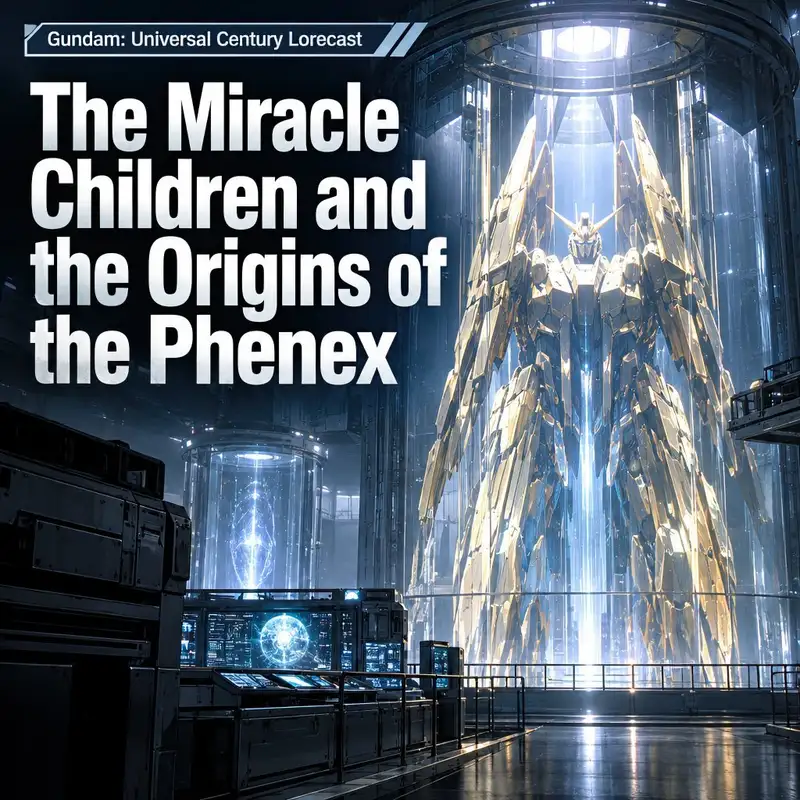
The Phenex was the third Unicorn Gundam unit, built around a full psycho-frame structure. Its external gold armor gave it a distinct visual identity, and the phoenix name made that identity explicit. The symbolism was not simply decorative. A phoenix suggests destruction, rebirth, and escape from death. In a military program, that was an unusually loaded image for a machine already linked to psycho-frame research and Newtype experimentation. It made the Phenex easy to remember, easy to mythologize, and difficult to discuss as just another classified development project.
Mechanically, however, the Phenex was not a magical exception produced from nothing. Official supporting material describes it as having been assembled with an early-delivered full psycho-frame body and construction data derived from the white Unicorn Gundam and the black Banshee. That meant it inherited the technological promise and the uncertainty of the RX-zero program. It was not evidence that the Federation could manufacture full psycho-frame machines in ordinary numbers, nor that it possessed a mature doctrine for operating them. It was evidence that a politically sensitive research effort had gained access to rare materials, specialized data, and personnel willing to attempt another unit.
That is how advanced military technology usually enters history. Not as an army-wide transformation, but as a narrow channel of access. A small number of laboratories, sponsors, contractors, officers, and pilots possess knowledge that the larger institution does not. The program may be highly funded and highly classified at the same time. It may promise a revolutionary advantage while lacking a repair system, a training pipeline, spare components, or reliable operational doctrine. The Phenex belonged to that category. It was an extraordinary machine, but extraordinary machines are often least useful when an institution cannot predict what they will do.
The full psycho-frame concept made this problem more severe. Psycho-frame technology was associated with the interaction between human consciousness and machine systems at a level that conventional military engineering could not fully explain or standardize. The Federation could identify effects. It could observe resonance. It could assign researchers, pilots, and security personnel to investigate the results. But observing an event was not the same as mastering it. The more a system depended on rare compatibility between a particular person and a particular machine, the less it resembled an ordinary weapon that could be issued, maintained, and replaced.
The Phenex therefore represented two contradictory ambitions. It was meant to investigate and perhaps contain the potential of psycho-frame technology. Yet its value rested on precisely those qualities that resisted containment. A stable fighter can be assigned to a squadron. A dependable mobile suit can be maintained by a unit with manuals, parts, and trained technicians. A machine whose most important effects emerge unpredictably from resonance with an exceptional pilot is something else. It may be militarily powerful. It may also be institutionally unmanageable.
To understand why Rita Bernal was in that cockpit, it is necessary to return to Universal Century seventy-nine. During the opening phase of the One Year War, Jona Basta, Michele Luio, and Rita Bernal were children in Australia. They experienced the catastrophe caused by the colony drop. Before it came, they perceived that something terrible was approaching. The record presents them as having foreseen the disaster and survived it. They became known as the Miracle Children, a name that sounds compassionate until one considers what happened next.
A colony drop is not merely a strategic symbol or an entry in a campaign history. It is a weaponized habitat. A colony cylinder contains homes, schools, hospitals, workplaces, food systems, transport networks, pressure systems, and communities. Turning such an object into an instrument of war means destroying lives on a scale too large for any individual survivor to grasp. For Jona, Michele, and Rita, the event was not a lesson in geopolitics. It was the destruction of the civilian world that should have protected them.
The children survived, but survival did not restore that world. They became orphans. In a functioning society, orphanhood after a catastrophe should have created an obligation of care. It should have meant housing, education, medical treatment, family placement, and protection from further exploitation. In the Universal Century, however, exceptional survival also attracted official interest. The children had apparently perceived a disaster before it occurred. To military institutions already searching for evidence of Newtype potential, that made them valuable.
This was the first conversion. The colony drop transformed civilians into victims. The state and its associated research system transformed some victims into data. The language of scientific inquiry made this seem orderly. Researchers could speak of aptitude, perception, neurological development, and human evolution. Those terms may describe genuine questions. They can also conceal power. A child who has no family protection, no political influence, and no ability to refuse is not a willing research participant merely because officials can describe the program in technical language.
After the One Year War, Jona, Michele, and Rita were placed in the Augusta Institute. Augusta was associated with investigation and development related to Newtypes. In principle, research into unusual human capacities could have taken many forms. It might have been medical, educational, or philosophical. The Augusta program shown in the record took a military path. It sought to identify, shape, and exploit people whose perception might offer an advantage in combat or in control of advanced systems.
This was not a neutral institutional choice. The One Year War had shown the military value attached to Newtype pilots, psycommu systems, and forms of combat that ordinary command structures struggled to understand. The Federation and its successor organizations did not simply inherit weapons after that war. They inherited anxiety. If an opponent could field a Newtype pilot, a remote weapon system, or a machine that responded directly to a pilot’s perception, then military planners feared falling behind. Such fear creates pressure for research. It also creates pressure to treat people as resources.
At Augusta, the Miracle Children were subjected to Cyber Newtype development. The term should not be allowed to soften what it implies. Cyber Newtype programs were not simply advanced flight schools for gifted pilots. They involved coercive experimentation, conditioning, isolation, and attempts to force human beings into military usefulness. The official purpose was to develop or control Newtype ability. The practical effect was to make vulnerable children available to institutions that had already decided their value lay in what could be extracted from them.
The program’s personnel matter, but they should not be allowed to obscure the larger structure. Colonel Escola Gedda, a Titans officer, is associated with Rita’s exploitation and control. The researcher Marga is associated with the harsh experiments imposed on children judged to have Newtype potential. They were not the whole institution. Augusta required administrators, security personnel, medical staff, researchers, funding channels, classification systems, and political protection. Abuse on that scale does not survive because one officer is cruel. It survives because many people accept a system in which cruelty is renamed necessity.
The Titans connection is also significant. The Titans were formally destroyed as a dominant political and military force after the Gryps Conflict, but organizations do not vanish as completely as their flags. Personnel, habits, files, laboratories, and professional networks can outlast a unit’s public disgrace. Augusta’s legacy demonstrates this institutional persistence. The Federation could condemn Titans excesses while retaining pieces of the research culture that made those excesses possible. A state can change the name on an office door without changing the assumption that extraordinary people belong to the security apparatus.
The three children did not emerge from Augusta in equal positions. Rita demonstrated the clear Newtype aptitude that the program wanted. Jona and Michele did not possess equivalent ability. That difference shaped all three lives. Rita became the direct object of military interest because her aptitude appeared useful. Jona and Michele became connected to the same system by proximity, memory, and survival. The institute created a hierarchy among children who had already lost almost everything. One was treated as the key. The others were left to understand what it meant to be close to the key.
We should not describe Rita as merely a Cyber Newtype. She was subjected to Cyber Newtype development, but the distinction matters because her aptitude was not simply manufactured by Augusta. The program identified something in her and attempted to shape it for military use. That does not make her an untouched natural genius outside history. It makes her a person whose genuine capacity was placed under coercive control. The institution did not create her humanity. It attempted to claim ownership over the part of her humanity it found strategically useful.
Jona’s later position reflects a different form of survival. By Universal Century ninety-seven, he is a Federation Space Force ensign. He has become a pilot, a role that places him within the very military structure that once exploited him. This should not be read as proof that the system healed him or that he accepted its judgment. Militaries often recruit people whose past makes them useful. Familiarity with an objective, a target, or another person can be treated as operational value. Jona’s connection to Rita made him relevant to the Phenex hunt, but relevance is not the same thing as control.
Michele’s path was different again. She became a special adviser to Luio and Company, the powerful New Hong Kong-based corporation with strong Federation connections. Her position gave her resources, access, and influence that neither Rita nor Jona possessed. But power acquired after trauma is not the same as freedom from trauma. Michele’s role in the Phoenix Hunt cannot be separated from her relationship with the other Miracle Children. Her motives include institutional and strategic concerns, but they are also inseparable from the past that Augusta tried to turn into a military asset.
The Phenex emerged from this same world of research, control, and unequal access. A full psycho-frame machine required more than an assembly line. It required specialized knowledge, rare materials, secure facilities, and personnel capable of working with technology that carried political consequences far beyond its size. The Federation-associated effort that produced Unit Three was not conducting routine procurement. It was working at the edge of a technology whose previous use had already challenged conventional ideas about command, weapon control, and human-machine interaction.
The gold armor did not make the Phenex faster, more durable, or more controllable by itself. What it did was make the machine symbolic. It marked the Phenex as something apart from ordinary military equipment. That mattered after its disappearance. A missing gray test unit might have remained a classified embarrassment. A vanished gold machine linked to unexplained psycho-frame phenomena became easier to transform into rumor, hope, fear, and political desire. The phoenix image encouraged the belief that the machine had somehow escaped ordinary destruction. The legend formed because the underlying event could not be fully explained.
The U.C. ninety-five accident was therefore not a simple equipment malfunction. Rita was not an interchangeable pilot placed inside an interchangeable cockpit. Her history at Augusta, her Newtype aptitude, and the Phenex’s full psycho-frame architecture all converged in that test. The film presents the relationship between Rita and the machine through images and events that resist a narrow technical explanation. The Phenex moves in ways that observers cannot comfortably place inside normal performance categories. Rita’s disappearance cannot be separated from those phenomena. But the precise mechanism remains unresolved.
That uncertainty should be preserved. It is reasonable to say that the film shows an extraordinary connection between Rita, the psycho-frame, and the Phenex. It is not reasonable to reduce that connection to a settled engineering formula. The available record does not prove that Rita’s soul simply became a power source for the machine. It does not establish routine time travel as a feature of the Phenex. It does not provide a repeatable method by which another pilot, another laboratory, or another government could produce the same outcome on demand.
This is what made the accident so threatening to military institutions. A conventional failure can be investigated through wreckage, telemetry, procedures, and human error analysis. A lost mobile suit may be embarrassing, expensive, or dangerous, but it remains a problem with recognizable categories. The Phenex did not fit easily into those categories. The more officials treated it as an object that could be recovered and mastered, the more they had to confront the possibility that its defining behavior could not be reproduced without Rita, and perhaps not even with her.
The Laplace Incident in Universal Century ninety-six intensified this anxiety. The events surrounding the Unicorn Gundam demonstrated that psycho-frame systems could produce consequences far beyond ordinary weapons testing. In response, the Federation moved toward containment. The Unicorn units and related technology became singularities, systems too politically sensitive and too poorly understood for normal service use. This was not simply caution. It was an admission that the state could not confidently explain the effects it had helped create.
By Universal Century ninety-seven, the Phenex had reappeared in the Earth Sphere. Its return created exactly that kind of competition. The machine was not merely a missing research asset from two years earlier. It was now a symbol of unresolved psycho-frame capability. Whoever found it might study it, secure it, deny it to an opponent, or claim political prestige from possessing it. The possibility that it could not be truly controlled did not reduce the desire to acquire it. In some ways, it increased that desire.
Operation Phoenix Hunt was the Federation response. Its stated purpose was to capture the Phenex. That word, capture, is crucial. Destroying the machine would have removed an immediate threat, but it would also have destroyed evidence and denied the Federation access to the technology. Capturing it required a much more difficult kind of operation. The target had to be located, approached, restrained, and recovered without triggering effects that the hunters did not fully understand. This was not a normal interception mission. It was a specialized recovery operation against a target that had already escaped one controlled environment.
The operation relied on the Clop-class cruiser Damascus, the specialized Shezarr Team, the Narrative Gundam, and equipment provided through Michele Luio’s corporate connections. This was a small but complex recovery architecture. It required intelligence to locate the Phenex, transport to bring the team into position, launch capability for mobile suits, communications under combat conditions, and enough technical support to employ highly specialized equipment. It also required command arrangements that were never entirely clean. Michele operated beside the formal Federation chain of command, but not wholly inside it.
That ambiguity reflected the larger political situation. Luio and Company was not the Earth Federation government, yet its resources and connections gave it influence over an operation involving Federation personnel and a strategically sensitive machine. Corporations in the Universal Century do not need to replace governments to shape military outcomes. They need access to money, technical expertise, transport, and decision-makers. Michele’s role demonstrates how a private actor can enter a state operation when the state needs capabilities it does not fully possess or cannot publicly acknowledge.
The Shezarr Team should not be mistaken for a conventional fleet formation capable of solving the problem through weight of fire. Its purpose was specialized pursuit and recovery. The Narrative Gundam was not deployed because it represented a mature, widely available class of machine. It was part of an improvised attempt to confront a particular target. The operation depended on exceptional equipment because the target itself was exceptional. That dependence revealed the weakness of the plan. The Federation wanted to treat the Phenex as an asset to be seized, but it needed uncommon resources merely to attempt contact.
Jona was selected to pilot the Narrative Gundam because he combined several forms of value. He was a Federation officer. He had experience connected to Newtype development. Most importantly, he had known Rita since childhood. From a commander’s perspective, that personal connection might offer insight into the target. Jona might recognize behavior, react to signals, or understand Rita in ways that a stranger could not. But personal knowledge is not a targeting system. It does not create a reliable command link with a machine that has already defeated institutional control.
The decision to use Jona also exposes the moral failure at the center of Phoenix Hunt. The state had once taken a traumatized child and subjected him to a military research program. Years later, it placed that survivor in another mobile suit and sent him to recover the person who had been exploited most intensely. This was operationally understandable. It was also ethically revealing. The Federation did not need to invent a new method of exploitation. It could simply return to the people it had already damaged and ask them to perform one more mission.
Jona’s emotional connection to Rita gave him motivation, but it did not give him certainty. He could not know exactly what had happened to her during the U.C. ninety-five accident. He could not know whether the Phenex would respond to him, reject him, or remain beyond any human appeal. In military terms, he possessed unique familiarity with the problem, not mastery of it. The distinction matters because the Phoenix Hunt repeatedly tests the belief that personal bonds can solve institutional failures. They can provide courage and insight. They cannot substitute for accountable command, ethical research, or reliable technology.
The Federation was not the only organization interested in the Phenex. The Republic of Zeon also moved to seize it. Its involvement was linked to Foreign Minister Monaghan Bahharov and his covert connections to Neo Zeon interests. This does not mean that every Republic institution was secretly Neo Zeon, nor that the Republic’s entire political structure can be reduced to one conspiracy. It means that factions within the Republic saw value in using the old Zeon legacy, its networks, and its technology for purposes that were not openly acknowledged.
The Republic’s interest demonstrates that the Phenex was a political object as much as a military one. Possession could mean research access. It could mean leverage against the Federation. It could mean preventing a rival from obtaining psycho-frame technology. It could also mean symbolic power. Zeon politics had long been shaped by claims about Newtypes, spacenoid destiny, and the failure of Federation rule. A machine visibly associated with extraordinary human potential could be used to reinforce those claims, even if no faction truly understood how to command it.
Zoltan Akkanen was sent into this contest as a Cyber Newtype and as the product of another effort to manufacture political and military symbolism around the legacy of Char Aznable. His creation reflects a different but related institutional impulse. Where Augusta tried to identify and control Newtype aptitude among vulnerable children, later programs sought to shape people into usable successors, symbols, and weapons. Zoltan was not Rita’s equivalent. Their histories, treatment, and roles were not identical. But both reveal institutions attempting to solve political insecurity by manufacturing human instruments.
The rivalry between the Federation, Luio and Company, and Zeon-linked actors was not a contest over a conventional mobile suit. No participant could reasonably assume that acquiring the Phenex would provide an immediate, stable battlefield advantage. Its performance was too uncertain. Its pilot relationship was too singular. Its psycho-frame architecture was too politically sensitive. Yet every side had reasons to fear the consequences of another side acquiring it. That is the classic shape of a technology-control crisis. The weapon is dangerous, unreliable, and hard to reproduce, but no one believes it is safe to leave in someone else’s hands.
The Phenex’s tactical value was real but limited. It demonstrated exceptional mobility and resilience, and it could survive encounters that would destroy ordinary machines. But tactical performance does not automatically become military utility. A weapon system must be available when needed, controllable by assigned personnel, supportable by technicians, repairable after damage, and integrated into a plan. The Phenex failed most of those tests. It could appear, act, and vanish in ways that denied commanders the ability to schedule or direct it. A machine that cannot be ordered to the decisive point is not a dependable instrument of strategy.
The political outcome is equally revealing. The Federation had reasons to fear psycho-frame proliferation after the Laplace Incident. Those reasons were not imaginary. A system capable of producing effects beyond ordinary military understanding should provoke caution. But caution became compromised when the Federation, its corporate partners, and rival Zeon interests all sought possession. The language of containment could not conceal the competition. Each actor could argue that it was acting to prevent misuse. Each actor also believed that it should be the one holding the dangerous asset.
This is where the story of the Miracle Children becomes inseparable from the story of the Phenex. The machine did not emerge from a clean laboratory process. Its history was bound to children who survived a catastrophe, were taken into a research institution, and were ranked according to military usefulness. Rita’s aptitude became the point at which psycho-frame ambition and human exploitation met. The Phenex was not simply paired with a talented pilot. It was connected to a person whose life had already been shaped by systems that believed extraordinary perception could be converted into state power.
Michele’s pursuit of the Phenex carries the burden of that history. She possesses influence, wealth, and institutional access, but those tools cannot erase what was done at Augusta. Jona’s pursuit carries the same burden from inside the military structure. He is asked to treat Rita as a mission objective while knowing her as a childhood friend and fellow survivor. Neither role is clean. Both show how institutions can convert personal memory into operational utility. The survivors are repeatedly asked to serve the systems that failed them.
Rita herself must not be reduced to a mystical object at the center of other people’s stories. The film presents her through absence, memory, trauma, and extraordinary phenomena, but she remains the person most directly claimed by the institutions around her. Augusta treated her as a research subject. The Federation treated her as a pilot for a sensitive experimental machine. Later hunters treated the Phenex as evidence of what had become of her. The tragedy is not that Rita was too extraordinary for ordinary people. It is that ordinary institutions treated her extraordinariness as permission to deny her ordinary human protection.
The Phenex also reveals the limits of military discovery. A government can discover a phenomenon. It can build a prototype around that phenomenon. It can assign specialists, classify data, and fund additional tests. None of those steps guarantee possession. The Federation could attach Rita to a full psycho-frame machine, but it could not make their relationship predictable. It could identify the machine as an asset, but it could not force it to remain an asset. It could create a recovery operation, but it could not turn recovery into certainty.
That failure does not mean that the Phenex lies outside history or outside analysis. On the contrary, it makes historical analysis more necessary. Calling the machine a miracle can describe the awe it inspires, but it cannot explain why it existed. The explanation lies in the colony drop, in orphanhood, in Augusta, in Titans-era research culture, in Federation insecurity, in corporate access, in the unresolved military consequences of psycho-frame technology, and in the political competition that followed the Laplace Incident. The extraordinary event is real within the film’s record. Its institutional causes are real as well.
The Miracle Children’s story begins with civilians surviving an atrocity they did not choose. It continues with a research system that interpreted their survival as military opportunity. It reaches its crisis when Rita Bernal, the one child whose aptitude the system considered most valuable, disappears with a machine built to exploit and contain that value. By Universal Century ninety-seven, governments and corporations are still trying to reclaim what they lost. They call it recovery, containment, security, and research. Those words do not change the underlying fact that they are competing for the survivor they once transformed into a strategic resource.
The Phenex matters because it demonstrates the failure of military institutions to distinguish discovery from possession. Rita’s Newtype aptitude could be observed, exploited, and joined to a psycho-frame machine. But neither Augusta, the Federation, Luio and Company, nor Zeon-linked rivals could turn that relationship into a dependable instrument of power. The gold mobile suit became a legend because it escaped their control. The Miracle Children remain the deeper history, because the first act in the creation of the Phenex was not engineering. It was the decision to treat children who had survived catastrophe as material for the next war.