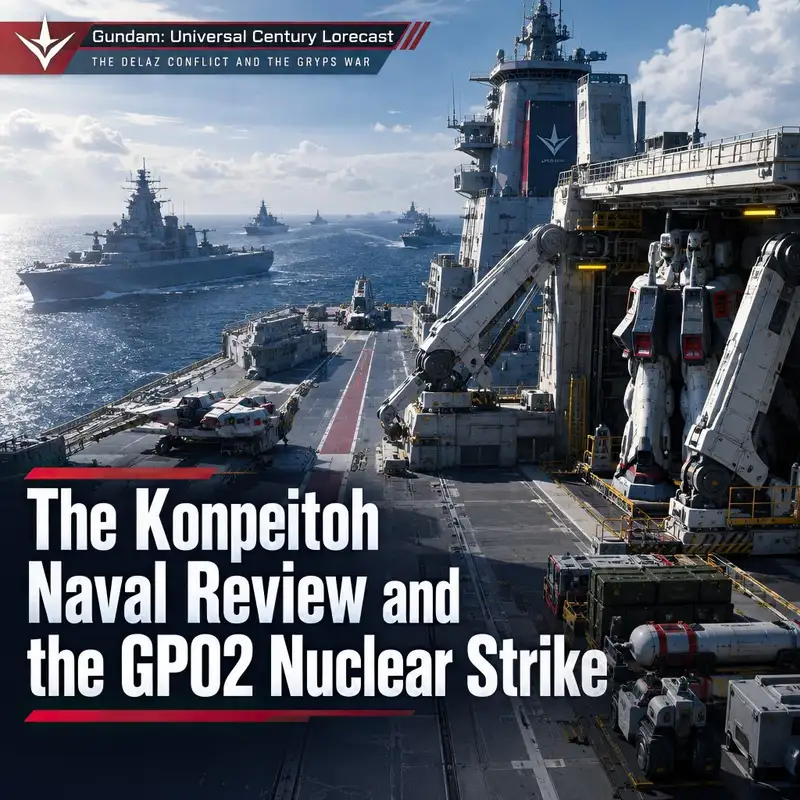
The Konpeitoh Naval Review and the GP02 Nuclear Strike
The Birmingham sat at the center of a celebration of restored power. Around the flagship, the Earth Federation had assembled warships, senior officers, and the visible proof that the disaster of the One Year War had been survived. Konpeitoh, once Zeon’s fortress of Solomon, was now a Federation-held anchorage. Holding a naval review there carried an obvious message. The Federation had reclaimed the strategic center of space. Its fleet had recovered. The remaining Zeon forces were remnants, dangerous perhaps, but no longer capable of dictating events.
That was the public meaning of the review. Militarily, it created something else: a dense, predictable concentration of command, ships, communications, and prestige. Admiral Green Wyatt was aboard the Birmingham, placing senior leadership in the same target area as the fleet he was displaying. The review was meant to reassure the Federation’s political class and the wider Earth Sphere that authority had been restored. Instead, it offered Aiguille Delaz a target set unusually well suited to one stolen weapon.
By the time Anavel Gato approached Konpeitoh, the central failure had already taken place. The Federation had not merely failed to stop an enemy mobile suit. It had failed to regain custody of a specialized nuclear-delivery prototype that it had designed and built itself. The catastrophe at the review was not an isolated surprise. It was the final result of earlier failures in procurement security, pursuit, intelligence, command judgment, and political confidence.
The Federation’s Gundam Development Project represented the industrial ambition of the postwar order. The One Year War had demonstrated that mobile suits could transform combat, but it had also exposed how badly the Federation had been caught by Zeon’s early technological advantage. In Universal Century eighty-three, Federation institutions were trying to recover that lost ground. Anaheim Electronics, working through the Gundam Development Project, produced experimental machines intended to explore several different military problems. The project was evidence of advanced industrial capacity. It showed that the Federation could commission sophisticated prototypes, coordinate military requirements with corporate engineering, and pursue technologies that had been beyond its reach only a few years earlier.
Gundam GP02A was the most troubling expression of that recovery. It was not a general-purpose mobile suit built to patrol, escort ships, or fight extended conventional engagements. Its defining mission was nuclear delivery. Its atomic bazooka gave it a weapon intended for mass effect, while the machine itself was designed to survive the conditions created by firing it. Its protection and cooling arrangements mattered because this was a system designed around a single strategic task. Its comparatively limited conventional armament reinforced the point. GP02A was not supposed to win a campaign through repeated duels. It was supposed to bring one extraordinarily destructive weapon into the range where it could decide a larger operation.
That does not establish that the Federation had adopted mobile-suit nuclear delivery as normal doctrine. GP02A was an experimental machine, and a prototype cannot be casually treated as the standard equipment of an entire service. But it does reveal an uncomfortable institutional reality. The Federation had developed a weapon of exceptional political and military consequence before it had demonstrated that it could secure the weapon, account for it under crisis conditions, or prevent an enemy from converting it into a strategic liability. The project displayed technological recovery. It also displayed the dangerous gap between building a machine and governing its use.
That gap became a crisis at Torrington Base. Gato, a former Zeon officer with an established reputation as an ace, stole GP02A as part of the Delaz Fleet’s operation. His skill mattered. He had to penetrate a guarded installation, seize an unfamiliar Federation prototype, and escape with a weapon whose value was immediately obvious. But reducing the theft to the achievement of one exceptional pilot misses the larger point. Gato did not steal GP02A for a private vendetta. He stole it for an organized remnant force that had selected the machine, prepared a mission for it, and understood what political effect its use could produce.
The theft should have transformed Federation priorities at once. This was not simply the loss of expensive experimental hardware. A uniquely dangerous nuclear asset had passed into the hands of a hostile force that retained trained personnel, ships, intelligence networks, and a political objective. The Federation’s response, centered in part on the assault carrier Albion and Kou Uraki’s Gundam GP01, was energetic but unsuccessful. The pursuit repeatedly failed to recover GP02A. Every failure gave Delaz more time to protect the machine, choose the point of attack, and force the Federation to react to his schedule rather than its own.
That is the first operational lesson of Konpeitoh. A security failure becomes more serious with every hour in which the defender cannot determine the enemy’s intent. The Federation knew that Gato had stolen a nuclear-capable prototype. It knew that the Delaz Fleet was active. It had forces searching for the machine. Yet it did not convert that knowledge into a defensive posture adequate to the threat. A state can possess excellent equipment, experienced officers, and substantial material resources while still losing the initiative. The issue is not whether it knows that danger exists. The issue is whether it can turn warning into a coherent decision before the enemy acts.
By the time the naval review began, the question was no longer where Gato had been. The question was what Delaz intended to do with him. The answer was larger than revenge. Vice Admiral Aiguille Delaz commanded a Zeon remnant force, but his objective was not simply to avenge the Principality’s defeat or to inflict losses on the Federation wherever opportunity appeared. Operation Stardust sought to destabilize Federation authority, embarrass its military institutions, and prove that Zeon’s defeat had not ended Zeon’s capacity to shape the Earth Sphere. The operation depended on the Federation appearing secure just before it was shown to be vulnerable.
Gato’s role was therefore precise. He was the designated delivery pilot for the weapon that could create the first and most visible shock. He was not expected to conquer Konpeitoh, destroy every Federation ship, or win a fleet battle through individual combat. His mission was to reach the review, fire on the concentrated target, and help create the confusion needed for the wider operation to continue. The nuclear strike was a major phase of Operation Stardust, but it was not the operation’s final objective. Its purpose was to disrupt Federation readiness, pull attention toward the immediate disaster, and contribute to the larger dislocation Delaz required for the next phase.
The arrival of an Axis advance fleet increased the political and strategic significance of the operation, but it should not be misunderstood as proof that every surviving Zeon force belonged to one unified command. The Earth Sphere after the One Year War contained remnants, local forces, political exiles, military holdouts, and competing claimants to Zeon’s legacy. Delaz’s fleet had its own command structure and its own operation. Axis support mattered because it gave the plan additional leverage and reinforced the sense that the Federation faced more than a few isolated raiders. But the strike at Konpeitoh was fundamentally Delaz’s operation, built around his assessment of Federation weakness and his willingness to use mass-casualty violence to exploit it.
The plan depended on more than a fast mobile suit and a powerful weapon. Delaz needed the Federation to look in the wrong directions. His forces created pressure across the approaches to Konpeitoh, presenting visible threats that required local responses. Patrols moved. Mobile suits were launched. Commanders had to make decisions with incomplete information. In such a situation, the defender often faces a difficult problem. Every attack may be dangerous. Every report may demand attention. But not every attack is the enemy’s main effort.
That distinction was the heart of Delaz’s deception. The scattered attacks were not meaningless. They were real enough to draw Federation units into contact and force defensive action. Yet their value to Delaz lay in the attention they consumed. A patrol engaged by an enemy force is focused on its own survival and mission. A mobile-suit unit responding to a local incursion is not automatically positioned to protect a distant approach route. A command staff receiving several urgent reports must determine which threat is a raid, which is a feint, and which is the penetration that cannot be allowed to succeed.
Gato did not fight his way alone through the entire Federation defense system. That is one of the most persistent misunderstandings created by the visual drama of the attack. He approached through a defensive environment already distorted by diversion. The Delaz Fleet created enough tactical activity that Federation formations had to react separately. The result was compartmentalization. Individual units could see their own problems, but the wider command system could not quickly assemble those problems into a single, accurate picture of the enemy’s purpose.
This is not an unusual failure in war. It is, in fact, one of the oldest. A defender may possess more ships, more pilots, more bases, and greater industrial depth than an attacker. None of that automatically matters at the decisive point if the attacker can force those assets to disperse. A larger force becomes less effective when it is responding piecemeal, especially when senior commanders are trying to preserve an event designed for political display. Delaz understood that the Federation’s strength at Konpeitoh was also an obligation. The review had to look controlled. It had to look secure. That requirement made sudden disorder especially damaging.
The Federation was not blind. A defense satellite detected Gato’s approach. That fact matters because it keeps the analysis grounded. Minovsky particles complicated detection, communications, and long-range control, but they did not make every sensor useless or turn space combat into mystical concealment. The Federation had warning. What it lacked was enough time, preparedness, and coordinated response to convert that warning into interception.
Detection begins a process. Someone must recognize the contact as hostile. The report must reach the appropriate command level. The threat must be authenticated. Intercepting units must be identified, tasked, informed of the approach geometry, and moved into a useful position. Under ideal conditions, these actions are difficult. Under Minovsky interference, with scattered attacks already competing for attention, they become slower and more uncertain. Commanders cannot assume that every report is complete, current, or correctly interpreted. Pilots cannot be sent instantly to the exact point where an enemy will be when they arrive. Ships and mobile suits still have to maneuver through space, account for relative motion, and avoid creating confusion among friendly formations.
Kou Uraki reached the area in GP01 Full Burnern, but he arrived too late to prevent the shot. That should not be read as a simple indictment of Kou’s courage or ability. He was being asked to solve, in the final moments, a problem created by the failure of an entire defensive system. He had incomplete information, little time, and an opponent operating from a prepared plan. Heroic interception is most useful when it supplements sound warning, coherent command, and layered defense. It is a poor substitute for all three.
The decisive tactical fact was that the Federation had created its own target geometry before Gato arrived. A naval review concentrates ships because concentration is part of its message. A dispersed fleet may be safer from a mass-effect weapon, but it does not present the same image of readiness, unity, or power. The Birmingham, as flagship and command platform, added another layer of concentration. It carried Admiral Green Wyatt, a senior figure in the Federation’s postwar military establishment. The ships around it were not merely hulls and weapons. They were evidence of recovery. Their presence together was intended to make a political claim.
That claim became vulnerable to one nuclear strike. The Federation fleet was not defenseless. It had patrols, defensive systems, mobile suits, and command structures. The point is not that warships had become obsolete, or that fleet power no longer mattered in the mobile-suit era. The fleet remained a major military instrument. It could transport forces, sustain operations, project power, and provide the organized structure mobile suits required for strategic movement. But fleet power is not measured only by the quality of individual ships. It is also measured by how those ships are deployed, protected, warned, and commanded.
At Konpeitoh, the defensive problem was not an ordinary exchange of fire between fleets. It was a compressed crisis involving a weapon designed for mass destruction and a target made unusually vulnerable by concentration. A few moments of warning could not undo the placement of ships already assembled for review. Local defenses could not easily compensate for the combination of surprise, diversion, and the final approach of a specialized delivery platform. The same concentration that made the review impressive made it fragile.
The visual record does not allow a precise reconstruction of ship spacing, total fleet strength, individual defensive assignments, or the exact mechanics of the blast. It is not necessary to invent those details. The larger military reality is clear enough. A nuclear weapon fired into a concentrated force does not need to destroy every ship to produce a strategic shock. It needs to destroy enough of the force, and enough of the command structure, to turn a ceremony of confidence into a demonstration of helplessness.
Gato locked the atomic bazooka onto the Birmingham and fired. The Birmingham was destroyed. Admiral Green Wyatt was killed. The nuclear blast devastated the assembled fleet, destroying or crippling a catastrophic portion of the ships gathered at Konpeitoh. Later accounts often attach a precise fraction to the losses, but the OVA’s meaning does not depend on an exact percentage. What matters is that the review force suffered an enormous blow in a single flash, at the very moment it had been assembled to demonstrate Federation control of space.
The strike was directed against military targets, but it cannot be treated as a clean or morally neutral military operation. Nuclear weapons are designed to produce mass casualties and mass destruction. Their political value lies partly in the scale of fear they create. Konpeitoh was a military concentration point, yet it existed within an inhabited orbital civilization. Ships, stations, crews, support personnel, transport routes, and nearby infrastructure did not become ethically irrelevant because the immediate aim point was a flagship. The attack was not a technical achievement detached from human consequence. It was an act of mass-casualty warfare intended to humiliate an adversary and reshape political behavior through shock.
That was also why Birmingham was the right target. Destroying a flagship has effects beyond the loss of one vessel. It kills senior leadership, disrupts command, damages morale, and creates a powerful public image. The Federation had placed a prominent admiral at the center of a display of restored order. Delaz destroyed both the man and the image. The strike announced that the Federation’s postwar security structure could be penetrated, that its high command could be reached, and that its apparent control of space was less secure than its ceremony had claimed.
Still, the blast was not the end of the operation. This is where the spectacle can obscure the strategy. Gato’s mission had achieved its immediate effect, but the wider purpose of Operation Stardust required the Federation to react exactly as a shocked institution usually reacts. It had to account for the losses, rescue survivors, reestablish command, determine whether another attack was coming, and direct its attention toward the disaster at Konpeitoh. That attention was itself a weapon in Delaz’s plan. A force preoccupied with a visible catastrophe is less able to anticipate the next move.
Kou pursued Gato after the strike. Their confrontation matters, but it must be understood at the correct scale. Kou was trying to prevent the enemy from escaping and, if possible, stop any further use of GP02A. Gato was trying to survive long enough for Operation Stardust to continue. Their engagement was intense because both pilots understood that the other represented an immediate threat. Yet even if Kou had destroyed GP02A at that point, the nuclear strike had already occurred. The political humiliation, command losses, and operational disruption could not be recalled.
The later clash between GP01 Full Burnern and GP02A disabled both machines, but Gato escaped immediate capture. Again, the result should not be reduced to a simple verdict on which pilot or mobile suit was superior. Kou had been pursuing an enemy after a catastrophic fleet strike, operating under pressure and exhaustion. Gato had completed the mission for which GP02A had been stolen, but he was also fighting to preserve his own ability to remain useful to Delaz’s larger plan. Both men were acting inside circumstances imposed by commands, institutions, and political decisions far above the cockpit.
This is the limit of heroic interception. Individual action can matter greatly. A pilot can protect a ship, delay an enemy, recover intelligence, or prevent a local disaster from becoming worse. But an individual pilot cannot easily reverse a completed strategic surprise. The Federation had allowed a stolen nuclear-delivery platform to remain at large. It had failed to establish the enemy’s objective. It had permitted its fleet and senior leadership to assemble in a predictable formation. It had been drawn toward diversions. By the time Kou came within fighting distance, the decisive failure had already matured.
For Delaz, the strike achieved several things at once. Tactically, it destroyed the Birmingham and inflicted catastrophic damage on the review fleet. Operationally, it disrupted Federation readiness and forced a major reallocation of attention and resources. Strategically, it proved that a Zeon remnant force could still penetrate Federation defenses and shape events on a scale far greater than its material strength might suggest. Politically, it humiliated the postwar government and damaged its claim that victory in the One Year War had restored durable security.
The intelligence result was just as important. The Federation had fragments of warning. Green Wyatt’s dealings with Cima indicate that senior officials were not operating in complete ignorance of the dangerous political currents around them. But fragments of intelligence are not the same as effective intelligence. Information has to be assessed, shared, trusted, and connected to action. It can be distorted by institutional rivalry, personal ambition, uncertain sources, compartmentalization, and the natural reluctance of senior organizations to disrupt a public event on the basis of incomplete reports. Delaz exploited that weakness. He did not need the Federation to know nothing. He only needed it to know too little, too late, and in the wrong organizational compartments.
Yet the strike did not restore Zeon. It did not give the Delaz Fleet the industrial base, territory, population, or durable political legitimacy needed to win a conventional war against the Earth Federation. Spectacular destruction can expose weakness, but it cannot by itself build a state. Delaz’s operation gained power from its ability to disrupt the Federation’s confidence. Its long-term political value depended on the Federation responding badly enough to deepen the divisions that had made the Earth Sphere unstable in the first place.
Konpeitoh was not destroyed because warships had become useless. It was not destroyed because mobile suits had replaced fleet power. It was not destroyed because Anavel Gato, however capable he was, could personally defeat an entire Federation military. The Federation failed because it combined a ceremonial concentration of force with unresolved custody of a nuclear prototype, fragmented intelligence, slow decision-making, and defenses drawn toward deliberate diversions. It had rebuilt ships and machines, but it had not built a command system capable of recognizing how those assets could be turned against it.
Delaz succeeded because he matched a specialized weapon to a politically predictable target. GP02A was not important because it was an extraordinary mobile suit in the abstract. It was important because its mission fit the vulnerability Delaz intended to exploit. The naval review placed command, prestige, and military hardware close together. Diversion ensured that defenders reacted to several threats without seeing the full pattern. Detection came, but not early enough to produce interception. The Federation recognized the danger only after the geometry of the attack had already been established.
The larger lesson is institutional rather than mechanical. The Federation made its recovery visible before it made that recovery secure. It displayed power before it resolved who controlled its most dangerous weapons, how intelligence warnings would be integrated, and whether its political leadership could distinguish reassurance from readiness. At Konpeitoh, one stolen prototype did not defeat a superior fleet. It exposed a state that had rebuilt its arsenal faster than it had rebuilt the judgment required to use it safely.