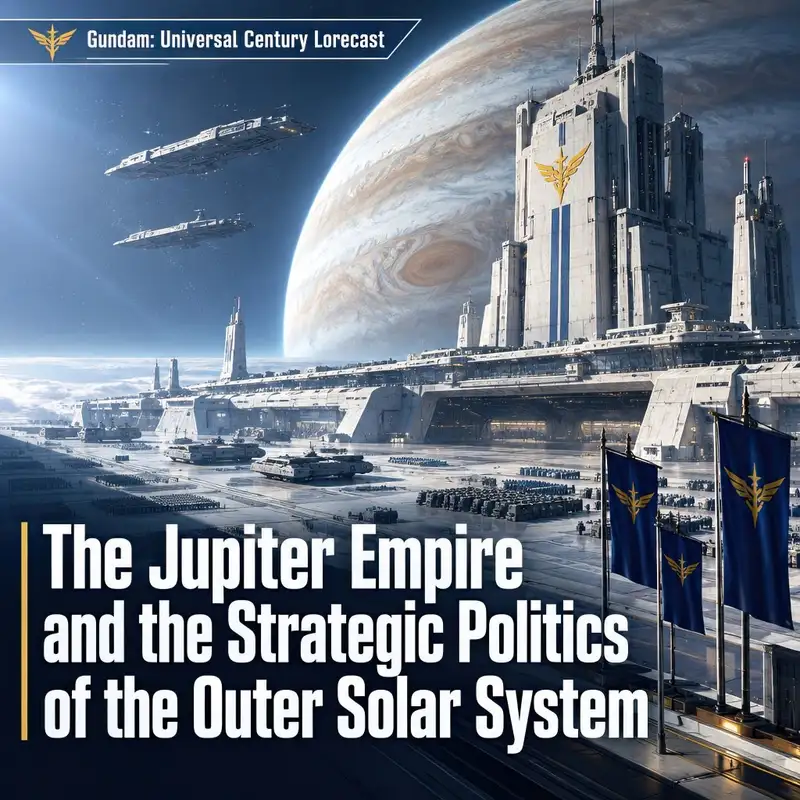
The Jupiter Empire and the Strategic Politics of the Outer Solar System
A transport leaving the Jovian sphere does not look like the beginning of an invasion. It looks like infrastructure. Its cargo is measured in contracts, schedules, reactor demand, maintenance hours, and the quiet confidence that someone, somewhere, will keep the route open. In the Universal Century, Jupiter’s importance rests first on that confidence. Energy-related resources, including helium-three associated with Jovian extraction, move inward toward the far more populous Earth Sphere. The journey is long, specialized, and expensive. It requires ships built for endurance, crews trained for work far from ordinary political oversight, depots and repair systems, and a chain of decisions that begins near Jupiter but affects industry much closer to Earth.
That arrangement gives Jupiter strategic weight without requiring it to equal Earth in population, territory, or industrial breadth. A remote frontier can matter because it supplies something difficult to replace quickly. It can matter because the route is specialized. It can matter because few officials in the political center understand the labor, machinery, and risks required to keep that route functioning. The ships are visible. The political society growing around them is much less visible. That is the central danger in the Jupiter Empire conflict of Universal Century one hundred thirty-three. A supplier that the Earth Sphere treated as distant infrastructure became a military threat precisely because it was not treated as a political actor until too late.
The account considered here comes from the Mobile Suit Crossbone Gundam manga branch, a comic-original continuation of the history established in Mobile Suit Gundam F91. It is not an animated late Universal Century record, and it should not be forced into seamless agreement with every later story set in the era. Within its own history, though, the Jupiter Empire offers one of the clearest studies of interplanetary power. Its question is not simply how an enemy built mobile suits in a faraway region. The harder question is how a distant resource frontier could acquire enough leverage, secrecy, and military capacity to contemplate control of Earth itself.
The older Jupiter Energy Fleet provides necessary context, but not a convenient answer to every institutional question. It is associated with the movement of valuable resources from Jupiter toward the Earth Sphere, and its economic role made it powerful and somewhat mysterious. That does not automatically mean that the energy fleet and the later Jupiter Empire were one identical organization, operating under one uninterrupted chain of command. The available record supports a relationship of strategic environment more securely than a complete institutional merger. Jovian commerce created routes, personnel, ships, technical expertise, and habits of operating beyond close Earth Sphere scrutiny. Those conditions could be used by a state. They did not, by themselves, create one.
This is the interplanetary version of a familiar strategic problem. A maritime power does not need to own every factory or every port in the world to exert influence. It may gain leverage by controlling access to a narrow passage, a fuel source, a repair station, or a transport service that others have come to depend upon. Jupiter was not a narrow strait. It was a distant system connected by routes so long that disruption, inspection, and reinforcement all became difficult. Its geography was not merely a backdrop. It was a political resource.
Distance protected the Jovian sphere, but it also burdened it. That distinction matters. The Earth Sphere could not casually inspect every remote facility, verify every cargo operation, or reinforce a threatened outpost on short notice. Intelligence collection was expensive. Communications and command moved across immense distances. A government focused on nearer crises could easily classify Jupiter as an economic concern rather than a military theater. From Jupiter’s perspective, that isolation created room to organize, conceal, and prepare.
But distance never made Jupiter self-sufficient, and compact fusion technology did not repeal the practical demands of spaceflight. Ships still needed propellant, maintenance, supplies, trained crews, replacement components, navigational planning, and time. Mobile suits still required hangars, technicians, spare parts, weapons support, and vessels capable of carrying them across interplanetary routes. A far-off industrial zone might hide a program more easily than a colony near Earth. It could not escape the physical burden of sustaining that program. The farther Jupiter projected force inward, the more it exposed itself to the very routes that had protected it.
For ordinary Jovian workers and residents, transportation was not an abstract strategic concept. In an isolated environment, reliable cargo movement is tied to daily security. Machinery, food, medical supplies, replacement parts, and economic opportunity all depend on systems that may be controlled by a small number of institutions. Such conditions can give centralized authority unusual influence. The organization that keeps the ships moving can claim to be the organization that keeps society alive. That claim may be persuasive even when it is also a source of coercion.
Yet geography does not mechanically produce dictatorship. Harsh conditions can encourage solidarity, decentralization, mutual aid, labor politics, or authoritarian control. The Jupiter Empire chose the last of these. It developed as a distinct Jovian political and military system, not as a simple continuation of the Earth Federation, the old Principality of Zeon, or Cosmo Babylonia. Its existence reflected the strategic isolation of Jupiter, but its ambitions reflected political choices made by leaders and institutions. The fact that a frontier has been neglected does not establish that it must conquer those who neglected it.
In Universal Century one hundred thirty-three, the Empire is associated with Crux Dogatie. Dogatie is important because leadership matters, especially in tightly centralized states. But reducing the Jupiter Empire to one man’s personality would obscure the more durable issue. A regime capable of preparing for interplanetary aggression requires administrators, technical workers, security personnel, military commands, transport crews, industrial facilities, and political mechanisms for separating what some people know from what others are permitted to know. It requires a civil-military structure in which commerce can serve strategy and strategy can conceal itself behind commerce.
That arrangement gave the Empire a particular kind of strength. It did not need to advertise a mass army comparable to the total forces available in the Earth Sphere. It needed time. It needed compartmentalization. It needed outsiders to assume that Jupiter’s ships were primarily commercial, that its residents were too distant to matter politically, and that any local security forces existed only to protect an energy frontier. A government that is underestimated can turn routine activity into cover. Cargo movements can obscure military logistics. Technical exchanges can identify useful recruits. Civilian travel can provide opportunities for observation, screening, and counterintelligence.
Tobia Arronax enters this world not as a senior commander or intelligence officer, but as an exchange student. That detail is more significant than it first appears. Exchange programs carry an optimistic vocabulary. They suggest education, contact, mutual understanding, and the possibility that people divided by distance may see one another as human beings rather than abstractions. In a militarized political environment, however, civilian exchange can also become an intelligence channel. It can reveal what outsiders know. It can expose what they assume. It can provide opportunities for recruitment, surveillance, indoctrination, or the careful testing of loyalty.
Tobia’s experience makes the Jovian sphere legible because he begins outside its hidden military logic. He encounters a society in which the boundary between civilian institution and state purpose is far less secure than it appears. His movement from student to combatant should not be read merely as the origin story of another gifted mobile-suit pilot. It reveals how rapidly an ordinary visitor can be drawn into a conflict when political authority treats education, transport, and personal relationships as parts of a larger security system. The individual is not outside the war simply because he did not arrive in uniform.
For the Earth Federation, this was an intelligence failure before it was a battlefield failure. The Federation retained immense resources. It possessed a vast human population, industrial centers, established military institutions, and access to the core regions of the Earth Sphere. But strategic power is not simply a matter of possessing more ships or more factories in the abstract. It depends on recognizing which distant systems can become threats, collecting reliable information, and creating institutions able to act before a concealed danger becomes operational.
The Federation’s weakness was political and administrative inattentiveness. A distant resource network could be categorized as commerce, and therefore treated as someone else’s responsibility. Military planners might focus on nearer frontiers. Civilian authorities might assume that economic interdependence reduced the likelihood of conflict. Intelligence organizations might receive fragments without producing a shared picture. None of those failures require a grand conspiracy. Bureaucracies are quite capable of missing a threat because every office believes another office is watching it. Jupiter benefited from that kind of fragmentation.
The result was strategic surprise. Not surprise in the narrow sense that no one had ever heard of Jupiter, but surprise in the more dangerous sense that the political center did not adequately understand what had developed behind the familiar movement of cargo and personnel. By the time the Jupiter Empire’s military purpose became clear, its preparation had already acquired the advantages of secrecy. It had selected the ground, or rather the routes, on which the conflict would begin. It had also ensured that its first serious opponent would not come from the normal Federation security structure.
That opponent was the Crossbone Vanguard. In this period, the Vanguard operates under Berah Ronah and Kincade Nau. Berah is the former Cecily Fairchild, while Kincade is the identity used by Seabook Arno. Their names matter because they connect the conflict to the unresolved aftermath of Cosmo Babylonia, but the organization should not be mistaken for a simple restoration of the old Crossbone Vanguard military. Its purpose, political position, and methods are different. It is a small, clandestine force confronting a threat that larger institutions have failed to recognize or address.
Its pirate identity is central to that position. Calling the Crossbone Vanguard pirates denies it conventional legitimacy. Pirates are, by definition, actors outside accepted state authority. They can be dismissed as criminals, opportunists, or local nuisances. But the same label also offers mobility and deniability. A pirate force can move through political gaps that a recognized navy cannot. It can undertake missions without forcing a government to admit what it knows, what it fears, or what it has failed to prevent. In the Universal Century, irregular status is often both a weakness and a weapon.
For Berah and Kincade, piracy is not simply costume or rebellion for its own sake. It is a practical response to institutional absence. Their force must expose the Jupiter threat, interfere with military preparation, protect civilians caught in the conflict, and prevent an invasion before it can exploit Federation complacency. Yet it must do so without the predictable support of a state navy. It lacks the broad legal authority, replacement system, and public visibility that a regular force might possess. Its success depends on speed, secrecy, intelligence, and the willingness of a small number of people to accept extraordinary risk.
The Mother Vanguard is therefore more than a dramatic ship in the background of mobile-suit action. It is the organization’s mobile base, command center, transport system, repair facility, and refuge. A small force cannot maintain operations across interplanetary space merely because its pilots are capable. It needs somewhere to brief crews, store weapons, repair damaged machines, treat wounded personnel, assess intelligence, and recover from missions that do not go according to plan. The ship’s survival is inseparable from the Vanguard’s survival. Lose the mobile base, and elite mobile suits become stranded assets rather than strategic instruments.
For that reason, the Crossbone Vanguard’s campaign cannot be understood as a sequence of duels. It is a preventive operation conducted by a force too small to win a conventional war of attrition. Its best chance lies in identifying the Empire’s critical vulnerabilities before the Empire can turn hidden preparation into overt coercion. That means attacking plans, information, specialized personnel, and key moments of transition. It means using mobility to compensate for numbers. It also means accepting that every operation risks exposing the force itself.
The Crossbone Gundams are part of this equation, but only part. The X-1, X-2, and later the X-3 are elite combat machines, not the standard equipment of a large conventional army. Their value lies in the combination of advanced design, specialized armament, skilled pilots, and a support system capable of keeping rare machines in operation. The X-3, in particular, is presented as an experimental machine with distinctive capabilities. That makes it important in a specific mission context. It does not make it evidence that either the Vanguard or the Earth Sphere had solved the broader problem of fielding such systems at scale.
A prototype can influence a campaign without becoming a strategic answer. It can defeat a particular threat, demonstrate an idea, or give a small force an edge at a decisive moment. It can also consume disproportionate maintenance effort and depend on people who cannot be replaced quickly. The Crossbone Gundams are effective because they are integrated into a narrow mission set and operated by exceptional personnel. Their performance cannot be generalized to every member of the Vanguard, much less to the Federation forces that fail to appear in the right place at the right time.
Jupiter’s own mobile suits likewise reveal a distinct military-industrial culture, but not necessarily industrial supremacy. A remote military system develops machines suited to its own requirements, available expertise, and strategic assumptions. Specialized designs can be dangerous precisely because opponents have not trained against them. They may reflect adaptation to long-distance operations, secrecy, or unusual local conditions. But the appearance of remarkable machines does not establish how many existed, how reliable they were, how quickly they could be replaced, or whether they could sustain a prolonged campaign near Earth.
The military balance, then, is less a matter of one side possessing universally superior hardware than of both sides trying to turn limited advantages into operational effect. Jupiter uses concealment, preparation, specialized forces, and the initiative granted by Federation neglect. The Crossbone Vanguard uses intelligence, mobility, exceptional equipment, and a willingness to act where regular institutions hesitate. In that environment, a single defection can have consequences beyond the loss of one pilot.
Zabine Chareux’s decision to defect to the Jupiter Empire is important for exactly that reason. He is not merely another capable rival entering the cockpit of an enemy machine. He brings elite experience, familiarity with Crossbone methods, and symbolic value. For a small irregular organization, personal trust is an operational resource. Crews must believe that confidential plans will remain confidential. Pilots must believe that the people beside them understand the mission. Commanders must know whether a disagreement is a debate within the unit or the beginning of a security breach.
Jupiter gains from Zabine’s defection not only through his skills, but through the strain it places on the Vanguard’s cohesion. A small force with a handful of key specialists has less room for internal failure than a major navy with deep personnel reserves. It cannot easily replace expertise. It cannot casually absorb uncertainty about loyalty. The defecting officer or pilot becomes a problem of intelligence, morale, and political identity all at once.
The contrast among Zabine, Berah, and Kincade reflects competing answers to the disorder left by earlier wars. Berah represents a search for legitimacy that does not repeat the authoritarian politics associated with Cosmo Babylonia. Kincade represents clandestine armed resistance, accepting the moral and practical compromise of operating outside normal legal authority in order to stop a greater danger. Zabine’s path aligns elite military identity with a new authoritarian project. These are not merely personal disagreements. They are arguments about whether order can be restored through reform, irregular defense, or domination.
The Vanguard survives this internal crisis not because mistrust vanishes. It survives because enough of its members continue to understand that the mission is larger than the rivalry within the unit. That is a hard standard for any military organization. Cohesion does not require everyone to like one another or agree on every political question. It requires enough shared purpose that a force can still function under pressure. Jupiter’s attempt to exploit division demonstrates that it understood this principle. The Empire’s larger campaign depended on similar calculations about the divisions within the Earth Sphere.
By this point, the Jupiter Empire’s objective is no longer a matter of guarded preparation or remote self-protection. Its intention is to control Earth and the wider Earth Sphere. This is the decisive shift in the conflict. Resource leverage can be used defensively. A remote society might seek better terms, political recognition, reliable access to markets, or protection against exploitation. The Empire goes further. It attempts to convert dependency into submission and strategic isolation into a platform for conquest.
That temptation is understandable in a narrow military sense. If Earth depends in part on a distant resource network, then control over that network may appear to offer political leverage. If the Federation is complacent and fragmented, then an aggressive actor may believe that a sudden threat can force concessions. If a hidden military program has achieved operational readiness, then leaders may conclude that delay only allows the enemy to catch up. These are the calculations that turn a bargaining position into an invasion project.
But dependency is not obedience. A society can rely on a commodity, a trade route, or an outside supplier without accepting foreign rule. The moment Jupiter seeks control over Earth, it discovers the difference between being economically important and being politically legitimate. It can threaten systems. It can exploit surprise. It can use secrecy to prepare frightening forms of coercion. Yet it cannot make the population of Earth, the colonies, and the Federation’s diverse institutions consent to Jovian rule simply because it has identified a point of vulnerability.
The Empire’s planned subjugation of Earth is therefore strategically flawed at its foundation. An invasion must do more than penetrate defenses or seize high-value installations. It must maintain communications across immense distances. It must keep transport routes open. It must sustain personnel and machines far from their industrial base. It must prevent resistance from forming among populations that may have little reason to accept a distant authoritarian government. It must also decide who will administer conquered territory, distribute resources, maintain public order, and manage the inevitable conflict between military necessity and civilian life.
None of those problems disappear because the attacking force possesses advanced mobile suits or a frightening strategic weapon. A mass-casualty threat may terrorize an opponent. It may compel hasty decisions. It may destroy infrastructure. It cannot build durable legitimacy. In fact, it can make political control more difficult by confirming that the invader sees civilian populations as instruments of coercion rather than communities with rights, memories, and agency. Jovian hardship and Earth Sphere neglect can explain the conditions from which resentment grew. They do not justify plans for domination.
This is where the Jupiter Empire’s apparent strength reveals its central weakness. Its advantage depends on ambiguity. It is strongest while it can remain partly hidden behind commerce, distance, and the assumption that Jupiter is merely a supplier. Once it openly attempts conquest, the ambiguity collapses. The transport network that once concealed preparation becomes a line of communication that must be defended. The remote industrial base that once provided sanctuary becomes a source of delay. The political isolation that once enabled secrecy becomes an obstacle to governing anyone beyond the Jovian sphere.
The Empire can win local encounters and still lose the larger contest. It can field dangerous specialists and still lack the depth to replace them. It can exploit an inattentive Federation and still be unable to control the political consequences of forcing the Federation to pay attention. This is the difference between tactical success and strategic success. A tactical victory destroys an enemy unit or opens a route. A strategic victory produces a political condition that endures. The Jupiter Empire sought the second through methods suited only to achieving fragments of the first.
The scale of Earth makes the mismatch even sharper. The Earth Sphere is not a single fortress awaiting capture. It contains multiple centers of power, industrial regions, colonies, military commands, corporations, local populations, and political factions. Federation weakness is real, but weakness is not the same as emptiness. A fragmented system can be slow to recognize danger and still possess immense capacity once threatened. It can also generate resistance that an external conqueror cannot easily predict or suppress.
For Jupiter, every additional commitment near Earth would have intensified the logistical problem. Deployed mobile suits require repair. Ships require resupply and crews capable of damage control. Weapons and components must be moved along routes vulnerable to interception or disruption. Injured personnel need medical support. Losses among highly trained pilots and technicians cannot be solved by simply ordering more recruits into service. A concentrated authoritarian system may be able to prepare a sharp initial blow. Sustaining control after that blow is a different kind of war.
The Crossbone Vanguard’s intervention matters because it denies Jupiter the ability to translate secrecy directly into strategic accomplishment. Its operations disrupt the transition from covert military preparation to open domination. It prevents the Empire’s immediate invasion project from reaching its intended result. That is a major achievement, but it should not be overstated as a comprehensive settlement of Jovian politics. Defeating or disrupting a plan is not the same as resolving the conditions that made the plan possible.
The immediate intelligence consequence is profound. Jupiter can no longer be treated merely as a remote economic partner. The military character of the Empire has been exposed. The Earth Federation’s earlier failure becomes visible, even if visibility does not guarantee reform. Institutions often learn selectively from embarrassment. They may improve surveillance without addressing the political neglect that created the blind spot. They may strengthen security while leaving distant populations convinced that they matter only when they become dangerous. The Universal Century is full of governments that respond to crisis by building new instruments of control without repairing the relationships that made crisis likely.
The civilian consequence is equally important. Jovian residents should not be collapsed into the Empire, Dogatie, or the military personnel who pursued conquest. A frontier population can be economically dependent, politically constrained, and exposed to propaganda without unanimously supporting its rulers. The defeat of an invasion plan does not automatically improve labor conditions, reduce isolation, or create a more equal relationship between Jupiter and the Earth Sphere. It merely proves that coercive expansion was not a viable solution to those problems.
The later record confirms that this was not a simple matter of one battle ending one danger. In Universal Century one hundred thirty-six, the events of Mobile Suit Crossbone Gundam: Steel Seven present a later escalation under new Jupiter Empire leadership associated with Callisto. This is not evidence that the same details were already known during the conflict of one hundred thirty-three. It is a separate phase, with its own crisis and its own plan, known as God’s Thunder. But it demonstrates that exposing one conspiracy does not necessarily dismantle the political and industrial structures capable of producing another.
Steel Seven also brings the physical reality of interplanetary war back into view. The Crossbone forces face the problem of reaching Jupiter in two weeks. That requirement is not a bit of technical color. It is the strategic situation. An urgent threat at Jupiter cannot be answered by a pilot launching from a nearby carrier and arriving before the next shift change. The journey requires a ship capable of the transit, sufficient endurance, careful planning, and support from institutions that possess the necessary infrastructure.
The involvement of the Strategic Naval Research Institute matters for the same reason. Even the most capable irregular force cannot answer every distant emergency with courage and exceptional machines alone. It needs access to ship capability, technical knowledge, transport planning, and organizations prepared to support a mission beyond ordinary ranges. The assistance shows what the earlier Federation failure had lacked: not raw potential, but the willingness and capacity to treat Jupiter as a real strategic theater.
Transit time is tyranny in interplanetary operations. A commander can understand a threat perfectly and still be unable to arrive in time. Reinforcement schedules shape what forces can be committed. Fuel and maintenance shape what they can do upon arrival. Damage to a ship can end a mission long before a mobile-suit pilot reaches combat range. The distance between Jupiter and Earth is not an empty interval between scenes. It determines warning time, response time, political confidence, and the difference between a preventive operation and an emergency reaction.
The later Jovian crisis therefore reinforces the larger historical lesson. Jupiter’s strength comes from the same factors that constrain it. Distance creates concealment, but also delay. Specialized infrastructure creates leverage, but also dependence on a narrow set of systems. Centralized authority can mobilize resources quickly, but it can also concentrate decision-making in ways that magnify error. A regime built around secrecy may be efficient at preparing a surprise. It is less well prepared for the political exposure that follows failure.
The Jupiter Empire was never powerful because Jupiter was magically beyond the reach of the Earth Sphere. It was powerful because the Earth Sphere had allowed a strategically vital frontier to become politically obscure. The route inward carried resources, expertise, and influence. The route outward carried distance, uncertainty, and the opportunity to conceal military preparation. Jupiter’s leaders recognized those facts. The Federation’s institutions recognized them too late.
But the Empire misunderstood what its leverage could accomplish. It treated economic dependence as though it were the same as sovereignty. It treated elite military capability as though it could replace political legitimacy. It treated secrecy as though it could survive the moment when an invasion required open coercion. These were not merely technical mistakes. They were failures to understand the difference between disrupting a system and ruling it.
The Federation’s negligence does not excuse Jupiter’s project of conquest. The hardship of an isolated frontier does not make authoritarian expansion inevitable. And the Crossbone Vanguard’s success, however necessary, does not solve the unequal relationship between Earth and the distant societies whose labor sustains it. What it does reveal is that strategic geography is never only about maps, engines, or routes. It is about which people are seen, which institutions are trusted, and which grievances are allowed to harden in the spaces beyond ordinary oversight.
In the end, the Jupiter Empire demonstrates that a remote frontier can become a formidable power through indispensable transport, specialized infrastructure, secrecy, and political neglect. Yet it also demonstrates the limit of that power. Distance can shelter a regime while it prepares for war. It cannot carry the burden of empire once that regime tries to rule through fear.