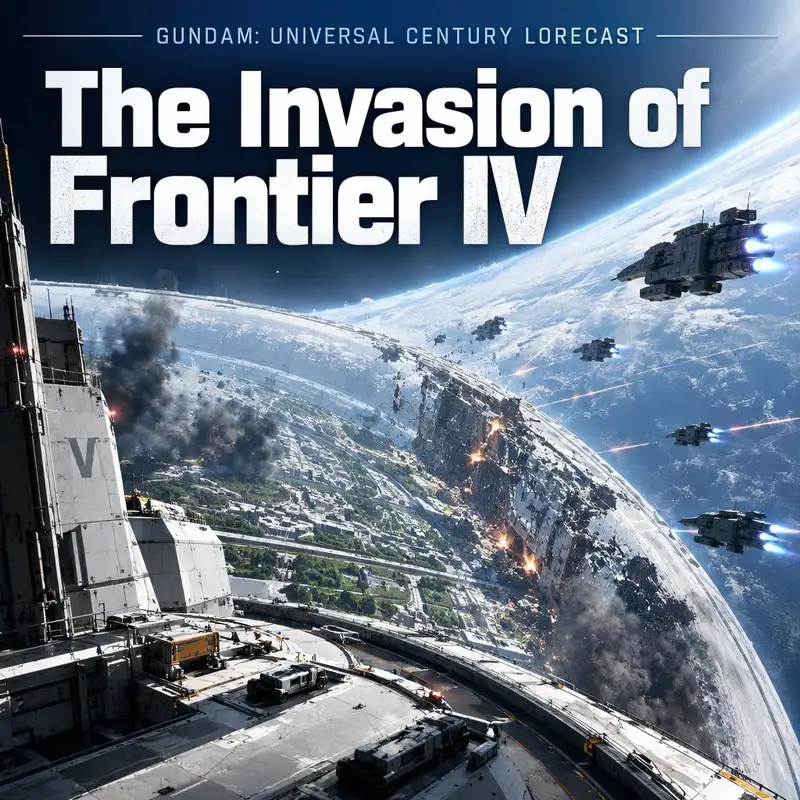
The Invasion of Frontier IV
On March sixteenth, Universal Century one hundred twenty-three, Frontier IV was not prepared to become a battlefield. Its residents were living the ordinary life of a colony. Students gathered for a school event. Families moved through public spaces built for work, education, shopping, and transit. The colony was part of Frontier Side, one of the newer settlements of the Earth Sphere, and it existed because people still believed that a managed civilian life could continue beyond Earth.
Then mobile suits appeared in that civilian world. The Crossbone Vanguard attacked with a speed that turned familiar streets and public facilities into terrain for evacuation, concealment, and panic. Seabook Arno was not a soldier at that point. He was a student trying to survive alongside classmates who had expected a public occasion, not a military assault. That distinction matters. Frontier IV did not fall in an empty sector where fleets could exchange fire at a safe distance. It was attacked where civilians lived.
A colony is not simply a large piece of military infrastructure. It is a pressurized habitat, a transportation network, a power system, a place of work, and a political community. Fighting inside one imposes constraints on everyone involved. Defenders cannot use every weapon as though they were fighting in open space. Attackers who move through civic districts create confusion even when they are not deliberately targeting civilians. Residents must decide where safety lies without knowing which routes remain open, which authorities still have control, or whether the next explosion means combat, structural damage, or the beginning of an evacuation.
That was the first achievement of the Crossbone Vanguard attack. Before it had secured the colony politically, it disrupted the habits that made civilian government possible. People could no longer assume that public institutions knew where danger was, that transportation would operate normally, or that the Earth Federation Forces could establish a protective perimeter. The invasion was not merely an encounter between mobile suits. It was an assault on the ability of a colony to remain an ordered society.
The shock of the attack was deliberate, but it was not improvised. Long before Crossbone Vanguard machines entered Frontier IV, the Ronah family had been preparing a political project that required military force. The question is not simply why the Federation’s local defenders lost a fight. It is why an aristocratic organization had the means, doctrine, and confidence to turn a populated Federation colony into the opening stage of a new state.
Frontier IV offered that stage. It was part of a developing colony side rather than an isolated military outpost. Taking it meant interrupting civilian administration, controlling routes of movement, and establishing a physical foothold within Frontier Side. The exact industrial and military value of the colony is not fully defined by the film, and there is no need to invent a detailed economic map. Its importance was political and operational. It was an inhabited place whose capture could demonstrate that Federation control was no longer dependable.
The Federation had not ceased to be a major power by Universal Century one hundred twenty-three. It still possessed military institutions, industrial capacity, research programs, and a political presence across the Earth Sphere. The problem was that these advantages did not automatically translate into strong frontier defense. The Federation had spent decades responding to crises after they erupted. It had also reduced costs and adjusted procurement around assumptions shaped by an extended period without a major conventional war of this kind.
The mobile suits present around Frontier IV reflect that problem. The Jegan had served as a long-running Federation design, updated over time but increasingly outmatched by newer developments. That does not mean every Jegan pilot was incompetent, or that the machine had no value. A mature mass-production design can remain useful because it is familiar, supportable, and available in numbers. But military value is relative. A machine adequate for routine security and limited conflict can become dangerously insufficient when confronted by an opponent built for a faster and more demanding form of combat.
Frontier IV revealed that gap sharply. The Federation had the capacity to innovate, but it had not translated innovation into a sufficiently modern and ready local shield. It had forces, but the available forces were not prepared to impose control before the Crossbone Vanguard established the tempo of the battle. The issue was not that the Federation had no weapons. It was that its defense posture had been shaped by peace, austerity, and an expectation that the next emergency would resemble the last one.
The Crossbone Vanguard, by contrast, had built its forces for the kind of fight it intended to start. Its mobile suits were smaller and more contemporary than the Federation machines they faced. That reduction in size was not just an aesthetic decision. Smaller mobile suits could offer a difficult combination of mobility, protection, and compactness. In the confined and cluttered environment of a colony, those characteristics could matter immediately.
The Denan Gei provides the clearest example. In the film’s early combat, a Denan Gei defeats a Federation Jegan. That single encounter should not be treated as a laboratory test proving that every Crossbone Vanguard machine would always defeat every Federation machine. Combat does not work that way. Pilot skill, position, surprise, support, damage, and mission all matter. But the engagement illustrates a genuine shift. The Vanguard’s machines belonged to a more advanced generation of mobile-suit development than the Federation’s local defenders.
The significance of compact mobile suits was especially clear within a colony. A colony interior is not open ocean, open desert, or empty orbital space. Lines of sight can be interrupted by structures. Civilian facilities restrict maneuver. A defender may hesitate to fire because a miss could destroy critical infrastructure or kill residents. An attacker willing to move quickly through that environment can force decisions faster than the defender can safely make them.
Still, technology alone does not explain Frontier IV. If the Crossbone Vanguard had arrived without operational surprise, disciplined command, or a political plan for occupation, its better machines might have won engagements without producing a rapid seizure of the colony. Newer equipment creates an edge. It does not substitute for organization. The Vanguard succeeded because it combined technological advantage with a clear purpose and a force structure prepared to act on that purpose.
The opening assault exposed a failure of warning and response. The Federation did not necessarily know nothing about the Crossbone Vanguard. The problem demonstrated by the attack was more immediate and more serious. The local defense system failed to detect, interpret, or counter the operation before armed mobile suits were already moving through Frontier IV’s civic environment. By the time the colony understood that it was under major attack, the attacker had already gained the initiative.
Minovsky-era warfare complicated every part of this problem. Particle interference could degrade long-range detection and communications, increasing the value of visual identification, local command judgment, prearranged procedures, and forces already positioned to respond. But Minovsky particles were not a universal excuse for military failure. They did not make all sensors blind or all communication impossible. They made command and control harder, which meant a prepared force had an even greater advantage over an unprepared one.
Inside Frontier IV, the Federation faced the worst possible version of that challenge. It needed to identify hostile units in a crowded civilian environment, coordinate defenders, protect evacuation routes, and avoid turning the colony itself into a casualty-producing weapon. A mobile suit cannot simply fire freely through streets, transit corridors, and public facilities. A warship cannot solve the problem from a distance. Even a capable commander would have faced severe constraints once the fighting had already entered the colony.
The Crossbone Vanguard benefited from the reverse condition. It had entered the operation with an offensive plan and a political objective. Its commanders and units knew that rapid control mattered. The Federation’s defenders were reacting to an event that had disrupted their communications, their freedom of maneuver, and their relationship with the civilian population they were supposed to protect. Under those conditions, every delay favored the invader.
For that reason, the fall of Frontier IV should not be reduced to a simple comparison of machine specifications. A Jegan facing a Denan Gei was part of the story, but not the whole story. The Federation’s local force was fighting with older or compromised systems while trying to establish order after order had already broken down. The Vanguard’s units were using better contemporary machines within an operation designed to create confusion, isolate resistance, and seize the political center of gravity before the Federation could recover.
The immediate result was not merely a military setback. It was the breakdown of ordinary governance. Civilian institutions cannot function normally when public routes are uncertain, security forces are engaged in combat, and residents are being told to flee. The operation displaced people from homes, interrupted services, separated groups, and made survival dependent on information that was incomplete or unavailable. The colony’s inhabitants did not need a constitutional lecture to understand that Federation protection had failed. They experienced that failure in the most direct way possible.
Official Universal Century chronology records that more than five hundred Frontier IV residents were killed and that approximately one hundred forty thousand people were evacuated. Those figures should be treated carefully. They are official reference data, not a fully transparent battlefield accounting that allows us to reconstruct every death, injury, or route of flight. But their scale is important. The invasion was not a clean transfer of authority between military organizations. It was a mass displacement event.
Evacuation is often described with sterile language. It can sound like a successful administrative procedure, a line on a situation report, or a number added to a chronology. In reality, evacuation means leaving home under uncertain conditions. It means that schools, workplaces, and neighborhoods cease to be secure. It means people must decide what to carry, whom to wait for, and whether the route they have been given is still safe. In a colony, where life depends on systems that usually remain invisible, the disruption of transport and public order can become frightening very quickly.
The Frontier IV attack also demonstrates the logistical burden of protecting civilians during war. Evacuation requires usable routes, communication, transport capacity, personnel who can direct movement, medical support, and enough security to prevent panic from becoming catastrophe. None of those systems can be assumed to function perfectly once combat begins. The fact that so many people were evacuated indicates an effort to move a large population. It also indicates how completely the invasion transformed the colony’s civil life.
For the Federation, this was a political failure as well as a humanitarian one. Governments derive legitimacy not only from constitutions, speeches, or historical claims, but from their ability to protect people in moments of danger. Frontier IV’s residents saw the Federation’s defenses fail before the attacker’s political program had even been fully announced. That did not make Cosmo Aristocracy legitimate. It did make the Federation look hollow at the point where its authority needed to be tangible.
In that atmosphere of fear, confusion, and displacement, Cecily Fairchild’s capture acquired meaning beyond the fate of one civilian. Cecily was separated from the evacuation group and taken by Crossbone Vanguard personnel. To those around her, she was a friend and fellow student caught in an attack she had not chosen. To the Ronah family, she was Bera Ronah, Meitzer Ronah’s granddaughter and a figure of dynastic importance.
Her identity transformed the operation’s political character. The Crossbone Vanguard had not only seized terrain. It had recovered a member of the family whose name and lineage could be used to support the new regime’s claim to authority. This is one of the clearest signs that the invasion was planned as state formation rather than military adventurism. A conventional raiding force might seize supplies, destroy defenses, or withdraw. The Vanguard wanted to establish a political order, and political orders often rely on symbols as much as on weapons.
Cecily’s position must be understood in both dimensions. She was not merely a ceremonial asset, and she was not merely an abstract victim. She was a young person caught between the life she had known and a family identity that the invading force treated as politically useful. Her capture shows how authoritarian projects convert private identity into public property. Family, inheritance, and personal history become resources to be organized by those who claim the right to rule.
The Ronah project needed Bera because Cosmo Aristocracy depended on more than a military victory. It needed the appearance of continuity, lineage, and a ruling house capable of embodying the state. The use of Cecily’s identity gave the occupation a dynastic face. It allowed the Vanguard to frame conquest as restoration, as though the arrival of the Ronah family represented the natural emergence of a better political order rather than the seizure of a civilian colony through armed force.
For that reason, Cecily’s capture belongs in the military history of Frontier IV. It was part of the invasion’s civil-military design. The operation joined battlefield action to political theater. The Vanguard was not simply fighting Federation mobile suits. It was arranging the personnel and symbols needed to make an occupation look like a founding event. The soldiers who took Cecily were participating in a campaign whose objectives extended from tactical control to legitimacy.
Her recovery was also not an improvised act of family sentiment. It was embedded in the priorities of the invading command. Carozzo Ronah, known as Iron Mask, led the Crossbone Vanguard’s military arm. He was Meitzer’s son-in-law and Bera’s father, placing him at the intersection of family authority and military command. That relationship did not make the operation less organized. It shows how deeply dynastic politics had been built into its structure.
Dorel Ronah, Carozzo’s son and a Crossbone Vanguard officer, was assigned to recover Bera during the Frontier IV operation. Official character material identifies Dorel as commanding a fifteen-machine battalion. That is a useful detail because it places him within an actual military formation rather than treating him solely as a member of a ruling family. The Ronahs did not rely on bloodline alone. They created an armed organization in which family members held operational responsibilities.
At the same time, the presence of Dorel does not justify inventing exact orders, routes, or tactical conversations that the film does not establish. We do not need those details to understand the larger point. The recovery of Bera was important enough to be assigned within the campaign. The Vanguard considered her a priority because the success of Cosmo Babylonia required more than territorial control. It required a visible dynasty.
Zabine Scharf’s role reinforces the same conclusion. As commander of the Black Vanguard, an elite Crossbone Vanguard formation, Zabine participated in the Frontier Side suppression operation that began with the assault on Frontier IV. His involvement indicates that the Vanguard committed experienced and important personnel to the campaign. This was not a local uprising that happened to obtain a few advanced mobile suits. It was a coordinated operation conducted by an organization with command cadres, elite formations, and a defined political mission.
The division of authority was clear enough in broad terms. Meitzer Ronah supplied the ideological and political purpose. Carozzo commanded the military instrument. Dorel operated within the invasion force while carrying the particular task of recovering Bera. Zabine led an elite combat formation that helped give the Vanguard its sharp military edge. The exact boundaries of every order are not fully available, but the structure shows that the attack was designed to seize a colony and exploit that seizure immediately.
Command cohesion mattered as much as technical superiority. A military organization can possess advanced equipment and still fail if its political leaders, field commanders, and combat units are working at cross-purposes. The Crossbone Vanguard avoided that problem in the opening phase. Its leaders shared a common objective. The military campaign was not separate from the political project. It was the means by which the project would become real.
That unity of purpose helped turn the occupation of Frontier IV into the proclamation of Cosmo Babylonia. The colony became the first platform from which Ronah authority could be presented as a new political reality. The occupation gave the Vanguard a place to stand, a population to control, and a setting in which the dynasty could display its claim to leadership.
The subsequent chronology confirms that Frontier IV was the beginning of a larger campaign, not its final objective. Attacks on Frontier II and Frontier III began on March nineteenth. Their subjugation was recorded by March twenty-second. On March twenty-six, Cosmo Babylonia was formally declared at Frontier IV. These dates should not be treated as proof that every aspect of the campaign proceeded smoothly or that every colony accepted the new order. They do show that the seizure of Frontier IV was part of a preexisting plan for Frontier Side.
The declaration was politically significant because it converted military occupation into a claim of statehood. But a declaration is not legitimacy. A flag, a dynasty, and a disciplined army can create the appearance of constitutional rebirth. They cannot demonstrate that the population has consented to the new regime. The people of Frontier IV had just endured an attack, civilian deaths, evacuation, and the collapse of the institutions that had organized their lives. There is no basis for treating that condition as a free endorsement of Cosmo Aristocracy.
This was political warfare in its most recognizable form. The Vanguard used force to create facts on the ground, then used those facts to support a narrative of rightful rule. The Ronah family could argue that the Federation had failed and that a more capable elite had taken responsibility. But the sequence matters. The Vanguard did not receive authority and then defend the colony. It attacked the colony, displaced its residents, and then announced authority over the resulting disorder.
Frontier IV therefore functioned as both a military foothold and a propaganda platform. It demonstrated that the Vanguard could defeat local Federation resistance. It also demonstrated that the Federation could not prevent a rival political order from establishing itself inside a civilian colony. The later expansion to Frontier II and Frontier III made that first success more important. It showed that the attack had not been a symbolic gesture. It was the opening phase of territorial consolidation.
Measured tactically, the Vanguard succeeded. Federation local resistance was overmatched by a force that possessed better contemporary mobile suits, offensive initiative, and stronger command cohesion. The defenders faced an opponent whose systems and doctrine were better suited to the immediate fight. But tactical success alone does not explain the operation’s historical significance.
At the operational level, the Vanguard gained an opening foothold in Frontier Side and disrupted Federation control of a populated colony. It forced the Federation into reaction. It created routes, facilities, and political space from which further action could be organized. It also demonstrated that the Federation’s local security posture was insufficient against a determined modern assault.
At the strategic level, Frontier IV opened the wider campaign that led to the declaration of Cosmo Babylonia. It proved that the Ronah project had moved beyond ideology and preparation into the physical seizure of territory. The invasion made the Vanguard a power that the Federation could no longer dismiss as a marginal organization. It had established itself through action, not rhetoric.
Politically, however, success remained incomplete. The Crossbone Vanguard could proclaim a state, but proclamation did not resolve the question of who accepted Ronah rule, who feared it, who resisted it, or how a supposedly exemplary aristocracy would govern people who had not chosen it. Its military effectiveness gave Cosmo Aristocracy an opening. It did not prove that aristocracy was just, stable, or broadly legitimate.
For civilians, the cost was immediate and unmistakable. Official records of deaths and evacuation capture only part of the damage. The deeper injury was the destruction of normal life. Residents were forced to abandon homes, lose contact with familiar institutions, and live under the consequences of a struggle between a decaying Federation system and an authoritarian challenger. They did not receive the benefits promised by either side in the moment of invasion. They received danger, displacement, and uncertainty.
The aftermath also revealed the weakness of the Federation’s available response. Space Ark, an aging training ship, became a refuge and later an improvised resistance asset. Its role should not be exaggerated into a complete account of the subsequent campaign. But its existence is revealing. When formal colonial defense had failed, an older vessel and the people able to use it became part of the practical response. That is a measure of the gap between institutional authority and actual capability.
Frontier IV did not fall because the Federation had vanished, or because every Federation soldier was ineffective, or because one Crossbone Vanguard machine possessed miraculous powers. It fell because the Vanguard attacked a vulnerable point with a coherent political objective, modern local combat systems, prepared command cadres, and the initiative. The Federation, despite its size and resources, could not translate its formal strength and advanced research into immediate protection for the colony under attack.
That failure was rooted in late Universal Century decay, but decay should be described precisely. The Federation’s problem was not simply corruption as a slogan. It was the erosion of readiness, the mismatch between procurement and threat, the difficulty of maintaining capable local defense across a vast sphere, and the loss of political credibility that follows when citizens learn that their government cannot protect them in a crisis. A state can retain laboratories, fleets, and official authority while losing the ability to make those assets matter at the place and time of danger.
The Crossbone Vanguard exploited that gap ruthlessly. Its leaders had prepared an armed organization around a shared political purpose. Its machines were designed for a changing era of mobile-suit combat. Its commanders could turn military movement into occupation. Its dynastic structure allowed it to convert Cecily Fairchild’s identity as Bera Ronah into a symbol of supposed constitutional renewal. It used competence in war to make authoritarian rule appear like an answer to disorder.
But the invasion of Frontier IV was not evidence that Cosmo Aristocracy was effective in any moral or democratic sense. It was evidence that disciplined authoritarian movements can exploit governments that have become distant from the people they claim to protect. The Vanguard did not solve Frontier IV’s political problems through consent. It created a new political order by force, then asked the colony to recognize the force as legitimacy.
The people of Frontier IV paid for both failures. They paid for a Federation that had allowed the connection between defense, readiness, and civilian trust to weaken. They also paid for a Vanguard that regarded a living colony as the foundation stone of a dynastic state. More than the machines, more than the banners, and more than the Ronah family’s claims, that is the enduring meaning of the invasion. Frontier IV showed how quickly a government’s empty authority can become an opening for conquest, and how often civilians bear the cost when power fails before ambition does.