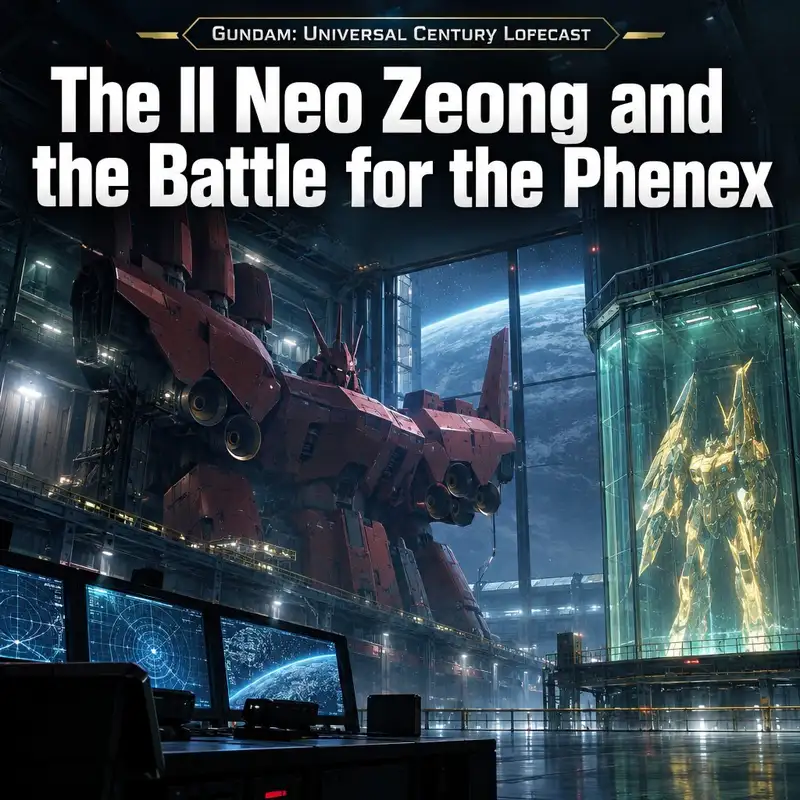
The II Neo Zeong and the Battle for the Phenex
At the Side Six helium-three storage facility, the immediate danger was not simply that two extraordinary mobile suits had found each other. The danger was that a mobile armor built for coercion had lost the boundary between combat and catastrophe. Helium-three storage was part of the Earth Sphere’s energy infrastructure, tied to the movement and use of fusion fuel. It meant workers, transport routes, maintenance crews, and nearby habitats depended on the installation remaining intact. When the II Neo Zeong turned its power toward that complex, the battle ceased to be a hunt for a missing weapon. It became an emergency in which an industrial site and everyone dependent upon it could be caught between rival governments, a corporation, and a machine no one truly understood.
That was the final contradiction of the Phenex pursuit. Several organizations had entered the operation hoping to capture an asset. Each believed that possession would create security, leverage, or knowledge. Instead, their competition brought an unstable Cyber Newtype, an improvised psycho-frame mobile armor, and a missing Unicorn-type machine into the same confined strategic space. The conventional forces present could still fight. They could launch, screen, evacuate, recover damaged machines, and limit some of the destruction. But they could not turn the crisis back into the orderly recovery mission it had supposedly been. By the time the II Neo Zeong was unleashed, ordinary command had already failed.
The Phenex had been missing for roughly two years by Universal Century ninety-seven. It was the third Unicorn unit, a machine built around psycho-frame technology and associated with the same family of systems that had become politically radioactive after the Laplace Incident. Its disappearance followed a test-related accident. Its pilot, Rita Bernal, was officially missing. Yet the Phenex continued to reappear in the Earth Sphere, moving and fighting in ways that made it impossible to dismiss as a conventional lost prototype.
One year earlier, the Laplace Incident had exposed the buried Newtype provisions of the original Universal Century Charter. That revelation had immense symbolic importance, but it did not remake the Earth Sphere’s political order. It did not dissolve the inequalities between Earth and the colonies. It did not suddenly make the Earth Federation more transparent, nor did it eliminate the competition among political elites, military offices, and industrial patrons. The public meaning of Newtypes remained contested. The military meaning of Newtype technology remained tempting. And psycho-frame, especially after the events associated with the Unicorn Gundams, had become something more dangerous than a normal weapons program.
The Earth Federation Space Force supplied the overt military structure. The cruiser Damascus carried the Shezarr Team, commanded by Iago Haakana, along with the personnel, maintenance systems, communications, launch facilities, and armed protection necessary to pursue the Phenex. Captain Aberef commanded the ship. Jona Basta, a Federation ensign, was sent into the operation in the Narrative Gundam. On paper, that arrangement offered a recognizable chain of command. A Federation vessel, a Federation mobile-suit team, and a formal military objective. In practice, Michele’s access, her knowledge of the Phenex, and her personal connection to Rita gave her influence that did not fit neatly into a naval command structure.
Michele wanted the Phenex secured. That objective had political and corporate dimensions, but it also had a personal one. Rita Bernal was not an abstract research subject to her. Jona was not merely another pilot assigned to a difficult sortie. Their shared past made Operation Phoenix Hunt more than a classified recovery effort. Yet personal commitment did not make Michele’s intervention illegitimate by itself. It did mean that the mission carried emotional pressures that could not be reduced to orders, target folders, and command charts. The operation was built around secrets, and secrets tend to create competing loyalties.
The Federation’s problem was not that it had no military capacity. Damascus and the Shezarr Team represented the ordinary machinery required for space operations. A mobile suit cannot pursue a target indefinitely without transport, maintenance, spare parts, weapons support, intelligence, and recovery planning. The ship mattered. Its crew mattered. The technicians who kept machines ready mattered. The command staff attempting to identify a rapidly changing threat picture mattered. But the more closely the mission depended on restricted information and private influence, the harder it became for those ordinary military systems to function with confidence.
The Republic of Zeon entered that weakness through deniability. By Universal Century ninety-seven, the Republic was not the old Principality of Zeon, and it was not the Sleeves. The Sleeves had been broken as a major force after the Laplace Incident. Their symbols, however, remained useful. A disguised warship could wear the appearance of a Sleeves vessel and direct suspicion toward a defeated remnant movement rather than toward officials of the Republic itself. In the short term, that disguise offered political cover. In the long term, it ensured that any crisis would begin with confusion over identity and responsibility.
Foreign Minister Monaghan Bahanar sponsored the Republic’s covert intervention. His goal was not a straightforward declaration of war against the Federation. The Republic wanted leverage over the Phenex and over the technology associated with it, while preserving the ability to deny responsibility if the operation went wrong. The disguised Gultop became the instrument of that policy. It carried a force that could intervene against the Federation hunt while allowing the Republic’s senior political leadership to pretend that another Zeon-associated group had acted independently.
This was not cleverness in the durable strategic sense. It was crisis management deferred until the crisis arrived. Deniable operations often appear efficient because they allow leaders to pursue risky objectives without public debate or formal responsibility. They also degrade identification, authentication, and coordination. A Federation commander confronting what appears to be a Sleeves attack must make decisions based on that information. A Republic official operating behind a disguise may avoid immediate exposure, but loses the ability to direct events openly once circumstances change. The very secrecy that protects the policy makes it harder to control.
At the center of the Republic’s operation was Zoltan Akkanen, a captain and Cyber Newtype assigned to the Sinanju Stein. The Sinanju Stein was not merely a powerful mobile suit in search of a pilot. It carried political associations with the earlier struggle over Full Frontal and Neo Zeon symbolism. Zoltan was himself shaped by that history. He had been developed as another attempt to produce a figure who could serve as a successor to Char’s military and political image. That effort did not create a stable leader. It created a man expected to bear an impossible symbolic burden for the benefit of people above him.
Erik Hugo accompanied Zoltan as both military associate and monitor. That role is revealing. The Republic’s covert apparatus knew Zoltan was a risk. It did not treat him as a routine officer who could be trusted with wide discretion. Yet the same apparatus still placed him in the center of an operation involving the Phenex and a rebuilt psycho-frame mobile armor. This was not simply an individual failure of judgment. It was an institutional decision to use a vulnerable and manipulated person as a high-performance military instrument while assigning someone nearby to watch for the consequences.
Zoltan still made choices. His destructive actions cannot be excused merely because he was exploited. But responsibility did not stop with the man in the cockpit. Monaghan’s operation, the officials who authorized it, and the military channels that accepted its terms all treated Zoltan’s instability as an acceptable risk. They had a monitor because they understood the danger. They proceeded because the potential value of the Phenex and psycho-frame leverage mattered more to them than the reliability of the person entrusted with the weapon. That is not a failure of temperament alone. It is a failure of oversight, command, and political responsibility.
Possession of components is not the same thing as mastery. A military organization may recover spare parts, stored assemblies, and technical knowledge from an earlier project. That does not mean it has restored the original production base, testing regime, trained maintenance crews, supply chain, or doctrine. Rebuilding a weapon is easier than proving that it can be safely deployed. The II Neo Zeong was therefore an improvised strategic asset. It had been given the appearance of decisive power without the institutional foundation that makes decisive power dependable.
Its wired guidance systems gave its arms a remote-control function reminiscent of the Zeong concept. That feature mattered because it expanded the area the machine could threaten. The II Neo Zeong was not limited to the direct reach of a single mobile suit’s weapons. It could project attacks through its massive structure and guided limbs, creating danger for mobile suits, ships, and fixed infrastructure at the same time. It was a system designed to turn one pilot-machine connection into influence across a much wider battlefield.
That did not make the II Neo Zeong invulnerable. It made it difficult to fight around. A conventional mobile suit can be dangerous, but it remains a relatively compact weapon system. It requires a pilot, ammunition or energy, propellant, maintenance, and a supporting ship or base. A mobile armor of the II Neo Zeong’s scale carries greater reach and greater destructive potential, but it also creates larger requirements. It must be transported, concealed, assembled, maintained, supplied, and integrated into a command plan. Every one of those tasks becomes more difficult when the operation itself is covert.
The II Neo Zeong also changed the political stakes. A Republic force operating a disguised vessel could claim plausible deniability while pursuing the Phenex. Once it deployed a mobile armor visibly associated with the legacy of Neo Zeon and Full Frontal, that deniability became increasingly fragile. The weapon was too large, too distinctive, and too dangerous to remain merely a classified contingency. It was the kind of system that could produce a short-lived tactical advantage while exposing the political choices that had brought it to the field.
The Republic’s gamble depended on Zoltan being able to command the machine. That assumption confused access with control. A pilot may be compatible with a psycommu system. A Cyber Newtype may be able to operate interfaces that ordinary personnel cannot. Neither condition guarantees sound judgment under stress. Neither guarantees that a psycho-frame system will remain within expected parameters. And neither turns a weapon designed around trauma, symbolism, and classified research into a stable instrument of national policy.
Three improvised systems converged during the Phenex pursuit. The Phenex was the missing objective, a Unicorn-derived machine whose behavior repeatedly escaped ordinary expectations. The Narrative Gundam was a psycho-frame testbed refurbished for Operation Phoenix Hunt. The II Neo Zeong was a rebuilt reserve-parts mobile armor intended to seize strategic leverage through overwhelming presence. None of these systems represented normal frontline force structure. None could be understood simply by comparing firepower, speed, or armor. Their importance came from what institutions expected them to achieve.
The Narrative Gundam illustrates the difference between a testbed and a mature combat system. It had not been developed as a standard Federation frontline machine. It was a platform connected to psycho-frame research, then adapted and refitted for the hunt. Its C-Packs configuration incorporated psycho-frame material associated with the Unicorn line. That gave Jona a machine suited to the specific problem the mission anticipated, but it also underscored the operation’s dependence on scarce parts, specialized knowledge, and a pilot with an unusual relationship to the target.
A prototype can be useful precisely because it does something ordinary equipment cannot. It can also become a burden because no larger support system exists behind it. A mass-production mobile suit can be replaced, repaired through established channels, and operated by a broad pool of trained pilots and technicians. The Narrative Gundam did not offer that kind of institutional resilience. Its value was tied to a narrow mission, a narrow technical lineage, and a narrow group of people. When it was committed against the II Neo Zeong, it was not entering a normal unit-on-unit engagement. It was entering a crisis where every major machine was exceptional, scarce, and difficult to sustain.
The Phenex was even less manageable. The Federation and Luio and Company wanted it recovered, but the film’s events make clear that it could not be treated as a cooperative aircraft returning to base. It was associated with Rita, with the trauma and experimentation surrounding the children from the Republic of Zeon’s past, and with phenomena that observers could witness without being able to explain. It appeared to respond to circumstances and people in ways that no command authority could reliably direct. The machine was the object of the operation, but it was never fully under the operation’s control.
When those three systems came together near the Side Six facility, the result was not a clean duel between rival prototypes. It was the collision of research programs, personal histories, covert policy, and incomplete doctrine. Every participant had entered the hunt believing that the Phenex could somehow be acquired. The Federation hoped to capture it. Michele hoped to reach Rita through it. The Republic hoped to turn it into leverage. Zoltan hoped, in his own damaged way, to prove that he could seize the role others had demanded of him. The II Neo Zeong made all of those ambitions physically dangerous.
The location made restraint essential. A helium-three storage facility is not an empty patch of space suitable for a weapons demonstration. It is an industrial installation. Its value depends on workers, transport systems, storage arrangements, maintenance, security, and links to a larger energy economy. Even without assigning unsupported numbers to its stores or personnel, the basic military problem is clear. Damage to such a site could disrupt more than one battle. It could endanger people on the installation, threaten surrounding traffic, and create consequences for civilian infrastructure that no tactical victory could justify.
Combat near the facility imposed constraints on every force present. Weapons fire could damage the structures the Federation was ordered to protect. Debris from disabled mobile suits or destroyed components could create additional hazards. A large mobile armor had limited room to maneuver without placing the installation under direct threat. Ships and mobile suits attempting to intervene had to balance their own survival against the need to prevent an escalation. The defenders could not simply employ the greatest available firepower and hope that the facility survived the solution.
The original capture mission effectively collapsed. Its tactical objective had been to secure the Phenex. Its operational framework assumed that a specialized team, a support ship, and a carefully managed pursuit could bring the target under custody. Once the II Neo Zeong began to threaten the facility, the mission changed. Containment replaced capture. Protecting the installation and the people around it became more urgent than recovering an extraordinary machine intact. The Federation’s forces had to delay, screen, and absorb risk while trying to prevent one dangerous system from turning into a wider disaster.
That change also exposed the costs of divided authority. A mission with one clear commander may still fail, but it has a defined process for adapting to failure. Operation Phoenix Hunt had too many competing claims. Michele’s private objectives mattered. Federation military requirements mattered. The Republic’s deniable intervention mattered. Zoltan’s instability mattered. The Phenex’s behavior mattered. No one had designed a command structure capable of integrating all of those realities. The battle became dependent on individual initiative because the larger institutions had already surrendered their ability to direct events coherently.
Michele’s final decision must be understood within that failure. Her sacrifice is tactically significant, but it should not be reduced to a simple moment of redemption. She had helped drive the hunt. She had used her access and influence to keep the Phenex at the center of a dangerous operation. Her motives included love, regret, and a desire to find Rita, but those motives existed alongside an effort to secure a politically valuable machine. By the final battle, that pursuit had placed Jona, the Federation force, and the Side Six facility at risk.
When Michele acts to protect Jona and disrupt the II Neo Zeong’s attack, the act opens a narrow space for survival. It matters because it prevents the crisis from tightening around the Federation force at its most vulnerable moment. It also matters because the stakes are larger than Jona alone. A successful attack on the Federation units could have left the mobile armor freer to menace the facility and its surrounding infrastructure. Michele’s intervention therefore has a tactical and humanitarian effect.
Banagher Links arrived in the Silver Bullet Suppressor at the point when that opening mattered. His arrival did not mean that the Federation had restored a complete Unicorn program, or that any government had recovered a reliable doctrine for psycho-frame warfare. Banagher brought experience. He had encountered the consequences of psycho-frame systems before, and he understood better than most participants that they could not be reduced to ordinary weapons specifications. That experience made him useful. It did not make him omniscient.
The Silver Bullet Suppressor’s significance was practical. It gave Banagher a means to intervene in the battle and help create the access Jona needed. The machine was not a magical answer to the II Neo Zeong. It was another specialized system operating within a larger network of ships, crews, maintenance, and tactical necessity. Banagher could help shift the immediate situation. He could not issue an order that made the Phenex obedient, explain every psycho-frame effect, or restore conventional command over a battle that had moved beyond conventional control.
The distinction matters because the final resolution is sometimes remembered as though one experienced pilot arrived and solved the problem. The film presents something less comfortable. Banagher’s intervention is essential, but it only creates the conditions for Jona to move beyond the ruined Narrative Gundam and reach the Phenex. The decisive event still depends on Jona, Rita, the Phenex, and a phenomenon outside the reliable authority of every organization present. Experience can make a person better prepared for the unknown. It does not make the unknown into doctrine.
Jona’s transfer from the heavily damaged Narrative Gundam to the Phenex marks the point at which the hunt’s original purpose is reversed. The Federation, Luio and Company, and the Republic had all pursued the Phenex as an object. They wanted to seize it, study it, exploit it, or deny it to rivals. Jona reaches it not because an institution successfully captures the machine, but because the battle has stripped away nearly every other option. His access comes through loss, damage, sacrifice, and the collapse of the operation’s original plan.
The relationship among Jona, Rita, and Michele must be handled carefully. The film depicts experiences of connection, memory, trauma, and apparent presence that are inseparable from the Phenex and psycho-frame phenomena. The characters experience those events as real and consequential. They guide choices, shape grief, and make possible the final confrontation. But the film does not provide a settled scientific explanation that can be converted into a standard military lesson. It does not establish a reproducible process through which a dead pilot can be restored, a consciousness can be stored in a machine, or a psycho-frame system can be made to produce the same result on command.
What it does establish is militarily devastating in a different way. The Phenex responds within a web of human experience that no corporation, government, or research bureau can reliably own. The machine everyone sought to control reveals itself as responsive to conditions beyond their command systems. This does not make psycho-frame technology meaningless. It makes it more dangerous. A weapon whose effects depend on rare personal connections, trauma, resonance, and uncertain consciousness cannot be treated as a normal strategic asset. It cannot be scheduled, standardized, or safely placed into a procurement chart.
Newtype phenomena are often attractive to military institutions because they appear to offer an advantage over uncertainty. Better awareness, faster reaction, more direct communication, and deeper perception all seem useful in combat. The events around the Phenex show the opposite side of that promise. Empathy and perception do not produce stable obedience. Trauma does not become harmless because it has tactical value. A system that reaches into memory, identity, and human connection may produce extraordinary results, but it also carries consequences no staff officer can fully calculate.
Zoltan’s final actions underline that failure. He separates from the II Neo Zeong and continues the confrontation through the Sinanju Stein. This is not merely a change of machines. It reduces the scale of his physical weapon while preserving the political and psychological conflict that had driven him. Zoltan had been used as an instrument by officials seeking leverage. He had been measured against a symbolic standard he could never safely inhabit. When the II Neo Zeong no longer serves as the vehicle for that ambition, he still pursues the Phenex through the Sinanju Stein.
The Phenex defeats the Sinanju Stein. That is the immediate tactical result. But the more important outcome concerns the II Neo Zeong and the facility around it. The mobile armor is subsequently neutralized or consumed in a massive psycho-frame event associated with the crisis at the helium-three storage complex. The film shows an event beyond the technical comprehension of the people involved. It is visible. It is consequential. It stops the immediate threat. Yet it cannot be honestly reduced to a known weapon effect, a measured energy discharge, or a procedure that another force could reproduce next month with the right parts and pilot.
The physical mechanism remains unresolved. The event should not be described as proof of unlimited energy, routine matter manipulation, time travel, or a settled model of life after death. None of those explanations are required to understand its historical significance. What matters is that the combatants cannot command the phenomenon through normal military methods. The Federation cannot order it. The Republic cannot weaponize it in the moment. Luio and Company cannot claim it as corporate property. The technical system has produced consequences that exceed the political structures trying to possess it.
At the tactical level, the immediate danger is stopped. The II Neo Zeong no longer threatens the facility as it had moments before. The Sinanju Stein is defeated. The Federation force survives a crisis that could have become far worse. But tactical survival is not the same thing as operational success. Operation Phoenix Hunt fails in its central purpose. The Phenex is not brought under durable custody. The Narrative Gundam is lost. The specialized machine and the specialized mission that had been assembled around Jona are destroyed or dispersed in the very crisis they were meant to control.
At the strategic level, no participant emerges with a stable monopoly over the Phenex or the II Neo Zeong’s capabilities. The Republic’s covert gamble fails to produce secure leverage. The Federation and Luio and Company do not demonstrate that they can contain Unicorn-derived technology through classified recovery operations. The event does not establish a new reliable psycho-frame deterrent. It establishes the opposite. These systems remain exceptional, rare, poorly understood, and bound to human conditions that no institution has mastered.
For that reason, the Battle for the Phenex matters in Universal Century ninety-seven. The Laplace Incident had not removed the political incentives that drove people toward Newtype technology. It had merely made those incentives more difficult to discuss openly. The Charter’s revelation did not resolve the Earth Sphere’s unequal political order. It did not create trustworthy institutions capable of handling extraordinary power. Instead, the struggle over psycho-frame systems shifted into covert procurement, corporate influence, classified projects, and deniable intervention.
The Federation’s role in the crisis was compromised by secrecy and divided authority. It had the formal military structure, but it accepted an operation shaped by private influence and incomplete disclosure. The Republic’s role was compromised by deniability. It sought strategic advantage while attempting to hide behind Sleeves imagery and avoid responsibility for escalation. Luio and Company pursued access to a machine whose implications exceeded any normal corporate interest. None of these institutions were identical. None carried equal responsibility for every act. But all helped create a situation in which possession mattered more than understanding.
The industrial lesson is equally stark. Psycho-frame machines could be assembled, restored, or refurbished under extraordinary circumstances. That did not make them mature military capabilities. The II Neo Zeong was rebuilt from reserve components, not drawn from a standard line of proven systems. The Narrative Gundam was adapted from a testbed, not issued as ordinary equipment. The Phenex itself remained a missing machine associated with an unresolved accident and an exceptional pilot. These were not the foundations of a stable force structure. They were fragile concentrations of knowledge, hardware, and human vulnerability.
The intelligence lesson is that secrecy narrows the very field of vision commanders need in a crisis. Monaghan’s disguise made attribution harder. Michele’s private objectives complicated the Federation’s mission. Zoltan’s condition was managed through monitoring rather than solved through responsible command. The Phenex’s nature was concealed behind classification and uncertainty. Every institution possessed some information. No institution possessed enough shared understanding to control the battle when it changed shape. Secrecy protected individual interests until it became an obstacle to collective survival.
The humanitarian lesson is the simplest and perhaps the harshest. The Side Six facility became a hostage to elite competition over an extraordinary technology. The people who worked there did not choose the terms of Operation Phoenix Hunt. The civilians and infrastructure dependent on its energy role did not volunteer to become collateral in a Republic covert action or a corporate-backed recovery mission. Yet their safety depended on decisions made by officials, advisers, pilots, and researchers far above them. The greatest danger was not only the destruction a mobile armor could cause. It was the willingness of powerful institutions to accept that risk in pursuit of control.
The II Neo Zeong did not fail merely because Zoltan lost a battle. It failed because the governments, corporations, and covert networks pursuing the Phenex tried to turn an unresolved human and technological phenomenon into strategic property. At Side Six, conventional forces contained part of the danger, but they could not command its source. The catastrophe was averted through an extraordinary psycho-frame event, not through institutional competence. In Universal Century ninety-seven, that was not proof that the Earth Sphere had mastered Newtype power. It was proof that its political order was still willing to gamble civilians, soldiers, and unstable people on forces it did not understand.