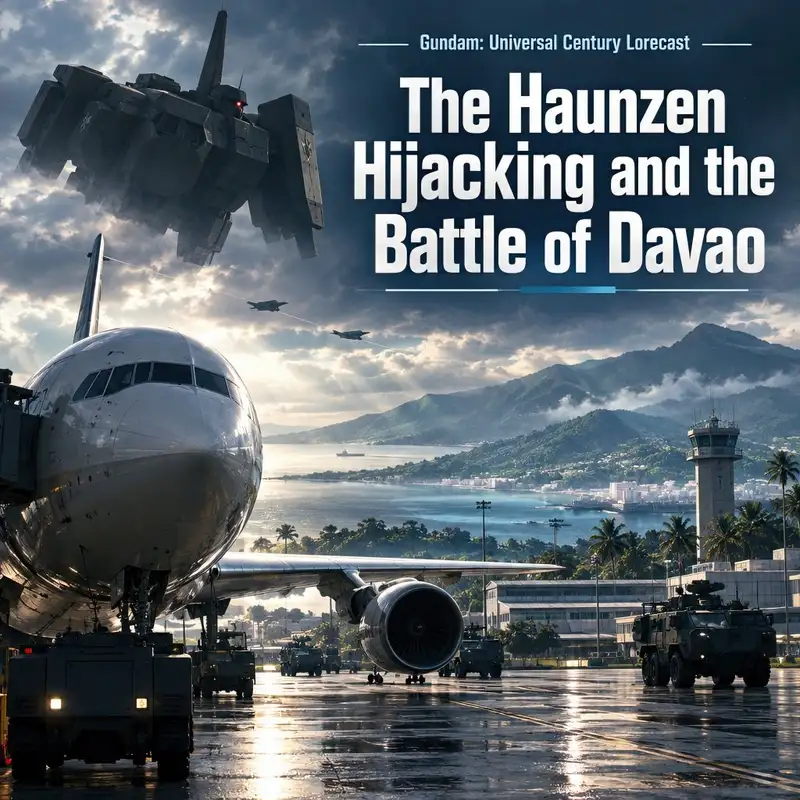
The Haunzen Hijacking and the Battle of Davao
The Haunzen was descending toward Davao under emergency conditions, carrying a cabin full of people who had expected a routine journey from the Moon toward Earth. It was a privileged route. Federation officials, wealthy travelers, and people accustomed to moving through the Earth Sphere with documents, access, and protection were aboard. Minutes earlier, armed hijackers had seized the shuttle in the name of Mafty. Now the hijackers had been stopped. The passengers were alive. And one of the men credited with saving them was Hathaway Noa, publicly a young civilian trainee with an unremarkable cover identity. Privately, he was Mafty Navue Erin, the leader of the organization whose name the hijackers had used.
That contradiction is the key to Davao. Hathaway helped defeat a terrorist seizure carried out under his own movement’s name, then arrived in a Federation-controlled city where the security response threatened to expose him. The hijacking was not his operation. The battle that followed, however, would become one. By the end of the night, Mafty would recover its leader, the Federation would demonstrate the reach of its anti-Mafty forces, two rare atmospheric mobile-suit prototypes would fight over the city, and civilians would pay for decisions made by people who claimed to be protecting them.
The Haunzen incident and the Battle of Davao are often remembered for the arrival of the Xi Gundam and the Penelope. Those machines matter, but they are not the whole history. Davao was a compound crisis. It began with false attribution, moved through an intelligence problem, became an extraction operation, and ended as urban combat. Each participant won something immediate. None solved the political conditions that had made violence useful in the first place.
The hijackers aboard Haunzen Flight 356 claimed Mafty’s name, but they did not belong to Hathaway’s organization. They were associated with the Oenbelli armed movement, using the reputation of Mafty for their own purposes. That distinction is not a technicality. It is the difference between an insurgent political organization and an armed group borrowing its identity, methods, and notoriety. Oenbelli understood that the name Mafty carried weight. It could frighten officials, attract attention, and make a relatively small operation seem connected to a much larger threat.
For the Federation, the fact that the hijackers called themselves Mafty was politically valuable whether or not the claim was accurate. Security institutions do not always wait for complete certainty before acting. The public had heard the name. The passengers had been threatened under that name. Officials could point to the incident as evidence that anti-Federation violence was expanding, becoming bolder, and reaching even the protected transport routes used by the governing class. The gap between what happened and what people believed happened could shape policy just as effectively as the hijacking itself.
Hathaway understood the danger immediately. If the Federation accepted the hijackers as genuine Mafty operatives, his organization would inherit the political consequences. If he acted too forcefully to stop them, he risked exposing training and instincts no ordinary civilian should possess. If he did nothing, people could die, and Mafty’s name would be associated with their deaths. He had to preserve his cover, protect the passengers, and prevent a counterfeit operation from defining the movement he actually commanded.
Kenneth Sleg faced a different version of the same problem. He was a Federation colonel, a former mobile-suit pilot, and an officer assigned to take command of an anti-Mafty force centered in Davao. To him, the Haunzen hijacking was not abstract evidence of instability. It was a live security failure, one involving government travelers and a movement already treated as a serious threat. Kenneth had every professional reason to stop the hijackers. He also had reason to study Hathaway, whose composure and capability did not fit comfortably with the role he claimed to occupy.
The cooperation between Hathaway and Kenneth during the hijacking is important precisely because it is practical rather than ideological. Neither man wants the aircraft destroyed. Neither benefits from hostage deaths. Both act under pressure, with incomplete information, inside a confined civilian environment where a firefight could turn the shuttle itself into a weapon. They work together because the immediate problem requires it. But the partnership contains no trust. Hathaway sees a capable Federation officer who may become his pursuer. Kenneth sees a civilian whose reactions suggest experience, discipline, and possibly a concealed connection to the world he has been sent to fight.
Gigi Andalucia complicates that environment further. She is a passenger, but not a passive one. Her presence affects both men because she pays attention to what others miss, especially the tension beneath their public behavior. The film does not reduce her perceptions to a neat scientific category, nor should it. What matters at Davao is that she changes the human terrain. Hathaway cannot rely on simple performance when someone near him recognizes that he is not entirely what he appears to be. Kenneth, meanwhile, has to judge not only evidence, but people.
The emergency landing at Davao resolves the hostage crisis without resolving the security problem. In fact, it transfers the problem to a more dangerous setting. A shuttle can be sealed, searched, and guarded. A city cannot. Davao contains an airport, a military base, hotels, roads, civilian neighborhoods, government personnel, service workers, travelers, security forces, and all the ordinary movement of urban life. It is a place where Federation authority is visible, but that authority is not absolute. Once Hathaway is on the ground, every layer of the city becomes relevant to his survival.
Davao is therefore both a security zone and a civilian city. The airport is not merely a military landing strip. It is a point of arrival and departure for people whose lives depend on movement. The air base is not an isolated fortress. It sits beside urban infrastructure. Hotels house officials, travelers, staff, and residents. Roads that might serve a military response also serve commuters, emergency vehicles, and families trying to leave danger. When mobile suits begin operating in such a place, the battlefield is not separate from civilian life. It is laid directly across it.
Hathaway’s detention after the landing turns this political setting into an operational emergency. Federation security personnel have every reason to question the man who helped stop a hijacking carried out under Mafty’s name. Hathaway cannot simply walk away. His public identity has to survive scrutiny. His private identity has to remain compartmentalized. And Mafty has to decide how far it is willing to go to recover the person at the center of its command structure.
Clandestine organizations depend on separation. A courier should not know every pilot. A local contact should not know the full plan. A mobile-suit operator should not necessarily know the political leadership’s location. This protects the organization when someone is captured, interrogated, followed, or killed. It also creates weakness. People cannot be treated as interchangeable parts. A movement may have committed operatives, but only a few may possess the knowledge, access, or trust required to recover its leader under pressure.
In Davao, Mafty personnel have to solve exactly that problem. Gawman Nobile is an experienced combat pilot. Emeralda Zubin is present to help recover Hathaway, but she is not simply another mobile-suit ace available for any assignment. Mihessia Hence, Mitsuda Kenji, and the organization’s local network all operate within limits imposed by secrecy, geography, and the Federation’s presence. They have to establish contact, understand Hathaway’s situation, and act before security pressure turns suspicion into evidence.
Hathaway’s capture would be dangerous even if he said nothing. His disappearance would disrupt command continuity. His detention could expose patterns of travel, communications, and association. It might compromise people who did not know his full identity but had interacted with him under his public cover. And it would threaten Mafty’s broader plans. The organization is not in Davao to fight a decisive campaign. Its principal strategic ambitions lie elsewhere. Davao becomes important because a local crisis places its leader at risk.
The decision that follows is a diversionary attack. Its immediate purpose is to create confusion large enough for Hathaway to escape surveillance and reconnect with his people. But it is not only an extraction plan. Federation officials are present in the city. Government facilities and privileged accommodations are part of the target environment. The attack is meant to disrupt the Federation, embarrass its security apparatus, and demonstrate that Mafty can strike where state authority appears secure.
That does not mean Hathaway’s only purpose is civilian killing. The film does not establish that as his sole intent, and it would be a poor reading of the operation. But the distinction between intention and responsibility does not absolve him. He authorizes military action in a dense urban environment. He knows that attacks near airports, hotels, roads, and government facilities cannot be cleanly separated from the civilians living and working around them. He accepts the possibility of destructive consequences because he judges the recovery of Mafty’s leadership worth the risk.
That is the moral contradiction inside Mafty’s operation. The movement condemns an Earth-centered system that treats ordinary people as disposable or controllable. Yet it uses a city full of ordinary people as the terrain for a military diversion. The state’s infrastructure is intertwined with civilian life, and Mafty attacks that infrastructure anyway. The organization may see the Federation as the responsible political power, but the people fleeing burning streets do not experience the crisis as an argument about constitutional legitimacy. They experience it as explosions, alarms, falling debris, and the sudden collapse of safety.
Once the diversion begins, control of the narrative becomes almost impossible. Oenbelli has already used Mafty’s name to hijack the Haunzen. Now actual Mafty forces attack Davao. From the perspective of a frightened resident, the difference between counterfeit Mafty terrorism and genuine Mafty military action may be difficult to see. The Federation can use that confusion. Mafty has helped create it. In political warfare, the sequence of events matters less to a public audience than the fact that violence has reached their city.
The mobile suits employed in the attack are Messer units. The Messer is suited to Mafty’s style of warfare because it can operate as part of a dispersed, concealed force rather than a conventional army standing in formation outside a capital. It is linked to support systems such as the Galcezon sub-flight vehicle, which allows mobile suits to be moved through the atmosphere and deployed where they are needed. That capability is significant. A guerrilla mobile suit cannot simply appear wherever its pilot wants. It must be transported, supplied, launched, recovered, maintained, and hidden.
The Galcezon is therefore not background equipment. It is part of Mafty’s operational system. It extends the range and flexibility of the Messer force, but it also creates dependencies. A sub-flight system needs crews, fuel, maintenance, routes, concealment, and secure places to operate. If those support arrangements are detected, the guerrilla force becomes more vulnerable. The same is true of pilots. A veteran like Gawman can make a Messer dangerous, but his skill does not make Mafty’s small force inexhaustible or immune to loss.
At night, in and around Davao, the Messers gain some advantages from surprise and confusion. Darkness complicates visual identification. Smoke, buildings, traffic, fires, and damaged infrastructure break up lines of sight. Communications are imperfect. Military forces have to distinguish enemy mobile suits from friendly units, identify targets without destroying the surrounding city, and decide whether reported attacks are genuine or diversions. Mafty can exploit that uncertainty. It can force the Federation to react before the full shape of the operation is clear.
But cities also restrict the attacker. A mobile suit is a large combat machine. It cannot move through dense streets without revealing itself. Its weapons create danger well beyond the intended target. Tall buildings, narrow routes, civilian vehicles, and panicked crowds all limit maneuver. A unit trying to use urban clutter for concealment can quickly find itself trapped by the same terrain. It may know the plan, but it cannot control how every civilian, security officer, or responding mobile suit will move once the battle begins.
The film’s view from street level is crucial. From a cockpit, a city can become terrain, a collection of firing lanes, obstacles, landmarks, and targets. From the ground, it is a home. It is a hotel where workers are still on duty. It is a road filled with people trying to escape. It is glass breaking under shockwaves, fires spreading through damaged structures, and rubble falling where no one can see it coming. Mobile suits turn those spaces into lethal environments even when no one intends to target civilians directly.
The Federation response rests first on systems that are more conventional than the Penelope. Gustav Karl Type-00 mobile suits deploy to confront the Messer raid. These are large Federation mass-production machines, built to give regular forces a capable, armored presence. They are not a universal answer to Mafty’s methods. A mass-production machine can be powerful and still struggle with surprise, urban terrain, uncertain intelligence, and a politically sensitive operating environment. But the Federation has advantages Mafty cannot easily match: local basing, organized command, established security infrastructure, and the ability to concentrate force.
The Kessaria sub-flight system helps provide that mobility. It can carry mobile suits through the atmosphere and support vertical operations, allowing Federation units to move rapidly between air base, airport, and urban crisis points. In that respect, it occupies a role similar to Mafty’s Galcezon. Both systems are enablers. They move machines that would otherwise have limited atmospheric reach. They help generate sorties, reposition forces, and connect mobile-suit combat to a wider logistical system.
The difference lies in the institutions behind them. Mafty must hide its support network and protect every scarce asset. The Federation can operate from recognized bases, draw on formal maintenance structures, and use the city’s security apparatus as part of its response. That does not guarantee good judgment. It does mean that once Mafty commits to open combat, the Federation can bring more of its available strength to bear. Guerrilla warfare depends on choosing when and where to become visible. The Davao diversion forces Mafty to remain visible longer than it would prefer.
Gawman’s Messer demonstrates both the value and limits of veteran experience. He is not a novice caught in his first engagement. He understands mobile-suit combat and the risks of the mission. Yet skill cannot remove the imbalance created by the Federation’s response. When a clandestine force is drawn into direct engagement with prepared government units, support vehicles, and a developing security cordon, it risks losing machines that are difficult to replace and exposing methods that were supposed to remain hidden.
The disabling and recovery of Gawman’s Messer matters for that reason. It is not merely a dramatic reversal in a duel. It is an intelligence opportunity for the Federation and a material loss for Mafty. A captured or recovered machine can reveal maintenance practices, equipment choices, damage patterns, and clues about support arrangements. Even if it yields no complete map of the organization, it narrows the gap between what the Federation suspects and what it can investigate. Mafty succeeds in creating confusion, but it pays for that confusion with evidence.
The Federation’s conventional response can contain much of the raid, but the arrival of the Penelope changes the character of the battle. The Penelope is not just another mobile suit arriving from a nearby base. It is a high-value Anaheim Electronics system built around the Odysseus Gundam and equipped with a Fixed Flight unit using compact Minovsky Flight technology. Its importance is operational. It can move through the atmosphere with a degree of speed and independence that ordinary mobile suits, dependent on sub-flight systems, cannot easily match.
In a conventional force, that kind of capability changes the response time to a crisis. A prototype able to move rapidly through the atmosphere can pursue raiders, reinforce threatened points, and contest airspace without waiting for carrier support or sub-flight coordination. It can turn what had been a localized mobile-suit attack into a pursuit problem. For Kenneth, the Penelope is not simply an impressive machine. It is part of his effort to build a more effective anti-Mafty force, one capable of responding to a mobile insurgency that has already shown it can choose the place and time of contact.
Lane Aim is the Penelope’s development pilot. He has demonstrated exceptional performance in testing, but combat is not a test range. Trials can measure handling, weapons function, system integration, and pilot-machine compatibility under controlled conditions. Combat introduces uncertainty, incomplete information, civilian clutter, hostile improvisation, fatigue, and the pressure of making decisions with consequences that cannot be reset. Lane’s lack of extensive combat experience does not make him incapable. It means the Penelope’s technical potential still has to be translated into operational judgment.
That is a common problem with advanced military systems. A prototype can prove that a new concept works. It does not automatically create a mature doctrine, a deep maintenance organization, a reserve of trained pilots, or a command structure that knows how to use it without creating new risks. The Penelope’s performance is remarkable, but it remains rare. Its parts, its maintenance burden, its pilot requirements, and its strategic value make it difficult to treat as ordinary equipment. The machine is a sharp instrument, not a complete solution to the Federation’s political and military problem.
Kenneth understands the need for a stronger response to Mafty, but military strength is not political legitimacy. The Federation can deploy the Penelope while continuing to enforce the Earth-residency system that Mafty condemns. It can defeat a raid while failing to address why the movement’s message has traction among people alienated from the existing order. Counterterrorism is often strongest when it combines security with political reform. A state that relies on force alone may protect itself in the short term while preserving the resentment that gives armed movements room to operate.
For Hathaway, the appearance of the Penelope raises the stakes. The initial diversion had been intended to create an escape window. The Federation’s response is now strong enough to close that window. Mafty needs more than confusion. It needs a way to break contact, recover its leader, and prevent the organization from being pinned inside Davao. That requirement brings the Xi Gundam into a local crisis for which it was not primarily intended.
The Xi Gundam is another exceptional Anaheim Electronics machine, a fifth-generation mobile suit prepared for Mafty’s larger plans. Unlike the Penelope, its Minovsky Flight capability is integrated directly into the machine. That gives it extraordinary atmospheric mobility and makes it a valuable strategic asset. But the Xi’s arrival at Davao should not be mistaken for proof that Mafty fields a fleet of comparable machines. It demonstrates the opposite. The organization has access to a rare and carefully prepared tool, important enough that its use reveals both capability and vulnerability.
A machine like the Xi can solve an immediate tactical problem while creating a long-term intelligence problem. It gives Hathaway a means to fight the Penelope and escape. It also confirms that Mafty possesses advanced technological support, trained personnel, and a network capable of moving a high-value mobile suit into an active crisis. The Federation may not know every detail, but it now has more evidence that Mafty is not simply a collection of isolated bombers or political agitators. It is an organization with industrial access and military planning.
The appearance of advanced Anaheim technology on both sides should not lead to a lazy conclusion that Anaheim controls the entire conflict. The corporation’s strategic importance is undeniable. It supplies systems, expertise, and industrial capacity that neither side can easily reproduce independently. But supplying technology is not the same as commanding armies, setting government policy, or determining every political objective. The Federation, Mafty, and Anaheim have overlapping interests at times, but they remain distinct actors with different responsibilities.
The Xi also exposes a tension in Mafty’s military structure. The Messer and Galcezon system supports guerrilla action through concealment, mobility, and selective violence. The Xi is something else. It is a rare political symbol and a high-end combat asset. Its loss would be difficult to absorb. Its use in Davao is therefore a sign of necessity. Hathaway cannot allow himself to remain trapped under Federation control. But by committing the Xi, he accepts that his organization’s deeper preparations may become visible before he intended.
The encounter between the Xi and the Penelope is not a fair measure of every Mafty and Federation unit. It is a clash between two prototypes, flown by pilots with very different experience and operating under the confusion of an urban emergency. Lane has the Penelope’s advanced capabilities and strong test performance. Hathaway has combat experience, an intimate understanding of Mafty’s immediate objective, and a willingness to improvise under pressure. Neither advantage is absolute. Both are shaped by the mission at hand.
The important result is not that one machine proves permanently superior to the other. The fight allows Hathaway to evade or defeat the Penelope sufficiently to escape Davao. Mafty achieves its central immediate objective. Its leader is recovered. The Federation loses physical control of the man Kenneth had begun to suspect. From a narrow operational perspective, that is a Mafty success.
But the success is incomplete. Mafty has lost a Messer. It has exposed personnel, routes, and support methods. It has revealed the Xi’s existence in combat. It has conducted a major operation inside a populated city, leaving the Federation with powerful visual and political evidence of Mafty’s threat. And Hathaway’s escape does not erase Kenneth’s suspicions. If anything, the sequence of events makes Hathaway more interesting to him. The colonel may not possess complete proof at that moment, but he has more reason than ever to look closely.
The Federation also achieves only a partial success. Its forces respond quickly. The Gustav Karls and Kessarias demonstrate that the anti-Mafty command has mobility and local depth. The Penelope demonstrates that the Federation can field an atmospheric prototype capable of challenging Mafty’s best equipment. The government survives the immediate crisis. Its officials are not simply left helpless. Yet the primary target, Hathaway, escapes. The city is damaged. And the response itself becomes part of the political story Mafty will exploit.
The false attribution created by Oenbelli makes that civilian experience even more politically dangerous. First, a group claiming Mafty hijacks a civilian shuttle. Then real Mafty forces attack Davao. The Federation can place both events into a single narrative of escalating Mafty violence. The fact that the hijackers were not Hathaway’s people matters historically, but it may matter less in the public imagination. A state confronting a security crisis tends to emphasize continuity of threat. The public, especially after a night of destruction, may find that account emotionally persuasive.
Mafty’s problem is equally serious. The organization can point to the Man Hunter system, privileged Earth residency, and the coercive structure of Federation rule. Those grievances remain real. But a political movement is judged not only by what it condemns, but by how it acts. If it claims to defend people excluded from power, then those people are entitled to ask why its operations bring mobile-suit warfare into their neighborhoods. If it claims to oppose a system that treats human beings as expendable, then it cannot dismiss urban destruction as merely an unfortunate side effect.
The Federation faces a related contradiction. It can describe Davao as proof that harsh security measures are necessary. It can argue that the airport, base, hotels, and government officials were attacked because Mafty respects neither law nor civilian safety. There is truth in the danger it identifies. But the Federation cannot escape its own responsibility for the political environment. The Man Hunter policy, the unequal access to Earth, and the gap between elite mobility and ordinary insecurity remain part of the crisis. Military success does not answer those questions.
Counterterrorism becomes self-defeating when it treats every political grievance as proof of disloyalty and every security response as sufficient policy. The state has a duty to protect civilians from armed violence. It also has a duty to examine whether its own institutions are creating permanent conditions of alienation. If it does only the first, it may become more militarily capable while less politically secure. It wins raids and loses trust. It arrests suspects while creating successors.
Insurgent movements can fall into an equally destructive pattern. They may correctly identify injustice, then decide that the urgency of their cause permits methods that reproduce the same contempt for civilian life they condemn in the state. They may win tactical victories that damage the social base they need for political change. They may become skilled at escape, sabotage, and symbolic attack while proving incapable of offering a safer political order than the one they oppose.
Davao shows both patterns operating at once. Oenbelli demonstrates the opportunistic use of terror, borrowing Mafty’s name because the name itself can produce fear and leverage. Mafty demonstrates the ability of a clandestine organization to recover a vital leader through planning, deception, and advanced military force. The Federation demonstrates that it can concentrate mobile suits, deploy prototypes, and respond to a sudden threat. Yet none of those achievements protects the people caught between the competing claims.
The Xi Gundam and the Penelope make the escalation visible. Both are products of advanced industrial development. Both offer extraordinary atmospheric mobility. Both depend on scarce expertise, specialized maintenance, and institutions capable of supporting them. Their duel is impressive because it represents a new level of mobile-suit warfare in the atmosphere. But technology does not settle the argument underneath the battle. It does not decide who deserves to live on Earth. It does not create political representation. It does not make coercion legitimate. It does not turn terrorism into liberation or military response into justice.
The Battle of Davao is therefore not the opening of a clean war between equal armies. It is a warning about the structure of the conflict in Universal Century one hundred five. False-flag violence makes repression easier to justify. A successful insurgent extraction damages the civilian legitimacy the insurgency claims to defend. A capable government response protects immediate authority while leaving the policies and inequalities that make rebellion durable. Every side acts decisively. No side demonstrates that it can keep ordinary people safe from the consequences of its own political choices.