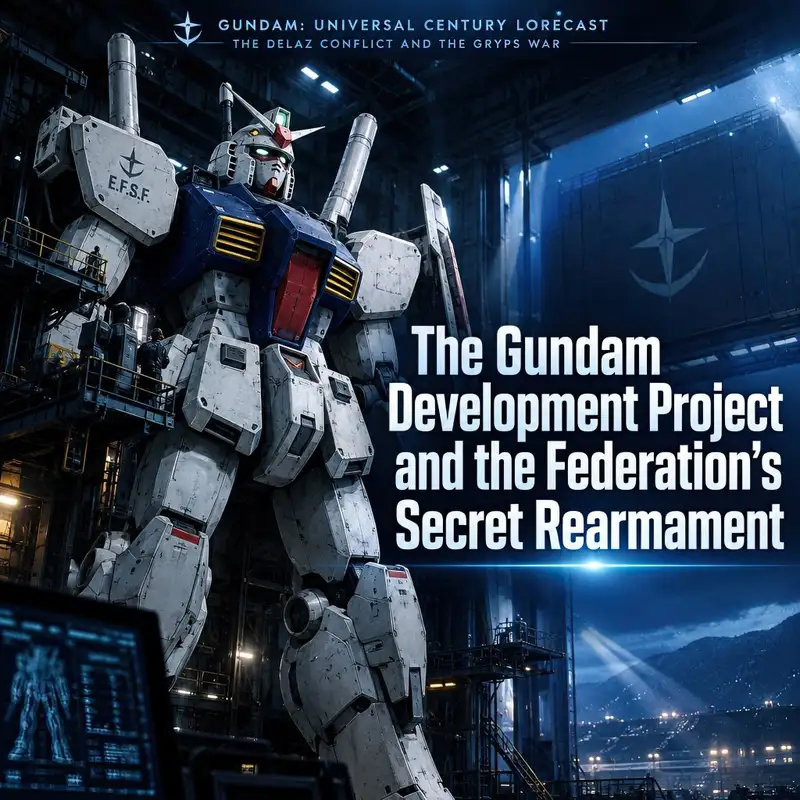
The Gundam Development Project and the Federation’s Secret Rearmament
At Torrington Base in Australia, the Earth Federation was preparing to test a weapon it could not comfortably acknowledge. Inside a controlled military installation, technicians had loaded an atomic warhead into the Gundam GP02A Physalis. Guards, test personnel, and officers treated the operation as classified routine. The Federation had defeated the Principality of Zeon three years earlier. It had survived the One Year War, rebuilt its military, and claimed responsibility for restoring order across the Earth Sphere. Yet here it was, placing a nuclear weapon in the hands of a mobile suit pilot.
That contradiction was the real beginning of the Gundam Development Project. This was not simply a program to build successors to the RX-78 Gundam. It was a secret rearmament effort shaped by institutional memory, technological ambition, and fear. The Federation had won the last war, but victory had not made its leaders confident. It had taught them that a larger industrial base could still be caught unprepared, that conventional fleets could be disrupted by mobile suits, and that political control of the Earth Sphere did not prevent a determined enemy from striking at its weakest point.
Then Anavel Gato entered Torrington. He did not arrive with an invading army. He infiltrated a base holding one of the Federation’s most sensitive weapons, took control of the GP02A after its warhead had been loaded, and escaped. In a few hours, a classified procurement program became an operational emergency. Within days, it would become a fleet disaster and the opening act of Operation Stardust. The Federation’s problem was no longer whether the new Gundams worked. It was whether the institutions that commissioned them could control the consequences of possessing them.
The project emerged from the Federation’s wider reconstruction effort after the One Year War. Its purpose was not to create a single replacement for the original Gundam. It was a family of advanced prototypes, each exploring a different answer to a different operational problem. One design sought a more capable general-purpose mobile suit. Another turned a mobile suit into a tactical nuclear delivery platform. A third attempted to combine the responsiveness of a mobile suit with the firepower and endurance of a much larger space weapon.
That separation matters in practice. The Gundam Development Project was not a neat progression from one stronger machine to the next. It was an argument inside military procurement. What would the next war demand? Better pilot control and maneuverability? A weapon capable of breaking a fleet concentration with one strike? A heavily armed defensive system for space operations around strategic installations? The Federation did not yet know which answer would matter most. So it funded several answers at once, with the confidence and confusion that often accompany postwar modernization.
Anaheim Electronics became central to this effort. The company had expanded rapidly in the postwar period and possessed access to technical knowledge that included former Zeon expertise. That did not make Anaheim a secret government or an all-powerful conspirator directing both sides of every conflict. It made the company something more ordinary and, in its way, more important. Anaheim was a major military contractor with the engineering base, industrial facilities, and specialized personnel needed to turn Federation requirements into advanced machines.
For the Federation, that arrangement offered speed. A private industrial organization could consolidate technical talent and develop prototypes without requiring every military command to build its own research structure. But contractor dependence also created distance between the people who authorized a capability and the people who understood its details. Military authorities set requirements. Anaheim engineers designed and assembled machines. Base personnel conducted testing. Ship crews transported and maintained the equipment. Political leaders dealt with consequences only after secrecy had failed. No single layer saw the entire problem clearly.
That fragmentation was not necessarily malicious. Large military programs often divide work among commands, laboratories, factories, test units, and political authorities because no one organization can do everything. The problem comes when compartmentalization becomes a substitute for oversight. A classified program can protect sensitive research from espionage. It can also prevent the people responsible for security, law, logistics, and political legitimacy from asking whether the program should proceed in its existing form. The Gundam Development Project would show both sides of that equation.
The GP01 Zephyranthes represented the most conventional and least politically explosive branch of the project. It was a general-purpose high-performance prototype, intended to push the capabilities of a humanoid mobile suit beyond the Federation’s wartime standards. In practical terms, it explored better mobility, better handling, and a more refined relationship between pilot and machine. Reference material connects its development to ideas that would influence later mobile-suit frame design, but in Universal Century eighty-three, it remained a prototype under evaluation rather than the foundation of a fully reequipped Federation force.
That status is essential. The GP01 was not proof that every Federation pilot now had access to an advanced Gundam. It did not mean the Federation had solved the problems of mass production, maintenance, standardization, or training. A prototype can reveal what is possible under careful support. It does not automatically reveal what an ordinary squadron can sustain in combat. The Federation still relied on regular mobile suits, regular crews, and the larger military system built around ships, bases, technicians, and supply networks.
Kou Uraki embodied the GP01’s original role. He was a young test pilot, not an experienced combat commander assigned to decide a campaign. His job was to evaluate an experimental machine in a controlled environment. That distinction collapsed the moment Gato stole the GP02A. Kou’s technical familiarity with the GP01 made him the available pilot for pursuit, but availability is not the same as institutional readiness. The Federation turned a test pilot into an emergency combatant because the program had been breached at the point where it was most vulnerable.
The GP01 also demonstrated that high performance depended on environment. A mobile suit designed around general-purpose capability still had to be configured and supported for the theater in which it fought. As operations shifted into space, the machine required adaptation for sustained zero-gravity combat. Its later Full Burnern configuration was not simply an upgrade in the language of a weapons catalogue. It reflected a basic military truth. Equipment that performs well in one environment may need substantial alteration, maintenance, and testing before it can perform effectively in another.
The GP02A Physalis represented a far more dangerous answer to the Federation’s postwar fears. It began as a concept for a heavy assault mobile suit, but its role changed into something far more consequential: a tactical nuclear platform. The reasoning behind that change was rooted in the experience of Minovsky warfare. If electronic detection and long-range targeting were degraded, then delivering an atomic weapon from a distant, predictable platform became more difficult. A mobile suit capable of penetrating close to a fleet formation could carry the weapon through the confused, short-range battles that Minovsky conditions encouraged.
From a narrowly military perspective, this had a brutal logic. A fleet gathered for review, resupply, staging, or maneuver presented a concentrated target. A mobile suit could approach under conditions that complicated conventional detection, exploit confusion at close range, and launch a weapon with an effect far beyond the machine’s own size. The GP02A was therefore not intended as a universal replacement for battleships or mobile-suit forces. It was a specialized system for a specialized mission, designed to create a fleet-level result from a single successful penetration.
The machine’s protective design made that mission clear. A pilot who launches an atomic weapon at relatively close range must survive heat, shock, radiation, and electromagnetic effects long enough to escape. The GP02A was built around that requirement. Its bulk and protection were not merely stylistic differences from the GP01. They reflected the fact that the machine’s primary danger was not only enemy fire. It also had to operate near the effects of its own weapon. The platform and the warhead formed one system, with the pilot placed at the center of both its capability and its risk.
But military logic is not the same as sound security policy. Nuclear weapons can serve several purposes at once. They may be conceived as deterrents, battlefield weapons, coercive instruments, or symbols of national resolve. Those roles overlap, and that overlap is dangerous. The Federation could argue that the One Year War had demonstrated the need to prepare against the worst forms of escalation. Zeon had already shown that mass-casualty warfare was not an abstract possibility. Yet building a secret nuclear mobile suit did not merely prepare for an emergency. It created a new object that could be stolen, exposed, imitated, or used to deepen political instability.
The Antarctic Treaty remained an important part of the postwar atmosphere surrounding nuclear weapons and other methods of mass destruction. The exact legal status and enforcement of every restriction across the postwar period are not developed in detail by the Stardust Memory record itself. What is clear is the political reality. A nuclear-armed mobile suit was not an ordinary procurement item. Its existence carried grave implications in a society still marked by colony gassing, nuclear attacks, mass civilian death, and the destruction of entire communities during the One Year War.
That was the Federation’s contradiction. It had defeated a regime associated with aggressive war and catastrophic escalation, yet it was quietly preparing a weapon that returned nuclear delivery to the center of mobile-suit doctrine. The Federation’s military planners may have regarded the GP02A as prudent preparation. Political leaders may have regarded it as a sensitive capability that required secrecy. But secrecy did not remove the weapon’s political meaning. It only ensured that, if the program became public through failure rather than disclosure, the Federation would lose control of the narrative as well as the machine.
Torrington was where that failure became visible. The GP01 and GP02A had been moved to the Australian base for testing. This created a chain of dependencies: transport security, base security, warhead handling, personnel vetting, intelligence protection, guard readiness, and command coordination. The Federation had concentrated an advanced prototype and a nuclear device at a predictable location. That concentration may have been necessary for testing. It was also an invitation to any adversary with enough information to identify the program and enough capability to penetrate its defenses.
The Delaz Fleet had that information and that capability. Gato’s operation did not prove that every Federation official was compromised, nor does the OVA establish that the theft was deliberately permitted. The evidence supports infiltration, negligence, and a serious breakdown in security. It does not support a confirmed false-flag operation or a carefully staged plot to justify later repression. The Federation did not need a hidden master plan to create disaster. It had already created the conditions for one through poor protection of an exceptionally sensitive weapon.
Gato’s theft exposed more than a weak guard post. It showed a failure of counterintelligence. A Zeon remnant force knew enough about the project to target the right machine, at the right base, during a moment when the weapon could be armed and removed. In any military system, a secret is only as secure as the network of people, facilities, communications, and routines required to make use of it. The GP02A could not be tested without technicians. It could not be transported without crews. It could not be armed without procedures. Every necessary process created another opportunity for an enemy to observe, infer, or penetrate.
The most damaging feature of the theft was timing. Gato did not seize an incomplete design document or a machine awaiting some final component. He escaped with a functioning nuclear platform after the atomic warhead had been loaded. That transformed the problem from procurement loss into immediate crisis. The Federation now had to locate, pursue, and neutralize its own weapon before a remnant force could decide where and how to use it. Classification had protected the project from open scrutiny. It had not protected it from operational vulnerability.
The Albion was drawn into that crisis as a test, support, and recovery organization suddenly forced to function as a pursuit force. Captain Eiphar Synapse, Lieutenant South Burning, Kou Uraki, and the ship’s technical personnel did not begin with a clean campaign plan, complete intelligence picture, or stable political guidance. They inherited an emergency. Their mission became a mixture of recovery, pursuit, evaluation, and combat, all while higher authority struggled with the implications of what had been stolen.
That is one reason the Albion matters more than as a familiar protagonist ship. Mobile suits do not operate independently for long. They require launch facilities, hangars, technicians, spare components, ammunition, propellant, medical support, communications, and command. The Albion provided those functions under conditions for which the project had not been designed. A controlled test environment had collapsed into a running military operation. The crew had to preserve the GP01, support its inexperienced pilot, gather information, and keep moving while the strategic situation changed around them.
Kou’s pursuit of Gato could not correct the Federation’s broader failure by itself. He had courage, growing skill, and an unusually capable machine. None of those qualities could replace intelligence about the enemy’s plan, resolve disputes among commands, restore the stolen weapon to secure custody, or explain to the public why the weapon existed. This is the limit of the ace-pilot story. A capable pilot can win a local engagement, protect a ship, or delay an enemy operation. He cannot repair a security architecture that has already failed at the strategic level.
The Federation’s difficulties also showed how quickly prototype testing becomes war when an opponent acts first. The GP01 had to be modified and supported for the environment in which the pursuit unfolded. Its performance was inseparable from the technicians who maintained it and the ship that carried it. The lesson was not that the machine was inadequate. The lesson was that advanced equipment is never just equipment. It is a relationship among design, support, theater, training, and command. Remove any one of those elements, and even an excellent prototype becomes a burden as well as an asset.
Gato’s objective was never merely to escape Torrington. The theft was intended to turn the Federation’s own secret capability against it, both militarily and politically. The target was Konpeitoh, the former Zeon fortress of Solomon, where the Federation had assembled a naval review. A fleet review is an expression of confidence. It gathers ships, personnel, command staffs, and political symbolism in one place. It also creates a dense and predictable target set. In military terms, concentration is valuable when it supports command and mutual defense. It is disastrous when the enemy can penetrate the concentration with a weapon designed to exploit it.
The GP02A’s strike at Konpeitoh demonstrated why the project had treated tactical nuclear delivery as a distinct mission. The machine did not need to defeat every ship one by one. It needed to reach a position from which one atomic launch could inflict severe damage on a formation that had assembled within a vulnerable area. Penetration, surprise, and target density mattered more than conventional mobile-suit superiority. The result was a major blow to the Federation fleet gathered for review, and it gave the Delaz Fleet a spectacular opening for the wider Stardust operation.
The strike was tactically effective because the Federation had allowed the enemy to combine a stolen capability with a vulnerable target system. But it did not make the GP02A a substitute for fleet control, logistics, occupation, or political strategy. One nuclear strike could damage ships and shock a government. It could not by itself hold territory, sustain a campaign, or create a durable state. The Delaz Fleet still needed ships, supply, planning, intelligence, allies of convenience, and a broader operation. The value of the GP02A was that it opened possibilities for that wider campaign by creating confusion, damage, and political panic.
The Federation’s failure at Konpeitoh was therefore larger than the loss of a prototype. It had failed first to secure the weapon, then to recover it, and finally to prevent its use against a concentrated formation. Commanders facing the crisis may not have possessed complete information at every stage. That limitation should be recognized. Yet from a historical perspective, the sequence revealed an institution that had invested heavily in advanced capability without creating equally resilient arrangements for its custody and control.
The political damage was just as serious. The Federation had sought to manage the GP02A as a secret program. Once the weapon was stolen and detonated, its existence could no longer remain merely an internal procurement matter. A government that claimed to guarantee postwar order had lost control of a nuclear mobile suit to a hostile remnant force. Even if officials could restrict details, they could not erase the basic fact that the enemy had used a Federation-developed weapon to inflict a major loss on Federation forces.
The third major animated system in the Gundam Development Project, the GP03 Dendrobium, revealed that the Federation’s ambitions extended beyond improved mobile-suit performance and nuclear delivery. Dendrobium was a space fortress-defense weapon built around the Stamen mobile suit and the Orchis armed base. The design attempted to combine the pilot responsiveness of a mobile suit with mobile-armor-scale firepower, weapons capacity, and endurance. It was an integrated system, not simply a large Gundam with more guns attached.
Its design reflected a real tactical problem. Large mobile armors can carry substantial armament and defensive capability, but their size can make them vulnerable in close combat, especially against smaller, more agile mobile suits. By placing a mobile suit at the center of the system, Dendrobium sought to preserve flexibility while giving the pilot access to a far larger weapons platform. In theory, it could defend a major space installation or confront enemy forces with an overwhelming concentration of firepower.
In practice, the system illustrated the limits of prototype ambition. Dendrobium required specialized support, complex maintenance, and careful handling. Its size and integration made external servicing difficult. It was not the sort of machine that could be casually dispersed across ordinary units or repaired in an improvised field workshop. Official reference material emphasizes its exceptional scale and cost, but the larger historical point does not depend on any precise accounting. The system demanded rare infrastructure, expert personnel, and a protected support network. Its effectiveness depended as much on those conditions as on the weapons mounted to Orchis.
That does not make Dendrobium pointless. Specialized systems can be useful when their mission is narrow, their support is available, and their command understands the circumstances in which they should be employed. But Dendrobium was a poor answer to every problem revealed by Operation Stardust. It could not repair an intelligence failure. It could not restore public confidence. It could not prevent a remnant force from exploiting political hesitation, divided command, and vulnerable infrastructure. The Federation was developing extraordinary machines while still struggling with the institutional basics of security and accountability.
The Gundam Development Project thus contained three separate visions of postwar military power. The GP01 imagined a more capable standard for mobile-suit performance. The GP02A imagined a mobile suit as a nuclear penetrator against concentrated naval power. The GP03 imagined a highly integrated space weapon capable of bringing exceptional firepower to a strategic defense mission. Each concept had a military rationale. None was inherently irrational merely because it was expensive or dangerous. The failure came from treating technical sophistication as though it could substitute for political and institutional discipline.
The anti-Federation side was not unified. Cima Garahau’s forces participated through a transactional arrangement rather than simple ideological loyalty. Her role is important because it shows that remnant warfare was not one coherent movement operating under one unquestioned command. Rival interests, survival, profit, resentment, and personal calculation all shaped the campaign. The Federation faced a threat, but it did not face a single resurrected Zeon state with the clear institutions of the old Principality.
That fragmentation did not make the threat harmless. In fact, unstable coalitions can be dangerous precisely because they combine different capabilities and motives. One faction may provide political symbolism. Another may provide ships, intelligence, or access. Another may cooperate only long enough to gain an advantage of its own. The Federation’s error was not simply underestimating Zeon remnants as individual pilots or isolated cells. It was failing to understand how a network of hostile actors could exploit a crisis created by its own secret rearmament.
The wider objective of Operation Stardust made clear that the ultimate target was civilian resilience. The colony-drop plan threatened North American agricultural production. This was not merely a strike against military infrastructure. It was an attack on food security, social stability, reconstruction, and political trust. A campaign can damage warships and still remain a military episode. A campaign that threatens the food supply of a major region reaches into civilian life, economic recovery, and the legitimacy of the government expected to protect its population.
For that reason, the fate of the Gundam Development Project cannot be measured by prototype performance alone. The GP02A worked in the most horrifying sense. It demonstrated that a mobile suit could deliver nuclear force against a concentrated fleet. The GP01 and GP03 demonstrated advanced capabilities in their own roles. Yet the project failed as a security policy because those capabilities did not prevent the enemy from dictating the crisis. Advanced machines could respond after the breach. They could not undo the breach itself.
After the conflict, records of the Gundam Development Project were erased. Official material associated with Stardust Memory identifies this erasure as part of the project’s aftermath. That decision was politically understandable. The Federation had reason to avoid public association with a stolen nuclear mobile suit, a catastrophic failure of security, and a campaign that had exposed the fragility of postwar order. Officials and commanders had incentives to narrow the record, contain blame, and present the crisis in a form less damaging to institutional legitimacy.
But damage control is not accountability. Erasing the project’s record protected reputations and reduced the immediate political burden of explanation. It also denied the public a full account of who authorized the program, why a nuclear mobile suit had been developed, how enemy forces obtained information about it, and which authorities failed to secure it. A government can classify sensitive material for legitimate reasons. It cannot erase responsibility without cost. The cost is institutional memory, public trust, and the ability to learn from failure.
Tactically, the project proved that its prototypes possessed formidable capability. Operationally, the theft and Konpeitoh strike revealed catastrophic weaknesses in security and crisis response. Strategically, Operation Stardust proceeded according to the enemy’s larger political design rather than the Federation’s preferred timetable. Industrially, Anaheim Electronics emerged as an increasingly important supplier of advanced military technology. At the civilian level, the consequences reached far beyond the test program, because food, safety, displacement, and confidence in public institutions became the real stakes.
The project’s disappearance from official records did not make its lessons disappear. It demonstrated that contractor expertise could be indispensable while still creating accountability problems. It showed that a military organization could possess extraordinary prototypes while remaining vulnerable to espionage, infiltration, and poor coordination. It showed that secrecy could hide a controversial program from democratic scrutiny, but could not guarantee that the program would remain hidden from an enemy. And it showed that technical achievement without political responsibility can turn a security measure into a source of new insecurity.
The Delaz Conflict also helped create the political conditions for harder Federation security policy. The later rise of the Titans should not be reduced to a single stolen Gundam or treated as the inevitable product of one project. Stardust Memory does not establish that the Gundam Development Project was designed as a pretext for the Titans, nor does it provide a complete chain of decisions from Torrington to every later act of repression. Such claims give too much coherence to events that were shaped by fear, opportunism, institutional rivalry, and political reaction.
What can be said is that the conflict created an opening. A visible Zeon remnant threat, a spectacular failure of military security, and public anxiety about renewed violence made aggressive anti-Zeon measures more politically viable. In that atmosphere, calls for exceptional authority could present themselves as practical necessity. The tragedy of the Universal Century is that institutions often respond to their own failures by demanding more coercive power rather than more transparent and competent governance.
The Federation authorized the Gundam Development Project because victory had left it insecure. It had survived technological surprise, improvised its way through a costly war, and emerged determined never again to be caught behind the curve. The GP01, GP02A, and GP03 were all attempts to answer that fear through military technology. In that sense, the program was not irrational. A postwar military that refuses to learn from defeat and surprise is inviting another disaster.
But the program became dangerous because the Federation tried to solve insecurity through classified escalation while dispersing responsibility among commands, contractors, test units, and political authorities. Its most sensitive weapon was protected by secrecy rather than by resilient oversight. It could therefore be stolen, used against the Federation, concealed after the fact, and exploited by those who wanted a more militarized political order. The GP02A did not merely expose a failed guard detail at Torrington. It exposed a state that had modernized its weapons faster than it had strengthened its responsibility for them.
The Gundam Development Project’s legacy was not which prototype appeared most powerful. Its legacy was the warning contained in its collapse. Military modernization can be necessary. Advanced weapons can answer real threats. But when accountability is treated as an obstacle to readiness, the weapon becomes one more source of instability, and the war that follows begins inside the institutions that claimed they were preparing to prevent it.