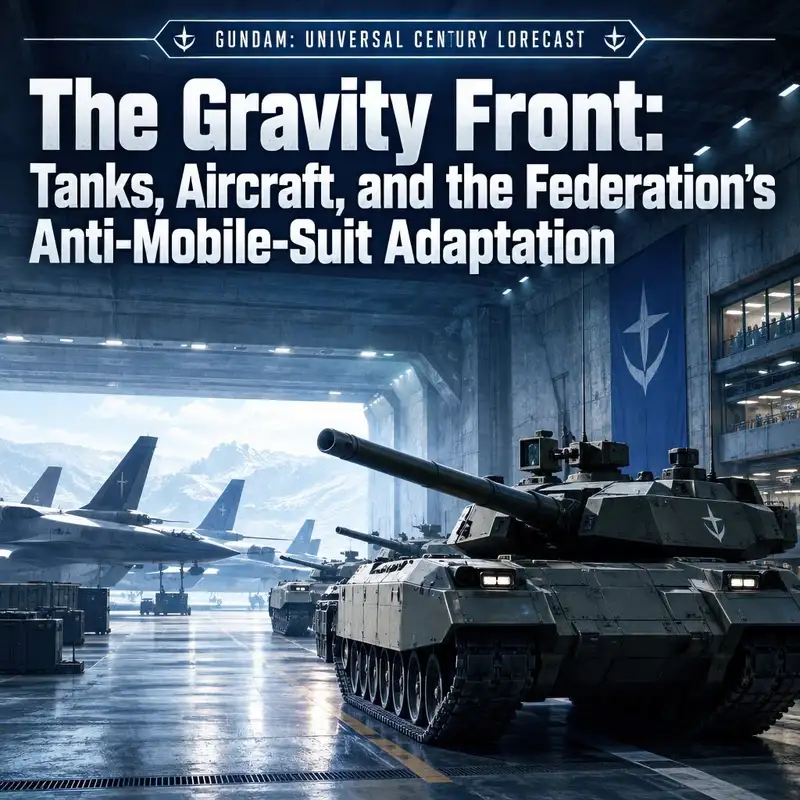
The Gravity Front: Tanks, Aircraft, and the Federation’s Anti-Mobile-Suit Adaptation
A Type 61 tank crew waits beneath camouflage while Zaku mobile suits move into a prepared killing ground. The tanks are not trying to outrun the enemy. They are not trying to match a mobile suit stride for stride across open country. They are waiting for the moment when terrain, concealment, range, and coordinated fire give them the first shot. In the European fighting depicted by MS IGLOO 2: Gravity Front, that kind of ambush can destroy Zakus. It is a necessary correction to the simple story that tanks became worthless the instant mobile suits reached Earth. But it is only a correction, not a solution. Once the Zakus detect the firing positions, close the range, or maneuver around the flanks, the balance can reverse with terrible speed. A successful ambush proved that a tank could kill a mobile suit. It did not explain how the Earth Federation could retake a continent.
That was the real problem on the gravity front in Universal Century seventy-nine. Zeon had arrived with a weapon system the Federation had not yet learned to fight. The Earth Federation did not answer by finding one perfect anti-mobile-suit gun, nor by immediately fielding an equal mobile-suit force. It recovered through layers of adaptation. Existing forces learned how to delay and ambush mobile suits. Infantry received specialized weapons and missions. Tanks and artillery found roles inside prepared defenses. Aircraft and transports remained essential because an army that cannot move ammunition, wounded personnel, mechanics, and orders cannot turn a battlefield success into anything larger. Local commands learned to function under uncertain communications. Industry began to produce ground-oriented mobile suits and then more broadly usable machines. By the time of the Odessa offensive, the Federation’s answer was not a single weapon. It was a rebuilt military system.
That advantage was especially disruptive because the Federation’s problem was not merely technical. It was organizational. Militaries prepare to fight the threats they expect. They build training systems, communications procedures, ammunition stocks, vehicle maintenance plans, and defensive positions around those expectations. The Federation had tanks, aircraft, infantry, artillery, transport networks, and a vast industrial base. What it lacked in the opening phase was a mature doctrine for combining those assets against mobile suits. A tank crew might understand armored warfare. Infantry might understand how to defend a village or bridge. Artillery officers might know how to cover routes of advance. But none of that automatically told them how to fight a Zaku appearing over a ridge, cutting through a forest, or moving through broken industrial ground.
Zeon did not conquer Earth with mobile suits alone. Its invasion also depended on transport, supply depots, armored vehicles, artillery, command posts, maintenance units, and occupation formations. The mobile suit was the sharp edge of the advance, not the entire instrument of conquest. A Zaku needed ammunition, spare parts, recovery equipment, technicians, and a route by which all of those things could reach it. Its pilot needed rest, orders, intelligence, and some idea of where friendly forces were operating. Zeon’s ground commands varied in competence, equipment, and mission. Some had experienced officers and well-maintained machines. Others were garrisons, rear-area formations, local security forces, or units trying to do more with the equipment they had than any staff officer would have preferred. The image of an unstoppable, uniformly elite Zeon army is as misleading as the image of a helpless Federation.
Still, the first encounters were often brutal. Mobile suits exposed weaknesses in static defenses and in conventional formations caught while moving. A tank column on a road could be attacked from positions it had not anticipated. Infantry in open terrain could be forced into cover before it had a chance to identify the enemy. A small mobile-suit formation could threaten bridges, rail junctions, fuel depots, or command posts that would previously have required a larger force to reach. The Federation had not been stripped of military power. It had been deprived of confidence in the assumptions that organized that power.
The Federation’s early defensive problem was therefore larger than the question of what could penetrate a Zaku’s armor. It involved recognition, warning, maneuver, and survival. Units needed to learn where a mobile suit could move easily and where it would be constrained. They needed to understand which routes were likely approaches and which terrain features offered cover to a concealed observer or missile team. They needed to protect their own guns and vehicles from being spotted before they fired. They needed to decide when to hold a position, when to withdraw, and when preserving a force mattered more than defending one piece of ground. These are not glamorous lessons. They are the lessons armies learn when the enemy has changed the conditions of contact.
The human cost of that learning was substantial. The ground war took place through settlements, farms, industrial areas, roads, rail lines, and bridges. A withdrawal was not an arrow moving backward on a staff map. It meant civilians caught in traffic, damaged infrastructure needed by both soldiers and families, medical facilities overwhelmed by casualties, and local authorities trying to keep food and water moving while military columns passed through. A mobile suit could break through a defensive line, but it could also wreck the transport network required to sustain the force that had broken through. Every commander on Earth faced that contradiction. The battlefield was also a working, inhabited planet.
The Federation’s first anti-mobile-suit measures were often evolutionary. They adapted older anti-armor logic to a new target. The M-101A3 Riggina, seen in MS IGLOO 2, is a heavy guided anti-mobile-suit missile developed from an anti-tank weapon. That lineage matters. The Federation was not waiting for a wholly new science to save it. It was taking a familiar military problem, destroying armored vehicles, and asking how it could be adjusted for a larger, more mobile, more heavily armed opponent. The answer involved specialized troops, carefully chosen positions, observation, concealment, and a willingness to fire from places where the enemy did not expect an infantry weapon to be waiting.
Such teams could exploit dead ground, foliage, ruins, embankments, and the folds of the landscape. A mobile suit was tall, but height did not make it omniscient. Its pilot could see farther than a tank crew in some circumstances, yet still miss an observer concealed beneath a slope or inside a damaged structure. A guided missile gave infantry a chance to strike at a target that would otherwise be beyond the reach of ordinary small arms. It let the Federation threaten a mobile suit without placing a tank directly in its line of fire. In theory, this was an efficient adaptation. In practice, it was dangerous work performed by soldiers with very little margin for error.
An anti-mobile-suit infantry team had to identify the target, establish a firing position, wait until the engagement geometry was favorable, launch, and then survive the response. If the missile missed, failed to disable the machine, or revealed the team before it could relocate, the result could be catastrophic. A mobile suit had weapons designed to engage ground targets and the mobility to change the terms of the fight rapidly. The people operating these weapons were not disposable tank hunters in a tactical exercise. They were soldiers asked to confront a new class of armored threat with concealment, planning, and courage standing in for the protection that their equipment could not provide.
The same was true of the Type 61 tank. The Federation’s principal tank remained a serious weapon when employed intelligently. A tank did not need to imitate a mobile suit in order to matter. It needed to use what it possessed: a stabilized firing platform, armored protection, concentrated direct fire, a trained crew, and the ability to operate with other tanks in mutually supporting positions. Concealed tanks could wait for Zakus to enter a kill zone. Multiple vehicles could concentrate fire on one target rather than trying to duel separately. A tank could use terrain to limit what the enemy saw and to deny easy movement. If a Zaku had to advance through a narrow route, crest a ridge, cross open ground, or expose itself to engage one firing point, it might become vulnerable to another.
Artillery retained a similar importance. It could shape the battlefield without necessarily destroying every mobile suit it targeted. Fire missions could cover a withdrawal, obstruct an approach, suppress suspected assembly areas, defend key infrastructure, and force an attacking formation to alter its timing. Artillery could also support infantry and tanks by making certain routes more dangerous and by creating the time needed for a threatened unit to reposition. Under Minovsky conditions, artillery depended heavily on observers, prearranged fire plans, and local knowledge. It was not a magical hand reaching across the battlefield with perfect information. But it remained part of the Federation’s ability to impose costs on an advancing force.
The weakness of conventional armor and artillery appeared when those systems lost their supporting network. Tanks caught in movement without warning could be attacked before they established firing positions. Guns that lacked observers could fire into uncertainty or remain silent while the enemy maneuvered around them. Infantry without armor support could be pinned or bypassed. A command post that lost contact with its forward units might issue orders for a battle that no longer existed. Zeon’s mobile suits exploited those seams. They did not have to destroy every tank on the field. Often, it was enough to strike logistics, disrupt command, or create panic at a vulnerable point.
Aircraft remained central to that process. Mobile suits did not make aviation obsolete. The idea has a certain appeal because mobile suits are visually dominant, and because low-flying aircraft faced very real danger from mobile-suit weapons and ground-based air defenses. But aircraft and transports performed missions that ground vehicles and mobile suits could not easily replace. They moved personnel across difficult terrain. They delivered supplies and evacuated wounded soldiers. They carried liaison officers, messages, reconnaissance teams, and spare parts. They helped connect formations separated by damaged roads, hostile territory, and unreliable communications. In a war where local units often had to act with incomplete information, the ability to move information and people quickly mattered enormously.
Reconnaissance from the air was dangerous and imperfect. Minovsky conditions complicated the use of long-range sensors and made it harder to build a complete picture from any single platform. Mobile suits could threaten aircraft operating at low altitude or near the front. Yet those risks did not remove the need for aerial observation. They made it more dependent on timing, route planning, local intelligence, and the willingness to accept that a reconnaissance report might be partial. An aircraft did not need to destroy a Zaku to affect the battle. If it located a mobile-suit column, confirmed a bridge was still usable, delivered artillery observers, or evacuated a wounded mechanic whose knowledge kept several tanks running, it had contributed directly to combat power.
Transport was equally important. An army that wins a local fight but cannot bring forward fuel, ammunition, replacement crews, medical support, and repair parts has achieved little more than a pause. This was particularly true for the Federation’s conventional forces, which often operated amid disrupted infrastructure and retreating populations. It was also true for Zeon. The difference was that the Federation fought on a planet containing much of its surviving population, industrial capacity, transport network, and administrative structure. That did not make the Federation’s logistics easy. It gave the Federation something Zeon could not easily reproduce: the ability to regenerate force closer to the places where that force was needed.
The Dabde, which appears in the ground war as a mobile command and combat platform, illustrates Zeon’s need to bring command and firepower forward with its advancing forces. It should not be treated as proof that Zeon possessed one flawless solution for ground operations. It was an example of how a mobile army tried to carry headquarters functions, protection, and heavy weapons into a contested theater. Such platforms had value because ground forces needed coordination under conditions where fixed command sites could be bypassed or attacked. They also revealed the scale of the problem. The more a force pushed forward, the more it needed mobile headquarters, escorts, maintenance, communications, and a reliable flow of supplies behind them.
The Federation’s recovery was uneven because ground warfare itself was uneven. There was no single moment when every unit across Earth learned how to fight mobile suits. A mechanized regiment in Europe did not have the same terrain, supply situation, or local command problems as a force operating in Southeast Asia. Some formations had experienced crews and functioning equipment. Others were rebuilding after losses. Some defended cities or industrial zones. Others operated in forests, mountains, rivers, or open country. What spread was not a single trick. It was an institutional understanding that mobile suits had to be met by coordinated reconnaissance, concealment, firepower, movement, and disciplined local command.
Reconnaissance became a form of survival. Every observed enemy machine, every recovered component, every battlefield report, and every encounter with a Zaku added to the Federation’s understanding of what mobile suits could and could not do. This did not mean that one captured part revealed every secret of Zeon technology. Nor did it mean that commanders suddenly understood enemy doctrine perfectly. But knowledge accumulated. Units learned that mobile suits required routes, that they could be surprised, that pilots had limited visibility in some terrain, that maintenance activity created vulnerable periods, and that a machine separated from support could be more vulnerable than its silhouette suggested.
Local initiative mattered because commanders could not always wait for higher headquarters to provide a complete picture. Junior officers, tank commanders, infantry leaders, artillery observers, and transport crews often had to act on fragmentary information. That kind of initiative can be dangerous. It can produce confusion, friendly-fire risk, and isolated units fighting battles they should have avoided. Yet under degraded communications it was also necessary. The Federation’s better formations learned to issue intentions and priorities rather than relying only on detailed, centrally controlled instructions. Hold this crossing until evacuation is complete. Delay the enemy on this route. Preserve the artillery. Keep the road open for medical transport. Those mission-focused orders gave subordinates something to act on when the battle no longer resembled the plan.
The Federation also had to learn the less dramatic business of recovery. A damaged vehicle had to be repaired or abandoned. A wounded crew had to be evacuated. Ammunition expenditure had to be reported and replenished. Tanks needed fuel, tracks, engines, guns, and trained mechanics. Missile teams needed replacement launchers and missiles. Artillery needed shells, maps, communications, and observers. The mobile-suit era did not eliminate these requirements. It made them more demanding, because the new battlefield could punish a force before it had time to complete the ordinary routines of resupply and repair.
That is where the Federation’s own ground mobile suits entered the picture. The RGM-79[G] GM Ground Type, deployed with formations such as the Kojima Battalion in Southeast Asia, represents an important stage in adaptation. It was not the sudden appearance of a Federation-wide, perfectly standardized mobile-suit arm. It was a ground-oriented machine employed in specific formations and theaters. Its existence shows that the Federation was beginning to put its own mobile suits into the field before the war’s end, but it also shows how unevenly that transformation occurred. A local ground formation could receive equipment and develop methods that did not yet define the entire Earth Federation Forces.
The 08th Mobile Suit Team offers a useful view of what that integration looked like in practice. Its Southeast Asian operations do not stand for all ground combat on Earth, and its exceptional individuals should not be mistaken for average soldiers. But the series makes an important point. Federation mobile suits operated amid infantry, local guides, transport, engineers, reconnaissance, artillery support, and difficult terrain. Their missions were shaped by roads, rivers, forests, villages, weather, and the need to locate enemy facilities before attacking them. The mobile suit was powerful because it could maneuver over obstacles, deliver direct fire, scout forward, and engage Zeon machines on more equal terms. It was not independent of the system around it.
A ground mobile suit required pilots trained for gravity, not merely for the abstract idea of mobile-suit combat. It required mechanics able to keep joints, weapons, sensors, and propulsion systems functioning under field conditions. It required ammunition, parts, recovery equipment, secure staging areas, and commanders who knew when to employ it aggressively and when to preserve it. It also introduced new risks. A machine large enough to cross obstacles was large enough to damage roads, buildings, and fields. A battle involving mobile suits could endanger civilians and infrastructure with a speed conventional commanders were still learning to manage. The arrival of Federation mobile suits did not remove the older problems of ground war. It added another demanding system to them.
The Federation’s industrial recovery was therefore as important as its battlefield learning. The Gundam demonstrated the possibilities of advanced mobile-suit technology, but it was a prototype with exceptional characteristics and exceptional circumstances. It did not single-handedly transform the Federation’s war effort. A prototype can prove a concept, provide combat data, train engineers, and influence subsequent designs. It cannot by itself equip a front, replace losses, or sustain operations across a planet. The strategic question was whether the Federation could turn technical knowledge into a practical force that could be built, maintained, crewed, moved, and supplied in useful numbers.
That advantage only mattered because it was connected to organization. Building a mobile suit was not the same as creating a mobile-suit arm. Pilots had to be trained and assigned. Units needed maintenance procedures, spare parts, ammunition, and depots. Ships and transports had to move machines between theaters. Damaged equipment had to be recovered. Commanders had to decide how mobile suits fit with tanks, artillery, infantry, aircraft, and existing defensive plans. A mass-produced machine with a workable support system could be strategically more important than a superior prototype that depended on rare parts, unusual expertise, or a single irreplaceable pilot.
This was the Federation’s larger answer to Zeon’s early lead. It did not abandon tanks because mobile suits existed. It did not abandon aircraft because the skies near the front had become dangerous. It did not dismiss infantry because armored machines dominated the visual record of battle. Instead, it began to restore the connections among these arms. Tanks could provide direct fire. Infantry could observe, secure terrain, and use concealment. Artillery could shape movement and support defense. Aircraft and transports could move people, supplies, and information. Mobile suits could scout, penetrate, and contest Zeon’s own machines. The strength of the system lay in the fact that no one element had to do every job.
By November, this layered adaptation could support an offensive rather than merely local survival. The Odessa operation became the clearest expression of that shift. Beginning on November seventh and breaking Zeon’s final defensive line by November ninth, the Federation offensive targeted Zeon’s Odessa mining base and the broader position it represented on Earth. Odessa mattered not simply because it was a battlefield. It was connected to resources, infrastructure, military control, and the political necessity of reversing Zeon’s hold over large parts of the planet. A successful Federation counteroffensive there would demonstrate that Zeon’s initial invasion had not become a permanent settlement.
The television record gives Odessa its place in the wider movement from Federation crisis toward counteroffensive action. MS IGLOO 2 provides a Federation-centered framing of the operation’s ground-war significance. These accounts should not be forced into one minute-by-minute composite chronology. Their common value is clearer than that. Odessa represented a campaign in which the Federation could bring together conventional ground forces, mobile suits, transport, staff work, and broader mobilization against a major Zeon defensive position. It was no longer relying only on scattered units discovering, often at great cost, that they could kill a Zaku under favorable conditions.
In the immediate fight, the offensive required the defeat or bypassing of local defenses, armored formations, artillery positions, and mobile-suit units. No single arm could accomplish all of that alone. Armor could support advances and exploit prepared routes. Artillery could suppress or disrupt defensive positions. Infantry and engineers could secure ground, clear obstacles, and keep routes functioning. Reconnaissance could identify threats and reduce uncertainty. Ground mobile suits could engage enemy machines and maneuver where conventional vehicles faced greater difficulty. Aircraft and transport remained necessary to keep the force connected, supplied, and medically supported. Staff officers had to convert those capabilities into a sequence of missions rather than a traffic jam of competing formations.
Across the campaign, Odessa was about breaking a defensive system and compelling Zeon to withdraw from a position it could no longer sustain. This was more than a collection of individual mobile-suit duels. A defender can lose machines and still hold a line if its command, supply, reserves, and routes remain intact. Conversely, a force can retain capable mobile suits and still be forced to retreat if its positions are ruptured, its logistical network threatened, and its ability to coordinate collapses. The Federation’s achievement was to make Zeon confront that larger problem.
In the wider war, the campaign weakened Zeon’s position on Earth. It did not erase every danger or end the war by itself. Zeon remained capable of fighting, and the wider conflict would continue. But the loss of a major ground position demonstrated that its early advantage had not translated into durable control. The Federation had recovered enough command capacity, enough mobility, enough industrial output, and enough confidence in its own forces to seize the initiative. This was the difference between surviving an invasion and beginning to reverse it.
There was also an industrial meaning to Odessa. A modernized Federation force had reached the point where it could be fielded and sustained in a major operation. That mattered more than the performance of any individual machine. It showed that the Federation’s institutions, however slow and imperfect they had been in the opening months, could absorb lessons from defeat and turn them into usable combat power. Zeon’s mobile suits had shocked the Federation into adaptation. They had not removed the underlying advantage of a larger industrial and demographic base once that base was mobilized effectively.
The civilian meaning should not be lost beneath the operational map. Odessa was fought around land and infrastructure that mattered because people lived and worked there. Mining facilities, roads, transport links, settlements, and industrial sites were not empty markers for military planners. They were the material basis of civilian life and of postwar recovery. A campaign that regained territory also inherited responsibility for damaged infrastructure, displaced populations, contaminated ground, disrupted labor, and the political consequences of occupation. Military success could restore control. It could not instantly repair the social damage created by invasion and counteroffensive.
Odessa did not prove that mobile suits had replaced everything that came before them. It proved the opposite. The Federation’s recovery succeeded because it had learned to make each arm support the others. Mobile suits mattered greatly, especially once the Federation could place its own machines in the field. But they were part of a force that still depended on tanks, artillery, infantry, aircraft, transport, engineers, mechanics, medical services, and command staffs. The mobile suit had changed the battlefield. It had not abolished the military system required to operate on that battlefield.
The concealed Type 61 tanks at the beginning of this story therefore matter for more than their immediate ambush. They reveal the first stage of a larger recovery. A tank could destroy a Zaku when its crew had surprise, suitable terrain, support, and a clear plan. The Federation’s task was to make those favorable conditions less accidental. Anti-mobile-suit infantry, artillery coordination, reconnaissance, improved command practices, transport, engineering, and local initiative all helped do that. None of them alone solved the problem. Together, they allowed the Federation to survive until its industrial capacity could provide mobile suits of its own.
Zeon’s early advantage was real because the Zaku arrived before the Federation possessed either an equivalent machine or a settled doctrine for fighting one. Yet gravity imposed limits on both sides. It made terrain matter. It made roads, depots, bridges, and repair facilities matter. It made civilians and occupied populations unavoidable. It made every advance dependent on maintenance, transport, and command. Zeon could win encounters through mobile-suit superiority. The Federation learned to win the larger contest by turning tanks, aircraft, infantry, artillery, transport, and eventually mobile suits into one military system that could absorb losses, learn from them, and keep moving forward.