The Formula Project and the Development of the Gundam F90
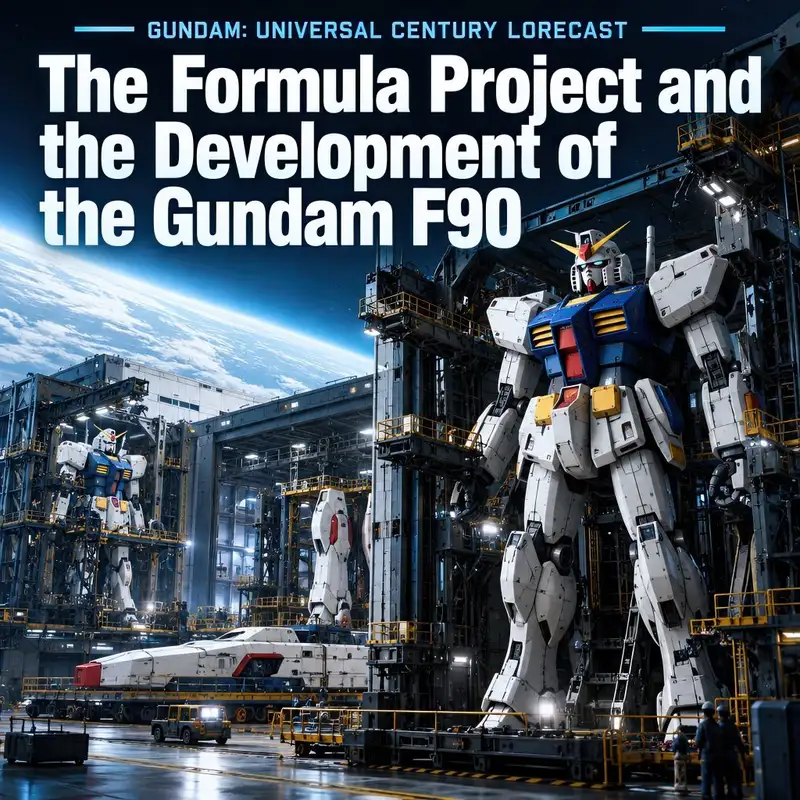
A technician locks a mission pack into place on the back of a Gundam F90. The machine beneath it is compact, stripped down, and almost austere by the standards of late Universal Century military hardware. Its basic armament is intentionally limited. Its frame is built to accept equipment rather than carry every possible weapon permanently. Before the sortie begins, the important question is not whether this particular Gundam can defeat another mobile suit. The Earth Federation is asking something more difficult. Can one common machine become several useful weapons without recreating the cost, weight, and maintenance burden that have made modern mobile suits increasingly hard to buy, operate, and replace?
That question produced the Formula Project. It was not simply an effort to make a smaller Gundam. It was an attempt to change how the Federation thought about mobile-suit procurement. The Gundam F90 became the project’s principal testbed, but the machine mattered because of the institutional argument built into its frame. The Strategic Naval Research Institute believed that a smaller, adaptable mobile suit could offer a path out of an expensive design cycle. It also believed that versatility should come from mission equipment that could be changed, tested, and improved, rather than from permanently loading one airframe with every weapon its designers could find room to install.
The problem was especially acute for an organization like the Earth Federation Forces. The Federation was no longer preparing only for a single total war against a peer adversary. It faced a less orderly security environment. There were local crises, armed remnants, regional instability, political distrust, and a military establishment shaped by years of uneven reform. In that environment, a mobile suit had to do more than win a duel under ideal conditions. It had to reach a threatened colony, operate from a ship or base with finite capacity, survive routine maintenance, accept repairs, and fit into a force structure that could not be rebuilt around a handful of elite machines.
The Formula Project began from the proposition that the mobile suit had drifted away from one of its original strengths. A mobile suit was valuable because it was a general-purpose humanoid combat machine. It could maneuver, use tools and weapons, operate in varied environments, and adapt to changing tactical problems. Over time, however, many development programs responded to each new threat by integrating another specialized system into the airframe. The result was often impressive. It was not always sustainable.
The Strategic Naval Research Institute, usually known as S.N.R.I., proposed a different route. Its Formula Plan, or F Plan, sought substantial miniaturization while preserving useful combat performance. The goal was not to build a weak machine cheaply. It was to make a compact machine capable enough for modern operations, then give it mission-specific equipment when the mission required it. In theory, that would reduce the need for entirely separate mobile-suit families devoted to narrowly defined roles. The common frame would remain the center of the system. Specialized capability would move outward, into equipment packs and mission modules.
The competition therefore concerned design philosophy as much as machine performance. Anaheim represented scale, accumulated industrial knowledge, and a familiar approach to advanced mobile-suit development. S.N.R.I. represented a specialized research institution willing to gamble on a more radical reduction in size and a more modular system of equipment. The Federation did not need to decide only which contractor could build a better prototype. It had to decide what kind of force it expected to maintain in the decades ahead.
The F90 was S.N.R.I.’s answer. Its compact size was immediately striking in an era accustomed to larger machines. But smallness was not an aesthetic statement. It was a systems decision. Reducing the size and weight of a mobile suit could reduce the amount of material required for each machine. It could potentially improve handling, transport, storage, and the number of machines a supporting force might move or service within a given infrastructure. A smaller frame might also make it easier to deploy mobile suits from ships and facilities designed around constrained hangar space.
The F90 used a compact frame, reduced armor mass, and a relatively minimalist baseline configuration. Official material associated with the Formula Project identifies structural and power-generation advances, including micro-honeycomb technology and paired miniaturized generators, as central to the design. The details matter not because they turn the F90 into a specification sheet, but because they reveal the engineering challenge. S.N.R.I. was trying to preserve performance while reducing bulk. It was trying to make compactness a practical military advantage rather than an exercise in technical elegance.
The most important decision was where to place specialization. Instead of making the F90 itself a permanently overloaded platform, S.N.R.I. gave it distributed hardpoints across the body. These attachment points allowed the machine to accept mission packs designed for particular operational roles. The F90 could be configured for assault, reconnaissance, long-range fire, electronic tasks, atmospheric operations, and other specialized missions, depending on the equipment available and the needs of the sortie.
This arrangement transformed the F90 from a single prototype into a development laboratory. A common frame could serve as the basis for many experiments. Engineers could test weapons, propulsion equipment, sensors, armor arrangements, and support systems without designing an entirely new mobile suit for every trial. Pilots could compare how different configurations affected handling and workload. Mechanics could determine which equipment could be fitted, serviced, and removed without imposing unreasonable delays. Commanders could learn whether a particular role was best performed by a modular F90 or whether it required a dedicated machine after all.
In that sense, the F90’s mission packs were a procurement strategy. They allowed S.N.R.I. to separate the expensive problem of developing a modern frame from the equally difficult problem of deciding what equipment should be standard, optional, or abandoned. The Federation could gather information before committing itself to whole production lines of specialized machines. A mission pack that failed to justify its maintenance burden could be revised or discarded without necessarily invalidating the base airframe.
The later F90 A to Z Project expanded the public record of these mission packs, including equipment associated with letters across the alphabet. That expansion is valuable because it illustrates the breadth of the Formula concept. It should not be mistaken for proof that every pack was completed, fielded, stocked aboard ships, or available simultaneously during the original development period. Some packs belong to later elaboration, reference development, or modern project material. The existence of a design concept is not the same as operational availability.
Modularity reorganizes logistics. It does not abolish logistics. A force using mission packs must store them, transport them, inspect them, protect them, and fit them to the correct machine. It needs handling equipment and trained crews. It needs spare components for both the base machine and the specialized pack. It needs appropriate ammunition, propellant, diagnostic systems, and maintenance manuals. It needs procedures to ensure that the attachment points, power connections, and control systems work correctly before a machine launches. The more specialized the equipment becomes, the more the support system must understand the difference between having a pack available and having it ready.
For that reason, the Formula Project required testing on a scale beyond a technical demonstration. A weapon system is not validated when it performs once in a controlled environment. It must be evaluated by pilots, mechanics, engineers, ship crews, evaluators, and commanders. Each group sees a different part of the problem. A pilot may report that a configuration handles well under combat maneuver. A mechanic may discover that the same equipment takes too long to inspect or remove. A ship’s crew may find that the pack occupies valuable hangar space. An evaluator may identify a maintenance trend that does not appear until several sorties have been flown.
Later material, particularly the F90FF manga, expands the project’s development history and places full-scale testing in Universal Century one hundred twelve. It presents the Formula program as more than a clean sequence of laboratory trials. The test teams operate in a politically charged environment shaped by military interest, industrial competition, security concerns, and the danger that valuable technology attracts. This later account should be understood as an elaboration of the Formula Project’s history, not as a seamless replacement for every earlier F90 source. Its value lies in showing what the original concept requires when placed inside a living military institution.
Test work is military work. It produces knowledge, but knowledge is purchased with risk. The more realistic the trial, the more useful the result may be. It is also more likely to damage scarce equipment, expose weaknesses, injure personnel, or reveal capabilities to an observer who should not have access to them. A test pilot can fly a machine through controlled maneuvers. That establishes only a limited portion of its military value. To understand how the machine behaves under pressure, evaluators must test it against uncertainty, time limits, incomplete intelligence, difficult maintenance conditions, and the possibility of actual enemy action.
The F90 test teams therefore mattered as much as the machine itself. The technicians who attached and serviced mission packs were not supporting actors in a story about a Gundam. They were the people determining whether modularity worked in practice. The pilots were not merely proving their own skill. They were reporting on handling, workload, visibility, endurance, and the interaction between an advanced frame and specialized equipment. Ship crews had to launch, recover, and protect the machines. Security personnel had to defend a program whose value made it a target. Evaluators had to separate useful data from the noise produced by individual luck, pilot talent, and unusual circumstances.
That last problem is easy to underestimate. A prototype can appear exceptional because it is operated by exceptional personnel. A skilled test pilot may compensate for design flaws that would frustrate an ordinary unit. A dedicated engineering team can keep a machine operational through effort that cannot be replicated across a fleet. A successful mission can demonstrate possibility without demonstrating routine reliability. The Formula Project had to determine not only whether the F90 could perform. It had to determine whether its underlying ideas could be repeated.
Political and industrial pressure made that task harder. A competition for the Federation’s next main mobile suit was not an abstract engineering exercise. S.N.R.I. needed to prove its approach had merit. Anaheim had an interest in protecting its own position and demonstrating the value of its capabilities. Federation decision-makers had to judge competing claims while managing budgets, readiness needs, and strategic uncertainty. Later Formula material includes sabotage and dangerous interference around the program, but the broader lesson does not require a fantasy of universal conspiracy. Valuable military technology creates incentives for rivalry, secrecy, theft, and bureaucratic maneuver. Institutions do not become neutral simply because they are studying advanced machinery.
The Formula Project was valuable even before it entered conventional service because it generated evidence. It could test the compact frame under different loads. It could measure how mission packs affected handling and maintenance. It could reveal whether pilots could transition effectively between configurations. It could show whether the hardpoint system remained reliable after repeated use. It could identify which specialized roles justified a pack and which roles demanded a different solution. The F90 was not simply competing to become the Federation’s next standard mobile suit. It was competing to shape the terms on which the Federation would make that decision.
The Formula Project gave S.N.R.I. a credible role in this debate. The institute was no longer merely proposing an abstract alternative to Anaheim’s established development model. It had a tangible system around which it could organize testing, gather data, and make a case to the Federation. That did not mean it had displaced large-scale industrial manufacturing. Research institutions and major contractors perform different functions. A laboratory can demonstrate a concept. A manufacturer must turn that concept into repeatable hardware. The Formula Project was strongest where those functions met: it could develop a design philosophy and test whether industry might someday sustain it.
The strategic environment, however, did not permit the F90 to remain safely inside a controlled test program. The Universal Century had repeatedly shown that the end of a major war did not mean the end of armed conflict. Zeon remnant movements, local militarization, political grievance, and unfinished struggles over colonial authority continued to create crises. The Federation’s strategic problem was not that every remnant force could threaten the entire Earth Sphere. It was that localized violence could still endanger colonies, routes, installations, and civilians before a slow and divided government assembled an adequate response.
The F90FF account expands this setting through events including the defense of Frontier One in Universal Century one hundred sixteen and the emerging activity of Oldsmobile. Oldsmobile should not be treated as a generic synonym for every former Zeon force. It was a specific later remnant formation with its own objectives and history. The distinction matters because the Federation did not confront one continuous, unified Zeon enemy after the One Year War. It confronted a changing collection of movements, organizations, veterans, opportunists, ideologues, and armed groups operating under different conditions.
But the same environment exposed the project’s vulnerabilities. Combat use produces valuable information. It shows how a machine performs when pilots are tired, communications are degraded, maintenance time is limited, and the enemy gets a vote. Yet combat also risks the loss of irreplaceable machines, classified equipment, test data, and trained personnel. A prototype sent into a real security crisis is no longer just an experiment. It becomes an operational asset, and an operational asset can be damaged, captured, misused, or turned into propaganda.
Colony defense makes that risk especially serious. A colony is not an empty range marked on a map. It is a habitat, a political community, an industrial site, and a pressure vessel filled with civilians. A mobile-suit engagement near a colony can damage docks, transport facilities, life-support systems, and civilian confidence. A failure of defense can create evacuation pressures even when the physical damage is limited. A successful defense can still leave residents wondering why an experimental machine, rather than a well-established security system, became necessary in the first place.
By around Universal Century one hundred twenty, F90 units had entered actual battlefield employment in the conflicts associated with Oldsmobile. These operations mattered because they placed the Formula concept under conditions no laboratory could fully reproduce. The machine and its equipment had to function amid incomplete intelligence, threat pressure, repairs, resupply demands, and command uncertainty. The Federation could learn whether a compact frame remained useful after repeated operations, whether particular mission equipment justified its support burden, and whether pilots and crews could adapt to the system as intended.
The F90 remained dependent on carriers, transports, bases, depots, and technicians. Its smaller size could improve some aspects of transport and storage, but it did not turn the machine into an independent strategic spacecraft. A damaged F90 still required recovery. A depleted mission pack still required replenishment. An advanced component still required repair or replacement. A specialized configuration still required crews who understood how to prepare it. Compactness could reduce a burden. It could not eliminate the system that carried the burden.
Combat also changed the intelligence problem. When an experimental machine appears in a contested theater, adversaries learn from observation. They can study its movement, weapons, vulnerabilities, maintenance patterns, and deployment doctrine. Even if they cannot capture the machine, they may observe which mission configurations are used under particular conditions. A modular system can create uncertainty for the enemy, but it can also reveal a pattern if employed predictably. The same hardpoint architecture that made the F90 adaptable created a visible signature of its development philosophy.
The later F90 Cluster manga takes this problem further. Set in Universal Century one hundred twenty-one during the First Oldsmobile War on Mars, it presents a later expansion of Formula Project history. It should not be treated as a definitive correction of every earlier F90 account. It does, however, provide a useful view of the project’s afterlife. By this stage, the Formula idea had moved beyond its original competition and testing environment into a conflict shaped by Mars, remnant warfare, and the strategic consequences of advanced hardware falling into hostile hands.
The Mars setting changes the character of the problem. A distant theater imposes its own transport, repair, and command burdens. Reinforcement is more difficult. Replacement parts take longer to arrive. Local forces may have to improvise when equipment is damaged or supply assumptions fail. A prototype or advanced test machine is especially vulnerable in such an environment because its components may not exist in deep reserve. The farther a force operates from its industrial and administrative center, the more expensive every mistake becomes.
F90 Cluster includes the capture and reuse of F90 Unit Two. That event illustrates a classic security failure. A prototype provides its owner with data, but capture can provide an adversary with insight as well. The enemy may not immediately duplicate the machine. Reverse engineering is not magic, and possessing a captured unit does not grant the industrial capacity to reproduce every component. But even limited access can reveal structural arrangements, control concepts, hardpoint interfaces, maintenance practices, and operational assumptions. It can also provide political value. Capturing an advanced Federation machine can become proof, for propaganda purposes, that the Federation’s technology is vulnerable and its authority contestable.
The later account brings figures such as Def Stallion, Bosch Welher, and Ivar Dana into the Formula Project’s extended history. Their importance here is not as a roster of names, nor as an excuse to recount every event of the Mars conflict. They show that the Formula Project had become embedded in the careers and loyalties of people operating under conditions far removed from the original U.C. one hundred eleven procurement competition. A development program can outlive its founding assumptions. It passes through different commands, theaters, and political crises. Its machines carry institutional memory, but they also carry unresolved vulnerabilities.
The capture of an F90 unit demonstrated that security is part of weapons development. Engineers can build an elegant modular architecture. Procurement officials can establish a promising test program. Pilots can generate valuable combat data. None of that matters as much as intended if the organization cannot protect the machine, its components, its support procedures, and its personnel. The Formula Project was designed to make capability more adaptable. It also had to defend that adaptability against enemies who could observe, steal, capture, or exploit it.
The Formula Project’s legacy is therefore not a clean story of technological triumph. Its value lay in demonstrating possibilities and exposing limits. It showed that miniaturization could be more than a way to reduce the size of a machine. It could become the basis of a new architecture for development, testing, and mission adaptation. At the same time, its operational history showed that a flexible system remains dependent on the institutions that operate it. Modularity may permit a force to adapt quickly. It may also create a larger demand for planning, training, storage, and security.
The connection to the Gundam F91 must be understood in that light. The F90 and the Formula Plan are recognized as important precursors to the F91. The earlier program helped establish the technical and institutional foundation for a later generation of compact Formula machines. It created experience with smaller frames, advanced systems integration, mission-specific equipment, pilot interaction, and the tradeoffs between performance and support burden. It gave S.N.R.I. a practical record from which later designers could learn.
That does not mean the F90 directly produced every later Formula machine, nor does it mean that every F90 mission pack or operational lesson passed intact into the F91. Development is rarely that tidy. Later machines respond to new threats, revised requirements, industrial constraints, and lessons that may contradict earlier assumptions. A successful experiment can influence a later design without dictating it. The F91 should be seen as a consequence of the Formula approach, not as proof that the F90’s entire equipment catalog became standard doctrine.
The more important inheritance was methodological. The Formula Project demonstrated that a research institution could challenge established design habits by separating the common platform from specialized equipment. It showed that miniaturization required more than reducing dimensions. It required advances in structure, power systems, internal arrangement, manufacturing, maintenance, and pilot integration. It showed that flexible design had to be tested against actual military work rather than celebrated as a drawing-board virtue.
It also reminded the Federation that performance alone was not enough. A smaller, more capable machine still had to be supported by ships, bases, depots, technicians, and trained crews. A mission pack was useful only when it could be stored, fitted, supplied, and employed with sound doctrine. A test result was useful only when evaluators understood what it did and did not prove. A captured unit could become an intelligence loss. A successful defense could still reveal a broader failure of preparation. The F90 was a technical achievement, but its history was inseparable from these institutional realities.
At the tactical level, the F90 showed the value of tailoring an advanced compact machine to a particular mission. The hardpoint system allowed specialization without forcing the Federation to design a wholly separate airframe for every role. At the operational level, it created a demand for disciplined support. The Federation needed ships, crews, maintenance procedures, spare parts, secure storage, and commanders capable of selecting the right equipment before a crisis became a battle.
At the strategic level, the Formula Project offered a possible path toward a more sustainable modernization program. It did not solve every Federation military problem, but it challenged the assumption that future capability required ever-larger and ever-more-integrated machines. At the industrial level, it gave S.N.R.I. a meaningful place in competition with established manufacturers. It did not make large-scale industry irrelevant. It did prove that an alternative design philosophy could compete for Federation attention.
At the intelligence level, the project revealed the risks of moving advanced prototypes into contested theaters. Combat generated vital data, but it also exposed equipment and procedures to hostile observation. The capture and reuse of an F90 unit in the later Mars account showed how quickly technical advantage can become a security liability. At the political level, the program demonstrated that the Federation still possessed the capacity for adaptation. Yet adaptation remained uneven. The same state capable of sponsoring a sophisticated development program still struggled with the persistent conflicts that made such programs necessary.
For civilians, the Formula Project mattered because the frontier remained dangerous. Colony and regional defense could not depend forever on massive war machines designed for exceptional battles. Communities needed forces able to respond to threats before those threats became disasters. But civilians also bore the risks when experimental systems were used near inhabited space. A failure in testing, security, or command could damage more than a prototype. It could damage the infrastructure and trust on which a colony depended.
The image of the F90 waiting for its mission pack therefore captures the Formula Project’s real achievement. The machine is incomplete until a mission gives it purpose. That was not a weakness in the design. It was the design’s central argument. The Federation did not need to build every mobile suit as a separate prestige machine, each one carrying its own permanent answer to every conceivable threat. It could build a capable common platform, then adapt it through equipment, testing, and doctrine.
But that argument only worked if the surrounding system was worthy of it. A modular machine requires modular planning. It requires secure supply chains, trained mechanics, informed commanders, disciplined testing, and an industrial base capable of turning promising concepts into reliable service. It requires political institutions that understand the difference between buying a symbol and sustaining a force. The Gundam F90 could demonstrate the value of a compact frame and adaptable equipment. It could not supply the wisdom, security, or organizational discipline needed to use them well.
The Formula Project succeeded because it reframed miniaturization as more than a smaller chassis. The Gundam F90 was a procurement experiment, a modular test platform, and a challenge to a Federation force structure that had allowed mobile suits to become too large, specialized, and burdensome. Its battlefield record mattered, but its deeper value was the data it generated about what compact, mission-adaptable machines could do under real operational pressure. That knowledge helped make the F91 possible, while the project’s vulnerabilities showed that no elegant design can compensate for weak security, incomplete doctrine, or the enduring burden of sustaining war.