The Flanagan Institute and the Militarization of Newtypes
Four warships are destroyed in a single day, not by a battleship line or a massed mobile-suit assault, but by a mobile armor that its targets can barely locate. The attacks arrive from several directions. Defensive crews have to identify threats, maneuver, coordinate fire, and protect their own vessels in a Minovsky-particle environment where long-range detection and communications are already unreliable. Against that confusion, the Elmeth turns one pilot into the center of a dispersed attack system. Its remote weapons extend her reach beyond the physical position of the machine itself.
That is the immediate military shock of Lalah Sune’s appearance in the final phase of the One Year War. But the important point is not that Zeon has built a frightening machine. The Elmeth is only the visible end of a larger system. It depends on a pilot with unusual abilities, a specialized control interface, technicians who can maintain an unfamiliar weapon, commanders willing to employ it, and a research establishment prepared to treat uncertain human potential as a military resource. The real weapon is not merely the mobile armor. It is the institution behind it.
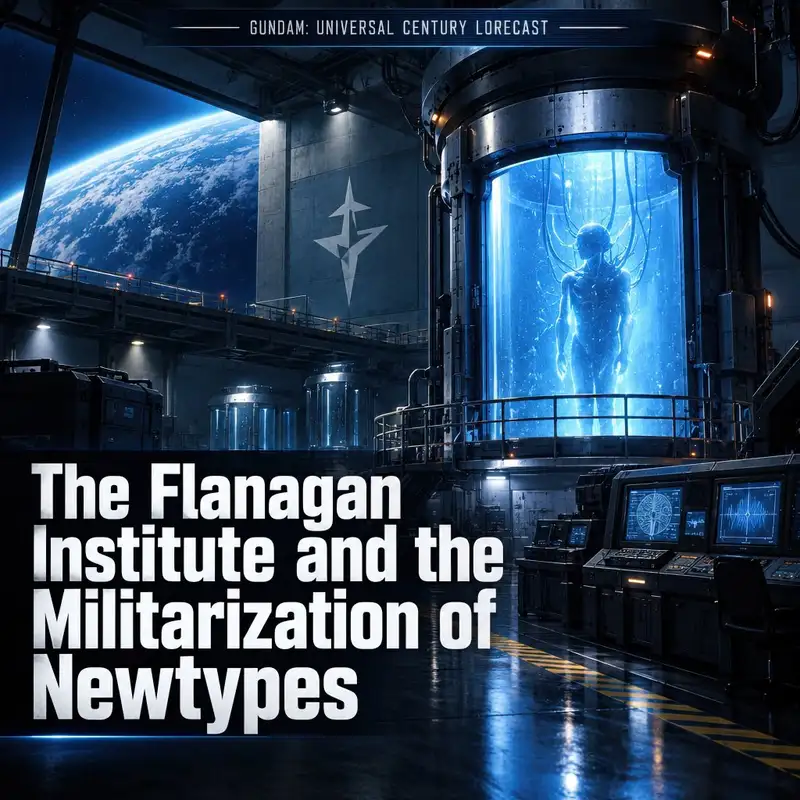
That institution was the Flanagan Institute, Zeon’s Newtype research effort. Its work transformed an idea about humanity’s future in space into a wartime program of identification, testing, equipment development, and combat deployment. It produced powerful results, at least briefly. It did not produce understanding. It did not create a stable doctrine. And it did not give Zeon the political legitimacy or social cohesion that its leaders claimed to seek. Instead, it created an elite and fragile weapons system built around a small number of vulnerable people.
To understand why, it helps to begin before the laboratory, before the psycommu system, and before the Elmeth. The word Newtype did not originally describe a weapons category. It described a political and philosophical possibility.
Zeon Zum Deikun’s Newtype thought grew from the experience of humanity’s movement into space. In broad terms, it held that life beyond Earth might produce people more capable of understanding one another, of perceiving a larger human community, and of escaping the limits of old Earth-bound politics. That idea was never a tidy scientific theory. It was part political philosophy, part hope, and part argument about colonial society. It belonged to a movement concerned with the relationship between Earth and the space colonies, with political representation, and with the belief that people living in space should not remain subordinate to distant institutions on Earth.
The later Principality of Zeon inherited that language, but it did not preserve its meaning intact. Under the Zabi regime, the language of spacenoid development could be folded into state ideology, military prestige, and claims of national destiny. That did not mean every Zeon citizen accepted the same interpretation, or that every soldier understood Newtypes in the same way. It meant that a theory about human possibility became available for political use. In wartime, that made it available for military use as well.
The One Year War created powerful incentives to make that shift. Zeon had achieved remarkable early successes through surprise, mobile-suit doctrine, and aggressive operations. But it was fighting a larger opponent with greater population, industrial depth, and the ability to recover from early disaster. By the war’s final phase, the Federation was no longer improvising alone. It had developed its own mobile suits, expanded production, and pushed back across multiple fronts. Zeon needed advantages that could not simply be matched by Federation numbers.
Minovsky particles made the search for such an advantage more urgent. They did not make sensors and communications vanish altogether, but they complicated conventional long-range command and detection. Fleets and mobile-suit formations had to operate with less certainty. Local initiative mattered more. Visual identification mattered more. A pilot who could sense danger early, recognize hostile intent, or manage a complex engagement under confusion could become militarily valuable. The temptation was obvious. If some people appeared able to perceive more than ordinary pilots, a state at war would try to find them.
That is the point at which a political proposition becomes an institution. A government does not need to fully understand a phenomenon before it begins to organize around it. It only needs to believe the phenomenon might provide an advantage, and to have enough evidence, fear, ambition, or desperation to fund the search.
The original television record does not provide a complete administrative history of the Flanagan Institute. It does not give us a detailed charter, personnel roster, budget, or laboratory map. It does establish something more important for military history: Zeon had organized Newtype research closely enough to connect exceptional pilots with specialized weapons and combat units. Dr. Flanagan is associated with that effort, and later official reference material identifies him as the founder of Zeon’s Newtype research facility. But the man remains less clearly documented than the institutional pattern attached to his name.
Later setting references commonly place the Institute in Side Six and date its establishment to June of Universal Century seventy-nine. Those details are useful as later background, but they are not presented with that precision in the original television episodes. The safer conclusion is that the Institute was a wartime Zeon research organization operating during the conflict’s final months, when the military value of Newtype capability had become a matter of direct operational interest.
The Flanagan Institute’s task was not to create Newtypes. It had no demonstrated ability to produce natural Newtype development on demand. Its task was more bureaucratic and more militarily familiar. It had to identify possible candidates, observe them, classify their capabilities, train them if possible, and connect those capabilities to machinery. In effect, the Institute tried to convert an uncertain human quality into a usable military system.
That process was never as clean as the language of research might suggest. Zeon did not possess a settled scientific definition of a Newtype. It had reports of unusual perception, battlefield incidents, political theories inherited from Deikun, and the testimony of people who believed they had encountered something new. It also had the urgent demands of a losing war. The Institute was therefore working at the intersection of incomplete evidence and intense expectation. That is a dangerous place for any research program, especially one dealing with human beings who cannot be manufactured to specification.
The state’s first question was practical. Could unusual perception improve combat performance? The next question was more difficult. Could that perception be connected to a machine in a way that mattered beyond a single pilot’s instincts? The answer Zeon pursued was psycommu.
Psycommu was a specialized control system designed to translate Newtype brain activity into machine control. It was not a generic term for every unusual Newtype experience, and it was not the same thing as the later bio-sensor, psycho-frame, or other technologies that would appear in subsequent Universal Century conflicts. In this period, psycommu represented a specific attempt to make a human cognitive capacity operate as part of a weapons interface.
The military attraction was considerable. A conventional mobile armor, however powerful, still directs its weapons from the position and orientation of its own hull. A psycommu-equipped system could extend control outward. Remote weapons could move away from the parent machine and attack from positions that made defense more difficult. Instead of facing one visible attacker, a target might confront fire from several vectors while struggling to determine where the controlling platform was located.
This changed engagement geometry. It placed new pressure on ship defenses, on mobile-suit escorts, and on commanders trying to identify the main threat. A vessel designed to concentrate its defensive fire toward an approaching enemy had to confront weapons arriving from directions that did not correspond neatly to the location of the mobile armor controlling them. In a battlefield already complicated by Minovsky interference, the effect could be disorienting. The enemy did not need to be completely blind for the advantage to matter. It was enough that the enemy’s decision cycle had become slower and more uncertain.
But the technology did not eliminate the ordinary burdens of war. Remote weapons still required specialized machinery, power, maintenance, testing, and recovery. The parent platform still needed protection, navigation, logistics, and a command structure capable of assigning it a meaningful mission. Most importantly, the system required a compatible operator. The human being was not simply seated inside the machine. The human being was part of the machine’s functional architecture.
That made the program unusually difficult to scale. A state can build more weapons if it has factories, materials, transportation, skilled labor, and time. It cannot easily build more people with a rare and poorly understood capacity. Even if the Institute could identify potential Newtypes, it still had to determine whether they could use psycommu equipment, whether they could endure combat stress, whether they could be trained, and whether they could function inside a military chain of command. The bottleneck was not merely industrial. It was human.
Zeon’s first major effort to test that human-machine relationship did not rely only on an inexperienced prodigy. It also used Sharia Bull, a professional officer known as the man who returned from Jupiter.
Sharia Bull matters because he shows what the Newtype program looked like when placed inside an existing military career. He was not simply a laboratory subject in uniform. He was an experienced officer associated with Newtype capability and assigned to a developing special unit. His transfer connected him to Kycilia Zabi’s command structure, and Gihren Zabi’s interest in the assignment makes clear that this was not a purely technical matter. The program sat inside the power struggle of the Zabi family.
Gihren’s questions about Kycilia’s Newtype unit reveal a familiar problem in authoritarian war ministries. Specialized weapons programs generate prestige, secrecy, and political leverage. Whoever controls the project may gain an advantage not only against the enemy but against rivals within the same state. A research institute can become a source of military innovation. It can also become a patronage network. In Zeon’s case, Newtype research was entangled with both.
Sharia Bull’s machine, the Braw Bro, represented an early attempt to apply Newtype capability at the scale of a large combat platform. The exact technical details matter less than the operational purpose. Zeon was testing whether an exceptional pilot could manage a weapon system whose combat potential exceeded the ordinary pilot’s ability to observe, process, and control a fast-moving engagement. The Braw Bro was not just another mobile armor. It was an experiment in whether cognition could become a decisive component of fire control.
His battle against the White Base and the Gundam demonstrated real potential. Sharia could perceive more than an ordinary opponent, and the encounter suggested that Zeon’s search had not been entirely speculative. But it also exposed the limits of the theory. Perception is not command cohesion. It does not automatically create mutual trust between units. It does not guarantee a sound tactical situation, a secure withdrawal route, or an organization capable of learning from the encounter before the pilot is lost.
The Braw Bro’s combat use was constrained by the same realities that limit every prototype in wartime. The machine had to be assigned, supported, and employed within an incomplete doctrine. Its pilot had to operate amid uncertainty. Its commanders had to decide how much risk to accept. And the intelligence gathered from the battle could only help Zeon if the institution survived long enough, and remained coherent enough, to use it. A special program built around secrecy and rivalry often learns slowly because the people who need the lesson do not share the same information.
Sharia Bull’s death therefore should not be treated as proof that the Newtype concept failed. Nor should it be treated as a simple test failure. His battle showed that Zeon had identified a potentially valuable military capability. It also showed that recognizing potential was not the same as building a reliable force. The program was still dependent on individual pilots, improvised employment, and competing political patrons.
The next step was more dramatic. It was also more fragile. Lalah Sune became the operator through whom psycommu warfare achieved its clearest battlefield effect.
Lalah was not Sharia Bull. She was not an established officer brought into a special program from a conventional career. She was a young woman with extraordinary ability, limited military experience, and a position shaped heavily by Char Aznable’s protection and sponsorship. Her value to Zeon did not emerge from a standard training pipeline. It emerged from the discovery that her perception and control were exceptionally suited to the Elmeth.
That made her both valuable and vulnerable. The military system could describe her as a Newtype pilot, but that label concealed the human dependencies beneath it. Lalah’s emotional state mattered. Her relationship with Char mattered. Her trust mattered. Her ability to survive the psychological pressure of combat mattered. In a conventional unit, a commander can sometimes replace a damaged vehicle or rotate an exhausted pilot. The Elmeth program could not casually replace Lalah. Her personhood was not separate from the weapon’s performance.
This is where militarization becomes ethically revealing. The Flanagan Institute’s work did not necessarily require cruelty in every individual interaction to produce a coercive structure. The coercion was built into the logic of the program. A rare human capacity became state property in practice. A person’s perception, attachment, fear, and concentration became military inputs. The state and its patrons could speak of potential, destiny, or national necessity, but the operational fact remained plain. A young person was being placed at the center of a weapon system because others believed her mind could do what their machines could not.
Char’s role made the arrangement still more complicated. He was not merely a distant commander assigning an asset to a mission. He had recruited, protected, and personally invested in Lalah. That relationship gave her support, but it also meant that military employment could not be separated cleanly from personal loyalty and political ambition. Char’s decisions affected how Lalah entered the war. His own rivalry, ambitions, and emotional commitments were therefore connected to the use of a strategic weapon.
This is one reason special weapons programs are so difficult to control. They often promise an impersonal technical advantage, but they may depend on relationships that are anything but impersonal. The more exceptional the individual operator, the more the program depends on trust, patronage, and private judgment. A military can write procedures. It cannot easily standardize a bond between a pilot and the people who claim to understand her.
When Lalah entered combat in the Elmeth, the Flanagan Institute appeared to have achieved a breakthrough. The mobile armor’s psycommu-controlled remote beam weapons gave Zeon a form of all-direction attack that ordinary fleets were poorly prepared to answer.
The Elmeth could remain apart from the immediate point of attack while its remote weapons moved outward to engage. That created a tactical problem more complex than simply confronting a powerful gun platform. Warships and escorts had to account for threats approaching from multiple directions. Mobile suits could not rely only on locating and closing with the parent mobile armor. Defensive commanders had to decide whether to protect ships, pursue the remote weapons, search for the controller, or preserve formation under attack. Each choice carried risk.
The system also challenged ordinary identification. In Minovsky conditions, forces already had reduced confidence in what lay beyond visual or local sensor range. Psycommu weapons exploited that uncertainty. A ship under attack might understand that it was being engaged, but not immediately understand where the controlling force was, how many weapons were in play, or whether it was facing one machine or several. The result was not invincibility. It was decision overload.
Lalah’s destruction of four warships in one day demonstrates the scale of the threat. It is an exceptional recorded performance, not evidence that every Elmeth deployment would produce the same result or that Zeon had discovered a routine fleet doctrine. But the result was significant enough to frighten ordinary Zeon pilots as well as Federation opponents. The new weapon disrupted conventional military culture. Pilots trained to understand skill in terms of formation flying, gunnery, maneuver, and direct engagement confronted a system in which one person’s unusual perception could direct attacks beyond the ordinary geometry of combat.
The answer, at least in the One Year War, was that the old military did not disappear. It continued to carry the larger burden of operations. Ships still moved forces. Mechanics still repaired machines. escorts still screened valuable assets. Commanders still chose objectives. Supply systems still determined what could be sustained. The Elmeth was a localized breakthrough, not a replacement for the entire Zeon war effort.
Its limitations were built into its strengths. The remote weapons were effective because Lalah could control them. That meant their effectiveness could not be separated from her condition. The mobile armor required specialized support. It needed technical personnel familiar with an unusual system. It needed maintenance, power, recovery arrangements, and a command environment capable of protecting an irreplaceable pilot. It needed missions appropriate to its strengths. Using such a machine carelessly could waste not just expensive hardware, but the rare person who made it valuable.
This was the central force-generation problem facing the Flanagan Institute. It could demonstrate a possibility. It could not create an ordinary, replaceable military capability before the war ended. Zeon could build machines in limited numbers more readily than it could identify and train compatible operators. Even a successful test did not answer basic questions. How many people could use the system? How long could they operate under combat stress? How would they respond to trauma, fatigue, loss, or divided loyalties? Could commanders predict their performance? Could the organization retain them, protect them, and replace them?
The answers were uncertain because Zeon did not truly understand the phenomenon it was exploiting. It had an interface. It had combat results. It had political interest. It did not possess a mature science capable of making Newtype performance predictable. The Institute was trying to build doctrine around a human capacity whose limits were still unknown.
That uncertainty made the program vulnerable to exaggerated expectation. When a weapon is rare, secret, and spectacular, senior leaders may imagine that it can reverse a war by itself. But no individual system, however frightening, could solve Zeon’s broader strategic problems. It could not restore lost industrial capacity. It could not remove the pressure of Federation production. It could not heal divisions within the Zabi leadership. It could not create political legitimacy in occupied territory or erase the consequences of Zeon’s own aggression and atrocities. A specialized weapon might change a battle. It could not repair a state.
The political structure surrounding the program made standardization even harder. Gihren, Kycilia, Char, the military, and the research establishment did not necessarily share the same goals. One patron might seek battlefield advantage. Another might seek influence. A field commander might seek to protect an irreplaceable pilot. A researcher might seek more testing. These are not identical objectives, and in a dictatorship shaped by family rivalry, disagreement could not always be resolved through transparent institutions.
Secrecy also imposed costs. Compartmentalization can protect a new capability from enemy intelligence, but it can prevent ordinary units from preparing to support it. A fleet cannot integrate a special weapon if it does not know what that weapon needs. A commander cannot plan effectively if the weapon’s operators answer to another patron. A mechanic cannot maintain a system if the technical information is too restricted to circulate. Bureaucratic secrecy is often presented as efficiency. In war, it can become a way of ensuring that no one has enough information to make the system work.
The final tragedy of the Flanagan Institute’s project becomes visible in the encounter between Amuro Ray and Lalah Sune. The events of “A Cosmic Glow” are often remembered for their emotional force, and rightly so. But their military meaning deserves equal attention. The meeting of Amuro and Lalah occurs inside a battle shaped by orders, rivalry, machines, and weapons already committed to action. Their unusual recognition of one another does not take place in a peaceful setting where new understanding can be explored. It takes place in a lethal operational environment.
The series presents an extraordinary connection between them. Their perceptions seem to cross the ordinary boundaries of distance and hostility. Yet that connection does not dissolve the institutions around them. Amuro remains a Federation pilot in combat. Lalah remains the operator of Zeon’s most advanced Newtype weapon. Char remains present as a commander, patron, and deeply invested participant. The war does not pause because two people perceive one another more clearly than ordinary combatants can.
That is the central irony. The political promise associated with Newtype thought concerned a greater capacity for human understanding. The Flanagan Institute turned that capacity into a means of targeting, control, and combat advantage. It made intimate perception operationally useful, then placed the people capable of it inside the most emotionally destructive conditions imaginable.
The result was not transcendence. It was intensified vulnerability. A person capable of unusual empathy might experience the enemy not as an abstract contact on a display, but as another human consciousness. That does not make violence impossible. It can make violence more traumatic. Orders still exist. Weapons still function. Fear and rivalry still shape decisions. The machinery of war does not become less lethal merely because its participants understand more of what they are doing to one another.
The encounter also demonstrates why Newtype ability could not be treated as moral wisdom. Perception is not agreement. Empathy is not command authority. A person may sense another person’s fear, pain, or intention and still remain trapped by loyalty, ideology, immediate danger, or the momentum of a battle. The Universal Century repeatedly returns to this problem. Greater sensitivity does not automatically produce better institutions. It may simply expose more clearly how inadequate those institutions are.
Zeon lost the One Year War. Its Newtype weapons did not reverse the strategic balance. The Flanagan Institute could demonstrate a dangerous concept, but it could not transform that concept into a mature, sustainable force before the state that sponsored it was defeated. The Institute’s immediate wartime program was therefore limited in strategic effect.
Its deeper legacy was more durable. The operational question survived Zeon’s defeat. If some people could operate advanced systems in ways others could not, military institutions would continue trying to identify, control, and reproduce that advantage. The Federation’s victory did not erase the incentive. In some respects, it made the incentive more urgent. The Federation had seen the dangers of Zeon’s Newtype research. It also had reason to fear being left behind by it.
Later Federation Newtype laboratories demonstrate this continuity of logic. They should not be treated as simple administrative extensions of the Flanagan Institute. The available record does not support the claim that one Zeon laboratory directly controlled every later Federation program. But they inherited the same basic military premise: exceptional human capability was a strategic asset, and states could not afford to leave it unexplored.
By the era of the Gryps Conflict, the Murasame Research Institute had become associated with the Psycho Gundam and with Cyber Newtype pilots. The change in language and method matters. Natural Newtypes were people whose abilities emerged in uncertain and uneven ways. Cyber Newtypes were the product of programs attempting to force compatibility through conditioning, manipulation, and other forms of intervention. This was not a simple technical upgrade. It was a deeper institutional violation.
The Murasame program did not merely seek gifted individuals. It sought to manufacture weapons operators. That required systems of control capable of overriding, damaging, or reshaping people whose minds and bodies did not fit ordinary military requirements. The human cost was not incidental. It was part of the program’s method. When an institution cannot reliably find the people it wants, it may begin trying to remake people into the form its weapons demand.
That is the grim continuity between the Flanagan Institute and later Cyber Newtype programs. The later laboratories did not need to repeat every detail of Zeon’s research to repeat its core error. They treated uncertain human potential as something to be measured, owned, modified, and deployed. They learned the weapons lesson while neglecting the human one.
The Flanagan Institute changed warfare at several levels. Tactically, psycommu-controlled remote weapons created new attack geometry. They allowed a single pilot to threaten targets from multiple directions and complicated the defensive problem for ships and mobile suits. Operationally, however, the capability remained limited. It was difficult to integrate, difficult to protect, and dependent on rare people and specialized support. It was not a substitute for fleets, logistics, training systems, or industrial depth.
Strategically, the Institute’s achievements could not compensate for Zeon’s wider defeat. A spectacular weapon cannot solve a deteriorating war when the state behind it remains divided, outproduced, and politically compromised. Industrially, the program proved that a complex human-machine interface could work, but it also exposed the shortage of compatible operators. The hardware was expensive and difficult. The people were rarer still.
Politically, the Institute marked a transformation in Newtype thought. An idea associated with humanity’s possible adaptation to life in space became a form of elite state control. The Newtype became less a citizen of a new political future and more a classified resource. Institutionally, the program helped normalize the idea that laboratories and military commands should classify exceptional people according to their potential military value. Later governments would repeat that logic with greater bureaucratic reach and more openly coercive methods.
For civilians and for the individuals caught inside these programs, the consequences were severe. A young person’s unusual perception could become grounds for surveillance, recruitment, isolation, manipulation, or forced military employment. The language might be scientific, patriotic, or therapeutic. The underlying reality was that vulnerable people became assets in an arms race they did not create.
The Flanagan Institute did not discover a final truth about humanity. It built a military interface around uncertainty and achieved frightening battlefield results. Its failure was not that Newtypes proved useless. Its failure was institutional. Zeon treated a potential capacity for communication as proprietary combat capital, subject to secrecy, rivalry, and sacrifice.
Later Cyber Newtype programs show why that failure mattered. Governments learned that Newtype capability might be weaponized, but they did not learn that human understanding cannot be produced through control. The Institute’s real legacy was a pattern repeated across the Universal Century: when states encounter an uncertain human capacity, they seek to measure it, own it, and weaponize it before they understand it.