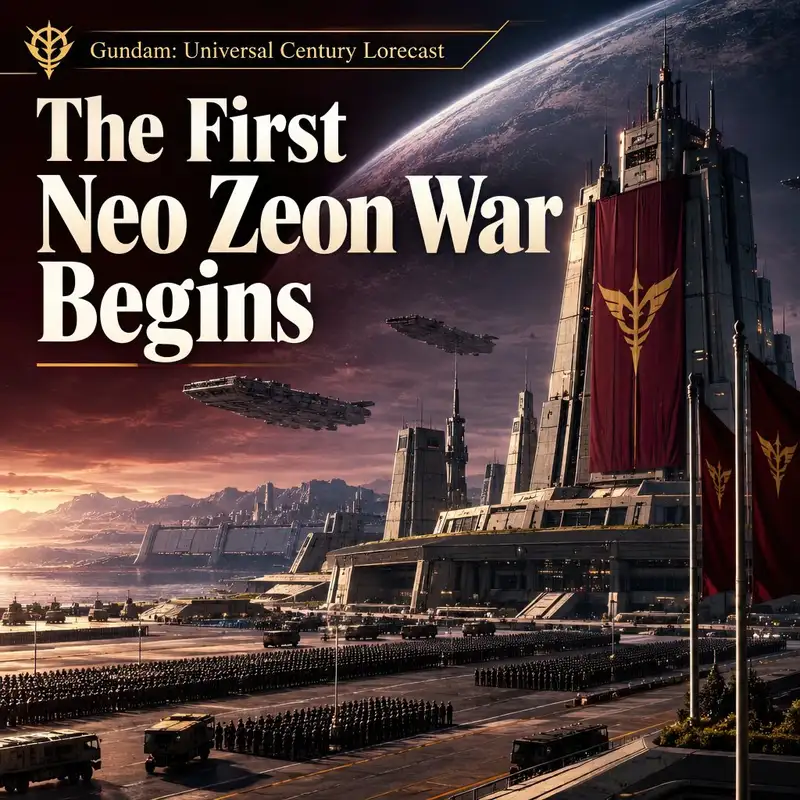
The First Neo Zeon War Begins
The Argama reached Shangri-La in no condition to celebrate a victory. Its hull and mobile suits needed repair. Its crew needed rest, supplies, replacement parts, and pilots. The ship had survived the Gryps Conflict, but survival was not the same as readiness. A warship is more than its guns and engines. It is a hangar, a maintenance department, a medical space, a command post, a storehouse for fuel and ammunition, and a home for people who have been operating under combat pressure for far too long. If any one of those systems fails, a carrier’s mobile suits become stranded equipment rather than combat power.
That was the real condition of the Anti-Earth Union Group after the Titans were broken. The AEUG had won the immediate military struggle, but it had not emerged as the uncontested authority of the Earth Sphere. It had destroyed an enemy formation, not built a government. It had stopped the Titans, not repaired the political order that had created them. The opening of the First Neo Zeon War begins in that gap between battlefield victory and political control.
The final phase of the Gryps Conflict had been ruinous for every major participant. The Titans were effectively destroyed as an independent force. Their authority, already compromised by repression and atrocities, collapsed with their military defeat. But the AEUG paid heavily for that result. Its ships, pilots, commanders, and political network had been strained by a conflict fought across Earth orbit, the Moon, colonies, and major Federation installations. The organization had always been an alliance of convenience as much as a formal military. It contained regular Federation personnel, dissident officers, civilian supporters, Karaba allies on Earth, and people united above all by opposition to the Titans.
That coalition lost some of the people and capabilities it needed most. Quattro Bajeena disappeared during the final fighting. Kamille Bidan, one of the AEUG’s most capable pilots, survived in a severely incapacitated state. The Argama itself remained afloat and operational, but its survival concealed a hard fact. It was no longer one ship within a growing resistance movement. It was becoming one of the few mobile instruments the AEUG still possessed. That changed every decision Bright Noa had to make.
The Earth Federation, meanwhile, had survived, but survival did not automatically produce coherent policy. The Titans had been a Federation institution, even if they had become a violent and semi-autonomous one. Their destruction left behind damaged command relationships, political embarrassment, military casualties, and a large question about responsibility. Federation leaders had to deal with a discredited security apparatus, exhausted regular forces, competing local interests, and a public that had every reason to distrust assurances that order had been restored.
The Federation government, the regular Earth Federation Forces, former Titans personnel, AEUG veterans, and local colonial authorities did not suddenly become one unified postwar administration. Some wanted stability. Some wanted accountability. Some wanted to protect their own careers, budgets, and jurisdictions. Some simply lacked the ability to act quickly after months of emergency operations. The result was paralysis without complete collapse. The Federation still existed. It still possessed enormous resources on paper. But it could not immediately translate those resources into decisive authority across the Earth Sphere.
The distinction matters because Neo Zeon did not begin its war by defeating a healthy, fully coordinated Federation. Haman Karn’s forces entered a political environment in which their enemies had already spent much of their strength defeating one another. The collapse of the Titans removed a threat to the AEUG, but it also removed one of the armed powers that had been maintaining, however brutally and incompetently, a balance of force. Once that balance disappeared, the question was not simply who had won the Gryps Conflict. The question was who could move next.
Axis had spent years beyond the immediate center of Earth Sphere politics, preserving a military force, a political identity, and the symbols of the old Zeon state. By Universal Century eighty-eight, it was ready to reenter the struggle under the name Neo Zeon. Official chronologies place the revival of the Zeon name at the end of February, though the television record is more concerned with the consequences than with a formal declaration ceremony. What matters is that Axis ceased to be merely a distant Zeon successor force. It began presenting itself as a government and a military power with ambitions across the Sides.
The word Neo in Neo Zeon did not mean that Haman Karn was simply restoring the old Principality of Zeon. The original Zeon state had been destroyed in the One Year War. Its dictatorship, its military institutions, its occupation system, and much of its political leadership were gone. But the name retained enormous symbolic force. It could invoke colonial grievance, Spacenoid identity, resentment toward the Earth Federation, and the memory of a state that had once challenged Earth’s rule over space. It could also invoke the authority of the Zabi family and the claim that Zeon’s defeat had never truly settled the political future of the colonies.
Haman’s project depended on more than symbolism. Neo Zeon possessed armed forces, warships, mobile suits, experienced personnel, and a command structure capable of acting while its rivals were disorganized. It also possessed a political language that could describe expansion as restoration. To colonies alienated from Federation authority, the message could be attractive even when the organization delivering it was prepared to use coercion. To soldiers and officials who had served under Zeon or lived with its legacy, Neo Zeon offered continuity, status, and a renewed chain of command.
But Neo Zeon was not a single popular movement speaking for every person in space. Colonial dissatisfaction with the Federation was real. So was the memory of the Titans’ repression. Neither fact made Haman’s government a neutral expression of self-determination. Her project combined state-building, military pressure, Zeon symbolism, personal authority, and control over the political future of Mineva Lao Zabi. Neo Zeon could claim inheritance from the past while also using that inheritance to consolidate power in the present.
Haman was the practical center of gravity in this new state. She was not merely a figurehead preserving a family name. She exercised real political and military influence over an organization that had retained its cohesion while the AEUG and Federation were exhausted. That cohesion was Neo Zeon’s greatest opening advantage. A force does not need to be stronger in every category if its opponents cannot agree on objectives, move resources quickly, or determine who is responsible for the next decision.
The opening campaign therefore began with a contest over initiative. Neo Zeon wanted to demonstrate that it could act, intimidate, negotiate, and seize opportunities before the Federation or AEUG could recover. It did not need to conquer the entire Earth Sphere at once. It needed to establish that its ships could appear where they chose, that its commanders could impose pressure on isolated targets, and that no larger force would arrive quickly enough to stop them. In a fragmented strategic environment, even a local success could have political value far beyond its immediate military scale.
For Bright Noa, this strategic vacuum arrived as a much more immediate problem. The Argama needed a safe place to dock. It needed repairs and resupply. It needed to restore its ability to launch and recover mobile suits. It needed to preserve the personnel who remained. These were not glamorous requirements, but they were the conditions of continued existence. A mobile suit carrier cannot fight indefinitely by improvisation alone. Damaged machines require technicians, tools, spare components, ammunition, propellant, and protected working time. Pilots require sleep, briefing, medical attention, and confidence that someone can recover them if they are forced down or disabled.
The Argama had once represented the AEUG at its most capable. It had carried important commanders and elite pilots. It had operated as part of a wider network of ships, bases, allies, and political support. By the beginning of Universal Century eighty-eight, it was increasingly a remainder of that network. Bright still held formal command, and his experience gave the ship continuity. But command experience cannot manufacture spare parts, restore lost pilots, or create a political settlement. He had to make decisions with the resources actually available, not the resources a victorious organization ought to have possessed.
This is why the Argama’s arrival at Shangri-La matters so much. The colony was not simply a convenient setting for the next phase of a mobile suit war. It was a place where the strategic disorder of the Earth Sphere became visible at human scale. Shangri-La, Side One’s colony one, was a damaged and economically marginal community. It was shaped by salvage work, informal labor, commercial opportunism, and the uneven distribution of security. Military debris, abandoned equipment, and visiting ships could be sources of income. They could also be sources of danger.
For people living in such a colony, the end of the Gryps Conflict did not necessarily look like peace. It could look like damaged infrastructure, uncertain employment, armed outsiders, and local authorities more interested in extracting payment than in protecting ordinary residents. A warship arriving for repairs brought business, but it also brought risk. Its cargo held value. Its mobile suits could be stolen, stripped, or fought over. Its enemies might follow. In a colony cylinder, this was not an abstract concern. The place where people argued, worked, and raised families was also a pressure vessel with life-support systems, transport routes, and fragile civilian infrastructure.
The residents of Shangri-La did not need to be ideological supporters of Neo Zeon or loyal defenders of the Federation to understand this reality. They lived in an economy shaped by neglect and scarcity. In that environment, military hardware was not merely a symbol of national power. It was material. A damaged weapon might become scrap. A component might become a meal, a rent payment, or a way to keep a family together. The boundary between civilian survival and military procurement became dangerously thin.
Judau Ashta emerged from that world. He was fourteen years old, a junk dealer with practical knowledge of machinery and a sharp understanding of what valuable equipment could mean in Shangri-La’s economy. His immediate concerns were not the AEUG’s constitutional legitimacy or Haman Karn’s long-term strategy. He was trying to survive, make money, and protect his younger sister, Leina. When he and his friends targeted the Zeta Gundam, they were not volunteering for a cause. They saw an opportunity.
That distinction is important. Judau did not begin as a trained cadet, an ideological recruit, or a soldier prepared for the responsibilities of combat. He and his companions had technical familiarity. They knew how to move through a colony, identify useful machinery, and exploit gaps in security. Those are meaningful skills. Salvage work can produce mechanical instinct, ingenuity, and confidence around complex equipment. But it does not provide formal training in weapons employment, identification procedures, combat discipline, command relationships, or the legal and moral burden of operating a military machine inside a civilian habitat.
The attempted theft of the Zeta Gundam revealed two failures at once. First, it revealed how vulnerable the Argama had become. A ship that had helped defeat the Titans could not secure its own remaining combat assets without difficulty. Second, it revealed how the wider system had failed the young people of Shangri-La. The Federation had built an Earth Sphere in which adolescents could know enough about military equipment to try to steal it, yet have so little reliable economic protection that the attempt made sense to them.
Bright recognized Judau’s unusual aptitude. That recognition was not irrational. The boy demonstrated nerve, technical ability, spatial awareness, and an instinctive capacity to operate equipment that should have been far beyond an ordinary civilian’s reach. But the circumstances were grim. The Argama needed pilots. It had lost experienced personnel. Kamille could no longer fill the role he had held. The surviving crew could not simply wait for a formal training pipeline to replace combat losses. In a crisis, institutions often redefine emergency measures as opportunity because the alternative is admitting that they have no acceptable options.
Judau’s movement from junk dealer to Argama pilot was therefore both a personal choice and an institutional indictment. He was not dragged aboard without agency. He made decisions, took risks, and developed loyalties. Yet his willingness to act did not erase the fact that adults, governments, and military organizations had created a situation in which a fourteen-year-old’s talent became strategically useful. The Universal Century repeatedly treats gifted young people as evidence of hope. It also repeatedly turns that hope into military labor.
The arrival of Mashymre Cello and the Endra made the danger at Shangri-La immediate. Mashymre’s mission was straightforward in concept. He intended to capture the Argama and deliver success to Haman Karn. A damaged AEUG carrier at a predictable repair stop was an attractive target. Capturing it would remove a surviving enemy asset, produce intelligence, and provide political theater. It would show that Neo Zeon could hunt the remnants of the Gryps Conflict while the Federation stood aside or arrived too late.
The Endra’s presence did not mean that Neo Zeon controlled all of Side One or possessed unchallenged authority throughout the Earth Sphere. It meant something more specific and more revealing. Neo Zeon had the ability to project force into a contested colonial environment. It could dispatch a commander with a clear objective. It could exploit a known vulnerability. It could operate against an isolated ship whose need for repairs had made its movements predictable. The Argama’s weakness was not simply that it had been damaged. Its weakness was that no broader system had secured the conditions of its recovery.
Mashymre was not the whole of Neo Zeon doctrine, and his personal style should not be mistaken for the complete character of Haman’s government. But his mission illustrates how a coherent force uses opportunity. A local commander does not need to understand every aspect of grand strategy to be useful. He needs an objective, enough resources to attempt it, and confidence that success will be recognized by higher command. In contrast, the Argama’s crew had to defend themselves while also solving a maintenance problem, a manpower problem, a security problem, and a civilian problem.
Combat inside Shangri-La was constrained by the nature of the battlefield. A colony is not open space. It contains homes, shops, transport systems, industrial areas, and people trying to live ordinary lives. It also depends on pressure integrity, environmental control, and infrastructure that cannot be casually destroyed without consequences far beyond the immediate fight. Mobile suits are powerful machines, but their use inside a habitat is never merely a duel between pilots. Every missed shot, collision, explosion, or falling piece of wreckage can threaten civilians who did not choose to become part of the operation.
This did not make violence impossible. The Universal Century contains many examples of armed forces fighting in and around colonies despite the danger. But it made every engagement a political act as well as a tactical one. Neo Zeon wanted to capture the Argama and demonstrate power. The Argama wanted to survive, retain its mobile suits, and escape. The people of Shangri-La wanted, above all, not to have their lives destroyed by another conflict conducted over their heads. None of those objectives aligned.
The confrontation also showed why the AEUG’s military problem could not be understood solely through the performance of one mobile suit. The Zeta Gundam remained an important asset, but the machine depended on pilots, launch procedures, maintenance crews, ammunition, recovery capability, and a carrier able to stay alive long enough to support it. Judau’s intervention mattered because he helped preserve a system already under stress. He did not suddenly solve the AEUG’s strategic weakness. He helped prevent a damaged ship from losing one of the few capabilities it still possessed.
In that sense, Shangri-La was an early test of the war’s underlying imbalance. Neo Zeon had not won a decisive campaign there. The Argama was not destroyed or captured. But the encounter demonstrated that Haman’s forces could pressure an AEUG survivor at a vulnerable moment. It demonstrated that the Argama had to rely on improvisation, local knowledge, and untrained recruits. And it demonstrated that the Federation was not yet acting as the kind of power that could protect a strategically important allied warship during a necessary repair stop.
By March eleventh, the Argama escaped Shangri-La. That was a success, but it was a withdrawal, not a settlement. Bright preserved his ship, his crew, and the mobile-suit capability that remained to him. Judau and his companions joined the Argama’s crew, giving the ship new personnel at a moment when it desperately needed them. Yet their recruitment did not restore the AEUG to its former strength. It was an emergency measure, shaped by necessity and risk.
In tactical terms, the Argama had survived a dangerous local encounter. At the operational scale, it remained isolated and under-supported. At the strategic scale, Neo Zeon had shown that it could contest the post-Gryps environment before the Federation and AEUG could establish a coherent response. In political terms, Shangri-La’s civilians had seen armed organizations maneuver through their colony while no higher authority appeared able to guarantee their safety. These outcomes are not interchangeable. A ship can escape and still be part of a losing political situation.
The Argama’s next need was not less urgent because it had escaped. Its equipment still required repair. Its pilot shortage remained. Its role as a surviving AEUG platform placed pressure on every remaining system aboard. This is where Anaheim Electronics and its dock ship, La Vie en Rose, enter the story. Anaheim’s involvement was important not because the corporation secretly controlled every political event in the Earth Sphere, but because warships and mobile suits depend on industrial support. A carrier cannot manufacture its own replacement combat power in a hangar.
The delivery associated with La Vie en Rose offered the Argama a new possibility. The ZZ Gundam was intended as a major AEUG combat asset, a high-performance machine with unusually concentrated firepower and a complex combining and transforming design. In the opening phase of the war, its importance was not simply that it was more impressive than the machines already aboard. Its importance was that it represented an industrial attempt to compensate for the AEUG’s shrinking depth of manpower and equipment.
On March sixteenth, after damage to the Zeta Gundam’s head, the arrival of the Core Top allowed the ZZ Gundam to become operational. The timing was significant. The Zeta had been one of the Argama’s most valuable remaining mobile suits. Damage to it was not a minor inconvenience. A depleted force cannot easily absorb the loss of a key machine, especially when it lacks a reserve pool of experienced pilots and secure access to major bases. The ZZ was therefore not merely an addition. It was a replacement capability arriving at a moment of visible vulnerability.
The machine’s combining structure and heavy armament made sense within that context. The Argama needed a mobile suit able to deliver substantial combat power from a single platform. It needed flexibility, reach, and a weapon system capable of confronting Neo Zeon forces that could not be dismissed as scattered remnants. A powerful prototype can give a small force options it would not otherwise have. It can deter attack, support a withdrawal, defend a carrier, or allow an outnumbered unit to survive an engagement that would otherwise be impossible.
But concentrated capability has costs. A complicated machine requires integration. Its components must be maintained. Its systems must be understood by technicians. Its pilot must learn how to use its weapons without creating new risks for friendly forces and civilians. The carrier must have the space, tools, parts, and time to support it. A high-performance combat machine is not a self-contained answer. It is an argument made in metal, reactor output, maintenance hours, and the labor of people who may never appear in the cockpit.
The ZZ Gundam also imposed a burden on Judau. His natural aptitude made him a plausible pilot, but plausibility is not the same as readiness. The fact that the Argama needed someone like him to operate such a machine says as much about the AEUG’s manpower crisis as it does about his potential. Military organizations often celebrate the exceptional individual because exceptional individuals make dramatic solutions possible. They are less eager to explain why a proper institution had no trained replacement ready for the job.
There is a familiar temptation in military history to treat a new weapon as the turning point that resolves a failing campaign. The ZZ Gundam resists that interpretation. It strengthened the Argama. It gave the ship a new core asset and improved its ability to survive the opening pressure of the war. But it did not rebuild the AEUG’s lost organization. It did not restore Kamille. It did not bring Quattro back. It did not repair Federation legitimacy, settle colonial grievances, or create a unified command structure among the forces that had opposed the Titans.
A weapon system can solve several problems at once, at least until the organization discovers how many of its problems were never mechanical. The ZZ could provide firepower. It could not provide political authority. It could improve a carrier’s tactical options. It could not guarantee secure docking rights, reliable intelligence, or a functioning postwar order. It could give Bright a stronger hand in a local fight. It could not transform improvised teenage recruits into a mature, sustainable force overnight.
That is not a criticism of the machine. It is a reminder of what military technology can and cannot do. The Universal Century is full of systems designed to compensate for institutional weakness. Mobile suits compensate for the limits of conventional fleets under Minovsky conditions. psycommu systems compensate for the difficulty of controlling all-range weapons. high-performance prototypes compensate for numerical disadvantage. Yet none of these technologies can permanently substitute for training, command, logistics, legitimacy, and political judgment.
Neo Zeon understood the value of this distinction. Haman Karn did not need to destroy every enemy ship in the first weeks of the conflict. She needed to exploit an environment in which the Federation was slow, the AEUG was depleted, and isolated communities had little confidence that anyone would protect them. Each local operation could become a test of authority. Could Neo Zeon move freely? Could it pressure a colony? Could it force its enemies to react rather than act? Could it present itself as the one organized power in a disordered Earth Sphere?
The Argama’s survival denied Neo Zeon an easy early victory. Bright’s command experience, the crew’s endurance, Judau’s intervention, and Anaheim’s industrial support all mattered. But the fact that all of those elements were required reveals the depth of the crisis. The AEUG’s remaining symbol of resistance depended on a damaged carrier, a precarious repair network, a corporate dock ship, and young civilians drawn from a struggling colony economy. That was not the posture of a coalition prepared to impose peace after victory.
The First Neo Zeon War therefore began at several levels at once. Politically, Neo Zeon revived the Zeon name and claimed a place in the Earth Sphere’s future. Strategically, Haman’s forces moved into a vacuum left by the Titans’ destruction and the AEUG’s exhaustion. Operationally, Neo Zeon commanders could threaten isolated targets before their opponents assembled a coordinated response. At the human level, the consequences appeared in places like Shangri-La, where civilians and teenagers were pulled into the struggle because larger institutions had failed to protect them.
Later in Universal Century eighty-eight, Neo Zeon would expand its operations and press the advantage created in this opening period. The war would grow beyond one damaged cruiser, one colony, one ambitious commander, and one newly activated Gundam. But those later developments make sense only because the first conditions were already in place. Neo Zeon did not create all of the Earth Sphere’s instability. It recognized that instability, organized around it, and moved before its rivals recovered.
The beginning of the war was not marked by a single clean declaration, a single decisive battle, or the sudden collapse of the Federation. It was marked by the absence of a settlement. The Titans were gone, but their defeat had not restored trust. The AEUG had won, but it lacked the strength to govern the outcome. The Federation remained, but it could not immediately act as a coherent guarantor of order. Into that opening stepped Haman Karn, armed with a disciplined remnant force, a powerful political symbol, and a clear willingness to use both.
The ZZ Gundam gave the Argama a new weapon at a necessary moment. It helped keep a surviving AEUG force in the fight. But the opening of the First Neo Zeon War had already exposed the deeper problem. In the Universal Century, military victory repeatedly arrived before the institutions needed to make that victory endure.