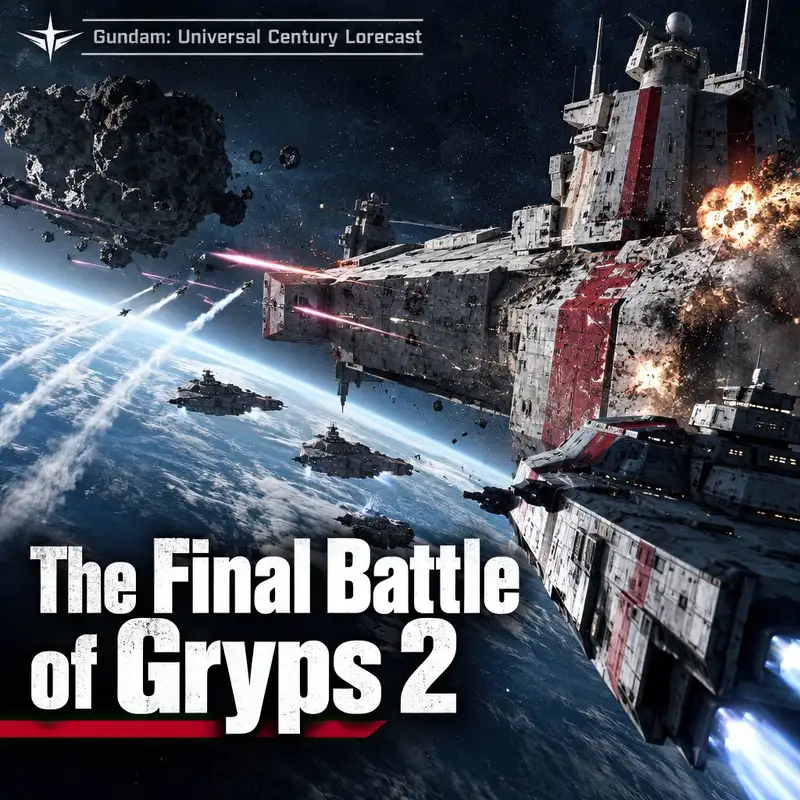
The Final Battle of Gryps 2
Gryps 2 had once been a colony. It had been built as a place where people could live, work, travel, raise children, and depend on artificial air, light, water, and gravity. By the final days of the Gryps Conflict, it had become something else: a colony laser, a strategic weapon capable of deciding the fate of fleets far beyond its own hull. The central question was no longer whether one pilot could defeat another in open space. It was whether the Anti-Earth Union Group, the AEUG, could hold this captured piece of infrastructure long enough to turn it on the Titans before Paptimus Scirocco sabotaged it, before Axis Zeon transformed the crisis into political leverage, and before the remaining Titans forces could recover their position.
That made Gryps 2 more than a fortress and more than an oversized cannon. It was a weapon whose destructive power depended on a chain of human and institutional decisions. Someone had to control the command spaces. Someone had to secure the interior. Someone had to keep the enemy from disabling the system. Someone had to decide when to fire, and at whom. Outside the colony laser, fleets maneuvered under the threat of a single decisive shot. Inside, mobile suits and commanders fought over access to the machinery that could make that shot possible. The final battle of Gryps 2 was therefore a struggle over command, infrastructure, and political succession as much as it was a battle between famous pilots.
That transformation of a colony into a weapon also mattered morally. A colony cylinder was not empty industrial material waiting for a military purpose. It was a political community and a life-support system. The Gryps Conflict had already shown how readily powerful institutions treated colonies as targets, hostages, bases, and symbols. The Titans had built their authority through repression and violence directed against colonial populations. Their enemies fought in the name of resistance, but they too were forced to operate in a political environment shaped by the militarization of inhabited space. Gryps 2 represented the extreme form of that process. A structure created to sustain civilian life had been converted into an instrument for destroying organized military force on a vast scale.
For that reason, the final battle cannot be reduced to Kamille Bidan against Paptimus Scirocco, or Char Aznable against Haman Karn. Those confrontations mattered, and their consequences were severe. But they took place within a larger contest over fleet survival, command authority, and the future distribution of power. Bright Noa’s role in the final operation illustrates the difference. Bright was not the most spectacular pilot in the battle. He was the commander responsible for converting a temporary military opportunity into an operational result. The AEUG had gained access to Gryps 2. The difficult task was to hold it, coordinate its use, defend it from interference, and fire before the opportunity disappeared.
The Titans entered that crisis with formidable weapons and experienced officers, but their deeper weakness had developed long before the final battle. A military organization can retain ships, mobile suits, and destructive capacity even after its political foundation has begun to disintegrate. The Titans had relied heavily on fear. They had relied on exceptional legal authority, secret programs, intimidation, and the assumption that opposition could be contained through force. Those methods could compel obedience for a time. They could not build broad consent, reliable alliances, or a stable succession system among ambitious commanders.
The Titans’ record had left them politically isolated. Their repression of colonial populations, their willingness to use inhabited space as a battlefield, and their internal rivalry made it difficult for them to present themselves as defenders of a legitimate Federation order. By the end of the conflict, they were no longer fighting from a position of secure authority. They were fighting for institutional survival. That distinction mattered. A government can survive battlefield reverses if it retains legitimacy, reserves, allies, and administrative cohesion. A coercive elite formation that has alienated much of the political system may not survive even one decisive operational defeat.
Paptimus Scirocco understood that the old Titans leadership could not simply continue as before. His power had grown because the formal chain of command was already weakening. He was an accomplished pilot, a capable commander, and a figure with ambitions far beyond the cockpit. After Jamitov Hymem’s death, Scirocco sought to position himself as the practical successor to Titans authority. But practical influence is not the same thing as a durable political coalition. Scirocco had followers and military assets. He did not possess a stable institution capable of surviving the fragmentation around him. He needed the Titans fleet to remain viable, and he needed Gryps 2 not to become the weapon that destroyed it.
That was the immediate military logic behind his move into the colony laser. Scirocco was not merely pursuing personal rivals. He was attempting to deny the AEUG the ability to use the decisive strategic asset in the theater. If the laser could be disabled, delayed, or thrown into confusion, the Titans might preserve enough fleet strength to continue the struggle. The final interior battle was therefore an act of sabotage and command denial. A strategic weapon is never secure merely because a force has captured the outer structure. It depends on access to controls, communications, technical personnel, power systems, security corridors, and the ability to keep hostile mobile suits away from the places where a few minutes of disruption can matter more than an entire squadron’s courage.
The AEUG faced its own version of that problem. It had reached the point where it could employ Gryps 2, but it was not arriving fresh. Its ships and pilots had endured a long campaign. The destruction of the Radish immediately before the finale was a reminder that the AEUG’s losses were no longer abstract. Ships could be replaced only with time, industrial support, trained crews, and secure facilities. Veteran officers and pilots could not be replaced quickly at all. Every damaged vessel reduced mobility. Every lost mechanic, operator, and bridge officer narrowed the organization’s ability to sustain operations. The AEUG was winning access to a strategic weapon while approaching the limits of its own endurance.
This was the paradox of the final battle. Gryps 2 gave the AEUG a means to achieve in moments what ordinary fleet attrition might not achieve before its own force came apart. But possession was not the same as control, and control was not the same as a usable shot. The laser had to be protected from Titans interference. The AEUG had to maintain enough local security to keep the interior from falling into enemy hands. Bright had to act under battlefield pressure, with incomplete information and dispersed forces. The mobile suits around Gryps 2 mattered because they protected, penetrated, disrupted, or threatened the command system that made the strategic weapon useful.
Minovsky interference sharpened those command problems by degrading long-range detection and reliable communications. The fleets had adapted to those conditions, but the final struggle still depended heavily on local judgment, prearranged intent, and commanders acting before a complete picture could reach them.
Inside Gryps 2, the command relationships were even more unstable. Scirocco entered to interfere with the laser and preserve the Titans’ prospects. Char, still publicly operating as Quattro Bajeena, pursued him because the Titans commander’s success would directly threaten the AEUG operation. Char was one of the AEUG’s most important military and political figures, but he was not an uncontested master of the organization. His authority rested on reputation, personal influence, and the confidence of allies who did not always share his larger political instincts. In the final battle, he was acting within an AEUG operation, but he was also confronting a future in which the destruction of the Titans would leave unresolved questions about leadership and power.
Haman’s presence made those questions sharper. She did not enter the crisis simply to settle a personal account with Char. Haman understood that the fate of Gryps 2 would shape Axis’s room for maneuver after the battle. If the Titans survived intact, Axis would face a still-dangerous Federation security force. If the AEUG won too completely, Axis could confront a newly consolidated anti-Titans coalition with greater legitimacy and momentum. The best outcome for Axis was not necessarily ownership of the colony laser. It was a postwar balance in which Axis retained its forces, its political identity, and the ability to dictate terms where the exhausted Federation factions could not.
The result was a three-sided contest in which cooperation and conflict existed at the same time. The AEUG and Axis could both benefit from the Titans’ collapse, but they did not share a political program. Scirocco and Haman could both oppose the AEUG’s monopoly on Gryps 2, but they were not building a common state. Char and Haman were connected by history and by competing claims over Zeon’s future, yet neither could simply absorb the other’s position. The final battle was not disorder caused by irrational personalities. It was the military expression of a political landscape in which no participant trusted the others enough to let them emerge dominant.
Bright’s decision to fire Gryps 2 against the Titans fleet was the decisive operational act of the battle. The colony laser did not matter because it was visually impressive. It mattered because it allowed a force that had been fighting from a position of exhaustion to impose fleet-scale losses on an enemy at the exact moment that enemy could not afford them. Conventional mobile-suit actions could destroy individual ships, cover retreats, protect a command vessel, or break a local formation. Gryps 2 could do something different. It could transform control of a single installation into the destruction or crippling of a major military concentration.
The timing was critical. The Titans still possessed armed vessels and mobile suits. They were not helpless. But their command system was under pressure, their political leadership had fractured, and the AEUG had gained the means to strike at the fleet rather than merely contest it. Once Gryps 2 fired, the Titans lost more than hulls. They lost the remaining operational position from which they might have restored control over the theater. A fleet can absorb losses when it has depth, secure bases, coherent command, and a political system willing to sustain the war. The Titans, by this point, lacked much of that resilience.
Tactically, the shot inflicted decisive losses on the Titans force in range. Operationally, it broke the Titans’ ability to maintain a credible fleet contest around Gryps 2. Strategically, it removed the military instrument through which the Titans hoped to preserve dominance within the Federation. And at the political level, it accelerated the collapse of an organization whose authority had already become dependent on military coercion. The laser did not create the Titans’ political failure. That failure had been built through their own conduct. But Gryps 2 turned a long deterioration into an immediate and irreversible battlefield result.
This is an important distinction. Strategic weapons are often described as though their power resides entirely in destructive output. In practice, their effect depends on timing, target selection, command authority, and the enemy’s capacity to recover. Gryps 2 was decisive because the AEUG held it at the moment the Titans could no longer absorb the consequences of losing their fleet. Had the AEUG failed to secure the facility, failed to complete the firing sequence, or failed to prevent Scirocco’s interference, the outcome might have been very different. The weapon was powerful, but power alone did not decide the battle. Control did.
Even after the decisive firing, the battle did not end. The destruction of a fleet does not settle every question that a fleet had been protecting. The Titans’ broader position had collapsed, but Scirocco remained alive and dangerous. Axis remained present. The AEUG had not established a stable political order. The mobile-suit fighting that followed was therefore not an afterthought. It was the struggle over leadership, survival, and the political meaning of the Titans’ defeat. The colony laser had destroyed the Titans’ ability to dominate militarily. It had not answered who would speak for the Federation afterward, who would represent the colonies, or who would exploit the weakness left behind.
The machines involved reflected different military purposes, but none of them should be mistaken for the complete explanation of the outcome. Scirocco fought in The O, a powerful mobile suit suited to an exceptional pilot and a commander who expected to remain at the center of a violent, unstable battlefield. Char used the Hyaku Shiki, a machine tied closely to his role within the AEUG’s mobile-suit force. Haman piloted the Qubeley, a psycommu-equipped machine that expressed Axis’s investment in elite Newtype warfare and high-performance command assets. Kamille flew the Zeta Gundam, an advanced transforming mobile suit developed through AEUG and Anaheim Electronics efforts.
The Zeta Gundam’s capabilities mattered. It gave Kamille mobility, adaptability, and high performance in an environment where rapid changes in range, direction, and tactical position could decide an encounter. But it was not a mass-produced answer to the Earth Sphere’s political crisis. Its advanced design represented technical ingenuity, specialized development, and the resources required to sustain a high-performance prototype. That did not make it unimportant. It made it difficult to reproduce across an entire force. The AEUG could use such machines to create tactical opportunities. It could not build a durable peace merely by possessing them.
Char’s confrontation with Haman was likewise about more than combat skill. Both had reason to oppose the other’s political future. Haman’s Axis project drew legitimacy from Zeon heritage, military strength, and Mineva’s symbolic position. Char’s relationship to Zeon’s legacy was more complicated and more personally charged. He had become central to the AEUG’s struggle against the Titans, but he could not escape the question of what would follow the Titans’ defeat. Haman sought influence over that future. Char resisted being drawn back into a political arrangement defined on her terms. Their conflict was not simply a rivalry between gifted pilots. It was a clash between incompatible claims to leadership in a post-Titans Earth Sphere.
Kamille’s confrontation with Scirocco carried a different weight. Scirocco was not only an enemy ace. He was the most consequential surviving Titans figure still capable of converting military skill into a political claim. As long as he remained alive and active, the Titans’ defeat was incomplete. He could become the rallying point for surviving forces, a successor to Jamitov’s authority, or the center of a new coercive coalition. Kamille’s battle with him was therefore tactically personal but politically significant. It was a fight against the remaining figure most able to transform the Titans’ remnants into a renewed bid for power.
The final confrontation was extraordinary. The television account depicts Kamille’s Zeta Gundam, its bio-sensor system, and Kamille’s Newtype experience entering a state beyond ordinary combat performance. Scirocco is defeated. Yet the event does not offer a clean technical explanation that can be converted into a standard military doctrine. What is shown is an exceptional moment under extreme emotional, physical, and tactical pressure. Kamille’s experience is shaped by the losses around him, by his own Newtype sensitivity, and by a battle in which ordinary command structures have nearly dissolved. The result cannot responsibly be described as a routine capability available to any pilot with advanced equipment.
The bio-sensor should not be treated as a button that produces miracles on demand. Nor should the event be reduced to a simple contest of psychic power. The series presents effects that are real within its narrative, but it does not provide a settled scientific model for every perception, voice, resonance, or mental shock involved. What can be said is that Kamille defeats Scirocco in the final confrontation, and that Scirocco’s final act leaves Kamille catastrophically incapacitated. The victor survives, but survival is not the same thing as recovery. The pilot whose actions help remove the Titans’ last major leader pays a human cost that no operational map can adequately measure.
That is one of the harshest truths of Gryps 2. Exceptional individual capability can alter a battle. It cannot protect the individual from the damage created by that battle. Kamille’s success removes Scirocco as a political-military threat. It does not restore the AEUG’s losses. It does not repair the people killed in the campaign. It does not make the institutions that used young and vulnerable people in war suddenly humane. The final battle demonstrates the military value of a remarkable pilot and advanced machine. It also demonstrates the moral bankruptcy of a system that repeatedly places such burdens on individuals and then treats their survival as proof that the cost was acceptable.
Scirocco’s defeat reveals the opposite side of the same problem. He possessed tactical intelligence, personal charisma, Newtype aptitude, and an advanced mobile suit. None of those qualities could compensate for the weakness of the political structure around him. He had risen because the Titans’ system had become unstable, but he could not make that instability disappear. His ambition depended on preserving enough military force to create a new order under his leadership. Once Gryps 2 destroyed the Titans fleet’s remaining position, his personal brilliance had nowhere secure to stand. A commander can seize influence during institutional collapse. That does not mean he can build legitimacy from the wreckage.
Char’s disappearance deepened the AEUG’s own crisis. At the moment the Titans fell, the AEUG needed experienced figures capable of translating military victory into political reconstruction. Char had been a central combat leader, a public symbol, and a figure whose history gave him unusual influence across the Earth Sphere. His disappearance did not erase the AEUG’s achievement, but it deprived the organization of one of its most significant and complicated leaders. Those left behind had to confront victory without the certainty that he would return, and without a simple agreement about what the victory should mean.
The disappearance also mattered because the AEUG had never been politically uniform. It had been united by opposition to the Titans, not by complete consensus on colonial autonomy, Federation reform, Zeon’s legacy, or the future use of military power. Removing a common enemy can expose disagreements that war had temporarily concealed. The destruction of the Titans did not automatically transform the AEUG into a governing institution. It remained a battered military-political coalition whose personnel, ships, and political authority had been consumed by the campaign that made victory possible.
Axis emerged from the crisis in a stronger relative position than either Federation faction. This did not mean that Axis had conquered Gryps 2 or personally dictated every detail of the battle. It meant that Haman’s forces retained strategic freedom while the Titans collapsed and the AEUG bled heavily. Relative strength matters after a war. A force does not need to own the battlefield if its rivals emerge exhausted, divided, and unable to convert victory into stable control. Axis had preserved enough capability to act, enough political identity to rally followers, and enough independence to exploit the vacuum opening across the Earth Sphere.
This was Haman’s real success. She did not need to make the Titans survive. Their survival would have limited Axis options. She did not need the AEUG to be annihilated either, because an outright Axis takeover in the middle of the battle might have united others against her. What mattered was that neither Federation force emerged whole. The Titans were shattered. The AEUG was victorious but depleted. Axis remained an organized armed power with a claim, however contested, to Zeon heritage and a leadership structure ready to exploit the aftermath. The force that fired the final strategic shot was not necessarily the force best positioned to dominate the peace.
The immediate end of the Gryps Conflict therefore produced an uneven result. The Titans collapsed as an effective political-military force. Their defeat removed a repressive organization that had become a threat not only to colonial populations but to the Federation order it claimed to defend. Yet the AEUG had lost much of its own strength. Its experienced crews had been killed, its ships damaged or destroyed, and its leading figures scattered, wounded, or missing. It had demonstrated that the Titans could be defeated. It had not demonstrated that it could rebuild the Earth Sphere’s political order.
Nor did the Titans’ fall resolve the conditions that had allowed them to rise. The Earth Federation still carried the burden of colonial inequality, weak representation, bureaucratic distance, militarized security politics, and the tendency to answer political problems with exceptional force. The destruction of the Titans removed one coercive instrument. It did not automatically reform the institutions that had authorized, tolerated, or failed to restrain that instrument. A military victory can remove a government’s most visible weapon without changing the habits of power that made the weapon attractive in the first place.
The same caution applies to industry. The AEUG’s access to high-performance systems, including the Zeta Gundam, showed what could be achieved through advanced development and support from Anaheim Electronics. But technical sophistication was not the same thing as a replacement military-industrial order. Designing a superior prototype, building a limited number of advanced machines, and sustaining a battered coalition in war were different tasks. Anaheim could provide equipment and expertise. It could not create political legitimacy, train an entire postwar security system, or decide what the Federation should become. Corporations can shape wars profoundly without becoming omniscient authors of history.
The final battle of Gryps 2 is often remembered through its most dramatic personal images: Kamille’s final assault, Scirocco’s defeat, Char and Haman’s confrontation, the immense beam of the colony laser. Those images matter because they carry the emotional and symbolic weight of the conflict’s ending. But the military history is clearer when the battle is understood as a contest over a strategic system. The AEUG did not win because one pilot was stronger than every opponent. It won because it gained temporary control of the one asset capable of breaking the Titans fleet before its own exhausted forces could be overwhelmed.
That temporary control had to be converted into action. Bright’s command decision mattered. The crews and defenders of Gryps 2 mattered. The mobile-suit pilots who prevented or delayed interference mattered. The Titans’ political isolation mattered. Scirocco’s inability to preserve the laser’s denial mission mattered. Axis’s decision to remain an independent competitor mattered. Kamille’s final victory mattered because it removed the Titans’ most dangerous surviving leader. None of these factors alone explains the outcome. Together, they explain why the colony laser became decisive at precisely the moment it did.
Gryps 2 decided the military outcome of the Gryps Conflict because it allowed the AEUG to turn a fleeting operational advantage into fleet-scale destruction. The Titans had reached the point where they could no longer absorb such losses, rebuild their position, or sustain their authority through organized military power. The laser destroyed the force that might have preserved their dominance. In that sense, it ended the war’s central military balance with extraordinary speed.
But the weapon did not produce a stable settlement. The AEUG had won at immense cost. Kamille was left incapacitated. Char disappeared. The organization that had resisted the Titans no longer possessed the strength it had needed to win, much less the strength required to govern the consequences. The Federation’s underlying political failures remained unresolved. Axis remained comparatively intact and prepared to exploit the vacuum. The destruction of the Titans removed a dangerous institution, but it did not remove the distrust, ambition, colonial grievance, and militarized competition that had made the conflict possible.
That is the final meaning of Gryps 2. A colony laser could destroy ships, break a fleet, and end an elite military organization’s bid for power. It could not supply legitimacy, rebuild exhausted institutions, heal the people consumed by the war, or prevent a surviving rival from inheriting the vacuum.