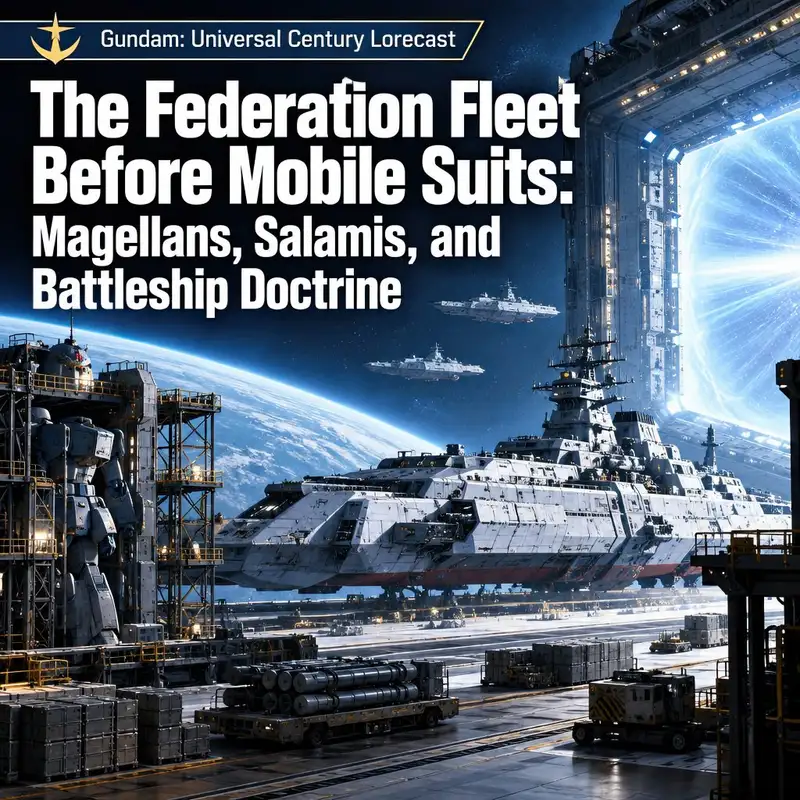
The Federation Fleet Before Mobile Suits: Magellans, Salamis, and Battleship Doctrine
A Federation commander could look across a formation of Magellan battleships, Salamis cruisers, fighters, transports, and supply vessels and see a force that ought to be formidable. The Federation possessed the larger political system, wider industrial resources, and far greater long-term capacity to replace losses than the Principality of Zeon. Its capital ships carried heavy weapons. Its cruisers extended the line. Its crews had trained for fleet combat. Yet when the opening battles of the One Year War placed that force against Zeon’s mobile suits, the Federation fleet suffered disasters out of proportion to its apparent material advantage.
The immediate problem was not that the ships had suddenly lost their guns, their armor, or their crews. The problem was that the fleet could no longer see, track, communicate, and concentrate fire in the way its doctrine expected. Before a Magellan could bring its main batteries to bear, commanders needed to know where the enemy was. Before a Salamis screen could protect the formation, it needed warning and a clear sense of which direction required protection. Before fighters could intercept, they needed targets, vectors, and enough time to act. Zeon’s mobile suits attacked the information system behind the fleet’s firepower.
That distinction matters. The defeat of the early Federation fleet is often told as a simple story: battleships were old, mobile suits were new, and the new weapon naturally replaced the old. It was not that simple. Magellans and Salamises were rational answers to a prewar environment in which large ships provided the heaviest weapons, the strongest command facilities, the greatest endurance, and the most practical means of moving combat power through space. The Federation did not enter the war with a foolish fleet. It entered with a fleet designed for conditions that Zeon had already begun to overturn.
The Earth Federation government and the Earth Federation Forces were not the same institution, even though the war would bind their fortunes tightly together. The government governed a vast and unequal political order stretching across Earth, the Moon, and the colonies. The military, including its space forces, had to protect routes, installations, population centers, and political authority across that enormous system. On paper, the Federation’s scale was an advantage. In practice, scale created its own burdens. Ships had to be crewed. Crews had to be trained. Ammunition had to be supplied. Repairs required dockyards, spare parts, technicians, and time. None of those things could be conjured into existence because the Federation possessed more territory.
A large fleet is not simply a collection of hulls. It is a system for converting industrial capacity into organized violence. The Federation’s fleet could do that effectively under the assumptions for which it had been built. Its capital ships could carry heavy weapons and command staffs. Its cruisers could operate in numbers that made screening, escort, and formation support possible. Its fighters could extend the fleet’s reach. Its transports connected the battle line to the depots, factories, bases, and colonies behind it. That system had weaknesses, but so does every military system. Before Zeon’s mobile suits changed the character of contact, those weaknesses did not necessarily outweigh its strengths.
The operational logic of the Federation fleet was broadly battleship-centered. The Magellan class stood at the heavy end of that structure. It represented concentrated firepower and fleet command. A Magellan was not merely a large gun platform. It was also a place where senior officers, communications personnel, navigators, intelligence staff, damage-control teams, and logistics specialists could coordinate a battle. Large ships offered room for people, equipment, stores, and weapons that smaller vessels could not carry as easily.
The Salamis class occupied a different but equally important place. A cruiser did not need to be the most powerful ship in the formation to be indispensable. Salamises could operate forward of heavier units, form screens, reinforce threatened sectors, escort vulnerable vessels, and help give the fleet depth. A battleship line without cruisers would be heavy but narrow. A cruiser force without heavier firepower would be flexible but limited in its ability to dominate a major engagement. Together, the two classes reflected an effort to combine concentrated firepower with a broader and more maneuverable protective structure.
This was not necessarily a formal doctrine with one universally published name and one rigid formation diagram. Universal Century sources do not provide a complete staff-college manual for the prewar Federation Space Force. But the fleet structure makes its assumptions visible. Heavy ships existed to deliver decisive fire. Cruisers existed to support and protect them. Fighters expanded reconnaissance, interception, and local defense. Transports sustained the force. Commanders expected that detection, communications, formation discipline, and coordinated weapons fire would allow these elements to function together.
Space warfare did not make those assumptions irrational. In fact, the scale of space made large ships attractive. A major vessel could carry substantial ammunition, fuel or propellant, maintenance facilities, sensors, medical support, and a crew capable of surviving a long deployment. It could serve as a communications center and a rallying point. It could absorb some damage that would destroy a smaller craft. Most importantly, it could mount weapons too large for fighters and too valuable to leave without protection.
The Federation’s pre-mobile-suit fleet was therefore built around an old military truth. A force that can locate the enemy first, maintain a coherent formation, and concentrate superior fire at the chosen range usually possesses a powerful advantage. The principle applied to naval warfare on Earth, and it remained persuasive in space. A battleship did not need to chase every enemy vessel if its sensors could track the engagement, its escort could prevent close attack, and its guns could destroy threats before they reached the formation.
But that logic depended on a chain of information. A ship needed to detect a target. It needed to identify it. It needed to determine its movement. It needed to pass that information to a fire-control system or another unit. A commander needed enough confidence in the picture of the battle to issue useful orders. A screen needed to know where to look. Fighters needed to know where to fly. The fleet did not require perfect information. No military force has ever possessed that. It did require information good enough to make its massed firepower relevant.
The Magellan and Salamis classes should be understood in that wider system, not as isolated icons from a technical chart. They depended on fighters, transports, and smaller support elements. The Federation employed conventional space fighters, including the Saberfish, as part of the wider fleet environment. Such craft could scout, intercept, strike, and provide local defensive capability. They gave the fleet options that a large warship alone could not provide. They also required their own maintenance crews, launch arrangements, fuel, weapons, replacement pilots, and recovery procedures.
Transport vessels were equally important, if less glamorous. Columbus-class ships are associated with the Federation’s logistical backbone. They moved matériel, personnel, and supplies through the Earth Sphere. In a war of this scale, ships could not remain on station indefinitely without resupply. A battle line consumed ammunition. Fighters required servicing. Damaged hulls required parts and skilled repair teams. Crews required food, medical treatment, and relief. The combat ships received most of the attention, but the transport network made their operations possible.
Later official materials, especially the Mobile Suit Gundam: The Origin retelling, give more detailed descriptions of Magellan armament, Salamis employment, fighter support, and transport conversions. Those details are useful for understanding how later official presentations imagined the fleet’s mechanical logic. They should not be treated as precise telemetry for the original television continuity. The important point is broader and secure across the setting’s early-war history. The Federation fleet was a combined organization of capital ships, cruisers, fighters, scouts, transports, technicians, and command staffs. It was an information, maintenance, and supply system with guns attached.
Zeon did not defeat that system merely by building a better warship. It changed the conditions under which the system had to fight. The first great change was the Minovsky particle environment. Minovsky particles did not make every sensor useless or turn every battle into blind chaos. Optical observation still mattered. Local communications could still function in some circumstances. Pilots and crews could still see nearby objects, use instruments, follow prearranged plans, and act on their own judgment. But the particles sharply degraded the radar-based and electromagnetic systems that supported long-range detection, tracking, guided weapons, and centralized command.
That degradation was a military revolution because it imposed uncertainty at the very moment fleet doctrine depended on clarity. A commander might know that enemy forces were in the area without knowing their exact disposition. A sensor report might indicate movement without providing a reliable track. A formation might receive an order late, receive it imperfectly, or lose contact with the unit expected to carry it out. A gun crew might know that something hostile was approaching but lack the data needed to engage effectively at the range its weapon was designed to exploit.
Under those conditions, warning time shrank. Identification became harder. Fire control became less certain. The practical burden shifted downward, from distant headquarters and centralized sensor networks toward scouts, pilots, ship captains, and local commanders. The value of reconnaissance did not disappear. It increased. Someone still had to find the enemy and report what they saw. But the information arrived later, covered less space, and was more vulnerable to confusion.
The Origin retelling makes this relationship explicit in its depiction of Loum-era Federation ships. It links Minovsky interference to reduced radar effectiveness and a greater reliance on visual reconnaissance and local observation. That is a useful expression of a problem that the principal animated record also makes clear in broader terms. The Federation’s old methods of fighting could no longer rely on the same information architecture. Its ships remained armed, but their weapons were receiving worse information at the moment they most needed precision.
A fleet can compensate for some uncertainty through training and discipline. It can establish sectors of responsibility, use prearranged signals, deploy scouts, and give subordinate commanders more authority. But those adaptations take time. They require exercises, revised procedures, communications plans, and a shared understanding of the threat. They also require a force to know what it is adapting against. Zeon’s mobile suits did not merely appear as another item on an enemy inventory. They exploited the exact range and geometry at which Federation assumptions were weakest.
Conventional fighters could not simply solve the problem. That does not mean fighters were useless. Fighters remained useful for reconnaissance, interception, attack, and local defense. They could be deployed quickly, and they offered a smaller, more agile alternative to a large warship. But a fighter was designed around a different set of tradeoffs. Its weapons, endurance, protection, pilot workload, and ability to operate close to a large ship all differed from those of a mobile suit.
The mobile suit was not decisive because it was automatically faster than every fighter or invulnerable to every gun. Those are the wrong questions. Its importance lay in the combination of independent maneuver, human visual judgment, flexible weapon use, and the ability to operate around a capital ship in three dimensions. A mobile suit could approach from above, below, ahead, behind, or along the formation’s flank. It could use debris, other ships, confusion, and close range to complicate defensive fire. It could change direction and choose targets in ways that made it difficult for large ship batteries to respond.
A battleship’s main weapons were valuable because they could engage powerful threats at range. They were not designed to swivel instantly through every angle and safely engage a small hostile machine moving among friendly ships. Secondary weapons and close-defense systems could help, but they still needed warning, targeting data, fields of fire, and crews able to distinguish friend from foe. In a confused formation, defensive fire could become dangerous to one’s own side. The closer the mobile suit came, the more the Federation’s heavy firepower risked becoming difficult to employ.
Mobile suits also changed the meaning of a screen. A cruiser screen could protect a battleship against an approaching conventional force by extending detection and placing weapons between the enemy and the heavy units. But a mobile suit did not need to defeat the screen in a simple frontal exchange. It could exploit gaps, approach from unexpected vectors, or use the close battle itself as cover. The screen could still fight. It could still inflict losses. It could still delay or disrupt an attack. It could no longer assume that its position alone would keep the enemy outside the battleship’s defensive perimeter.
Zeon’s achievement was not merely technological. It was doctrinal and organizational. The Principality possessed conventional warships, but it integrated mobile suits into fleet operations as an offensive arm. The mobile suit became an anti-fleet weapon. Its purpose was not simply to win individual duels. It could penetrate a formation, disrupt command, attack ships at close range, and force enemy commanders to divide attention between the distant enemy fleet and the immediate danger around their own hulls.
That close-in threat created disproportionate effects. A mobile suit did not need to destroy every ship in a formation to damage the formation’s combat power. It could threaten communications equipment, weapons, propulsion, command spaces, and other exposed systems. The exact vulnerabilities and damage effects varied by ship, weapon, and source, and there is no reason to pretend that every anti-ship engagement followed a single formula. But the operational principle is clear. An attack on a command ship or a key defensive unit could disrupt far more than one hull.
Human pilots were central to this system. Under Minovsky conditions, Zeon could not depend entirely on distant sensors or automated guidance either. Mobile suit pilots made local decisions at visual range. They could recognize opportunities, alter approach vectors, coordinate with nearby units, and press attacks when a larger formation was confused. That did not make them superhuman. It made them useful in an environment where centralized control had become less reliable. The mobile suit placed a human decision-maker inside a weapon system capable of moving through the battlespace in ways a conventional ship could not easily match.
This was why the mobile suit posed a deeper challenge than a new missile or a heavier gun. The Federation had faced powerful enemy weapons before. Militaries can often respond to a weapon by adding armor, increasing range, improving point defense, or changing tactics. Zeon’s mobile suits demanded changes across several layers at once. The Federation needed better reconnaissance. It needed close-defense doctrine. It needed its own mobile response. It needed new command procedures for a battle in which threats could enter the formation. It needed ships capable of launching, recovering, supplying, and repairing those mobile units.
The Federation did not have to be completely ignorant of Zeon’s mobile suits for this to be a surprise. Technological surprise is often misunderstood as total ignorance. More often, an organization knows that a new weapon exists but fails to understand its scale, reliability, support structure, or tactical consequences. A report that Zeon has developed a humanoid combat machine is not the same as understanding how those machines will be used against a fleet under Minovsky conditions.
The Federation’s deeper problem was doctrinal surprise. It had not yet built a mature answer to mobile-suit warfare. Knowing that the enemy possessed mobile suits could not instantly produce trained mobile-suit pilots, new ships, replacement parts, revised fighter tactics, anti-mobile-suit gunnery, reconnaissance methods, and commanders experienced in the new form of battle. Large military institutions do not turn as quickly as a single machine. They must change training schools, procurement programs, maintenance systems, doctrine, command relationships, and assumptions about what a battle will look like.
War made that adaptation harder. The opening phase of the One Year War did not give the Federation a calm period for reflection. It brought mass destruction, political crisis, disrupted routes, fleet losses, and the urgent need to defend multiple theaters. A military under attack must often improvise while suffering the consequences of earlier assumptions. There is a reason emergency programs receive grand names. They are usually evidence that the normal system has failed to prepare in time.
The Battle of Loum became the most visible early demonstration of that failure. In the principal animated Universal Century record, the broad result is clear. A major Federation fleet suffered catastrophic defeat. Admiral Revil was captured. Zeon’s mobile suits demonstrated that they could shape a fleet engagement at a scale too large to dismiss as an isolated technical novelty. Loum was not simply another battle in which one side had better pilots. It was a collision between two different concepts of space warfare.
The Origin retelling provides a more elaborate account of Loum, including an exact January twenty-third date, named ships, expanded reconnaissance details, and specialized mobile-suit tactics. It depicts Zeon’s mobile-suit assault reversing an apparently unfavorable conventional balance, and it gives particular attention to coordinated attacks by elite units. Those details belong to The Origin’s own historical branch. They should not be silently inserted into the television version as though every name, sequence, and tactical movement were shared evidence. But the larger lesson of Loum is common enough to matter. Zeon used mobile suits in a way that exposed the Federation fleet’s structural weakness.
The Federation could still bring substantial firepower to the battle. Its ships could still fight. Individual crews could still resist. The disaster was not caused by a lack of courage or by every Federation vessel being incapable of defense. It came from a mismatch between the force’s design and the combat environment. The Federation’s heavy ships needed a coherent picture of the battle to use their greatest advantages. Zeon’s mobile suits reduced that coherence, entered the close defensive zone, and turned the fleet’s own formation into a source of congestion and vulnerability.
Tactically, Loum showed that mobile suits could penetrate and disrupt capital-ship formations. At the command level, it demonstrated that flagships and communications nodes were vulnerable when the enemy could move through the battle rather than merely approach from outside it. At the operational level, it showed that a conventional battle line could no longer be trusted as the sole answer to a fleet engagement. A fleet that could not protect its command structure, maintain local awareness, or counter close threats could lose combat effectiveness even before every ship had been destroyed.
Strategically, the battle gave Zeon something it badly needed: early freedom of action and the prestige of a spectacular victory. Zeon did not possess the Federation’s long-term resources. Its leadership understood that a prolonged industrial contest would be dangerous. Early victories therefore had political and military value far beyond the destruction of enemy hulls. They could disrupt Federation planning, support Zeon’s claims of military superiority, and create the impression that the smaller power had found a decisive answer to Federation mass.
That impression should not be confused with legitimacy. Zeon’s early military success did not validate its dictatorship, aggressive war, colony gassing, or attacks on civilian populations. Its liberation rhetoric drew on real colonial grievances, but military innovation did not cleanse the regime’s conduct. Loum took place in an opening war already marked by catastrophe for civilians across the Earth Sphere. The technical story cannot be separated from that human reality. Fleets existed to protect inhabited infrastructure, transport routes, and political authority. When the fleet failed, colonies and civilians became more exposed, not less.
Loum also exposed a logistical problem that battle narratives sometimes hide. A damaged or scattered fleet cannot simply return to full strength after the cameras leave the battlefield. Lost crews must be replaced. Survivors must be treated. Ships require repair facilities, dry docks, components, and time. Fighter squadrons need replacement aircraft and pilots. Transport disruptions affect ammunition, food, medical supplies, and spare parts. The defeat therefore weakened the Federation not only in immediate firepower but in institutional confidence and operational readiness.
A doctrine is more than a collection of tactical instructions. It is an investment in ships, schools, command habits, procurement priorities, and expectations about risk. When Loum revealed that the Federation fleet could not depend on its old battle logic, it also revealed that the Federation lacked an organic answer inside the fleet itself. Its ships had fighters and defensive systems, but it did not yet possess a mature mobile-suit arm integrated into fleet operations. It had not built the full ecosystem required to contest Zeon on the same terms.
Here, the Federation’s industrial advantage became important, though not magical. A large industrial base could support research, prototypes, production lines, training programs, and new ship designs. It could eventually create a force capable of fighting Zeon’s mobile suits with mobile suits of its own. But industrial potential is not immediate combat power. A factory must be organized. Designs must be tested. Production must be standardized. Pilots must learn to operate new machines. Technicians must learn to maintain them. Ships must be adapted or designed to carry them. Every one of those steps consumes time, labor, material, and political attention.
Operation V emerged from that emergency. It should not be understood as a single brilliant machine descending fully formed into the war. It was the Federation’s attempt to build a new combat system under the pressure of defeat. The prototypes associated with Side Seven, including the Gundam, demonstrated that the Federation had begun to answer Zeon’s technological advantage. But the larger significance lay in the relationship between mobile suits and the ships built to support them.
The White Base represented that new relationship. It was not important merely because it carried exceptional prototypes or because it survived extraordinary circumstances. It mattered because it combined strategic mobility with mobile-suit launch, recovery, maintenance, command, and fire support. A mobile suit could fight independently for a time, but it could not sustain a campaign alone. It needed a place to rearm, refuel or replenish propellant, receive repairs, carry spare equipment, treat injured personnel, brief pilots, process intelligence, and recover damaged machines. The ship became the infrastructure that allowed the mobile suit to become operationally useful.
That was the real adaptation. The Federation did not abandon the fleet. It changed the fleet’s relationship to combat power. Instead of treating large ships as independent decisive weapons whose guns would settle the battle at range, the Federation increasingly needed ships to serve as mobile bases, command platforms, artillery support, transport nodes, and recovery systems for mobile suits. The central weapon of the fleet was no longer necessarily the largest gun on the largest hull. It was the combined system of ship, mobile suit, pilot, crew, sensors, maintenance, and logistics.
That change did not erase the value of Magellans and Salamises. They continued to matter because space warfare still required endurance, command capacity, transport, protection, and heavy weapons. A mobile suit force without ships would be strategically stranded. It could not move reliably between theaters, sustain long operations, recover damaged units, or protect the supply chain on which its combat power depended. The mobile suit changed fleet warfare. It did not make fleets disappear.
The older ships could adapt in several ways without becoming identical to later purpose-built mobile-suit carriers. They could provide fire support. They could escort transports. They could carry command staffs. They could contribute to layered defense. They could serve as logistical nodes or operate alongside vessels better suited to mobile-suit deployment. Their continued presence in later conflicts demonstrates an institutional reality often overlooked in stories of revolutionary weapons. New systems rarely erase old systems overnight. More often, they force old systems into new roles.
A Magellan still possessed the virtues of a large hull: weapons, endurance, room for staff work, and the ability to support a formation. A Salamis still offered numbers, flexibility, and a useful platform for escort and screening roles. What they could no longer do was operate under the assumption that their own guns and formations were sufficient protection against close-range mobile threats. They needed mobile-suit cover, improved local awareness, revised defensive procedures, and commanders willing to think of the fleet as an integrated combat team rather than a line of warships.
This is a familiar pattern in military history. A new weapon does not simply defeat an old platform. It exposes a doctrine’s hidden dependencies. The old platform may remain useful, but only after its role changes. Battleships did not become harmless because mobile suits appeared. They became vulnerable when their commanders expected the old system of detection, screening, and standoff fire to function unchanged. Loum punished that expectation with unusual speed and severity.
The defeat was therefore tactical, operational, industrial, political, and human all at once. Tactically, Zeon proved that mobile suits could enter and disrupt a capital-ship formation. Operationally, it showed that the Federation could not rely on conventional battle lines alone. Strategically, it gave the smaller power an early advantage in initiative and prestige. Industrially, it forced the Federation to create an entire mobile-suit ecosystem rather than merely build a few impressive prototypes. Politically, it weakened the Federation’s claim that it could protect the population under its authority during the most catastrophic opening phase of the war.
The central lesson of the Federation fleet before mobile suits is not that Magellans and Salamises were worthless, nor that Zeon had discovered a weapon that made every ship obsolete. The Federation’s ships were built for a form of war in which long-range detection, coordinated fire, disciplined screening, and centralized command could turn material strength into decisive combat power. Minovsky conditions and mobile-suit tactics broke the connections between those elements. Heavy firepower without reliable information, flexible defense, close-range maneuver, and distributed command could become a liability.
Loum was not the execution of an obsolete fleet by superior machines. It was the defeat of a battleship-centered operational system whose sensors, communications, formations, and defenses had been overtaken by Minovsky-era close combat. The Federation recovered not by abandoning naval warfare, but by making its ships the command, logistics, launch, recovery, and fire-support foundation of a mobile-suit fleet.